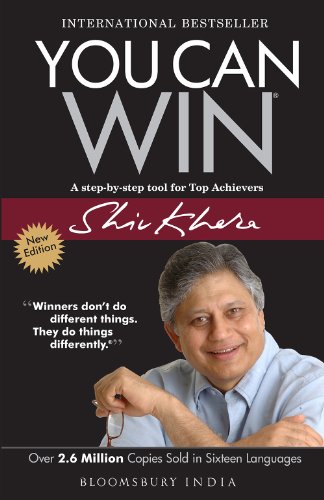
⚡️ What is You Can Win About?
I remember picking this up and thinking it might just be another collection of generic platitudes. But Shiv Khera does something different. He opens with a story about a balloon seller who tells a curious boy that it’s not the color of the balloon that makes it rise—it’s what’s inside. That’s the entire thesis of the book: your internal environment, specifically your attitude, dictates your altitude in life. More summaries by Shiv Khera often highlight this blend of common sense and ancient wisdom.
Khera argues that we’re often so obsessed with technical skills and IQ that we forget the “Winning Edge.” It’s that tiny margin of difference—like a horse winning a race by a nose—that translates into massive rewards. This isn’t just about thinking happy thoughts; it’s a manual for building character, integrity, and a work ethic that doesn’t quit when things get uncomfortable. If you’re looking for more self-help book summaries, you’ll find that Khera is much more focused on moral character than many modern ‘productivity’ gurus.
🚀 The Book in 3 Sentences
- Success is a journey of progressive realization toward a worthy goal, fueled largely by a positive attitude rather than mere talent.
- The “Winning Edge” principle shows that you don’t need to be 100% better than the competition; being 1% better in 100 different areas creates an unstoppable advantage.
- Character is the foundation of long-term winning, as charisma might open doors, but only integrity keeps them open.
🎨 Impressions
Reading this felt like sitting down with a very stern, very wise uncle who isn’t afraid to call you out on your excuses. I’ll be honest: some of the anecdotes feel a bit dated, and Khera relies heavily on classic parables you might have heard before. But the way he threads them together into a “tool kit” makes it stick. I found myself dog-earing the sections on “Auto-suggestion” because he moves past the “woo-woo” and explains it as a psychological conditioning tool.
What really got me was his take on persistence. He doesn’t just say “don’t give up.” He uses the example of Abraham Lincoln’s lifetime of failures to show that losing an election or a business doesn’t make you a loser; only quitting does. It’s a punchy, high-energy read, though I did find the repetitive bullet points in some chapters a little overwhelming. If you can get past the 90s-style formatting, the core logic is rock solid.
📖 Who Should Read You Can Win?
If you feel like you’ve hit a glass ceiling in your career despite being technically competent, this is for you. It’s also perfect for students or young professionals who need a foundational framework for professional ethics. However, if you’re looking for a deep psychological study or nuanced scientific data, you might find this a bit too “anecdotal.” It’s a book for practitioners, not theorists.
☘️ How This Book Changed My Thinking
Before reading this, I used to think success was about waiting for the right opportunity. Khera flipped that on its head for me.
- I stopped looking for “the perfect job” and started focusing on bringing a “perfect attitude” to my current role.
- I realized that my “reasons” for not finishing projects were actually just well-disguised excuses for a lack of persistence.
- The “Mama Test” (would my mom be proud?) became a quick mental filter for my business decisions.
✍️ 3 Quotes That Stuck With Me
- “Winners don’t do different things, they do things differently.” — This is the book’s heartbeat; it’s about the ‘how’ and ‘why’ rather than the ‘what.’
- “Our thoughts lead to actions, actions lead to habits, and habits form character.” — It’s a sobering reminder that a single lazy afternoon is actually a brick in the wall of your future character.
- “Success is not a destination, it’s a journey.” — It sounds cliché until you realize that if you aren’t happy during the struggle, you won’t be happy at the finish line.
📒 Summary + Notes
The book’s narrative arc follows a logical progression: first, you fix your internal state (Attitude), then you define your external target (Goals), and finally, you build the bridge between them (Character and Action). Khera spends a lot of time debunking the myth of the “overnight success.” By highlighting figures like Thomas Edison and Colonel Sanders, he builds a case that success is actually a war of attrition. Whoever can stay positive the longest while failing usually wins.
Khera also emphasizes that success isn’t just about money. He defines a “Winner” as someone who lives with purpose and contributes to society. It’s a holistic view that covers your subconscious mind, your interpersonal relationships, and your personal values. By the end, the author wants you to believe that you are entirely responsible for your life—which is both terrifying and incredibly empowering.
🧠 Core Ideas Explained Simply
While the book is simple, these three pillars are the foundation of everything Khera teaches.
The Winning Edge
Think about a racehorse. The horse that wins by a fraction of a second gets ten times the prize money of the horse that comes in second. Did the first horse run ten times faster? No. It was just a tiny bit better. In life, small improvements in your punctuality, your tone of voice, or your follow-up can lead to massive, non-linear rewards.
The Caterpillar Trap
Have you ever seen people who are constantly busy but never seem to get anything done? Khera uses the analogy of processionary caterpillars that follow each other in a circle until they starve, even though food is right next to them. Activity does not equal accomplishment. Without clear, written goals, you’re just spinning your wheels.
Positive Believing vs. Positive Thinking
Khera makes a vital distinction here. Positive thinking is just a wish. Positive believing is confidence backed by preparation. It’s the difference between saying “I will win” and “I have trained so hard that I have every right to win.” One is a delusion; the other is a fact.
1: Importance of Attitude
Have you ever wondered why some people seem to soar while others, with the same background, just… stall? Khera argues that your attitude is your window to the world. A dirty window makes everything look gloomy, no matter how bright it is outside. He cites a study suggesting that 85% of why someone gets a job or a promotion is due to their attitude.
We are shaped by three things: Environment, Experience, and Education. While we can’t change our past, we can consciously choose our current environment. If you hang out with “complainers,” you’ll eventually start smelling like them. It’s about taking ownership of the mental atmosphere you live in.
2: How to Build a Positive Attitude
If attitude is the engine, how do we actually tune it up? Khera lays out eight specific steps. My favorite is the “Do It Now” rule. Procrastination isn’t just a time-waster; it’s an attitude-killer. It builds a habit of avoiding the hard stuff. He suggests digging for gold like Andrew Carnegie did—you have to move tons of dirt to find an ounce of gold, but you don’t go looking for the dirt.
- Focus on the positive and be grateful.
- Develop the habit of doing it now.
- Get into a continuous education program.
- Build high self-esteem.
- Stay away from negative influences.
3: Success
Success isn’t a trophy on a shelf; it’s a “progressive realization of a worthy goal.” This chapter hits hard because it redefines success as a journey rather than a destination. If you’re a student working toward a degree, you’re being successful *right now*, not just on graduation day. He uses the story of the butterfly—if you help it out of the cocoon, it dies because it needs the struggle to strengthen its wings. Are you avoiding the very struggles that are supposed to make you strong?
4: What is Holding Us Back?
Why do we sabotage our own progress? Khera identifies twenty “emotional brakes,” like the fear of failure or the desire for instant gratification. He tells the story of the monkey trap—the monkey grabs the nuts in the box and won’t let go, so his fist is too big to get out. We are often the same; we cling to our small comforts or our excuses and end up trapped by our own greed or fear.
5: Motivation
Motivation is like fire—if you don’t keep adding fuel, it goes out. Khera distinguishes between external motivation (fear or incentives) and internal motivation (pride and belief). Fear might make you work faster for a day, but belief makes you work better for a lifetime. He suggests that the most powerful motivator is recognition—feeling like your work actually matters to someone else.
6: Self-Esteem
There’s a massive difference between being arrogant and being confident. Khera defines self-esteem as how we feel about ourselves. High self-esteem leads to a desire to do things well; low self-esteem leads to a desire to “fit in” even if the crowd is wrong. He tells a touching story of a beggar who started seeing himself as a businessman selling pencils, which eventually changed his entire life trajectory. You can’t perform better than your own self-image.
7: Importance of Interpersonal Skills
Nobody cares how much you know until they know how much you care. This chapter focuses on the “people” side of winning. We’ve all met people who are geniuses but impossible to work with. Khera argues that charisma without character is a scam. To build real relationships, you need to be a good listener and practice empathy. It’s about looking for the “Win-Win” in every interaction.
8: 25 Steps to Building a Positive Personality
Think of your personality as a collection of micro-behaviors. Khera lists 25 actionable steps, ranging from “Accept responsibility” to “Be humble.” It’s a bit of a laundry list, but the core message is: stop being a critic and start being an encourager. He shares the story of a pianist who helped a student, only to have that student (Herbert Hoover) save his country from famine years later. Kindness is an investment with a long horizon.
9: Subconscious Mind and Habits
Our subconscious is like a giant tape recorder that never stops. We are the sum of our habits, and habits are just behaviors repeated so often they become automatic. Khera suggests using “Auto-suggestion”—positive statements in the present tense—to reprogram the subconscious. If you tell yourself “I am a focused worker” enough times, your subconscious eventually starts to believe it and acts accordingly. It takes about 21 days to break or form a habit.
10: Goal Setting
A dream is just a wish without a deadline. Khera gets very practical here: goals must be SMART (Specific, Measurable, Achievable, Realistic, and Time-bound). He warns against being like the processionary caterpillars—don’t mistake movement for progress. You need a balanced set of goals across your health, finances, family, and spiritual life. If you win at work but lose your family, have you really won?
11: Values and Vision
At the end of the day, what’s the point of winning if you lose your soul? This final chapter is a plea for ethics. He uses the “Headline Test”: would you be okay if your actions today were on the front page of tomorrow’s paper? Alfred Nobel redirected his life after reading a premature obituary that called him the “merchant of death.” We have the chance to write our legacy every single day through our choices.
⚖️ A Critical Perspective
While the book is incredibly motivating, it can be overly simplistic. Khera presents success as a purely individual effort, largely ignoring systemic barriers like socioeconomic status or institutional bias that can make the “climb” much steeper for some than others. Additionally, many of the statistics cited (like the famous 85% Harvard study) are decades old and often lack the nuance of modern behavioral science. It’s a great “mental hygiene” book, but it shouldn’t be your only source for understanding the complexities of achievement.
🔄 How It Compares
If you’ve read Stephen Covey’s *The 7 Habits of Highly Effective People*, you’ll find *You Can Win* to be much more accessible and story-driven, though slightly less rigorous. While Covey focuses on deeply ingrained paradigms, Khera focuses on the day-to-day “attitude” and the immediate action steps. It’s essentially a more “street-smart” version of classic motivational literature.
🔑 Key Takeaways
These are the core shifts you can implement tomorrow morning.
- **The 85/15 Rule:** Recognize that your technical skill is only 15% of your value; focus the other 85% on your people skills and attitude.
- **The Winning Edge:** Stop trying to be 100% better at one thing; aim to be 1% better at 100 things like punctuality, listening, and follow-through.
- **Auto-Suggestion:** Use 21 days of positive, present-tense affirmations to reprogram your subconscious self-image.
- **The Headline Test:** Vet every decision by asking if you’d be proud to see it published in a national newspaper.
💬 Frequently Asked Questions
What is the main message of You Can Win?
The main message is that success is determined by attitude and character rather than talent alone. Khera argues that “Winners don’t do different things, they do things differently.” By building positive habits, setting clear goals, and maintaining high integrity, anyone can achieve their version of success.
Does Shiv Khera believe anyone can be successful?
Yes, provided they are willing to take total responsibility for their lives. Khera emphasizes that while we can’t control our circumstances, we can control our response to them. He views success as a result of choices, persistence, and character rather than luck or innate genius.
What are the three factors that shape attitude according to Khera?
Khera identifies Environment (the people and culture around us), Experience (how we interpret past events), and Education (both formal and informal learning). While these shape us, the book’s core premise is that we can consciously change our attitude by altering our current environment and education.
What is the difference between winners and losers in the book?
Khera contrasts them through their approach to challenges. Winners see an answer for every problem, while losers see a problem for every answer. Winners make commitments, while losers make promises. The distinction is essentially one of proactive responsibility versus reactive excuse-making.
How do you build a positive attitude according to Shiv Khera?
Khera outlines eight steps, including focusing on the positive, acting immediately (“Do it now”), practicing gratitude, and continuous self-education. He also emphasizes avoiding negative influences and building self-esteem through helping others and taking responsibility for your actions.
Conclusion
Ultimately, *You Can Win* is a book about reclaiming your agency. In a world where it’s easy to blame the economy, your boss, or your upbringing for your lack of progress, Khera offers a bracing alternative: you are the driver. It’s a common-sense guide that isn’t trying to be revolutionary, but rather to remind you of the basic truths about human character that we often ignore in our pursuit of shortcuts.
If you take away just one thing, let it be the idea of the “Winning Edge.” You don’t need a miracle to change your life; you just need to be slightly better than you were yesterday in the small, “unimportant” things. Master your attitude, and the rest usually follows. This remains one of the most practical self-help book summaries because it focuses on the internal foundation that makes all other success possible. Remember: the balloon rises because of what’s inside.
More From Shiv Khera →
Discover more from AI Book Summary
Subscribe to get the latest posts sent to your email.