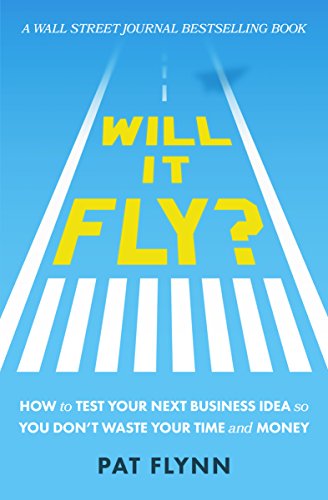
⚡️ What is Will It Fly? About?
Ever had that lightning-bolt moment where a business idea hits you and you’re ready to quit your job by lunchtime? I’ve been there. Most of us have. Pat Flynn wrote this book because he’s seen too many people spend six months and $10,000 building something that nobody actually wants. The central argument of Will It Fly? is that you don’t have to guess. You can—and must—validate your idea with a real, paying audience before you build the full version. More summaries by Pat Flynn
Flynn, the mind behind Smart Passive Income, isn’t just theorizing here. He’s a practitioner who has built multiple successful niche sites and software companies. He breaks the validation process into five distinct phases, moving from personal alignment (does this even fit your life?) to the ‘Flight Simulator,’ where you actually ask people for money. It’s a practical, no-nonsense guide for anyone tired of the ‘build it and they will come’ myth. If you enjoy this, you’ll find similar wisdom in our business book summaries.
🚀 The Book in 3 Sentences
- Successful businesses are built on validated demand, not just creative inspiration or gut feelings.
- The validation process requires moving from internal alignment to external market research, and finally to a small-scale pre-sale.
- If you can’t get a handful of people to pay for a simplified version of your idea today, they won’t pay for the full version tomorrow.
🎨 Impressions
I finished this book last week, and the first thing I did was scrap a landing page I’d been working on. Flynn’s writing style is incredibly conversational—it feels like he’s sitting across from you with a coffee, gently telling you why your current ‘brilliant’ idea might actually be a nightmare in disguise. It’s refreshing because he doesn’t hype you up; he slows you down. He wants you to do the ‘boring’ work of talking to people so you don’t end up with a beautiful product that gets zero traffic.
There’s a specific moment in Part One where he has you map out your ideal life, and honestly, it was the section I dog-eared most. It made me realize that some of the businesses I was dreaming about would actually make me miserable if they succeeded. Isn’t that the ultimate irony? We build businesses for freedom, then create cages. Flynn’s focus on ‘Mission Design’ is what sets this apart from your standard startup manual. It’s not just about the money; it’s about the person behind the desk.
📖 Who Should Read Will It Fly??
If you have a ‘Notes’ app full of half-baked business ideas but don’t know which one to start, this is for you. It’s specifically built for solo entrepreneurs, bloggers, and creators. However, if you’re looking for a deep dive into high-growth venture capital or complex manufacturing, this might feel a bit too ‘lifestyle business’ for your taste. It’s a handbook for the person who wants to start small and be sure they aren’t wasting their weekends.
☘️ How This Book Changed My Thinking
Before reading this, I thought validation was just looking at Google Keyword Planner to see if people were searching for a topic. Now, I realize that search volume doesn’t equal a business.
- I stopped focusing on ‘originality’ and started looking for ‘neighborhoods’ where people are already spending money.
- I changed my definition of validation from ‘getting a compliment’ to ‘getting a credit card number.’
- I now spend more time defining the ‘Target Customer’ than I do picking a brand name or logo.
✍️ 3 Quotes That Stuck With Me
- “Speed is only useful if you’re running in the right direction.” — This reminds me that ‘hustle’ is a waste if the map is wrong.
- “Your goal should be to fail fast and fail cheap if you’re going to fail at all.” — It takes the sting out of a ‘bad’ idea; it’s just data.
- “Validation is the process of proving that your idea has a market… by actually getting people to pay for it.” — This clears up any confusion about what real success looks like.
📒 Summary + Notes
The book’s narrative arc is a steady climb from your own internal psychology to the cold, hard reality of the marketplace. Flynn starts with ‘Mission Design,’ forcing you to confront whether your idea actually matches your long-term goals. It’s a sobering start. He then moves into the ‘Development Lab,’ where you move from a messy mind map to a structured idea. The core of his case is that most people jump to the end too fast; they want the ‘All Systems Go’ feeling without doing the flight planning.
As the book progresses, it gets increasingly external. You stop looking at your own thoughts and start looking at ‘The Market Map.’ This involves finding where your customers hang out online and what they’re already buying. By the time you reach the ‘Flight Simulator,’ you aren’t just guessing anymore. You’re running a small, controlled experiment to see if your target audience will open their wallets. Flynn wants you to believe that a ‘No’ during validation is just as valuable as a ‘Yes’ because it saves you from a year of frustration.
1: Part One: Mission Design
What does your life actually look like five years from now? Flynn opens with the ‘Airport Test.’ Imagine you’re at an airport five years today and you run into an old friend. You tell them your life is amazing. Why is it amazing? This isn’t just ‘the secret’ style manifesting; it’s about defining the constraints of your business. If your ideal life involves picking up your kids every day at 3:00 PM, but your business idea requires 24/7 client support, the business is a failure before it even starts.
He also introduces the ‘Shark Tank’ effect. We often fall in love with the *idea* of being an entrepreneur more than the actual work involved. By mapping out your ‘Life Pillars’ (Health, Wealth, Relationships, Spirituality), you create a filter. If the business doesn’t support the pillars, it doesn’t fly. Have you ever considered that your ‘dream business’ might actually be a nightmare for your family life?
2: Part Two: Development Lab
Your idea probably isn’t as original as you think—and that’s a good thing. In this stage, Flynn has you dump everything onto a mind map. He suggests the ‘Brain Dump’ method: get every feature, every worry, and every ‘what if’ out of your head and onto paper. Then, you start pruning. Most of us try to build a Swiss Army knife when the market just needs a pair of scissors.
- The Top 3: Pick the three most important features or problems your idea solves.
- The 1-Sentence Pitch: If you can’t explain what you do to a five-year-old, you don’t understand it well enough yet.
- The ‘Neighborhood’ Check: Who else is in this space? Competition isn’t a threat; it’s proof of concept.
3: Part Three: Flight Planning
So you’ve got an idea, but does anyone actually care? This chapter is about the ‘Market Map.’ Flynn walks you through the ‘Customer Avatar’—but not just the boring demographics. He wants you to find the P.A.I.N. (Problems, Accomplishments, Individuals, and Nightmares). You need to find the places where your target audience is already complaining. Forums, Amazon reviews, and social media groups are gold mines for this.
One of the best tactics here is the ‘Top 10’ list. You find the top 10 influencers, the top 10 blogs, and the top 10 products in your niche. If you can’t find them, you aren’t looking hard enough, or the market doesn’t exist. He also introduces ‘The Google Keyword Planner’ and other SEO tools, but warns that numbers are just numbers until you understand the *intent* behind the search. Are they looking to learn, or are they looking to buy?
4: Part Four: Flight Simulator
Imagine trying to sell a product that doesn’t exist yet. This is where most people get nervous. Flynn argues that this is the most important step: the pre-sale. You don’t need a website. You don’t need a logo. You need a small group of people (he suggests starting with 10) who are willing to pay you for the solution you’ve promised.
He outlines the ‘Validation Communication’ strategy. It’s about reaching out to those ‘Customer Avatars’ you identified and offering them a ‘beta’ version or a founding member discount. If they say ‘I’d totally buy that,’ you haven’t validated anything. Validation only happens when money changes hands. If they won’t pay now, they won’t pay later. Why would you spend months building something that people only *say* they want?
5: Part Five: All Systems Go
The data is in, and it’s time to make a choice. Flynn gives you three options: Proceed, Pivot, or Pause. If the validation was a success, you proceed with a roadmap. If people liked the idea but wanted a different angle, you pivot. If nobody cared, you pause and go back to the mind map. This final section is about the mindset of the long game.
He emphasizes that even a ‘failed’ validation is a massive win because it saved you time. He shares the story of his own failed software launch to show that even the ‘pros’ get it wrong when they skip these steps. It’s a grounded, humble ending that reminds you that entrepreneurship is a series of experiments, not a one-time gamble.
⚖️ A Critical Perspective
While Flynn’s framework is solid for digital products and services, I found the section on ‘Flight Simulators’ a bit overly optimistic for someone starting with absolutely zero audience. He assumes you can easily find 10-20 people to talk to, but for a true introvert or a complete beginner, that initial outreach is much harder than he makes it sound. Additionally, some of the market research tools mentioned are starting to show their age; in 2025, AI-driven sentiment analysis and TikTok ‘neighborhoods’ are more relevant than some of the older forum-hunting methods he suggests. It’s still a 9/10 book, but it skews heavily toward the ‘online creator’ business model rather than brick-and-mortar or complex B2B.
🔄 How It Compares
Compared to The Lean Startup by Eric Ries, Will It Fly? is much more accessible for the average person. While Ries focuses on ‘Build-Measure-Learn’ cycles for tech companies, Flynn focuses on the human element and the pre-build phase. If Ries is for the Silicon Valley founder, Flynn is for the person trying to build a business from their kitchen table.
🔑 Key Takeaways
These lessons are designed to move you from paralyzing doubt to calculated action.
- The Airport Test: Use your 5-year vision as a filter for every business decision.
- The P.A.I.N. Formula: Solve a problem that is actually keeping people awake at night, not just a ‘nice to have.’
- Pre-Selling is the Only Real Truth: Don’t trust ‘likes’ or ’email signups’; trust transactions.
- Pruning is Progress: A simple, focused idea is 10x easier to validate and sell than a complex one.
💬 Frequently Asked Questions
What is the main argument of Will It Fly?
The book argues that business failure is preventable through validation. Instead of spending months building a product based on assumptions, you should run small-scale experiments to prove demand exists. Real validation only occurs when your target audience is willing to pay for your solution before you fully build it.
What is the ‘Airport Test’ in Pat Flynn’s book?
The Airport Test is a visualization exercise where you imagine meeting a friend five years from now. You describe why your life is perfect across four pillars: health, wealth, relationships, and spirituality. This helps ensure your business idea aligns with your personal goals rather than creating a life you hate.
How do you validate a business idea according to Flynn?
Validation follows a five-step process: checking personal alignment, mind-mapping the idea, researching the existing market, and running a ‘Flight Simulator’ pre-sale. The final step is analyzing the data to decide whether to proceed, pivot, or pause the idea entirely based on real-world feedback and financial commitments.
Is Will It Fly? still relevant for entrepreneurs?
Yes, though some specific tools have evolved, the core principles of market research and pre-selling are timeless. In an era where it’s easier than ever to launch a business, the risk of ‘noise’ is higher, making Flynn’s focus on deep customer pain points and community engagement even more critical for success.
What are the 4 Ps of the Flight Simulator?
The 4 Ps are Part of the Solution, Proof of Concept, Product Description, and Price. You present a simplified ‘part’ of your idea to a target audience to prove it works. You then provide a clear description and ask for a specific price to see if they will commit.
Conclusion
Building a business is scary, but Will It Fly? reminds us that the fear usually comes from the unknown. When you replace ‘I hope this works’ with ‘I know people are already trying to solve this,’ the fear dissipates. Pat Flynn has given us a flight manual that doesn’t just teach us how to take off; it teaches us how to land safely if the weather isn’t right.
The ONE thing you should take away from this is that a ‘No’ from the market today is a gift. It frees you up to find the ‘Yes’ that will actually change your life. Stop building in the dark. Go talk to your customers, ask for the sale, and see if your idea is truly clear for takeoff. If you want to keep sharpening your entrepreneurial edge, check out more in our business book summaries.
More From Pat Flynn →
Discover more from AI Book Summary
Subscribe to get the latest posts sent to your email.