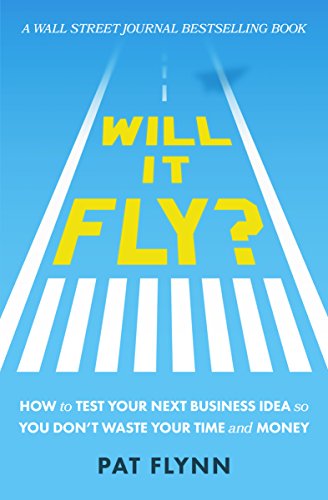
⚡️ What is Will It Fly? about?
Will It Fly? by Pat Flynn is a comprehensive, step-by-step guide designed to help aspiring entrepreneurs and business owners validate their business ideas before investing significant time, money, and resources. Drawing an analogy to a pilot’s pre-flight checklist, Flynn provides a framework of exercises and case studies to test the viability of an idea. The book’s core mission is to prevent the common and painful failure of building something nobody wants. It moves beyond simple brainstorming into a rigorous process of market research, self-assessment, and real-world testing. Flynn, a respected voice in the online business world, leverages his own experiences and successes to create a practical, actionable, and often workbook-like experience. It’s not just about having a great idea; it’s about proving that idea can actually succeed in the marketplace and align with your personal goals.
🚀 The Book in 3 Sentences
- Will It Fly? provides a systematic pre-flight checklist to validate your business idea, ensuring you don’t waste your life savings on a venture doomed to fail.
- The book forces you to honestly assess your own strengths and weaknesses, deeply understand your target market, and test your assumptions with real data before you even think about building a product.
- Ultimately, it’s about replacing guesswork with a proven validation process, giving you the confidence to either move forward with your idea or pivot to something better with minimal loss.
🎨 Impressions
My impression of Will It Fly? is overwhelmingly positive; it’s one of the most practical business books I’ve ever read. Unlike many books that are heavy on theory and light on action, Flynn’s guide feels like a personal workshop. The pilot analogy is not just a gimmick; it’s a consistent and powerful framework that ties every chapter together. I appreciated the emphasis on introspection first—understanding yourself before trying to understand the market. The book is filled with real-world examples, case studies, and downloadable resources that make the concepts tangible and immediately applicable. It’s not a book you just read; it’s a book you do. This hands-on approach is what makes it an invaluable tool for anyone serious about entrepreneurship.
📖 Who Should Read Will It Fly?
This book is essential reading for anyone with a business idea, from first-time entrepreneurs to seasoned small business owners launching a new product or service. If you’re a side-hustler looking to turn your passion into a full-time gig, the Will It Fly? framework is your best friend. It’s also perfect for corporate innovators or intrapreneurs who need to pitch and test new ideas within a larger organization. If you’ve ever failed at a business venture and are afraid to try again, this book will give you a structured, low-risk way to get back in the game. Essentially, if you have an idea and a limited budget, you need to read this book before you do anything else.
☘️ How the Book Changed Me
Reading Will It Fly? fundamentally shifted my approach to new ventures. I moved from being an “idea hoarder” to an “idea validator.” The biggest change was adopting a mindset of evidence over excitement.
- I now start every new project with the self-assessment exercises from the book to ensure it aligns with my personal and professional goals.
- I’ve stopped building products based on my own assumptions and now prioritize direct conversations with potential customers first.
- I created a simple landing page to test my last idea, which saved me months of development work after I discovered there was no real interest.
✍️ My Top 3 Quotes
- “An idea is not a business. An idea is just a starting point. You need to validate it. You need to make sure it will fly before you build the plane.”
- “Your audience is the most important asset you have. If you don’t have an audience, you don’t have a business.”
- “The goal isn’t to find a perfect idea. The goal is to find an idea that you can validate and that you’re excited to work on.”
📒 Summary + Notes
Will It Fly? is structured as a step-by-step pre-flight plan for your business idea, moving from internal validation to external market testing. The journey begins with a deep look at yourself—your passions, strengths, and what you truly want out of a business. From there, it guides you through refining your idea into a clear, testable hypothesis. The middle of the book is dedicated to exhaustive market research, teaching you how to find and listen to your potential customers. Finally, it walks you through creating and running small-scale, low-cost experiments to gather real-world data. Each chapter builds on the last, creating a comprehensive dossier of evidence that will give you the confidence to make a go or no-go decision. Below are the detailed notes from each crucial chapter.
Chapter 1: The Mission: Your Pre-flight Checklist
This introduction sets the stage for the entire book, establishing the central metaphor of a pilot’s pre-flight checklist. Pat Flynn argues that just as a pilot would never take off without checking every system, an entrepreneur shouldn’t launch a business without validating their idea. The chapter outlines the high-level steps of the validation process, promising a journey that will save time, money, and heartache. It frames the book not as a collection of theories, but as a practical, actionable mission plan.
- The core idea is to treat your business idea as a hypothesis that needs to be proven, not a certainty to be executed.
- Flynn introduces the concept of the “idea graveyard,” a place where failed ideas go, and explains how this book helps you avoid adding yours to it.
- The chapter emphasizes that validation is a skill, and this book is designed to teach you that skill from the ground up.
- This introduction made me realize how much I had been “jumping out of the plane” without a parachute in my past ventures.
- The mission is clear: to build a strong foundation of evidence before committing resources.
Chapter 2: The “You” P.O.V.: Your Personal Avionics
This chapter is all about looking inward before looking outward. It argues that a business can only be successful if it aligns with the founder’s personal strengths, passions, and lifestyle goals. Flynn guides you through a series of exercises to define what success means to you beyond just money. This self-assessment is crucial because it ensures you’re building a business you’ll actually want to run for years to come. It’s about checking your own “avionics”—your internal instruments—to make sure you’re fit for the journey ahead.
- You are guided to define your “A-L-I-G-N” factors: Assets, Liabilities, Interests, Gifts, Needs.
- The chapter includes a powerful exercise to map out your ideal day, forcing you to think about the lifestyle your business should support.
- Flynn stresses the importance of understanding your “why”, which will be your fuel when things get tough.
- This section helped me realize that one of my past failed businesses was a poor fit for my personality, even if the idea was sound.
- It challenges you to be brutally honest about your weaknesses and how they might impact your business.
- The key takeaway is that the best business for you is at the intersection of what you’re good at and what you enjoy.
Chapter 3: The Idea: The Destination
With a solid understanding of yourself, this chapter moves on to the business idea itself. It’s not about brainstorming a thousand ideas, but about taking your existing idea and sharpening it into a clear, concise statement. Flynn introduces the “One-Sentence Profit Pitch,” which forces you to define who you serve, what problem you solve, and how your solution is unique. This chapter is about transforming a vague concept into a specific, testable destination for your business flight.
- The One-Sentence Profit Pitch is a critical tool: “I help [your target audience] do [their problem] through [your solution].”
- Flynn introduces the “Airport Test” for your idea: if you were stuck at an airport, could you easily explain your idea and its value to a stranger?
- The chapter advocates for mind mapping your idea to explore all its facets and potential branches.
- You are encouraged to list potential revenue streams from the very beginning to ensure the idea has financial viability.
- This process forced me to simplify my convoluted idea into something much more focused and easier to communicate.
- It’s about finding the core essence of your business and stripping away everything else.
Chapter 4: Market Research: Charting Your Territory
This is where the external validation begins. Chapter 4 is a masterclass in market research, teaching you how to become a detective in your chosen niche. Flynn provides a treasure map of tools and techniques for understanding your target audience, their pain points, and what solutions already exist. The goal is to listen more than you talk, gathering as much unbiased information as possible. You learn to explore forums, Amazon reviews, and social media to find the language your customers use and the problems they desperately want solved.
- The chapter teaches you to create a detailed customer avatar or profile of your ideal customer.
- You learn to use Amazon reviews for competing products to find what customers love and, more importantly, what they hate.
- Flynn shows you how to “lurk” in online communities like forums and Facebook groups to understand the real conversations happening in your niche.
- The key is to identify “trigger words” and phrases that indicate a strong pain point.
- This chapter was an eye-opener for me, revealing that I had been making many assumptions about my target audience.
- You are tasked with creating a Market Map to visualize the competitive landscape and find your unique position.
Chapter 5: Mission-Driven Design: The Flight Plan
Armed with self-knowledge and market intelligence, this chapter is about designing your business plan. However, it’s not a traditional, 50-page business plan. It’s a “Mission-Driven Design” that focuses on the customer journey and how you will deliver value. You map out every touchpoint, from the first time a potential customer hears about you to the moment they become a raving fan. This chapter is about architecting the experience and ensuring your business is built to serve your audience’s needs at every stage.
- You learn to map the customer journey, identifying key stages like awareness, consideration, conversion, and advocacy.
- The chapter emphasizes designing a Minimum Viable Product (MVP)—the smallest version of your product that can solve the core problem.
- Flynn encourages you to think about the transformation your customer will experience, not just the transaction.
- You are guided to outline your content strategy and how you will attract and nurture your audience.
- This step helped me move from a product-centric view to a customer-centric view of my business.
- The flight plan is your blueprint for building a business that not only sells but also serves.
Chapter 6: Validation: The Test Flights
This is the heart of the validation process. Chapter 6 is all about running small, low-cost experiments to test your core assumptions in the real world. Flynn outlines several “test flights” you can conduct, from simple surveys to creating a basic landing page to gauge interest. The goal is to gather hard data, not opinions. This is where you find out if people are actually willing to pay (or at least give their email address) for your proposed solution. It’s about proving demand before you supply.
- The “Smoke Test” involves creating a landing page that describes your product and includes a call-to-action (like “Pre-order Now” or “Get Notified”) to measure intent.
- Flynn details how to create and run effective surveys to your target audience to validate your assumptions about their problems and willingness to pay.
- You learn the art of the customer interview, asking open-ended questions to dig deep into the customer’s experience.
- The chapter provides scripts and best practices for conducting these validation tests to get unbiased feedback.
- This was the most intimidating but most rewarding chapter for me; the data I gathered was incredibly enlightening.
- The key is to test your riskiest assumptions first—the ones that, if proven wrong, would kill your business.
Chapter 7: The Final Approach: From Idea to Launch
After running your test flights, this chapter guides you through analyzing the data you’ve collected. It’s time to make the go/no-go decision. Flynn provides a framework for interpreting your results, helping you see if you have a green light to move forward. If the validation is successful, the chapter offers advice on the next steps: building your MVP, starting an email list, and preparing for a full launch. If not, it helps you understand how to pivot or gracefully abandon the idea, having learned a tremendous amount in the process.
- You are guided to review your validation data against a success metric you defined before running the tests.
- The chapter discusses what to do with “yellow light” results—data that is promising but not conclusive.
- Flynn provides a checklist for a successful launch, including building anticipation and leveraging your early audience.
- If the idea fails validation, the book frames it as a success because you saved yourself from a much larger failure.
- This chapter taught me the importance of setting objective metrics beforehand to avoid emotional decision-making.
- The final approach is about making a calculated, data-driven decision about your business’s future.
Chapter 8: Conclusion: Ready for Takeoff
The conclusion wraps up the entire journey, recapping the pre-flight checklist process. Pat Flynn reiterates the core message: validation is the key to entrepreneurial success and risk mitigation. He shares inspiring stories of people who have used the Will It Fly? framework to launch successful businesses. The chapter ends with a call to action, encouraging you not to let your validated idea sit on the tarmac. It’s time to start your engines, knowing you’ve done the work to ensure you’re ready for takeoff and a successful flight.
- The conclusion reinforces that the process taught in the book is a repeatable system you can use for all future ideas.
- Flynn emphasizes that entrepreneurship is a marathon, not a sprint, and validation prepares you for the long haul.
- You are left with a feeling of empowerment, equipped with the tools to smartly pursue your entrepreneurial dreams.
- The final message is one of action: now that you know your idea will fly, it’s time to build the plane and take off.
- This chapter served as a great motivation to take the final leap of faith, backed by solid evidence.
- It’s a celebration of the hard work you’ve put in to de-risk your venture.
Key Takeaways
The Will It Fly? methodology is built on a few powerful, overarching principles that can transform how you approach business. The most critical lesson is the importance of validation over assumption. By systematically testing your ideas, you replace guesswork with evidence, dramatically increasing your chances of success. Another key takeaway is that a successful business must align with who you are; it’s not just about the market, it’s about your personal fit. Finally, the book instills the discipline of starting small and listening intently to your audience, as they are the ultimate arbiters of your success.
- Validate before you build: The core principle of the Will It Fly? framework is to prove demand exists before you invest time and money into creating a product.
- Align business with self: A business is more likely to succeed and be fulfilling if it aligns with your personal strengths, passions, and lifestyle goals.
- Your audience knows best: Market research and direct customer feedback are non-negotiable. You must listen to the language and pain points of your target market.
- Start with a Minimum Viable Product (MVP): Don’t try to build the perfect product from day one. Start with the smallest version that solves the core problem and iterate from there.
- Failure in validation is success: Discovering your idea won’t work after a small, inexpensive test is a massive win, saving you from a catastrophic failure later on.
Conclusion
Pat Flynn’s Will It Fly? is more than just a book; it’s an indispensable toolkit for any modern entrepreneur. It provides a clear, compassionate, and rigorous path to take your idea from a fragile dream to a validated business plan. By following its pre-flight checklist, you can navigate the turbulent skies of entrepreneurship with a newfound sense of confidence and control. The lessons in this book will save you from making costly mistakes and empower you to build something that not only succeeds in the market but also brings you personal fulfillment. If you have an idea you’re passionate about, do yourself a favor: read this book, do the work, and then get ready to fly.
More From Pat Flynn →
Discover more from AI Book Summary
Subscribe to get the latest posts sent to your email.