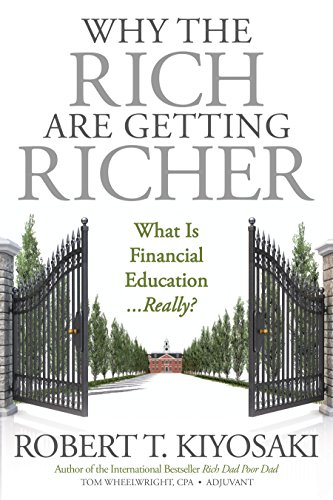
⚡️ What is Why the Rich Are Getting Richer About?
I remember sitting in a local coffee shop finishing this book and thinking: why didn’t my accounting professor mention any of this? In Why the Rich Are Getting Richer, Robert Kiyosaki essentially takes everything your parents told you about money—get a good job, save your pennies, buy a house, and pay off your debt—and sets it on fire. He argues that the “old rules” of money died in 1971 when President Nixon took the US dollar off the gold standard, turning our currency into debt. Since then, the system hasn’t been broken; it’s been working exactly as intended for those who know the rules. You can find more summaries by Robert T. Kiyosaki to see how his philosophy has evolved over decades.
The central thesis is that the widening wealth gap isn’t just about greed—it’s about education. While schools train us to be good employees (who pay the highest taxes), the truly wealthy focus on a different curriculum involving leverage, tax incentives, and “phantom income.” If you’ve ever felt like you’re running up a down escalator while the ultra-wealthy are on an express elevator, this is the book that explains why. It’s a deep dive into the mechanics of investing book summaries that focuses more on the macro-economics of wealth than just picking stocks.
🚀 The Book in 3 Sentences
- The global financial system changed fundamentally in 1971, turning the US dollar into a debt instrument that punishes savers through inflation and rewards those who use debt to acquire assets.
- True wealth is built by aligning your financial activities with government incentives, specifically by using debt to create jobs, housing, and energy, which results in paying little to no taxes legally.
- The gap between the rich and everyone else is primarily an educational one, where the middle class follows outdated rules while the rich use “phantom income” and leverage to grow their net worth.
🎨 Impressions
I’ve read Rich Dad Poor Dad probably three times, so I expected this to be a simple rehashing of the same concepts. I was wrong. While the core principles remain, this book feels grittier and more urgent. It’s less of a “you can do it” pep talk and more of a “here is how the plumbing of the global economy actually works” manual. I found myself dog-earing pages about the specific ways taxes function as incentives rather than just penalties. It’s a bit jarring to hear someone say “debt is good,” but once he breaks down the difference between consumer debt and investment leverage, it’s hard to un-see the logic.
Honestly, I found the section on “Phantom Income” the most eye-opening. We’re taught to look for cash flow, but Kiyosaki points out that the real money is often made in what you *don’t* pay the government. Some parts of the book do feel a bit repetitive—Kiyosaki loves to drive a point home until it’s bruised—but the core message is so contrary to everything we’re taught in school that the repetition is probably necessary to break through the mental conditioning. It’s a polarizing read, but it’s one of the few finance books that actually made me look at my tax return and feel like I was looking at a scorecard I didn’t know how to read.
📖 Who Should Read Why the Rich Are Getting Richer?
If you’re an entrepreneur or a real estate investor feeling stuck at a certain level of net worth, this is for you. It’s for the person who is tired of hearing “save 10% of your income” and wants to understand the high-level strategy used by the 1%. However, if you are currently struggling with heavy consumer debt or looking for a “get rich quick” scheme, you should probably skip this until you’ve got your basics sorted. This book requires a high tolerance for risk and a willingness to completely rethink your relationship with the bank.
☘️ How This Book Changed My Thinking
Before reading this, I viewed my taxes as an inevitable “theft” and debt as something to be avoided at all costs. Now, I see both as tools that are either working for me or against me based on my own education.
- I stopped trying to “pay off” low-interest investment debt and started looking for ways to use that capital to acquire more cash-flowing assets.
- I changed my perspective on taxes from a “cost of doing business” to a government “incentive program” that I can choose to participate in.
- I realized that the biggest risk isn’t a market crash—it’s staying financially illiterate while the value of the currency is being eroded by inflation.
✍️ 3 Quotes That Stuck With Me
- “The rich don’t work for money. They work for assets that put money in their pockets.” — A classic reminder that trading time for dollars is the least efficient way to get wealthy.
- “Debt and taxes make the rich richer, while debt and taxes make the poor and middle class poorer.” — This highlights how the same tools can be either a weapon or a shield depending on who’s holding them.
- “Your house is not an asset.” — Still the most controversial take in the Kiyosaki universe, but it forces you to define assets by cash flow rather than sentiment.
📒 Summary + Notes
The book’s narrative arc is built on a simple premise: the world changed in 1971, and most people are still playing by the pre-1971 rules. When the US dollar became “fiat” money, it stopped being an asset and became a liability. This means that if you save it, you lose. If you work for it, you’re taxed on it at the highest rate. The author wants you to believe that the only way to win is to stop being a “saver” and start being a “debtor” who uses that debt to buy real assets like real estate, oil, or businesses.
Kiyosaki spends a significant amount of time explaining that the government *wants* you to be rich if you’re doing what they need—providing housing, creating jobs, and producing energy. That’s why the tax code is thousands of pages long: it’s not a list of punishments; it’s a list of instructions. By the end of the book, the argument is clear: financial freedom doesn’t come from a high salary, it comes from “phantom wealth” and the ability to leverage the banking system just like the banks leverage you. It’s a heavy-duty shift from the “Poor Dad” mentality to a more aggressive, strategic “Rich Dad” philosophy.
🧠 Core Ideas Explained Simply
The author’s case relies on a few heavy-hitting concepts that flip traditional finance on its head.
Phantom Income
Think of this as the money you make that the IRS never sees. It’s not illegal; it’s things like depreciation and amortization. If you own an apartment building, the government lets you “write off” the building’s wear and tear over time. That “loss” on paper cancels out your actual profit, meaning you put cash in your pocket but report zero income. It’s like having a job where you get a paycheck, but the government treats it as if you earned nothing at all.
The 1971 Pivot
Why did savers become losers? When the dollar stopped being backed by gold, it became debt. Governments can print as much of it as they want. This leads to inflation, which makes the “stuff” (assets) more expensive and the “cash” (savings) less valuable. If you owe $1 million on a property and the dollar’s value drops by half, your debt is now “cheaper” to pay back, but your property is likely worth twice as much. The rich use this “printing” to their advantage while the middle class sees their purchasing power evaporate.
Good Debt vs. Bad Debt
Bad debt is when you borrow money to buy a TV; you pay the bank back with your after-tax labor. Good debt is when you borrow money to buy a rental property; your tenants pay the bank back for you, and you keep the extra cash. The rich are actually the biggest debtors in the world, but they don’t pay for their own debt—their assets do. Isn’t it wild that we’re taught to fear the very tool that the wealthy use to scale their empires?
01: Why the Rich Get Richer
What if the advice you got from your parents was actually dangerous? Kiyosaki starts by pointing out that the wealth gap is growing because our educational system is designed to produce “A-students” who work for “C-students.” The rich are getting richer because they are playing a different game with different rules. While the middle class focuses on their “earned income” (wages), the rich focus on “passive income” and “portfolio income.” The chapter sets the stage by arguing that unless you change your financial philosophy, you’ll always be at the mercy of the economy rather than the master of it.
02: What is Financial Education?
Imagine you’re playing a game where the rules changed in 1971, but nobody told you. Kiyosaki defines true financial education not as “learning to save” or “balancing a checkbook,” but as understanding the relationship between debt, taxes, and cash flow. He distinguishes between “academic” education (reading, writing), “professional” education (becoming a doctor or lawyer), and “financial” education (making money work for you). He argues that schools don’t teach the latter because the system needs employees, not employers. Don’t you find it strange that we spend 12-16 years in school but never learn how to manage the one thing we spend our whole lives working for?
03: Why Savers are Losers
Why does the bank pay you 0.1% interest while charging you 18% on a credit card? In this chapter, the “Savers are Losers” mantra is explained through the lens of inflation and currency devaluation. When the government prints money, the value of each dollar in your savings account drops. This is essentially a “hidden tax” on your hard work. The author notes that after 1971, money became “currency”—something that must flow and move, not sit still in a vault. If you let your money sit, it dies. If you move it into assets, it lives and grows.
04: Why Taxes Make the Rich Richer
“Taxes are the single largest expense for most people,” but they don’t have to be. Kiyosaki makes the case that the tax code is actually a giant roadmap. It tells you exactly what the government wants you to do. Think about it: why are there tax breaks for housing? Because the government wants you to build and provide housing. Why are there breaks for energy? Because the government wants energy independence. If you do what the government wants, you get a discount (tax breaks). If you don’t—if you just work a job—you pay full price. It’s a complete shift in how I view my tax return. It’s not a bill; it’s a scorecard.
05: Why Debt Makes the Rich Richer
Debt is essentially “money created out of nothing,” and that is its greatest power. When you take out a loan for a rental property, that money didn’t exist before—the bank created it through fractional reserve banking. If you use that debt to buy an asset that pays for the debt, you’re getting rich on money that isn’t yours. Most of us were taught that debt is a four-letter word. But there’s a world of difference between debt that eats you alive (consumer debt) and debt that feeds you (investment debt). This chapter is the dog-eared one for me; it explains how the rich use the bank’s money to acquire assets while the middle class uses the bank’s money to buy liabilities.
06: Why Mistakes Make the Rich Richer
Do you remember being punished for mistakes in school? Kiyosaki argues that this fear of making mistakes is exactly what keeps people poor. In the real world, the most successful people are those who make the most mistakes and learn from them. The rich understand that “losing” is part of winning. They don’t try to be “perfect”; they try to be “prolific.” He encourages readers to start small, make their mistakes early when the stakes are low, and view every failed deal as a tuition payment for their real-world financial education. It’s a refreshing take on the paralysis that often comes with starting a new venture.
07: Why the Rich Work for Less
It sounds insane to say you should work for free, but that’s the “Rich Dad” way. The rich don’t work for a “paycheck”—they work to acquire assets or to learn skills that will help them acquire assets. A paycheck is the most heavily taxed form of income. By working for “nothing” (or for equity/assets), the rich avoid the immediate tax trap and build long-term wealth. This chapter focuses on the mindset shift from “How much will this job pay me?” to “What will this job teach me?” or “What asset will this job help me build?”
08: Why the Poor and Middle Class Get Poorer
Ever feel like you’re running up a down escalator? This chapter is a sobering look at why people who work hard are still struggling. As the cost of living rises and the value of currency drops, the “working class” is getting squeezed from both sides. They are paying more for food and gas with dollars that are worth less, all while paying the highest percentage in taxes. Without the protection of assets, the middle class is essentially a “cash cow” for the government and the banking system. It’s a call to action to move out of the “Employee” and “Self-Employed” quadrants and into the “Business” and “Investor” quadrants.
09: The Rich Are Getting Richer… So What’s Next?
What happens when the gap between the haves and have-nots becomes a canyon? In the final chapter, Kiyosaki looks at the social and political implications of the wealth gap. He predicts more volatility and potentially more social unrest as the system continues to favor those with financial education. However, he also sees this as a time of immense opportunity. For those who are willing to learn the new rules of money, there has never been a better time to build wealth. He concludes with a challenge: will you stay a victim of the system, or will you learn to use the system to your advantage? Why the Rich Are Getting Richer is ultimately a plea for self-reliance in an unstable world.
⚖️ A Critical Perspective
While Kiyosaki’s insights are powerful, they are heavily weighted toward the US tax code and real estate market. If you’re a reader in a country with different tax structures or less access to easy leverage, some of these “secrets” may not apply. Additionally, he often glosses over the extreme risks of high leverage. “Debt is good” works until a market crash happens and you’re over-leveraged; many people following this advice in 2008 lost everything. I also find his dismissal of traditional education a bit hyperbolic—you still need doctors and engineers, even if they aren’t all “B” or “C” students.
🔄 How It Compares
Compared to The Automatic Millionaire by David Bach, which focuses on slow, steady savings and “The Latte Factor,” Kiyosaki’s approach is far more aggressive and sophisticated. While Bach teaches you how to be a “wealthy middle-class person,” Kiyosaki is teaching you how to play in a completely different league of wealth. It’s the difference between learning how to save for a rainy day and learning how to control the weather.
🔑 Key Takeaways
Here are the actionable lessons you should carry into your financial life immediately.
- Shift your focus from increasing your “earned income” to increasing your “passive income” through assets that provide depreciation and tax breaks.
- Stop viewing debt as a moral failing and start viewing it as a financial tool that can be used to acquire income-producing property.
- Invest in your own financial education first; the most valuable asset you own is your ability to tell the difference between a good deal and a bad one.
- Stop saving cash and start “saving” assets (like real estate, gold, or silver) that hold value against a devaluing currency.
💬 Frequently Asked Questions
What is the main argument of Why the Rich Are Getting Richer?
The book argues that the rich get richer because they utilize the “new rules of money” established after 1971. This involves using debt as leverage and maximizing tax incentives to acquire cash-flowing assets. Meanwhile, the middle class follows outdated advice like saving money and paying off debt, which actually works against them in an inflationary economy.
Why does Kiyosaki say that savers are losers?
Since the US dollar stopped being backed by gold, it became a debt-based currency that governments can print at will. This printing leads to inflation, which erodes the purchasing power of cash. Therefore, someone holding cash in a savings account is actually losing wealth over time compared to those who hold hard assets like real estate.
How do the rich avoid paying taxes legally?
The rich align their investments with government goals, such as providing affordable housing or producing energy. The tax code provides massive incentives (like depreciation and tax credits) for these activities. By using these legal deductions, wealthy individuals can often reduce their taxable income to zero while still maintaining significant positive cash flow from their investments.
What is the difference between good debt and bad debt?
Bad debt is money borrowed for things that lose value or don’t produce income, like cars or credit card purchases, which you must pay back yourself. Good debt is borrowed money used to buy assets that generate enough income to pay for the debt and put money in your pocket, effectively making the debt “free.””
Is this book better than Rich Dad Poor Dad?
While Rich Dad Poor Dad introduces the mindset, Why the Rich Are Getting Richer provides more technical depth. It explains the “why” behind the strategies, focusing on macroeconomics, the history of money, and the specifics of tax-free wealth. It is a more advanced read for those ready to move from theory to high-level strategy.
Conclusion
If there’s one thing I took away from Why the Rich Are Getting Richer, it’s that being “safe” is now one of the riskiest things you can do. The old strategy of working a single job for 40 years and retiring on a pension is a relic of a world that doesn’t exist anymore. In 2025 and beyond, your only real security is your ability to understand the flow of money and adapt to a system that rewards those who provide value and leverage debt intelligently. It’s not about being greedy; it’s about being informed in a world where the financial goalposts have been moved without our permission.
Don’t just take this as financial advice—take it as a challenge to your own worldview. The next time you see a tax bill or a loan application, don’t just see a burden. Look for the opportunity. If you can master the lessons in this Investing book, you’ll stop being a victim of the wealth gap and start being one of the people on the winning side of it. After all, the rules are there for everyone to read; most people just never bother to open the book.
More From Robert T. Kiyosaki →