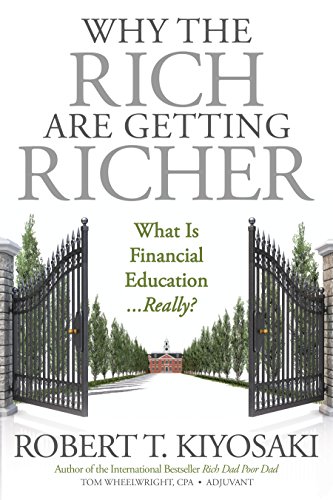
⚡️ What is Why the Rich Are Getting Richer about?
Robert Kiyosaki’s Why the Rich Are Getting Richer is a provocative follow-up to his bestseller Rich Dad Poor Dad. The book’s central thesis is that the financial rules taught to the middle and poor classes—go to school, get a safe job, save money, and invest in a 401(k)—are fundamentally broken in the post-1971 economy. Kiyosaki argues that the rich continue to amass wealth because they operate by a different set of rules, understanding how to use debt and taxes as powerful tools to build their asset columns. He claims that the current financial system, where money is no longer backed by gold, is designed to transfer wealth from the uninformed to the informed through inflation and taxes. This book is a call to action, urging readers to abandon traditional financial advice and embrace the financial education and strategies of the wealthy.
🚀 The Book in 3 Sentences
- Kiyosaki explains that the rich are getting richer because they understand how to use debt and taxes to acquire assets that generate cash flow, while the poor and middle class are trapped by outdated financial advice.
- The book asserts that the traditional path of a good education and a stable job is a recipe for financial struggle in an economy designed to devalue savings and punish employees with high taxes.
- The ultimate solution is to increase your financial intelligence, learn to invest in assets like real estate and businesses, and shift your mindset from that of an employee to an investor.
🎨 Impressions
My overall impression of Why the Rich Are Getting Richer is that it’s a necessary, albeit sometimes repetitive, wake-up call. Kiyosaki’s style is blunt and designed to challenge your core beliefs about money. While some of his strategies, like leveraging debt, can seem risky, his underlying message about the importance of financial literacy is undeniable. The book doesn’t offer a step-by-step plan but rather a new lens through which to view the world. It successfully shifts the reader’s focus from working for money to making money work for them, which is a powerful paradigm shift for anyone feeling stuck in the ‘rat race’.
📖 Who Should Read Why the Rich Are Getting Richer?
This book is essential reading for anyone who feels trapped in their job, is questioning the value of traditional retirement savings, or wonders why their hard work isn’t translating into wealth. It’s perfect for aspiring entrepreneurs, real estate investors, and individuals who want to take control of their financial destiny. If you’re tired of conventional financial wisdom and are ready to explore the strategies the wealthy use, this book will provide the mindset and foundational knowledge you need to begin your journey.
☘️ How the Book Changed Me
Reading this book fundamentally altered my perspective on debt, taxes, and financial security. I moved from a ‘save and hope’ mentality to an ‘acquire and grow’ strategy. The most significant change was my active pursuit of financial education, moving beyond what I learned in school.
- I now view debt not as an enemy, but as a tool. I differentiate between ‘good debt’ used to buy cash-flowing assets and ‘bad debt’ used to buy liabilities.
- It sparked an intense curiosity in me to understand the tax code, not just to comply, but to see how I could legally use it to my advantage, just as the wealthy do.
- I stopped seeing my house as my primary investment and started focusing my energy on building a portfolio of assets that actually put money in my pocket each month.
- I began to actively look for financial problems in the world, viewing them not as news, but as potential business opportunities to solve for profit.
✍️ My Top 3 Quotes
- “The single most powerful asset we all have is our mind. If it is trained well, it can create enormous wealth.”
- “In the real world, the smartest people are people who make mistakes and learn. In school, the smartest people don’t make mistakes.”
- “The rich buy assets. The poor only have expenses. The middle class buys liabilities they think are assets.”
📒 Summary + Notes
Why the Rich Are Getting Richer is a detailed exposition on the financial strategies that separate the wealthy from the working and middle classes. Kiyosaki dives deep into the economic shifts since 1971, when the U.S. dollar was taken off the gold standard, creating a new era of ‘fake money’ that benefits those who understand it. He argues that savers are being losers due to inflation, while debtors and investors are winners. The book is a masterclass in financial intelligence, breaking down complex topics like taxes, debt, and asset acquisition into understandable concepts. It challenges readers to move beyond the traditional ‘E’ (Employee) and ‘S’ (Self-Employed) quadrants of the Cashflow Quadrant into the ‘B’ (Business Owner) and ‘I’ (Investor) quadrants where true wealth is built.
Chapter 1: Is the School System Preparing Your Child for the Real World?
Kiyosaki begins by questioning the purpose of traditional education, arguing that it prepares students to be good employees (‘E’s and ‘S’s) rather than savvy entrepreneurs or investors (‘B’s and ‘I’s). He contrasts his ‘Rich Dad’s’ practical, real-world financial education with his ‘Poor Dad’s’ academic path. The chapter highlights that schools teach students to work for money, but not how money works. This fundamental gap in education is why so many intelligent people struggle financially. The real world requires skills in sales, communication, leadership, and investing—subjects rarely touched upon in formal education. Kiyosaki insists that financial education must begin at home and is a parent’s most important responsibility.
- The core problem is that schools create employees, not employers.
- Financial literacy is a more crucial skill for the modern world than most academic subjects.
- The ‘safe and secure’ job path is an illusion; true security comes from financial intelligence.
- Parents must take the lead in teaching their kids about money, as schools will not.
- Kiyosaki uses his two dads as a powerful metaphor for two different life philosophies.
Chapter 2: What Is the Difference between the Rich and the Poor?
This chapter introduces the famous Cashflow Quadrant, which is the central framework of the book. Kiyosaki explains the four quadrants: E (Employee), S (Self-Employed), B (Business Owner), and I (Investor). He details the mindset, skills, and financial outcomes associated with each. The left side (E and S) is where people trade their time for money, pay the most in taxes, and have little freedom. The right side (B and I) is where people build or own systems that generate money, pay less in taxes, and enjoy true financial freedom. The key difference, he argues, is that the rich operate on the right side of the quadrant. The path to wealth is not about climbing the corporate ladder in the ‘E’ quadrant, but about moving from the left side to the right side.
- The Cashflow Quadrant is the most important concept for understanding wealth creation.
- ‘E’s and ‘S’s work for money; ‘B’s and ‘I’s have money or systems work for them.
- The greatest wealth is built in the ‘B’ and ‘I’ quadrants due to tax advantages and leverage.
- Moving from the left to the right side requires a significant shift in mindset and core values.
- Job security is a myth; the real security is the ability to generate your own cash flow.
Chapter 3: Why Your Banker Never Asks You for Your Report Card
Kiyosaki uses this chapter to hammer home the point that academic success does not equal financial success. Your banker cares about your financial statement, not your GPA. He defines financial intelligence as the ability to read and understand financial statements. This skill allows you to see the whole picture of a business or investment—to distinguish between assets and liabilities, and to understand cash flow. The rich are masters of their financial statements, constantly working to strengthen their asset column. The poor and middle class, by contrast, often have weak or non-existent financial statements. This chapter is a call to action to become financially literate by studying accounting, investing, and market dynamics. It’s about learning the language of money.
- Financial intelligence is measured by your financial statement, not your academic report card.
- The ability to read numbers is the key to identifying good investments and bad ones.
- The rich focus on building a strong asset column that generates passive income.
- Academic intelligence can get you a job, but only financial intelligence can make you rich.
- Start by creating your own personal financial statement to understand your current financial reality.
Chapter 4: Why the Rich Are Getting Richer
Here, Kiyosaki gets to the heart of the book’s title. He explains that the rich are getting richer because they understand and exploit the two biggest forces in the economy: taxes and debt. For the poor and middle class, taxes are an expense and debt is a liability. For the rich, taxes are a game to be minimized, and debt is a powerful tool for leverage. The rich use ‘good debt’—debt used to purchase income-generating assets—to acquire more and more assets without using their own money. They also use the tax code, which is designed to incentivize business owners and investors, to legally pay a lower percentage in taxes. This chapter demystifies these concepts, showing how the financial system is tilted in favor of those who know how to play the game.
- The rich use debt as leverage to acquire assets, while the poor use it to acquire liabilities.
- The tax code provides massive loopholes and incentives for ‘B’s and ‘I’s, not for ‘E’s and ‘S’s.
- Understanding how to use debt and taxes is the primary reason the rich are getting richer.
- Your house is not an asset in the way Kiyosaki defines it; it’s a liability that takes money out of your pocket.
- The government uses the tax code to encourage behavior it wants, like providing housing (real estate investors) or energy (oil investors).
Chapter 5: The Unfair Advantage
Kiyosaki discusses the concept of an ‘unfair advantage,’ arguing that the rich have access to deals, information, and financial techniques that the general public does not. This isn’t about illegal activity; it’s about being in the right quadrant and having the right network. When you’re a business owner or a professional investor, you get access to private placements, pre-IPO stock, and off-market real estate deals. You also learn to see opportunities where others see only risk. For example, a market crash is a time of fear for most, but for the rich, it’s a massive sale on assets. This unfair advantage is built through financial education, experience, and a network of like-minded individuals. It’s the reward for playing the game on the right side of the Cashflow Quadrant.
- The rich have an ‘unfair advantage’ through access to exclusive investment deals.
- Financial crises are opportunities for the rich to buy assets at a discount.
- Your network is a key part of your unfair advantage; who you know is as important as what you know.
- This advantage is earned, not given—it’s the result of seeking financial education and experience.
- The rich see the world through a different lens, identifying opportunities that are invisible to the financially untrained eye.
Chapter 6: Which Side of the Table Are You On?
This chapter uses the metaphor of a financial table. On one side are the ‘E’s and ‘S’s, the people who pay taxes and interest first. On the other side are the ‘B’s and ‘I’s, the people who get paid first and pay taxes last. Kiyosaki explains that the government’s financial statement is structured to reward the ‘B’ and ‘I’ quadrants. Business owners and investors earn income, spend it on expenses, and are taxed on what’s left. Employees earn income, are taxed on it upfront, and then try to live on what’s left. This structural difference is a massive advantage. The chapter urges readers to consciously choose which side of the table they want to be on and to take the steps necessary to get there. It’s about changing your position from a financial spectator to a financial player.
- The financial world has two sides: those who pay taxes first and those who pay taxes last.
- Business owners and investors have the legal right to manage their income and expenses before paying taxes.
- Employees have their taxes taken before they even see their paycheck.
- Moving to the other side of the table requires starting a business or becoming a professional investor.
- This ‘side of the table’ concept is a simple but powerful illustration of wealth-building principles.
Chapter 7: How to Find Your Own Financial Genius
In the final chapter, Kiyosaki focuses on the internal work required to become wealthy. He argues that everyone has a ‘financial genius’ inside them, but it’s often suppressed by a fear of making mistakes. The key to unlocking it is to ‘fake it till you make it’—to start small, take action, and learn from your failures. He encourages readers to start a small side business, buy a small rental property, or begin trading with a small amount of money. The goal is not immediate success, but education. Through action, you gain experience, build confidence, and develop your financial intuition. Kiyosaki stresses that the journey to wealth is a process of learning, failing, and growing. The most important step is the first one: deciding to take control of your financial education and future.
- Everyone has a financial genius; it’s unlocked through practice, not theory.
- Don’t be afraid to fail; mistakes are your best teachers in the world of finance.
- Start small with a side business or a small investment to gain real-world experience.
- The journey to wealth is a marathon, not a sprint. Focus on learning and growing.
- Your greatest asset is your mind, and investing in your financial education is the best investment you can make.
Key Takeaways
The core lessons from Why the Rich Are Getting Richer are transformative and challenge conventional wisdom. The book’s power lies in its ability to reframe your entire perspective on money, work, and wealth. By understanding these key takeaways, you can begin to apply the same principles the wealthy use to build and sustain their fortunes.
- Shift your mindset from being an employee or self-employed person to becoming a business owner or investor.
- Master the strategies of using good debt and tax laws to accelerate your wealth acquisition.
- Prioritize financial education above all else; learn to read financial statements and understand the language of money.
- Focus your efforts on acquiring assets that generate consistent cash flow, rather than just working for a paycheck.
- Understand that the financial system is designed to favor the informed; your goal is to become one of the informed.
Conclusion
>In conclusion, Why the Rich Are Getting Richer is more than just a book; it’s a new financial operating system for your mind. Robert Kiyosaki masterfully deconstructs the complex world of finance into simple, actionable principles that anyone can learn. While his style may be unconventional, his message is clear and urgent: the old rules of money no longer apply. To thrive in today’s economy, you must take control of your financial education and adopt the mindset and strategies of the rich. This book is the perfect starting point for that journey. It will challenge you, frustrate you, and ultimately empower you to build a future of financial freedom. I highly recommend reading it and immediately beginning to apply its life-changing lessons.More From Robert T. Kiyosaki →
Discover more from AI Book Summary
Subscribe to get the latest posts sent to your email.