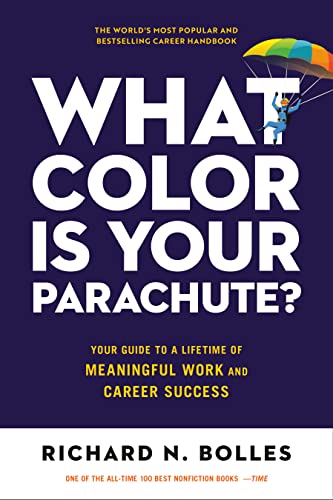
⚡️ What is What Color Is Your Parachute? About?
Have you ever felt like you’re screaming into a void every time you hit ‘apply’ on a job board? It’s a soul-crushing experience, and More summaries by Richard N. Bolles explains exactly why that is: the way most people look for work is the exact opposite of how most employers actually hire. While we’re busy polishing resumes, employers are looking for people they already know or people who come recommended by a trusted friend. This book, a staple in Self-Help book summaries, flips the script on the traditional job hunt by focusing on self-inventory first and job titles second.
Bolles’ central thesis is that the job market is essentially two different worlds that don’t speak the same language. On one side, you have the “Resume World,” which is crowded, competitive, and largely ineffective. On the other, you have the “Parachute World,” where you define your skills, your preferred environment, and your personal mission before you even look at a job posting. It’s about taking the power back from HR departments and placing it squarely in your own hands. Why let a blind algorithm decide your worth when you can build a bridge directly to the decision-makers?
🚀 The Book in 3 Sentences
- Job hunting is a completely different skill set from actually doing the job; you have to master the hunt as a separate craft.
- The most effective way to find meaningful work is to conduct a thorough self-inventory (The Flower Exercise) to identify your transferable skills and favorite knowledges.
- Successful career changers bypass traditional HR filters by using informational interviewing to find the person who actually has the power to hire them.
🎨 Impressions
I’ll be honest: when I first saw the diagrams in this book, I thought it looked like something from a 1990s church basement. It’s got a folksy, almost quirky vibe that feels a bit dated at first glance. But once you get past the clip-art and the occasional religious undertones, the logic is incredibly sharp. I spent years thinking my resume was the problem, but Bolles made me realize that the *method* was the problem. It’s refreshing to read someone who admits that the current hiring system is broken and provides a manual for how to ignore it entirely.
The Flower Exercise was the part I dog-eared the most. It’s a lot of work—I’m talking hours of writing and reflecting—but it’s the only time I’ve felt like I was actually in the driver’s seat of my career. I found the sections on salary negotiation especially punchy. There’s no fluff there; just straight-up psychological warfare tactics for getting paid what you’re worth. It’s a rare book that manages to be both deeply philosophical about the “meaning of work” and ruthlessly practical about how to get a paycheck.
📖 Who Should Read What Color Is Your Parachute?
If you’re a mid-career professional feeling like a cog in a machine, this is your exit ramp. It’s perfect for the person who knows they want to leave their industry but has no idea where to go next. However, if you’re looking for a quick fix or a list of “AI resume keywords,” you’ll probably find this tedious. This book demands introspection. It’s for the seeker who is willing to treat their career hunt like a full-time job for a few months to ensure the next twenty years don’t suck.
☘️ How This Book Changed My Thinking
Before reading this, I viewed job hunting as a game of high-volume submission—send enough resumes and someone eventually bites. Now, I see it as a targeted research project.
- I stopped treating HR as the gateway and started seeing them as the hurdle to be bypassed.
- I realized that “transferable skills” are my real currency, not my past job titles.
- I shifted from asking “Who will hire me?” to “Who do I actually want to work for?”
✍️ 3 Quotes That Stuck With Me
- “The job-hunt is a hunt for a person—specifically, the person who has the power to hire you.” — This reminds me that companies don’t hire people; people hire people.
- “You are not your job title.” — This hits differently when you’re feeling stuck in a niche you no longer care about.
- “The goal of an interview is for you to decide if you want to work with them, just as much as it is for them to decide if they want you.” — This simple shift in power dynamics completely changes how I walk into a room.
📒 Summary + Notes
The book’s narrative arc follows a logic of radical self-reliance. It begins by exposing the “Job-Hunting World” as a chaotic mess where traditional methods like resumes and agencies only work about 5-10% of the time. Bolles argues that because the system is so inefficient, you have to create your own system. This starts with the “Flower Exercise,” a self-inventory that forces you to look at seven different petals: people, working conditions, skills, knowledge, money, geography, and purpose. By the time you finish this, you aren’t looking for a “Marketing Manager” role; you’re looking for a role that allows you to use your data-analysis skills with creative people in a medium-sized firm in Portland.
Once you have your “Flower,” the author’s case moves into the tactical phase. You aren’t allowed to just sit at home and click buttons. You have to get out and talk to people. Bolles teaches “Informational Interviewing,” which is basically being a curious detective rather than a desperate beggar. You meet with people in your target field just to learn how the industry works. This naturally leads to the “bridge” where someone eventually says, “You know, we actually need someone like you.” It’s a slow-burn strategy that yields much higher-quality results than the spray-and-pray method.
1: It’s a Whole New World
Did you know that the traditional job hunt is actually getting harder despite all our new tech? Bolles starts by pointing out that the Internet has made it too easy to apply for jobs, which has overwhelmed employers. They’ve responded by installing digital filters that screen out 90% of applicants before a human even sees them. If you’re playing the game this way, you’re essentially competing with thousands of people for a 2% chance of success. It’s a rigged game, and the author wants you to stop playing it immediately.
2: Google Is Your New Resume
A hiring manager is going to search for your name before they ever call you for an interview. Are you okay with what they’ll find? This chapter maps out the reality of our digital footprints. It’s not just about hiding the bad stuff; it’s about proactively planting the good stuff. Bolles argues that your LinkedIn profile and professional social presence are essentially your “24/7 resume.” If you don’t curate your online identity, you’re letting Google tell your story for you, and Google doesn’t care if you get the job.
3: There Are Over Ten Million Vacancies
What if I told you that the “job market” you see on LinkedIn is only the tip of the iceberg? There is a massive “hidden job market” consisting of roles that are never advertised. Employers hate advertising jobs because it brings in too many unqualified people. They prefer to hire from within or through their network. This chapter is a wake-up call: the best jobs aren’t on the boards because the best companies don’t need to post them there. You have to find where these vacancies are hiding by being present in the professional circles where they exist.
4: The Best and Worst Ways to Look for a Job
How much time are you wasting on methods that have a 5% success rate? Bolles breaks down the math of the hunt. Answering ads in journals or newspapers (or their digital equivalents) is near the bottom. Using a private employment agency is only slightly better. What actually works? Knocking on doors of employers that interest you, using your personal network, and—the gold standard—conducting a thorough self-inventory. The more work you do on *yourself* before you look for the job, the more likely you are to find it.
5: The Flower Exercise
This is the heart of this framework, and it’s where things get intense. You can’t just skim this; you have to do the work. The exercise asks you to map out seven “petals” of your career identity:
- Your favorite knowledges or subjects.
- The kinds of people you like to work with.
- What you can actually do (transferable skills).
- The working conditions you thrive in.
- The salary and level of responsibility you need.
- Where you want to live.
- Your goal, purpose, or mission in life.
The goal is to move from a vague desire for “a better job” to a laser-focused profile of your ideal work life. When you know exactly what your flower looks like, you can recognize the right garden the moment you see it.
6: You Need to Understand How to Deal with Any Handicaps
We all have something we’re afraid will disqualify us—too old, too young, too much gap in the resume, or not enough experience. Bolles’ approach to this is refreshing: stop trying to hide it and start finding employers who don’t care about it. Every “handicap” is only a handicap in the wrong environment. If you’re 60 years old, don’t try to get hired at a startup that only wants 22-year-olds. Go where your wisdom is a premium. The key is to stop apologizing for your history and start looking for people who see it as an asset.
7: You Need to Target More Than One Person
Imagine you’ve found the perfect company—what now? Most people send a resume to the HR department and wait. Bolles says that’s a death sentence for your application. You need to identify the person who actually has the power to hire you for the specific job you want. Usually, this is a department head or a manager, not someone in HR. Your goal is to get in front of that person. How? By using your network to find a bridge or by simply asking for ten minutes of their time to learn about their department.
8: The Great Secrets of Information Interviewing
Is it possible to get a job offer without ever asking for a job? That’s the magic of informational interviewing. You are coming to people as a student of the industry, not a job seeker. You ask three questions: How did you get into this? What do you like best/least about it? And who else should I talk to? This lowers the pressure for everyone involved. It builds your network, increases your industry knowledge, and often leads to the interviewee saying, “You know, we might actually have an opening coming up.”
9: How to Conduct an Interview
Why do so many people treat interviews like a trip to the principal’s office? An interview is just a conversation between two people seeing if they can help each other. Bolles gives a great tip: keep your answers between 20 seconds and 2 minutes. Any shorter and you’re not giving enough; any longer and you’re boring them. He also emphasizes that the most important part of the interview is what you ask *them*. If you don’t have questions about their problems and goals, you’re signaling that you’re just there for the paycheck.
10: The Six Secrets of Salary Negotiation
Never, ever be the first one to mention a number. That’s the cardinal rule here. Bolles explains that the person who mentions a number first usually loses. If they push you, you deflect. You want them to decide they want you *before* the price tag comes out. He also points out that you aren’t just negotiating salary; you’re negotiating a total package. Vacation, remote work, bonuses—everything is on the table. But the leverage only exists once they’ve said “we want you.”
11: Five Ways to Start Your Own Business
What if the best employer for you is actually… you? This chapter is a reality check for would-be entrepreneurs. Bolles doesn’t paint a rosy picture of “being your own boss.” He warns about the long hours and the risk. But he also provides a framework for testing your business idea on a small scale before you quit your day job. It’s about “parallel paths”—building your side hustle while you still have the safety net of a salary. If your Flower Exercise points toward independence, this is your roadmap.
12: How to Find Your Mission in Life
“What am I here for?” is the heavy question Bolles tackles at the end. This is where his background as a clergyman shows through, but even for the secular reader, it’s poignant. He argues that work isn’t just about survival; it’s about stewardship. Your mission is the intersection of your greatest joy and the world’s greatest need. If you can align your daily labor with that mission, you’ll never feel like you’re “just working” again. It’s a soulful end to a very practical book.
⚖️ A Critical Perspective
While the “Flower Exercise” is brilliant, it can be overwhelming for someone in a state of financial crisis who just needs a job *now*. The book also assumes a level of social capital that not everyone has; “informational interviewing” is much harder if you don’t have a professional network to start with. Additionally, some of the advice on bypassing HR feels a bit optimistic in the age of strict corporate security and gatekeeping. However, even if you only apply 20% of his methods, you’ll still be miles ahead of the person just clicking ‘Apply’ on LinkedIn.
🔄 How It Compares
Compared to a book like *Designing Your Life* by Bill Burnett and Dave Evans, which uses design thinking to solve career problems, Bolles’ approach is much more inventory-based and traditional. While *Designing Your Life* focuses on prototyping and small experiments, the author’s case in Parachute is about deep internal reflection before taking a single external step. Both are excellent, but Parachute feels more like a comprehensive manual, whereas *Designing Your Life* feels like a modern workshop.
🔑 Key Takeaways
The lessons in this book are designed to shift you from a passive victim of the market to an active architect of your career.
- The person who gets hired isn’t always the one who can do the job best, but the one who knows the most about how to get hired.
- Resumes are essentially a tool for exclusion; your goal is to find methods of inclusion (networking and direct contact).
- Salary negotiation should only happen at the very end of the process, once the employer is emotionally invested in hiring you.
- The “hidden job market” is where the best opportunities live, and it can only be accessed through human connection.
💬 Frequently Asked Questions
What is the main argument of What Color Is Your Parachute?
The book argues that job hunting is a specific skill distinct from professional expertise. To succeed, seekers must move away from ineffective high-volume resume submissions and toward a self-directed “Parachute” approach. This involves deep self-inventory to identify transferable skills and targeting the “hidden job market” through networking.
What is the Flower Exercise?
The Flower Exercise is a comprehensive self-assessment tool used to visualize a person’s ideal career. It covers seven “petals”: people, working conditions, transferable skills, knowledge, salary, geography, and purpose. By defining these specific preferences, job hunters can narrow their search to roles that align with their identity.
Is What Color Is Your Parachute? still relevant in 2025?
Yes, because while technology changes, human psychology in hiring remains the same. Employers still prefer referrals over cold resumes. The book is updated annually to include modern shifts like AI in recruiting and social media branding, making it a bridge between timeless career wisdom and current market realities.
What is informational interviewing?
Informational interviewing is a research method where a seeker meets with professionals to learn about an industry without asking for a job. It builds a network, uncovers the hidden job market, and helps the seeker refine their career goals. It often leads to referrals or unexpected job offers.
Why does Bolles say resumes are the least effective way to find a job?
Bolles argues that resumes are “exclusionary tools” used by HR to filter people out, not to find the best fit. Statistical data shows they have a very low success rate (around 7%). He suggests that direct contact with hiring managers and networking are far more successful strategies.
Conclusion
At the end of the day, What Color Is Your Parachute? is more than just a job-hunting guide; it’s a manifesto for personal agency. It challenges the idea that we are at the mercy of the economy or the whims of HR departments. By doing the hard work of figuring out who you are and what you offer, you stop being a beggar in the market and start being a consultant who can solve a specific problem for the right employer. It’s an empowering, if slightly labor-intensive, way to look at your professional life.
If you take only one thing away from this summary, let it be this: the system is broken, but you don’t have to be a victim of it. Whether you use the Flower Exercise or just start taking more people out for coffee, shifting your focus from “applying” to “connecting” will change everything. Careers are built on relationships and self-knowledge, and this book remains the definitive map for that journey. It truly is the gold standard for anyone seeking more than just a paycheck in our modern world.
More From Richard N. Bolles →
Discover more from AI Book Summary
Subscribe to get the latest posts sent to your email.