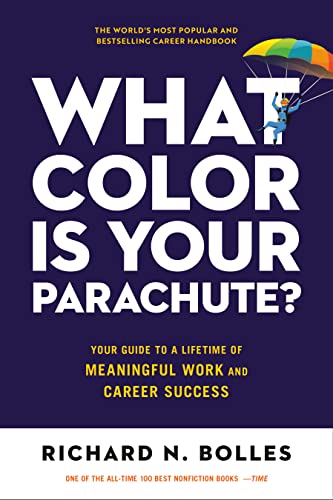
⚡️ What is What Color Is Your Parachute? about?
What Color Is Your Parachute? is not just another job-hunting guide; it’s a comprehensive manual for navigating the modern world of work and finding a career that brings true fulfillment. Richard N. Bolles presents a timeless philosophy that shifts the focus from desperately chasing job postings to first understanding yourself deeply. The book’s core is the famous Flower Exercise, a powerful self-assessment tool that helps you identify your unique skills, passions, values, and ideal working conditions. It teaches you that the most effective job hunting techniques begin with a clear picture of who you are and what you have to offer. This book is a lifeline for anyone feeling lost in their career, providing a step-by-step framework to move from confusion to clarity, and from simply having a job to building a meaningful life’s work. It’s about becoming the architect of your own career, not just a passenger.
🚀 The Book in 3 Sentences
- The most successful job search starts with an intimate self-inventory to identify your unique skills, passions, and purpose, not by scanning job boards.
- Once you know what you have to offer, you can strategically target organizations and roles that align with your personal blueprint, making you a perfect candidate.
- The book provides practical, modern career strategies for every step of the process, from building an impressive online presence to acing interviews and negotiating your ideal salary.
🎨 Impressions
I was genuinely impressed by how What Color Is Your Parachute? manages to be both incredibly practical and deeply philosophical. It’s not merely a checklist of actions but a guide to introspection and purpose-driven work. The book’s strength lies in its empowerment; it hands you the tools to take control of your career destiny rather than leaving you to the whims of the job market. Bolles’ compassionate yet direct tone makes the daunting process of self-discovery feel achievable and even exciting. This isn’t just for the unemployed; it’s a vital resource for anyone at a career crossroads or simply wanting to ensure their work aligns with their life. Its yearly updates prove its enduring relevance in our ever-changing professional landscape.
📖 Who Should Read What Color Is Your Parachute??
This book is essential reading for anyone feeling stuck, unfulfilled, or uncertain about their professional path. Whether you’re a recent graduate entering the workforce, a mid-career professional contemplating a change, or someone who has been laid off and is re-entering the job market, What Color Is Your Parachute? offers invaluable guidance. It’s also perfect for those who are employed but feel a disconnect between their job and their deeper passions. If you believe that work should be more than just a paycheck and are ready to invest the time to find a career that truly fits, this book is your indispensable roadmap.
☘️ How the Book Changed Me
Reading this book fundamentally transformed my perspective on careers from a linear ladder to a dynamic, personal journey. It shifted my focus from what jobs are available to what value I can create and where I would be happiest doing it. The emphasis on transferable skills was a revelation, helping me see my experience as a collection of abilities rather than just a list of past job titles.
- I now approach my career with a proactive, entrepreneurial mindset, constantly seeking alignment with my core values.
- I stopped passively waiting for opportunities and began actively researching and creating them for myself.
- The book gave me the confidence to negotiate for what I’m worth, armed with a clear understanding of the value I bring.
✍️ My Top 3 Quotes
- “The person who gets hired is not always the best at the job, but the best at getting hired.”
- “Job hunting is no longer an optional exercise. It is a survival skill.”
- “You need to dream about the broad outcome of your life, and not just this year’s job search.”
📒 Summary + Notes
What Color Is Your Parachute? is structured as a practical workbook, guiding you through a journey of self-discovery and strategic action. The following chapter-by-chapter summary breaks down its core career strategies and exercises. Bolles systematically dismantles old, ineffective job-hunting myths and replaces them with a robust, adaptable framework for finding meaningful work in any economic climate. The process requires introspection and effort, but the reward is a career path that feels authentic and sustainable.
Chapter 1: It’s a Whole New World for Job-Hunters
This chapter sets the stage by explaining how the world of work has fundamentally changed. Bolles argues that the traditional job-hunting model—responding to ads—is broken. He highlights the rise of the gig economy, automation, and the fact that people now change jobs multiple times in their lives. The key takeaway is that job-hunting is no longer a one-time event but a continuous survival skill. You must adapt your approach to succeed in this new landscape where employers prioritize minimizing risk, and candidates must learn how to stand out by demonstrating clear value.
- The job hunt is longer and more challenging than ever before.
- Employers are more risk-averse, often preferring internal candidates or referrals.
- You must learn to navigate both the visible and hidden job markets.
- Adaptability and continuous learning are now essential professional traits.
- Your attitude and approach to the hunt are more critical than ever.
Chapter 2: Google Is Your New Resume
In the digital age, your online presence is your first impression. Bolles emphasizes that employers will Google you, so you must manage your digital footprint proactively. This chapter is a guide to crafting a professional online persona. It’s not about hiding but about curating. You need to ensure your social media profiles, especially LinkedIn, present a consistent and compelling narrative of your skills and professionalism. This “online resume” can either open doors or close them before you even get a chance to submit an application.
- Conduct a search on yourself to see what employers see.
- Clean up any unprofessional content on your social media profiles.
- Optimize your LinkedIn profile with keywords and a professional headshot.
- Create a simple personal website or online portfolio to showcase your work.
- Use your online presence to demonstrate your expertise and passion for your field.
Chapter 3: There Are Over Ten Million Vacancies Available Each Month
This chapter is designed to combat job-hunter despair by highlighting the sheer volume of opportunities that exist. However, Bolles clarifies that most of these jobs are part of the “hidden job market”—they are never advertised. They are filled through referrals, networking, or by creating a position where one didn’t exist before. The goal is to shift your mindset from scarcity to abundance and to learn the job hunting techniques for tapping into this hidden market. It’s about being proactive rather than reactive.
- The vast majority of jobs are filled through networking, not online ads.
- Focus your energy on contacting organizations you admire, even if they have no openings.
- Informational interviews are a powerful tool for uncovering hidden opportunities.
- Your aim is to be remembered when a need arises, not just to apply for a posted role.
- Every conversation is a potential networking opportunity that could lead to a job.
Chapter 4: Sixteen Tips About Interviewing for a Job
This chapter is a masterclass in the art of the interview. Bolles provides 16 actionable tips that go far beyond “show up on time.” He emphasizes that an interview is a two-way street; you are interviewing them as much as they are interviewing you. The core of his advice is to shift the focus from your past (your resume) to their future (how you can solve their problems). You must do your homework, understand the company’s challenges, and prepare to demonstrate exactly how your skills will bring them value and help them achieve their goals.
- Research the organization’s mission, values, and recent challenges.
- Prepare a 90-second “elevator pitch” that summarizes who you are and what you do.
- Frame your answers around how you can help the employer solve their problems.
- Ask intelligent, thoughtful questions that show you’ve done your research.
- Always send a follow-up thank-you note within 24 hours.
Chapter 5: The Six Secrets of Salary Negotiation
Negotiating salary can be intimidating, but this chapter demystifies the process. Bolles outlines six “secrets” to empower you to get the compensation you deserve. The key principle is to postpone discussing salary until you have a firm job offer. Once they have decided they want you, you are in the strongest possible position to negotiate. He advises doing thorough research on industry salary ranges and focusing on the value you bring, not just your personal needs. This chapter is about turning a moment of anxiety into an opportunity to demonstrate your worth.
- Never discuss salary until you have a concrete job offer in hand.
- Research the typical salary range for the role, industry, and location beforehand.
- Let the employer give the first number, if possible.
- When you name a figure, give a range, with the bottom of your range being what you’d accept.
- Remember that everything is negotiable, including benefits, vacation time, and flexible work arrangements.
Chapter 6: What to Do When Your Job Hunt Just Isn’t Working
This chapter is a troubleshooting guide for the frustrated job hunter. Bolles addresses the common pitfalls and psychological barriers that can derail a search. He encourages you to treat your job hunt like a job itself, with discipline, structure, and goals. He suggests diagnosing the problem: Are you using the wrong methods? Is your resume ineffective? Are you targeting the wrong kinds of jobs? The chapter offers concrete steps to get unstuck, such as seeking feedback, expanding your network, and perhaps most importantly, taking care of your mental and emotional health during the stressful process.
- Treat your job hunt as a full-time job with set hours and daily goals.
- Seek feedback on your resume and interview performance from trusted sources.
- Analyze which of your job hunting techniques are producing results and which are not.
- Don’t be afraid to completely change your approach if what you’re doing isn’t working.
- Join a job-hunting support group to share experiences and stay motivated.
Chapter 7: Self-Inventory, Part 1 (Understanding Who You Are)
Here begins the heart of the book: The Flower Exercise. This chapter introduces the concept of a deep self-inventory as the foundation for a successful career. It argues that you cannot find the right work if you don’t know who you are. This first part of the exercise focuses on identifying your favorite transferable skills—the abilities you enjoy using and are good at, regardless of the job title. The process involves writing stories about times you felt proud and fulfilled, then analyzing those stories to find recurring patterns of skill and passion.
- The Flower Exercise is a diagram with seven petals, each representing a part of your career identity.
- Identify your favorite transferable skills by analyzing past “peak experiences.”
- Distinguish between skills you are good at and skills you genuinely enjoy using.
- Group your skills into categories like people, data, things, and ideas.
- This self-knowledge becomes the core of your value proposition to employers.
Chapter 8: Self-Inventory, Part 2
This chapter continues the Flower Exercise by guiding you through the remaining petals. You’ll define your preferred working conditions, the types of people you want to work with, your ideal geographical location, your salary requirements, and your ultimate sense of purpose or mission. This holistic view ensures that when you find a job, it’s not just a good fit on paper but a good fit for your entire life. This detailed inventory creates a clear blueprint of your ideal job, making it much easier to recognize and pursue the right opportunities.
- Petal 2: Define your ideal work environment (e.g., quiet, collaborative, flexible hours).
- Petal 3: Identify the types of people you work best with.
- Petal 4: List your favorite subjects or fields of knowledge.
- Petal 5: Pinpoint your preferred geographical places to live and work.
- Petal 6: Determine your desired level of responsibility and salary needs.
Chapter 9: You Get to Choose Where You Work
With your self-inventory complete, this chapter shows you how to put it to use. It’s about moving from self-knowledge to real-world exploration. Bolles provides a framework for identifying industries, companies, and specific roles that match your “flower.” He encourages you to think broadly and creatively, using your passions and skills as a compass. The chapter introduces various methods for researching potential workplaces, including online resources, industry reports, and, most importantly, conducting informational interviews to get an inside look at potential career paths.
- Use the results of your Flower Exercise to create a list of keywords for job searching.
- Brainstorm a list of organizations that align with your values and mission.
- Explore career fields that you may not have considered before.
- Use the Occupational Outlook Handbook and other resources to research different careers.
- Conduct informational interviews to gather first-hand knowledge about a field or company.
Chapter 10: How to Deal With Any Challenges You Have
This chapter offers compassionate and practical advice for job hunters who face specific obstacles, such as age discrimination, a gap in their resume, a lack of experience, or a physical handicap. Bolles’ approach is not to hide these challenges but to address them head-on with confidence and strategy. He provides career strategies for reframing potential negatives into positives or neutral facts. For example, a career gap can be framed as a time for skill development or personal growth. The message is one of empowerment: your challenges do not define you, and you can control the narrative.
- Be prepared to address potential concerns proactively and honestly in an interview.
- Frame your “handicaps” or challenges in a way that emphasizes your strengths and resilience.
- If you lack experience, focus on your transferable skills and enthusiasm to learn.
- For older workers, emphasize your wisdom, reliability, and experience.
- Focus on what you can do for the employer, not on what you perceive as your limitations.
Chapter 11: The Five Ways to Choose/Change Careers
Bolles outlines five distinct paths for making a career change, recognizing that there’s no one-size-fits-all approach. These range from a traditional, systematic change using the book’s exercises to more intuitive or entrepreneurial paths. He explains that you can change careers by finding a new field, starting your own business, or even finding new ways to use your skills within your current field. This chapter helps you identify which path is right for you based on your personality, risk tolerance, and the results of your self-inventory, giving you a menu of options for your next move.
- Path 1: Use the Parachute model for a systematic, self-inventory-based change.
- Path 2: Follow your passion or what you’ve always dreamed of doing.
- Path 3: Change careers by moving to a different organization within the same field.
- Path 4: Use your current skills in a new field or context.
- Path 5: The “What’s Easy?” path, where you leverage a natural talent or connection.
Chapter 12: How to Start Your Own Business
For those who feel that traditional employment is not the right fit, this chapter provides a foundational guide to entrepreneurship. Bolles doesn’t promise a get-rich-quick scheme but offers a realistic look at what it takes to start your own business. He encourages you to begin by identifying a need you can fill or a problem you can solve, drawing from the skills and passions uncovered in the Flower Exercise. The chapter covers the basics, from testing your business idea to creating a simple plan, making the prospect of self-employment feel more accessible and less overwhelming.
- Start your business by identifying a need that aligns with your skills and passions.
- Test your business idea on a small scale before committing fully.
- Seek advice and mentorship from other successful entrepreneurs.
- Understand that you are not just selling a product or service, but also yourself.
- Create a simple business plan that outlines your mission, target market, and financial goals.
Key Takeaways
The entire philosophy of What Color Is Your Parachute? can be distilled into a few powerful principles. The most crucial takeaway is that self-knowledge is the foundation of career success. You must first understand your unique combination of skills, passions, and values before you can find meaningful work. Secondly, the job market has changed, and effective job hunting techniques now require a proactive, targeted approach that focuses on solving an employer’s problems rather than just filling a vacancy. Finally, your career is a journey of continuous learning and adaptation, and you have the power to shape it.
- Your career search should begin with a thorough self-inventory, not with job listings.
- Most jobs are found in the “hidden market” through networking and direct outreach.
- An interview is a conversation where you demonstrate how you can solve an employer’s problems.
- Salary negotiation is a skill that can be learned and is crucial for your long-term financial well-being.
- Ultimately, the goal is to find work that aligns with your purpose and brings you a sense of fulfillment.
Conclusion
What Color Is Your Parachute? is more than a book; it’s a career companion for a lifetime of meaningful work. It provides the tools and the mindset to navigate the uncertainties of the modern job market with confidence and purpose. By shifting the focus from a desperate search for any job to a thoughtful exploration of the right job, it empowers you to take control of your professional destiny. While the exercises require time and introspection, the reward is a career that doesn’t just pay the bills but also nourishes your soul. I highly recommend this book to anyone ready to stop drifting and start designing a career that truly fits. It is an investment in yourself that will pay dividends for years to come.
More From Richard N. Bolles →
Discover more from AI Book Summary
Subscribe to get the latest posts sent to your email.