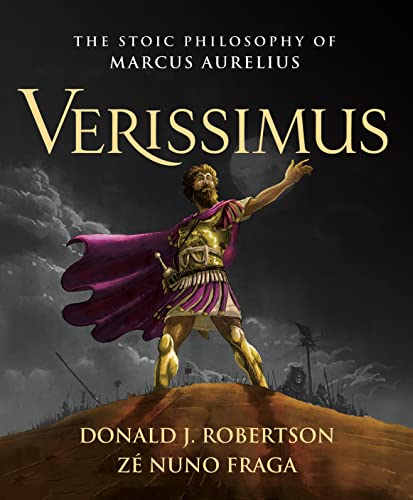
⚡️ What is Verissimus About?
I’ve read my fair share of philosophy books that feel like wading through cold porridge, but this isn’t one of them. Imagine being the most powerful man on the planet while your empire is literally rotting from a plague and your borders are being smashed by invading tribes. That’s the reality More summaries by Donald Robertson captures in Verissimus. Instead of just lecturing us on Stoic principles, Robertson uses the graphic novel medium to show us how Marcus Aurelius actually used these tools to keep his sanity while everything around him turned to chaos.
The central argument here is that philosophy isn’t a hobby for the elite; it’s a survival strategy for the overwhelmed. By following Marcus from his childhood—where the Emperor Hadrian nicknamed him “Verissimus” (The Most Truthful)—to his final days on the Danubian frontier, we get a front-row seat to the internal dialogue of the man who wrote the Meditations. It’s a masterclass in applying Psychology book summaries to the grittiest parts of human existence.
🚀 The Book in 3 Sentences
- Stoicism is a practical technology for maintaining character and composure under extreme external pressure, not just a set of abstract ideas.
- Marcus Aurelius’s life was a constant battle between his desire for quiet study and his duty to lead an empire through its most catastrophic era.
- True power lies in the “Dichotomy of Control”—recognizing that while you can’t stop a plague or a war, you have total authority over your own response to them.
🎨 Impressions
Honestly, I was skeptical about a “Stoic graphic novel.” I thought it might be a bit gimmicky. But I was wrong. Seeing Marcus’s facial expressions during his sessions with his tutor Rusticus makes the philosophy feel three-dimensional. There’s a moment early on where you see him struggling with his temper, and it hit me: this guy wasn’t born a saint. He was a frustrated, sickly man who used logic to build a cage for his own impulses. That’s far more inspiring than a dry textbook.
The artwork by Zé Nuno Fraga is grittier than I expected. It doesn’t shy away from the brutality of Roman life—the blood in the arenas, the lesions of the plague, and the mud of the Germanic trenches. This visual weight forces you to realize that when Marcus wrote “the view from above,” he wasn’t sitting in a comfortable armchair; he was trying to find perspective while looking at a battlefield. If there’s one thing that frustrated me, it’s that some of the deeper logical nuances of Stoic physics get glossed over, but for a narrative-driven book, that’s a fair trade.
📖 Who Should Read Verissimus?
If you’ve tried reading the Meditations and found it too repetitive or cryptic, this is your gateway drug. It provides the historical context that makes those entries make sense. It’s also perfect for anyone dealing with high-stress leadership or chronic illness, as Marcus’s own physical frailty is a major theme. However, if you’re looking for a deep, academic breakdown of Stoic logic without the “distraction” of a story, you might find the comic format a bit too fast-paced.
☘️ How This Book Changed My Thinking
Before reading this, I viewed Stoicism as a way to “grit your teeth” through bad times. After seeing the narrative arc of Marcus’s life, I realized it’s more about “cognitive distancing”—seeing your problems as if they are happening to someone else so you can judge them objectively.
- I stopped viewing my daily frustrations as obstacles and started seeing them as “weight training” for my character.
- I began using the “View from Above” technique during stressful meetings to remind myself how small the moment actually is in the grand timeline.
- I realized that vulnerability and strength aren’t opposites; Marcus’s strength came from admitting his own weaknesses to himself in his journals.
✍️ 3 Quotes That Stuck With Me
- “Life is warfare, and a sojourn in a foreign land.” — This reframes every struggle not as a mistake, but as a standard part of the mission.
- “The best revenge is not to be like your enemy.” — I keep this in mind whenever I’m tempted to snap back at someone on social media.
- “Everything we hear is an opinion, not a fact. Everything we see is a perspective, not the truth.” — A vital reminder in an era of echo chambers.
📒 Summary + Notes
The book isn’t just a biography; it’s a psychological reconstruction. Robertson shows how Marcus Aurelius was groomed for power but remained fundamentally grounded through the influence of his teachers. We see the transition from a boy who loved wrestling and hunting to a man who had to wrestle with the burden of absolute power. The narrative moves chronologically, but the real movement is internal—Marcus constantly refining his ability to separate his “ruling faculty” from the chaos of the Roman court.
By the time we reach the plague and the wars, the book has established the Stoic toolkit Marcus is using. He isn’t just “being brave”; he is using specific mental exercises like Premeditatio Malorum (the premeditation of evils) to ensure nothing catches him off guard. The author wants you to believe that character is the only thing that cannot be taken from you, and by the end of the story, as Marcus faces his own death, that belief feels earned rather than just stated.
🧠 Core Ideas Explained Simply
Marcus didn’t just “think positive”; he used a systematic way of looking at the world that Robertson makes incredibly accessible.
The Dichotomy of Control
This is the bedrock of the whole book. Imagine you’re an archer. You can choose your bow, fletch your arrows, and practice your aim—that’s in your control. But once the arrow leaves the string? The wind, a sudden movement by the target, or a snapped string are out of your hands. Stoicism teaches you to derive your self-worth from the aim, not whether the arrow hits the bullseye. For Marcus, this meant doing his duty as Emperor perfectly while accepting that the empire might still fall.
Cognitive Distancing
How do you stop a panic attack in 165 AD? Marcus practiced “stripping things bare.” When he looked at a purple imperial robe, he reminded himself it was just sheep’s wool dyed with the blood of a shellfish. When he looked at fine food, it was just a dead bird or fish. By describing things in purely objective, physical terms, he removed the emotional “value judgment” that causes us so much anxiety.
I: The Dead Emperor
The story opens where most stories end: with a body. We see the death of Antoninus Pius, Marcus’s adoptive father and the man he respected most in the world. It creates immediate tension because Marcus doesn’t want the throne. He is a philosopher by nature, but he accepts the crown because his Stoic training tells him that “duty is the highest good.” It’s a powerful lesson in doing what is necessary rather than what is pleasant.
II: The Most Truthful Child
Did you know Hadrian nicknamed a young Marcus “Verissimus” because he couldn’t tell a lie? This chapter goes back in time to show a young boy being noticed by the Emperor for his strange, serious nature. We see the roots of his integrity here. He wasn’t some prodigy of war; he was just a kid who was obsessed with being honest in a court full of flatterers. It makes you wonder: how many of us lose that “truthfulness” as we get older?
III: The Stoic Master
What happens when a future emperor meets a man who owns nothing but his integrity? This is where Marcus meets Junius Rusticus, the man who would give him a copy of Epictetus’s lectures. This chapter is the “training montage” of the book. We see Marcus learning to catch his own anger before it explodes and learning that the mind is a “citadel” that no one can enter without your permission. It’s the most intellectually dense part of the novel, showing that Stoicism is a rigorous practice, not just a set of quotes.
IV: The Empress Faustina
Ever felt like the world was judging your family based on rumors? This section deals with the relationship between Marcus and his wife, Faustina. History hasn’t always been kind to her, but Robertson paints a more nuanced picture. He shows Marcus applying Stoic “kindness” to his own home life. Even when there were rumors of infidelity or political tension, Marcus chose to treat her with affection and respect, proving that philosophy must work at the dinner table, not just in the senate.
V: The Legionary Legate
A surprising claim this chapter makes is that a philosopher can be a competent military leader without losing his soul. We meet Avidius Cassius, the “hard man” of the Roman military who serves as a dark mirror to Marcus. Cassius believes in cruelty and raw power; Marcus believes in justice and discipline. The chapter sets up a major theme: can you be a “good man” while commanding legions that kill? Marcus’s answer is a hesitant but firm “yes,” provided you never enjoy the violence.
VI: The Parthian War
War breaks out in the East, and Marcus has to manage it from Rome while his co-emperor Lucius Verus takes the field. This chapter highlights the “Dichotomy of Control” perfectly. Marcus can’t be everywhere at once. He has to trust others, manage logistics, and stay calm while the first reports of defeat roll in. It shows the administrative side of being an emperor—the part that’s mostly paperwork and bad news—and how philosophy keeps you from burning out.
VII: The Temple of Apollo
Is it possible to stay rational when the gods themselves seem to be against you? Marcus visits the Oracle, but he remains skeptical of superstition. This chapter explores the Stoic view of “providence” versus “atoms.” Whether the universe is a planned city or a chaotic soup of particles, Marcus concludes it doesn’t change your duty to be a good person right now. It’s a great example of Stoic pragmatism: don’t wait for a sign from heaven to do the right thing.
VIII: The Antonine Plague
The imagery in this chapter is haunting—piles of bodies in the streets of Rome as a devastating plague returns with the legions from the East. This is where Marcus’s training is truly tested. He loses friends, family, and millions of his subjects. Instead of fleeing to a villa, he stays in the city, sells off imperial treasures to fund the recovery, and uses his own life as an example of calm. It’s the ultimate “practice what you preach” moment.
IX: The Marcomannic Invasion
The “barbarians” cross the Danube, and the empire faces its greatest threat in centuries. Marcus, now an old man in failing health, has to lead the army himself. The chapter illustrates the “View from Above”—Marcus looks down at the tiny, scurrying armies from the perspective of a mountain and realizes the fleeting nature of all human glory. This doesn’t make him lazy; it makes him fearless, because he knows how little he has to lose.
X: The War of Many Nations
Midway through the brutal winter campaigns, we see Marcus actually writing the Meditations by his campfire. This isn’t just a literary device; Robertson shows how the writing was a form of self-therapy. He was literally talking himself through the misery of the cold, the betrayal of allies, and the proximity of death. It’s a reminder that we should all have a “journal for our own use” to keep our heads straight.
XI: The Egyptian Uprising
What do you do when your most trusted general, Avidius Cassius, declares himself Emperor and betrays you? This chapter shows Marcus’s response to civil war. Instead of calling for blood, he asks the Senate to be merciful. He doesn’t want to kill fellow Romans; he wants to restore order. His reaction to the news of Cassius’s death—he was disappointed he didn’t get to forgive him in person—is one of the most powerful examples of Stoic “cosmopolitanism” in the book.
XII: The Sarmatian War
The story concludes on the frozen frontier. Marcus is dying, but he isn’t afraid. He treats death as just another natural process, like a grape ripening or a leaf falling. The final pages show him passing the torch to his son, Commodus, with a mix of hope and Stoic resignation. He has done his duty, and now it’s time to step aside. It’s a quiet, dignified end that reinforces everything the book has been building toward.
⚖️ A Critical Perspective
While Verissimus is a brilliant introduction to Stoicism, the graphic novel format occasionally forces the philosophy into “soundbites.” If you’re a serious student of the Meditations, you might find the complex logical chains of Stoic reasoning a bit simplified for the sake of the plot. Additionally, the book is very sympathetic to Marcus, perhaps glossing over some of the valid criticisms of his choice to let his son Commodus succeed him, which ultimately led to disaster for Rome. It’s more of a philosophical hagiography than a critical historical biography, but as a teaching tool, it’s still top-tier.
🔄 How It Compares
Compared to Robertson’s other bestseller, How to Think Like a Roman Emperor, this book is far more immersive and less “instructional.” While the former feels like a therapy session mixed with history, Verissimus feels like a movie. It’s better for visual learners and those who want to see Stoicism in action rather than having it explained through modern CBT exercises.
🔑 Key Takeaways
Here are the core lessons Marcus’s life offers for our own modern chaos:
- Your character is your only true possession; everything else—wealth, health, reputation—is “indifferent” and can be taken at any time.
- Obstacles are actually the raw material for virtue; the fire that is strong enough consumes whatever you throw into it and uses it to grow.
- The “View from Above” is the ultimate cure for anxiety; reminding yourself of the scale of the universe makes your “emergency” look like a tiny dot.
- Kindness is an invincible weapon, provided it is genuine and not a mask for manipulation.
💬 Frequently Asked Questions
Is Verissimus a true story?
Yes, it is based on the surviving Roman histories (like the Historia Augusta and Cassius Dio) and Marcus Aurelius’s own writings. While some dialogue is dramatized for the narrative, Donald Robertson is a world-renowned Stoic expert who ensured the historical and philosophical accuracy of the events depicted.
What does the word ‘Verissimus’ mean?
‘Verissimus’ is Latin for “The Most Truthful.” It was a nickname given to young Marcus Aurelius by the Emperor Hadrian. It reflects Marcus’s lifelong commitment to honesty and integrity, which became the cornerstone of his Stoic practice and his reputation as a ruler.
How is this different from the Meditations?
Is this book suitable for beginners in Stoicism?
Absolutely. It is arguably the best starting point for a beginner because it humanizes the philosophy. Instead of dry definitions, you see the “Dichotomy of Control” and “Cognitive Distancing” being used in real-time high-stakes situations, making the concepts much easier to remember and apply.
Does the book cover the death of Marcus Aurelius?
The final chapter depicts Marcus’s death during the Marcomannic Wars in 180 AD. It focuses on how he used his Stoic training to face his end with tranquility, treating death as a natural transition. It serves as the final proof of his philosophical commitment.
Conclusion
After finishing Verissimus, the one thing I couldn’t stop thinking about is how little the human condition has actually changed in 2,000 years. We still have plagues, we still have political betrayals, and we still have to figure out how to be “good” when the world is being “bad.” Marcus Aurelius wasn’t a superhero; he was a guy with chronic stomach pain and a stressful job who simply refused to let his mind be conquered by his circumstances.
If you take nothing else from this summary, remember the “Inner Citadel.” Your thoughts are the only place where you are truly free. No matter what is happening at work or in the news, you have the power to withdraw into yourself, find clarity, and come back out with a sense of purpose. That’s the legacy of Verissimus, and it’s a lesson that feels more relevant in 2025 than ever before. If you’re interested in more practical applications of these ideas, dig into our other Psychology book summaries.
More From Donald Robertson →
Discover more from AI Book Summary
Subscribe to get the latest posts sent to your email.