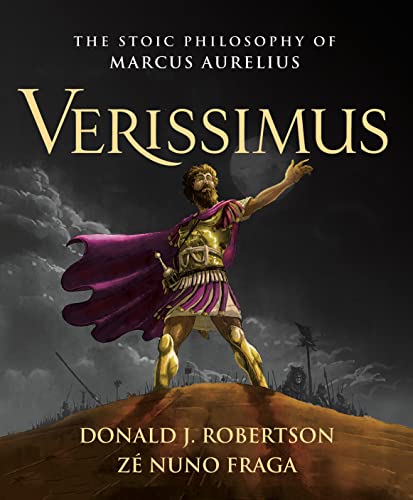
⚡️ What is Verissimus about?
Verissimus by Donald Robertson is a comprehensive exploration of Marcus Aurelius’s Stoic philosophy and its relevance in modern life. The book delves into the life of one of Rome’s greatest emperors and most influential Stoic philosophers, examining how his personal struggles and philosophical insights continue to offer valuable lessons today. Robertson masterfully connects ancient wisdom to contemporary challenges, providing readers with practical tools to develop resilience, emotional intelligence, and a meaningful personal philosophy. Through Verissimus, readers discover how to navigate life’s adversities with the same clarity and wisdom that characterized Marcus Aurelius’s rule and personal writings.
🚀 The Book in 3 Sentences
- Verissimus illuminates the life and philosophy of Marcus Aurelius, showing how his Stoic principles can guide us through modern challenges with resilience and wisdom.
- The book bridges ancient philosophy with contemporary psychology, demonstrating the timeless relevance of Stoic practices for developing emotional control and personal virtue.
- Robertson provides practical exercises and insights that enable readers to implement Marcus Aurelius’s teachings in their daily lives, fostering greater tranquility and purpose.
🎨 Impressions
Verissimus strikes an impressive balance between scholarly depth and practical accessibility. Robertson’s writing engages both newcomers to Stoicism and seasoned practitioners, offering fresh insights into Marcus Aurelius’s philosophy. The book excels in translating ancient wisdom into actionable modern applications, making Stoicism feel relevant rather than merely historical. What stands out most is how Robertson humanizes Marcus Aurelius, presenting him not as a distant historical figure but as a relatable individual who faced similar struggles to our own.
📖 Who Should Read Verissimus?
Verissimus is essential reading for anyone interested in philosophy, personal development, or leadership. It particularly resonates with those facing adversity or seeking greater emotional resilience in their personal and professional lives. The book is equally valuable for students of ancient history, psychology enthusiasts, and individuals looking to develop a coherent personal philosophy that can guide decision-making in an increasingly complex world.
☘️ How the Book Changed Me
How my life / behaviour / thoughts / ideas have changed as a result of reading the book.
- My approach to obstacles has transformed through the Verissimus principles, viewing challenges as opportunities for growth rather than mere frustrations.
- I’ve developed a more consistent meditation practice, focusing on the Stoic exercises Robertson recommends for building self-awareness and emotional resilience.
- The book has fundamentally shifted my perspective on what I can control versus what I cannot, reducing anxiety about external circumstances while strengthening my commitment to personal virtue.
✍️ My Top 3 Quotes
- “The Verissimus or ‘most truthful’ approach to life begins with acknowledging our limitations while striving to reach our highest potential.”
- “Marcus Aurelius taught that the greatest empire one can conquer is oneself—this is the central challenge and opportunity of Stoic practice.”
- “In the face of life’s uncertainties, the Stoic philosophy found in Verissimus offers not escape, but rather a way to engage more fully with reality as it is.”
📒 Summary + Notes
Verissimus takes readers on an intellectual and practical journey through the philosophy of Marcus Aurelius. Donald Robertson masterfully combines historical context with philosophical analysis and practical application, creating a comprehensive guide to Stoic wisdom. The book explores how Marcus Aurelius developed his philosophical outlook, the core tenets of his thought, and how these principles can be implemented in contemporary life. Throughout Verissimus, Robertson demonstrates the remarkable relevance of ancient Stoic philosophy for addressing modern challenges, from dealing with adversity and cultivating emotional resilience to making ethical decisions and finding meaning in daily life.
Chapter 1: The Life of Marcus Aurelius
This chapter provides a comprehensive biography of Marcus Aurelius, from his early education to his reign as Roman Emperor. Robertson details the key events that shaped Marcus’s character and philosophical development, including his adoption by Emperor Antoninus Pius and the Stoic tutors who influenced his thinking. The chapter highlights how Marcus faced numerous challenges—political crises, wars, plagues, and personal tragedies—that tested his philosophical commitments.
- Marcus Aurelius’s nickname “Verissimus” reflected his reputation for truthfulness and integrity, qualities that defined both his personal character and his imperial reign.
- Despite being born into privilege, Marcus chose the path of philosophy over indulgence, dedicating himself to self-improvement and the service of others.
- The chapter reveals how Marcus’s personal struggles, including illness and family losses, deepened his philosophical insights rather than embittered him.
Chapter 2: The Historical Context of Stoicism
Robertson situates Marcus Aurelius within the broader tradition of Stoic philosophy, tracing its development from its origins in ancient Greece to its flourishing in Rome. The chapter explains the core principles of Stoicism and how they evolved over time, culminating in the distinctive Roman Stoicism that Marcus practiced. Robertson provides valuable context about the political and cultural environment that shaped Stoic thought during the Roman Empire.
- Stoicism emerged as a practical philosophy focused on ethics and personal resilience rather than abstract theoretical speculation.
- The chapter explains how Stoicism adapted from its Greek origins to the Roman context, emphasizing duty, self-control, and civic responsibility.
- Robertson highlights the continuity and innovation in Marcus’s approach to Stoicism, showing how he both preserved and transformed the tradition he inherited.
Chapter 3: The Meditations and Their Significance
This chapter delves into Marcus Aurelius’s personal writings, known as the Meditations, which represent one of the most important documents of ancient Stoic philosophy. Robertson analyzes the structure, themes, and purpose of these private notes, revealing how they served as a tool for Marcus’s own philosophical practice rather than intended for publication. The chapter explores the enduring significance of the Meditations as a window into the mind of a philosopher-king.
- The Meditations were Marcus’s personal philosophical journal, written during military campaigns and moments of reflection, never intended for public consumption.
- Robertson identifies recurring themes in the Meditations, including the acceptance of mortality, the importance of virtue, and the discipline of perception.
- The chapter explains how the private nature of these writings offers an unvarnished view of Marcus’s inner life and philosophical struggles.
Chapter 4: The Dichotomy of Control
Robertson explores one of the most fundamental Stoic principles emphasized by Marcus Aurelius: the distinction between what is and is not within our control. This chapter details how Marcus applied this dichotomy to navigate the challenges of his reign and personal life. Robertson provides practical guidance on how modern readers can implement this powerful framework to reduce anxiety and focus their energy where it can make a difference.
- The dichotomy of control teaches that our power lies solely in our judgments, desires, and actions—not in external events or other people’s behavior.
- Marcus consistently applied this principle to political crises, personal setbacks, and even physical illness, maintaining equanimity in the face of adversity.
- Robertson provides modern examples of how this ancient practice can transform our approach to everything from career challenges to personal relationships.
Chapter 5: Stoic Virtue Ethics
This chapter examines the heart of Marcus Aurelius’s philosophy: the cultivation of virtue as the highest good and the foundation of a meaningful life. Robertson explains the four cardinal virtues—wisdom, courage, justice, and temperance—as understood by Stoics and how Marcus interpreted and applied these concepts. The chapter connects ancient virtue ethics to contemporary moral philosophy and personal development.
- For Marcus and the Stoics, virtue was not just about abstract ideals but about practical excellence in daily living and decision-making.
- The chapter details how Marcus viewed justice as the most important social virtue, governing his approach to ruling and his relationships with others.
- Robertson demonstrates how cultivating these virtues requires consistent practice and self-reflection rather than mere intellectual understanding.
Chapter 6: The Discipline of Perception
Robertson explores Marcus Aurelius’s teachings on how to discipline our perceptions—the first step in Stoic practice. This chapter explains how Marcus believed that our interpretation of events, rather than the events themselves, determines our emotional responses. Robertson provides practical techniques for examining and correcting our impressions, drawing on both ancient Stoic practices and modern cognitive psychology.
- Marcus taught that nothing is inherently good or bad except our judgments about things, making the examination of our impressions crucial for emotional well-being.
- The chapter details specific techniques from the Meditations for questioning automatic judgments and reframing challenging situations.
- Robertson shows how these ancient practices align with modern cognitive-behavioral therapy, demonstrating their enduring psychological validity.
Chapter 7: The Discipline of Desire
This chapter focuses on the second aspect of Stoic practice as outlined by Marcus Aurelius: managing our desires and aversions. Robertson explains how Marcus advocated for aligning our desires with nature and reason, seeking fulfillment in virtue rather than external achievements or possessions. The chapter addresses how this discipline can help overcome unhealthy attachments and find contentment in the present moment.
- Marcus taught that true freedom comes from wanting what we already have rather than constantly seeking what we lack.
- The chapter explores the Stoic practice of negative visualization—contemplating loss—as a way to appreciate what we have and reduce attachment.
- Robertson connects these ancient practices to modern approaches to overcoming materialism and finding sustainable happiness.
Chapter 8: The Discipline of Action
Robertson examines the third discipline of Stoicism as practiced by Marcus Aurelius: the discipline of action. This chapter explores how Marcus approached decision-making, ethical behavior, and the performance of duties with mindfulness and integrity. Robertson provides guidance on how to apply these principles to modern contexts, from professional responsibilities to personal relationships.
- For Marcus, every action should be performed with awareness of its purpose and alignment with one’s values and duties.
- The chapter explains the Stoic concept of “kathekon” or appropriate action—doing what is fitting in each situation while maintaining ethical integrity.
- Robertson provides practical frameworks for making decisions that balance personal values with social responsibilities, following Marcus’s example.
Chapter 9: Stoic Practices for Daily Life
This chapter translates Marcus Aurelius’s philosophical insights into concrete practices for modern readers. Robertson details specific exercises and routines that can be incorporated into daily life to develop Stoic resilience and wisdom. From morning meditations to evening reflections, these practical techniques help readers embody Stoic principles rather than merely intellectualize them.
- Marcus began his day with a reminder of the challenges he would face and the virtues he would need to meet them.
- The chapter describes the practice of “the view from above”—visualizing the cosmos and one’s place within it to gain perspective on personal concerns.
- Robertson adapts ancient Stoic journaling practices for contemporary readers, providing specific prompts and approaches inspired by Marcus’s Meditations.
Chapter 10: Stoicism and Relationships
Robertson explores how Marcus Aurelius applied Stoic principles to his relationships with family, friends, colleagues, and subjects. This chapter examines the Stoic understanding of social duty, forgiveness, and the cultivation of healthy connections. Robertson shows how Marcus’s approach to relationships balances personal boundaries with genuine concern for others, offering valuable insights for modern interpersonal dynamics.
- Marcus viewed relationships as opportunities to practice justice and kindness, treating others with respect regardless of their behavior toward him.
- The chapter addresses the Stoic approach to anger and resentment, emphasizing the importance of understanding others’ perspectives and responding with wisdom rather than emotion.
- Robertson demonstrates how Stoic principles can improve modern relationships by fostering empathy, reducing conflicts, and deepening connections.
Chapter 11: Facing Adversity with Stoic Resilience
This chapter focuses on how Marcus Aurelius’s Stoic philosophy equipped him to face adversity with remarkable resilience. Robertson analyzes how Marcus responded to wars, plagues, political challenges, and personal losses, drawing lessons that can help modern readers navigate their own difficulties. The chapter provides practical strategies for developing emotional fortitude and maintaining perspective in challenging times.
- Marcus viewed obstacles as opportunities to practice virtue and strengthen character, embodying the Stoic principle that “the impediment to action advances action.”
- The chapter explores how Marcus used his philosophical journaling to process difficult emotions and maintain clarity during crises.
- Robertson connects these ancient practices to modern resilience psychology, showing their scientific validity in helping people overcome trauma and adversity.
Chapter 12: Stoicism and Leadership
Robertson examines Marcus Aurelius’s approach to leadership through the lens of Stoic philosophy. This chapter analyzes how Marcus governed the Roman Empire with wisdom, integrity, and service to others despite the immense pressures of his position. Robertson extracts valuable leadership principles that can be applied in various contexts, from corporate management to community organizing.
- Marcus viewed leadership as a form of service rather than privilege, consistently prioritizing the welfare of his subjects over personal gain or glory.
- The chapter details how Marcus maintained humility and openness to criticism despite his supreme authority, embodying the Stoic value of intellectual humility.
- Robertson provides modern examples of how Stoic leadership principles can transform organizational culture and improve decision-making at all levels.
Chapter 13: Stoicism and Mortality
This chapter explores Marcus Aurelius’s Stoic reflections on mortality and how these perspectives can help modern readers develop a healthier relationship with death. Robertson examines how Marcus contemplated his own mortality not with fear but as a motivation to live virtuously in the present. The chapter addresses practical ways to apply these insights to live more fully and purposefully.
- Marcus frequently reminded himself that life is brief and death inevitable, using this awareness to prioritize what truly matters and let go of trivial concerns.
- The chapter explains the Stoic practice of “memento mori”—remembering death—as a tool for appreciating life and maintaining perspective on daily challenges.
- Robertson connects these ancient practices to modern approaches to death anxiety and existential therapy, demonstrating their psychological benefits.
Chapter 14: Verissimus in the Modern World
In this final chapter, Robertson synthesizes how the philosophy of Marcus Aurelius—embodied in his nickname “Verissimus”—can be applied to contemporary challenges. The chapter addresses modern objections to Stoicism and adapts ancient practices to address current issues from social media anxiety to political polarization. Robertson offers a vision for how Stoic principles can contribute to individual flourishing and collective well-being in the 21st century.
- The Verissimus approach—prioritizing truthfulness and integrity—offers a powerful antidote to modern challenges like misinformation and superficiality.
- The chapter demonstrates how Stoic practices can help navigate digital age challenges, from social media comparison to information overload.
- Robertson argues that Marcus’s emphasis on community service and social responsibility provides a model for addressing collective challenges like climate change and social inequality.
Key Takeaways
The philosophy of Verissimus offers profound wisdom for navigating modern life with resilience and integrity. Donald Robertson’s masterful exposition of Marcus Aurelius’s Stoic principles provides both intellectual understanding and practical guidance. The key lessons from this book center on developing self-awareness, cultivating virtue, and finding meaning through service to others. By applying these ancient insights, readers can transform their approach to challenges, relationships, and personal growth.
- The dichotomy of control—focusing on what is within our power rather than what is not—is fundamental to Stoic practice and emotional resilience.
- Virtue ethics provides a framework for making decisions and living authentically, emphasizing wisdom, courage, justice, and temperance.
- Regular philosophical practice—including reflection, journaling, and mindfulness—is essential for internalizing Stoic principles and applying them consistently.
- Relationships offer the perfect context for practicing Stoic virtues, from patience and understanding to forgiveness and service.
- Viewing adversity as an opportunity for growth rather than merely a source of suffering transforms our relationship with life’s challenges.
Conclusion
Verissimus by Donald Robertson stands as a masterful guide to the philosophy of Marcus Aurelius and its practical application in modern life. Through this comprehensive exploration, readers discover not just historical knowledge but a living philosophy that can transform their approach to challenges, relationships, and personal growth. Robertson’s ability to bridge ancient wisdom with contemporary concerns makes Verissimus an invaluable resource for anyone seeking greater resilience, authenticity, and purpose. By embracing the principles embodied by Marcus Aurelius—truthfulness, service, and philosophical reflection—we can develop the inner strength and wisdom needed to navigate our own complex world with grace and integrity.
More From Donald Robertson →
Discover more from AI Book Summary
Subscribe to get the latest posts sent to your email.