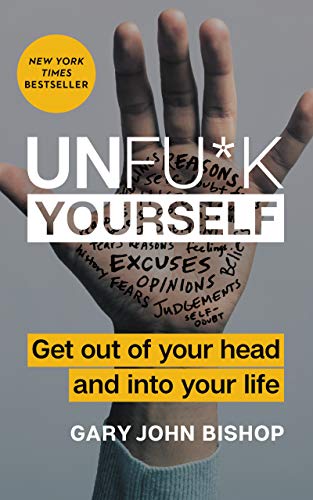
⚡️ What is Unfu*k Yourself about?
Unfu*k Yourself is a no-nonsense self-help book by Gary John Bishop that cuts through the typical motivational fluff and gets straight to the point. The book is designed to help readers break free from the self-imposed limitations that hold them back in life. Bishop uses his signature blunt, in-your-face style to challenge readers to take responsibility for their lives and stop making excuses. The core message revolves around seven powerful personal assertions that can transform your mindset and, consequently, your life. Throughout the book, Bishop emphasizes that real change comes from action, not just positive thinking. He provides practical strategies to overcome negative self-talk, face uncertainty, and develop the resilience needed to create lasting change. Unfu*k Yourself is a wake-up call for anyone tired of being stuck in their own head and ready to start living life on their own terms.
🚀 The Book in 3 Sentences
- Unfu*k Yourself teaches that you are the only one standing in your way, and it’s time to get out of your own head and into your life.
- Through seven powerful personal assertions, Gary John Bishop provides a blueprint for breaking free from self-imposed limitations and taking decisive action.
- The book’s core message is that real change comes not from positive thinking alone, but from embracing your personal agency and committing to action despite your feelings and circumstances.
🎨 Impressions
Unfu*k Yourself stands out from other self-help books due to its refreshingly direct and profanity-laced approach. Bishop doesn’t sugarcoat his advice or offer empty platitudes; instead, he delivers hard truths that cut through the noise of typical motivational content. What impressed me most about the book is its emphasis on personal responsibility and action over mere positive thinking. The seven assertions serve as powerful anchors that readers can return to when facing life’s challenges. Unlike many self-help books that focus solely on mindset, Unfu*k Yourself bridges the gap between thought and action, making it a practical guide for real change. The book’s tone may be off-putting to some, but for those ready for tough love, it delivers a powerful punch that can genuinely help transform your approach to life’s obstacles.
📖 Who Should Read Unfu*k Yourself?
Unfu*k Yourself is ideal for anyone who feels stuck in their own head and frustrated with their lack of progress in life. If you’re tired of traditional self-help approaches that haven’t delivered results, Bishop’s direct, no-nonsense style might be exactly what you need. This book particularly resonates with people who respond well to tough love and blunt honesty rather than gentle encouragement. If you find yourself making excuses, procrastinating on important goals, or letting negative self-talk dictate your actions, Unfu*k Yourself offers practical strategies to break these patterns. It’s also valuable for those facing significant life changes or challenges who need to develop resilience and embrace uncertainty. Ultimately, this book is for anyone ready to stop being their own worst enemy and start taking decisive action toward creating the life they want.
☘️ How the Book Changed Me
Reading Unfu*k Yourself has fundamentally shifted how I approach challenges and setbacks in my life. The most significant change has been in how I handle the negative self-talk that used to paralyze me into inaction. Bishop’s seven assertions have become mantras that I return to whenever I feel stuck or doubtful.
- I’ve developed a stronger awareness of when I’m making excuses and have become better at catching myself in the act.
- The assertion “I am wired to win” has helped me reframe failures as learning opportunities rather than evidence of my inadequacy.
- I’ve become more willing to take action even when I don’t feel ready or confident, recognizing that waiting for the perfect moment is a form of self-sabotage.
- The book has helped me embrace uncertainty rather than fear it, allowing me to take calculated risks that I would have avoided before.
- I’ve noticed a significant improvement in my productivity and sense of personal agency, as I now take full responsibility for my outcomes rather than blaming external circumstances.
✍️ My Top 3 Quotes
- “Personal development doesn’t happen by accident. It’s the result of a conscious decision to make yourself into the person you want to be.”
- “You are not your thoughts. You are the awareness of your thoughts.”
- “The only thing that’s keeping you from getting what you want is the story you keep telling yourself about why you can’t have it.”
📒 Summary + Notes
Unfu*k Yourself by Gary John Bishop is a powerful guide to breaking free from the mental barriers that hold us back. The book combines blunt, no-nonsense advice with practical strategies to help readers transform their mindset and take decisive action. Bishop’s approach is refreshingly direct, cutting through the typical self-help fluff to deliver hard truths that can catalyze real change. The core of the book revolves around seven personal assertions that serve as anchors for developing a new way of being in the world. These assertions are designed to override the default patterns of thinking and behaving that keep us stuck. Throughout the book, Bishop emphasizes that lasting change comes not from positive thinking alone, but from embracing personal agency and committing to action regardless of how we feel. The following chapter summaries break down these key concepts and provide insights for applying them in your own life.
Chapter 1: I Am Willing
The first chapter introduces the foundational assertion “I am willing,” which sets the stage for all the transformations that follow. Bishop explains that willingness is the starting point for any meaningful change in life. He argues that most people fail not because they lack ability, but because they’re not truly willing to do what it takes to succeed. The chapter challenges readers to examine whether they’re genuinely willing to face discomfort, put in the work, and make the necessary sacrifices to achieve their goals. Bishop emphasizes that willingness isn’t about feeling motivated; it’s about making a conscious choice to act regardless of how you feel. This chapter provides a reality check, forcing readers to confront the gap between their stated desires and their actual commitment to achieving them.
- The power of making a conscious choice to be willing, even when you don’t feel like it.
- How to distinguish between wanting something and being willing to do what it takes to get it.
- Bishop shares examples of people who transformed their lives once they became truly willing to change.
- I realized that many of my own goals had remained unachieved because I wasn’t fully willing to endure the discomfort required to reach them.
- The chapter teaches that willingness is the foundation upon which all other personal development is built.
Chapter 2: I Am Wired to Win
In this chapter, Bishop introduces the assertion “I am wired to win,” challenging the common narrative that we’re fundamentally flawed or destined to fail. He explains that humans are actually designed for success and adaptation, having evolved to overcome challenges. The key is to tap into this innate wiring rather than working against it. Bishop discusses how our brains are pattern-seeking machines that can work for or against us, depending on how we direct them. He provides strategies for reprogramming your mind to expect success rather than failure. The chapter emphasizes that winning isn’t about never failing, but about persisting and learning from setbacks. Bishop argues that adopting this mindset is crucial for building the resilience needed to achieve your goals.
- Understanding that your brain is naturally wired to look for patterns and solutions to problems.
- How to shift your default expectations from failure to success by consciously directing your attention.
- Bishop explains the concept of “neuroplasticity” and how you can rewire your brain for success.
- I realized how often I had been operating from a mindset of expecting failure, which became a self-fulfilling prophecy.
- The chapter provides practical exercises for reinforcing the belief that you are wired to win, such as creating evidence logs of past successes.
Chapter 3: I Got This
Chapter 3 focuses on the assertion “I got this,” which addresses the importance of self-reliance and personal responsibility. Bishop argues that too often we look to others to save us or solve our problems, when the power to change our circumstances lies within us. This chapter is about stepping up and taking ownership of your life without waiting for permission or validation from others. Bishop discusses how this mindset shift is essential for building confidence and competence. He explains that saying “I got this” doesn’t mean you have to handle everything alone, but rather that you trust in your ability to figure things out and find solutions. The chapter includes strategies for developing self-reliance and overcoming the tendency to play the victim. Bishop emphasizes that taking responsibility for your life is empowering, not burdensome.
- The difference between genuine self-reliance and the illusion of independence that keeps us isolated.
- How to move from asking “Why me?” to declaring “I got this” when faced with challenges.
- Bishop shares stories of people who transformed their lives when they stopped waiting to be rescued.
- I recognized how often I had been giving away my power by expecting others to fix my problems or validate my choices.
- The chapter includes practical steps for building self-reliance, such as starting with small commitments and gradually taking on bigger challenges.
Chapter 4: I Embrace the Uncertainty
In this chapter, Bishop introduces the assertion “I embrace the uncertainty,” addressing one of the biggest sources of anxiety and inaction in modern life. He explains that our desire for certainty and control often keeps us stuck, preventing us from taking risks and pursuing meaningful goals. Bishop argues that uncertainty is not something to be feared but embraced as the very space where growth and opportunity exist. The chapter provides strategies for developing comfort with ambiguity and learning to take action despite not having all the answers. Bishop discusses how our attempts to control the future often create more anxiety than the uncertainty itself. He emphasizes that embracing uncertainty doesn’t mean being reckless, but rather developing the confidence to navigate the unknown. This chapter is particularly valuable for those who tend to overthink and procrastinate due to fear of making mistakes.
- Understanding the paradox that seeking certainty actually creates more anxiety than embracing uncertainty.
- How to distinguish between helpful planning and unhelpful attempts to control the uncontrollable.
- Bishop explains the concept of “uncertainty tolerance” and how to build it through gradual exposure.
- I realized how much of my hesitation and procrastination was rooted in a fear of uncertainty rather than actual risks.
- The chapter provides practical exercises for becoming more comfortable with uncertainty, such as intentionally making decisions with incomplete information.
Chapter 5: I Am Not My Thoughts; I Am What I Do
Chapter 5 presents the assertion “I am not my thoughts; I am what I do,” which addresses the common misconception that our thoughts define us. Bishop explains that while we can’t control all the thoughts that arise in our minds, we can choose which ones to act on. This chapter is about bridging the gap between intention and action, recognizing that who we are is ultimately determined by what we do, not what we think or feel. Bishop discusses how many people get stuck waiting to feel motivated or confident before taking action, when in reality, action often precedes the desired feelings. He provides strategies for observing thoughts without being controlled by them and for taking action even when you don’t feel like it. The chapter emphasizes that your identity is built through your behaviors, not your intentions or aspirations. This is particularly valuable for those who struggle with overthinking or procrastination.
- The distinction between having thoughts and being controlled by them, and how to create mental space between the two.
- How to shift from “I’ll do it when I feel like it” to “I do it regardless of how I feel.”
- Bishop explains the concept of “cognitive defusion” and how it can help you detach from unhelpful thoughts.
- I recognized how often I had let temporary feelings or negative thoughts dictate my actions, or lack thereof.
- The chapter includes practical techniques for taking action despite unhelpful thoughts, such as the “5-second rule” and committing to tiny first steps.
Chapter 6: I Am Relentless
In this chapter, Bishop introduces the assertion “I am relentless,” focusing on the importance of persistence and consistency in achieving your goals. He explains that success rarely comes from grand gestures or occasional bursts of effort, but from the daily practice of showing up and doing the work. Bishop argues that relentlessness isn’t about being aggressive or never resting, but about maintaining your commitment to your goals even when faced with obstacles, setbacks, or distractions. The chapter provides strategies for developing discipline and consistency, including how to create systems that support your objectives. Bishop discusses how the modern culture of instant gratification undermines our ability to persist through challenges. He emphasizes that true relentlessness means staying committed to the process rather than being fixated on immediate results. This chapter is particularly valuable for those who struggle with consistency or who give up easily when faced with difficulties.
- Understanding the difference between being relentless and being rigid, and how to maintain flexibility while staying committed.
- How to build relentlessness through small, consistent actions rather than relying on motivation.
- Bishop shares examples of successful people who achieved their goals through persistence rather than innate talent or luck.
- I realized how often I had abandoned pursuits when results didn’t come quickly enough, rather than trusting the process.
- The chapter provides practical strategies for developing relentlessness, such as habit stacking and creating accountability systems.
Chapter 7: I Expect Nothing and Accept Everything
The final chapter presents the assertion “I expect nothing and accept everything,” which addresses our relationship with outcomes and circumstances. Bishop explains that while goals and aspirations are important, becoming overly attached to specific outcomes can lead to suffering and disappointment. This chapter is about finding peace with whatever life brings while still striving for your objectives. Bishop discusses how expectations often set us up for disappointment by creating a gap between how we want things to be and how they actually are. He provides strategies for letting go of rigid expectations while still maintaining direction and purpose. The chapter emphasizes that accepting everything doesn’t mean resigning yourself to unfavorable circumstances, but rather facing reality as it is and working with it rather than against it. This final assertion brings together the previous six, creating a comprehensive approach to engaging with life more effectively.
- The difference between healthy aspirations and rigid expectations that create suffering.
- How to practice acceptance without becoming passive or resigned to undesirable circumstances.
- Bishop explains the concept of “non-attachment” and how it can lead to greater peace and effectiveness.
- I recognized how many of my frustrations came from clinging to expectations about how things “should” be.
- The chapter provides practical exercises for developing acceptance, such as mindfulness techniques and reframing challenges as opportunities.
Key Takeaways
Unfu*k Yourself delivers several powerful insights that can transform your approach to life’s challenges. The most important lesson is that you are the primary obstacle to your own success, and overcoming this requires conscious effort and commitment to the seven assertions. Bishop emphasizes that real change comes from action, not just positive thinking or feeling motivated. The book teaches that your identity is shaped by your actions, not your thoughts or intentions, highlighting the importance of consistent behavior regardless of how you feel. Another key insight is that embracing uncertainty rather than fearing it creates space for growth and opportunity. Finally, the book stresses the importance of personal responsibility and self-reliance, recognizing that waiting for others to save you or circumstances to be perfect is a form of self-sabotage.
- The power of personal assertions as tools for overriding default patterns of thinking and behaving.
- How willingness is the foundation for all meaningful change and must precede any other efforts.
- The importance of reframing your relationship with uncertainty as a space of possibility rather than threat.
- Recognizing that your actions, not your thoughts or feelings, ultimately define who you are and what you achieve.
- Understanding that relentlessness—consistent, persistent action—is more valuable than occasional bursts of effort.
Conclusion
Unfu*k Yourself is a powerful wake-up call for anyone ready to stop being their own worst enemy and start creating the life they want. Gary John Bishop’s direct, no-nonsense approach cuts through the typical self-help fluff to deliver hard truths that can catalyze real change. The seven assertions presented in the book serve as practical tools for transforming your mindset and, consequently, your actions. What makes this book stand out is its emphasis on personal responsibility and action over mere positive thinking. Bishop recognizes that lasting change comes not from waiting for motivation or perfect circumstances, but from committing to action regardless of how you feel. For anyone tired of being stuck in their own head and ready to start living life on their own terms, Unfu*k Yourself provides the blueprint for breaking free from self-imposed limitations. By applying the principles in this book, you can develop the resilience, self-reliance, and relentlessness needed to create meaningful change in your life.
More From Gary John Bishop →
Discover more from AI Book Summary
Subscribe to get the latest posts sent to your email.