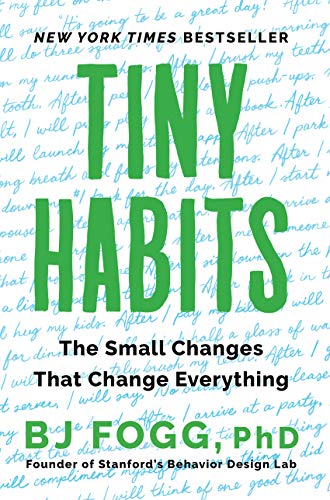
⚡️ What is Tiny Habits about?
Tiny Habits by BJ Fogg is a revolutionary guide to understanding and reshaping human behavior. At its core, the book dismantles the common misconception that lasting change requires immense motivation or willpower. Instead, Fogg introduces his groundbreaking Fogg Behavior Model (B=MAP), which posits that behavior happens when Motivation, Ability, and a Prompt converge simultaneously. The book’s central thesis is that the easiest and most reliable way to create change is by focusing on making behaviors ridiculously easy to do, thus boosting your ability. It’s a practical, science-backed manual for designing good habits and stopping bad ones by starting small. Fogg, a Stanford behavior scientist, provides a step-by-step method that is both simple and profound, empowering readers to become the architects of their own lives by mastering the art of Tiny Habits strategies and techniques.
🚀 The Book in 3 Sentences
- Behavior is a design problem, not a character flaw, and it occurs when Motivation, Ability, and a Prompt happen at the same moment.
- To build lasting habits, you must start with actions so small they feel effortless, thereby wiring them into your brain without needing motivation.
- The secret to making habits stick is creating a positive emotion immediately after performing the new behavior, a process Fogg calls celebration.
🎨 Impressions
Reading Tiny Habits felt like a lightbulb moment for me. Unlike other self-help books that feel abstract or preachy, this one is a hands-on, practical toolkit. I was immediately impressed by its simplicity and the author’s emphasis on self-compassion. Fogg’s approach feels less like a rigid system and more like a flexible, human-centered framework. The core idea that you don’t need to overhaul your life overnight is incredibly liberating. I found the B=MAP model to be an elegant and instantly applicable lens through which to view my own actions and inactions. This isn’t just a book to read; it’s a manual to implement, and its effectiveness lies in its actionable, non-judgmental Tiny Habits techniques.
📖 Who Should Read Tiny Habits?
This book is for anyone who has ever tried to build a new habit and failed. If you’re tired of feeling guilty about not going to the gym or not meditating daily, Tiny Habits is your antidote. It’s perfect for people feeling overwhelmed by big goals, productivity enthusiasts looking for sustainable systems, and parents or managers who want to understand how to effectively encourage positive behavior in others. Whether you want to improve your health, advance your career, or simply be more mindful, the book’s strategies are universally applicable. It’s especially valuable for those who appreciate a practical, science-based approach over motivational fluff.
☘️ How the Book Changed Me
Reading this book fundamentally shifted my relationship with personal development. I moved from a cycle of “all-or-nothing” ambition and subsequent failure to a mindset of consistent, incremental progress. The biggest change was learning to stop blaming myself for my lack of motivation and instead start designing my environment and behaviors for success. I now see habit formation as a skill to be practiced, not a test of my worth.
- I successfully started a flossing habit by committing to just one tooth. It felt so silly and easy that I never missed a day, and now I floss my whole mouth without thinking.
- I incorporated a two-minute tidying routine into my evenings, which has dramatically reduced my weekend cleaning burden and created a more peaceful living space.
- I’ve become much more compassionate with myself when I miss a habit, understanding it’s a design flaw, not a personal failing, which has made me more resilient overall.
✍️ My Top 3 Quotes
- “Emotions create habits. Not repetition. Not frequency. Not fairy dust. Emotions.”
- “If you want a habit to grow big, you need to start small and simple. Once the habit wires in, you can grow it naturally.”
- “In behavior design, we match ourselves with new habits we can do even when we are at our most hurried, unmotivated, and beautifully imperfect.”
📒 Summary + Notes
\p>The Tiny Habits method is built on a solid foundation of behavioral science, primarily the Fogg Behavior Model. This model is the key that unlocks everything else in the book. Understanding that Behavior (B) happens when Motivation (M), Ability (A), and a Prompt (P) align at the same moment is a game-changer. The book systematically breaks down each of these elements, showing you how to analyze and influence them. Instead of trying to force motivation—which is unreliable and fluctuates—Fogg teaches you to focus on what you can control: making the behavior easier (increasing Ability) and setting up clear triggers (Prompts). This foundation is crucial because it reframes habit formation from a battle of wills to a process of intelligent design.Chapter 1: Elements of Behavior
This chapter introduces the cornerstone of the entire book: the Fogg Behavior Model, or B=MAP. Fogg explains that three elements must converge at the same moment for any behavior to occur: Motivation, Ability, and Prompt. He uses simple diagrams and clear examples to illustrate how these variables interact. Motivation is your desire to do the behavior, Ability is your capacity to do it (how easy it is), and Prompt is your cue to do it. The chapter emphasizes that no behavior happens without a prompt, and if motivation is low, the behavior must be very easy to happen. This model provides a universal framework for diagnosing why you do or don’t do certain things, shifting the focus from blame to analysis.
- Motivation (M) is complex and fluctuates, making it an unreliable foundation for habits.
- Ability (A) is the most practical lever to pull; making a behavior easier is the key to consistency.
- Prompt (P) is the trigger; without it, no behavior occurs, regardless of motivation or ability.
- The Behavior Line concept shows that for a behavior to happen, your motivation/ability combination must be above this line when a prompt appears.
Chapter 2: See the Behavior
In this chapter, Fogg teaches you how to become a behavior detective, both for yourself and others. He introduces the concept of “Fogg Behavior Grid,” which helps categorize behaviors based on duration and whether they are new or familiar. The grid includes Dot Behaviors (one-time actions), Span Behaviors (for a period), and Path Behaviors (long-term). More importantly, he introduces the “Pearl Habits” concept—behaviors that seem negative or neutral at first but have a positive long-term effect. The chapter’s main goal is to help you break down vague aspirations into specific, observable actions. By learning to “see” behavior clearly, you can more effectively apply the B=MAP model to design the changes you want.
- The Fogg Behavior Grid helps classify behaviors into types (e.g., BlueSpots, GreenPaths) for better analysis.
- Pearl Habits are actions that may feel inconvenient now but yield valuable future benefits, like flossing.
- Breaking down aspirations into concrete, specific behaviors is the crucial first step before trying to implement them.
- Learning to identify the Prompts, Motivations, and Abilities in your daily life is a skill that allows for better habit design.
Chapter 3: See the System
Fogg zooms out from individual behaviors to the systems that create them. He explains that our lives are composed of various “domains” (like work, home, social) and that behaviors exist within these contexts. The key insight is that you can’t change a behavior in isolation; you must understand the system it’s part of. He introduces the idea of “Behavior Design” as a practice of tweaking these systems. The chapter encourages you to map out the habits already in place, both good and bad, to see how they connect. By understanding the existing system of prompts and routines in your life, you can find better places to insert new Tiny Habits and identify which old habits you might want to disrupt.
- Your habits are interconnected within larger systems; changing one can have ripple effects.
- Identifying your existing “habit clouds” or routines helps you find natural anchors for new behaviors.
- Behavior Design is about making small adjustments to your current systems, not a complete overhaul.
- Understanding the context (domain) of a behavior is critical for successfully designing a change.
Chapter 4: Find Your Golden Behaviors
This chapter is about selection—choosing the right behaviors to focus on to achieve your aspirations. Fogg introduces a powerful technique called “Focus Mapping.” You brainstorm a long list of possible behaviors that could help you reach your aspiration. Then, you plot each one on a matrix based on two criteria: how impactful the behavior is (High/Low Impact) and how easy it is for you to do (Easy/Hard). The behaviors that land in the “High Impact” and “Easy” quadrant are your “Golden Behaviors.” These are the habits you should focus on first because they offer the biggest return for the least effort. This process prevents you from wasting energy on hard, low-impact actions and sets you up for quick, motivating wins.
- Focus Mapping is a practical exercise to identify the most effective and easiest habits to adopt.
- Golden Behaviors are the sweet spot: high impact and high ability for you personally.
- This method moves you from vague aspirations to concrete, prioritized actions.
- Focusing on Golden Behaviors first builds momentum and confidence, making harder habits easier to tackle later.
Chapter 5: Go Tiny to Grow Big
This is the heart of the Tiny Habits method. Fogg explains in detail why starting small is not just a good idea, but a necessity for creating automatic habits. He defines a “Tiny Habit” as a version of a new behavior you can do in less than 30 seconds. The chapter is filled with techniques for scaling behaviors down until they feel ridiculously easy. For example, instead of “read more,” a tiny habit is “read one sentence.” Instead of “do yoga,” it’s “get out my yoga mat.” The goal is to make the new behavior so easy to do that you don’t need motivation. Fogg emphasizes that once the habit is wired into your brain through repetition, you can naturally let it grow bigger. This approach removes the friction and failure that so often derails habit formation.
- A Tiny Habit is a scaled-down version of a new behavior that takes less than 30 seconds.
- Starting tiny bypasses the need for motivation, which is unreliable.
- The “Tiny” formula is: “After I [Anchor Moment], I will [Tiny Behavior].”
- Once a tiny habit is automatic, you can gradually increase its scope without losing momentum.
Chapter 6: Anchor Prompt
Here, Fogg focuses on the “P” in B=MAP: the Prompt. He argues that the best type of prompt for a new habit is an existing routine in your life, which he calls an “Anchor Moment.” An Anchor is a reliable, consistent action you already do without thinking, like brushing your teeth, flushing the toilet, or sitting down on the couch. The chapter provides a long list of potential anchors to help you find the right one for your new Tiny Habit. The key is to match the new habit to an anchor that has the right frequency and context. For example, a habit you want to do once in the morning should be anchored to a morning routine. This technique ensures you have a built-in trigger for your new behavior, making it much more likely you’ll remember to do it.
- An Anchor Moment is an existing routine that serves as a reliable trigger for your new Tiny Habit.
- The best anchors are solidly established in your life and happen with the same frequency as your desired new habit.
- The recipe format, “After I [Anchor], I will [Tiny Behavior],” creates a clear prompt for your brain.
- Choosing the right anchor is as important as choosing the right tiny behavior for success.
Chapter 7: Shine
This chapter reveals what Fogg calls the “secret sauce” of the Tiny Habits method: Celebration. He states unequivocally that emotions create habits. When you perform a new behavior and immediately feel successful, your brain releases dopamine, which rewires your neural pathways to repeat that action. This “Shine” moment is crucial. Fogg encourages you to create a feeling of success right after you do your Tiny Habit. This can be anything that generates a genuine positive emotion: saying “Good for me!”, doing a fist pump, a little dance, or smiling. The chapter emphasizes that this celebration must be immediate and authentic. It’s not about being silly; it’s about using the science of emotion to make habits stick faster and more effectively than repetition alone.
- Shine is the act of creating an immediate feeling of success after performing your Tiny Habit.
- Emotions, specifically the feeling of success, are what wire habits into the brain.
- Your celebration must be immediate and authentic to be effective; it can be physical, verbal, or internal.
- Celebrating helps you rewire your self-perception, seeing yourself as someone who succeeds, which builds confidence for future changes.
Chapter 8: Troubleshooting
Even with a perfect design, sometimes habits don’t stick. This chapter is a practical guide to figuring out why. Fogg provides a simple diagnostic flowchart. If a habit isn’t happening, he tells you to ask three questions in order. First, “Is there a prompt?” If not, fix the anchor. Second, “Is the behavior easy enough?” If not, make it smaller or simpler. Third, “Does the person want to do the behavior?” (i.e., is there enough motivation?). He advises focusing on Ability first because it’s the most reliable lever. The chapter is filled with practical tips for each problem, like how to find better anchors or how to simplify a behavior even further. This troubleshooting guide empowers you to be a habit scientist, experimenting and adjusting until you find what works.
- When a habit fails, diagnose it in order: Prompt, Ability, then Motivation.
- The most common reason for failure is that the behavior isn’t easy enough; the solution is to make it tinier.
- If there’s no prompt, the solution is to find a better, more reliable Anchor Moment.
- This chapter turns failure into data, removing judgment and encouraging a mindset of iteration and refinement.
Chapter 9: The Tiny Habits Method
This chapter serves as a concise summary and reinforcement of the entire process. Fogg lays out the seven steps of the Tiny Habits Method clearly: 1. Clarify your aspiration. 2. Explore behavior options. 3. Match yourself with specific behaviors (using Focus Mapping). 4. Start tiny. 5. Find a good prompt (Anchor). 6. Celebrate success (Shine). 7. Troubleshoot and iterate. He presents this as a complete, repeatable system for designing any change you want in your life. This chapter ties everything together, from the high-level aspirations to the moment-by-moment practice of celebrating. It solidifies the idea that behavior design is a skill you can learn and apply to any area, from health and relationships to work and creativity.
- The Tiny Habits Method is a 7-step process from aspiration to implementation.
- This chapter provides a clear, actionable roadmap you can refer back to anytime you want to create a new habit.
- The process is cyclical; you continuously troubleshoot and refine your habits for better results.
- Mastery of this method gives you a sense of control and agency over your own behavior.
Chapter 10: The Magic of Tiny Habits
In the final chapter, Fogg explores the transformative, cascading effects that Tiny Habits can have on your entire life. He shares inspiring stories from people who have used the method to achieve remarkable changes, not because they aimed for them directly, but because small, consistent wins created a positive upward spiral. A tiny habit of tidying one thing can lead to a clean house. A tiny habit of doing one push-up can lead to a full fitness routine. The “magic” is that these small changes build self-efficacy and reshape your identity. You start to see yourself as a person who is healthy, organized, or mindful. This identity shift, Fogg argues, is the ultimate goal and the most powerful outcome of mastering the Tiny Habits method, leading to profound and lasting personal transformation.
- Tiny Habits create a ripple effect, where one small success makes it easier to succeed in other areas.
- The method builds self-efficacy—your belief in your ability to succeed—which is a powerful psychological force.
- As your habits change, your identity begins to change; you start to become the type of person you want to be.
- The ultimate magic is not just in the habits you form, but in the person you become in the process.
Key Takeaways
The Tiny Habits method is a masterclass in sustainable personal growth. The most profound lesson is that behavior is a system to be designed, not a character flaw to be fixed. By focusing on making actions easy rather than relying on fickle motivation, you can build consistency. The B=MAP model is an invaluable tool for understanding why we do what we do. Perhaps the most critical and unique insight is the central role of emotion; celebrating immediately after a new behavior is what truly cements it in our brains. Finally, the book teaches that small, incremental wins are not just a path to big goals; they are transformative in their own right, building confidence and reshaping our identity from the inside out.
- Focus on Ability (making it easy) before Motivation when designing new habits.
- Immediately celebrate your successes to create the positive emotions that wire habits into your brain.
- Anchor new Tiny Habits to existing, reliable routines to ensure you have a consistent prompt.
- View habit formation as a process of experimentation and refinement, not a pass/fail test.
Conclusion
Tiny Habits is more than just a book; it’s a practical operating system for personal change. BJ Fogg has distilled decades of research into a simple, elegant, and profoundly effective method that anyone can use. By shifting the focus from willpower to design, from massive leaps to tiny steps, and from guilt to celebration, he offers a compassionate and reliable path to becoming the person you want to be. If you’ve ever felt stuck in your attempts to grow, this book provides the tools and the mindset to break free. I highly recommend diving into the full book to experience the hands-on exercises and discover the magic of designing your own Tiny Habits. It’s an investment that will pay dividends for the rest of your life.
More From BJ Fogg →
Discover more from AI Book Summary
Subscribe to get the latest posts sent to your email.