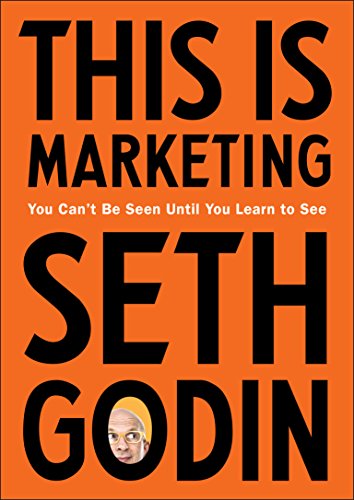
⚡️ What is This is Marketing about?
This is Marketing by Seth Godin represents a fundamental shift in how we think about marketing in the modern world. Godin argues that effective marketing isn’t about shouting louder or interrupting more people—it’s about creating change in people by understanding their needs, desires, and worldviews. The book redefines marketing as the act of making change happen by connecting with the smallest viable market that truly cares about what you’re offering. Through this approach, marketers can build authentic relationships that transcend traditional advertising tactics.
🚀 The Book in 3 Sentences
- This is Marketing requires focusing on serving the needs of a specific group of people rather than trying to appeal to everyone.
- Effective marketing creates change by understanding and empathizing with your audience’s worldview and aspirations.
- Marketing is not about advertising or manipulation but about telling authentic stories that resonate and spread.
🎨 Impressions
Reading This is Marketing felt like having a marketing paradigm shift. Godin’s approach is both revolutionary and refreshingly human-centric, moving away from the noisy, interruption-based marketing I had grown accustomed to. The book provides a powerful framework for creating genuine connections with audiences while maintaining ethical integrity in a world saturated with manipulative advertising tactics.
📖 Who Should Read This is Marketing?
This is Marketing is essential reading for entrepreneurs, marketers, business owners, and anyone responsible for spreading ideas or creating change. It’s particularly valuable for those tired of traditional advertising approaches and seeking more authentic ways to connect with their audience. Whether you’re launching a new product, growing a business, or trying to make a difference in your community, Godin’s principles offer invaluable guidance.
☘️ How the Book Changed Me
How my life / behaviour / thoughts / ideas have changed as a result of reading the book.
- I’ve shifted from trying to reach everyone to focusing on serving a specific, engaged audience that genuinely values what I offer.
- I now approach marketing as an act of empathy rather than persuasion, seeking to understand before seeking to be understood.
- I’ve begun creating more authentic stories that resonate with my audience’s worldview rather than simply highlighting product features.
- I’ve stopped viewing marketing as a series of tactics and instead see it as a consistent approach to creating change in the world.
- I’ve learned to prioritize creating value for my smallest viable market over chasing mass appeal at all costs.
✍️ My Top 3 Quotes
- “Marketing is our quest to make change on behalf of those we serve, and we do it by understanding the irrational forces that drive each of us.“
- “People don’t buy what you do; they buy why you do it. And what you do simply proves what you believe.“
- “The marketing that works is marketing that embraces the human condition, that seeks to make change based on our deepest dreams and desires.“
📒 Summary + Notes
This is Marketing presents a revolutionary approach to connecting with audiences and creating change in the world. Godin challenges traditional marketing paradigms and offers a more human-centered framework that focuses on serving specific groups rather than interrupting the masses. The book explores how understanding human psychology, status dynamics, and storytelling can transform how we spread ideas and build movements.
Chapter 1: Marketing is Attunement
Godin begins by redefining marketing as attunement—the process of understanding and aligning with your audience’s needs, desires, and worldview. He argues that effective marketing requires empathy and the ability to see the world through your customers’ eyes. This chapter establishes the foundation for the entire book: marketing isn’t about manipulation but about genuine connection.
- Marketing begins with listening, not talking
- Understanding your audience’s worldview is more important than perfecting your message
- Empathy is the most critical skill for modern marketers
- Successful marketers create products and services that match existing desires
- Attunement requires seeing the world as your customers see it
Chapter 2: Marketing is Not About Advertising
Godin makes a clear distinction between marketing and advertising, arguing that they are fundamentally different activities. While advertising is about interrupting people to get attention, marketing is about creating products, services, and ideas that people naturally want to engage with. This chapter challenges readers to think beyond traditional promotional tactics.
- Advertising is a tactic; marketing is a strategy
- Great marketing makes advertising unnecessary
- The goal is to create something worth talking about
- Marketing happens before, during, and after the product is created
- Attention is scarce; earn it through value, not noise
Chapter 3: The Smallest Viable Market
One of Godin’s most powerful concepts is the smallest viable market—the smallest group that can sustain your business or idea. Rather than trying to appeal to everyone, Godin argues for focusing intensely on serving a specific, engaged audience that truly values what you offer. This approach leads to more authentic connections and sustainable success.
- Trying to please everyone guarantees you’ll delight no one
- Identify the smallest group that can sustain your mission
- Focus on creating raves, not satisfaction
- Specificity leads to authenticity and trust
- Smaller markets often have less competition and more passionate customers
Chapter 4: Seeking Dominance
Godin explores the concept of market dominance not in terms of being the biggest, but in terms of being the most respected and sought-after in a specific niche. He explains how focusing on a small market allows you to create products and services so exceptional that they become the obvious choice for that audience.
- Dominance in a small market is more valuable than mediocrity in a large one
- Create offerings that are the “only” choice, not merely the “best” choice
- Being dominant means setting the standard in your field
- Focus on creating extraordinary value rather than ordinary products
- Market leadership comes from solving specific problems exceptionally well
Chapter 5: Semiotics, Symbols, and Stories
This chapter delves into how humans interpret meaning through symbols and stories. Godin explains that marketing is fundamentally about creating and communicating meaning through the symbolic elements of our products and services. Understanding semiotics—the study of signs and symbols—is crucial for effective marketing.
- Every element of your offering communicates meaning
- Humans are wired to understand and remember stories
- Symbols trigger emotional responses and associations
- Consistency in symbolism builds brand recognition
- The meaning of symbols is determined by the audience, not the marketer
Chapter 6: People Like Us Do Things Like This
Godin explores the fundamental human drive for belonging and identity through the phrase “People like us do things like this.” He explains how much of human behavior is driven by the desire to fit in with groups we admire or belong to. This insight is crucial for marketers seeking to understand why people make certain choices.
- Identity is a powerful motivator for human behavior
- People buy products that reinforce their desired identity
- Marketing successful positioning often involves group affiliation
- Tribal identity drives many consumer decisions
- Understanding group dynamics helps marketers create resonant messages
Chapter 7: Status, Dominance, and Affiliation
This chapter examines how status dynamics influence human behavior and purchasing decisions. Godin explains that people constantly seek to improve their status within groups, and marketers can tap into this fundamental drive by understanding how their offerings affect perceived status and social standing.
- Status is a primary driver of human behavior
- Products and services often serve as status signals
- Different audiences value different forms of status
- Marketing can appeal to either affiliation or distinction
- Understanding status dynamics helps create more resonant offerings
Chapter 8: Tension and Change
Godin discusses how effective marketing creates tension that leads to change. He explains that marketing works when it highlights a gap between the current situation and a desired future state, motivating people to take action. Understanding this dynamic is essential for creating marketing that drives results.
- Change happens when people feel tension between their current and desired state
- Effective marketing identifies and amplifies relevant tensions
- People resist change until the pain of status quo exceeds the fear of the new
- Tension must be resolved through action, not just awareness
- Marketers help people navigate the journey from current to desired state
Chapter 9: Creating a Movement
Godin explores how marketers can move beyond selling products to creating movements. He explains that movements are built on shared values, stories, and connections rather than transactions. This chapter provides a framework for building communities around ideas that matter.
- Movements are built on shared narratives, not just products
- Successful movements focus on connecting people to each other
- Movements require a cause that matters more than the products
- Leaders of movements focus on empowering others, not just themselves
- Movements grow when members become evangelists
Chapter 10: The Funnel is Dead
In this chapter, Godin challenges the traditional marketing funnel model, arguing that it no longer reflects how people make decisions in today’s connected world. He presents a more dynamic, relationship-based approach that better captures how modern consumers engage with brands and make purchasing decisions.
- The linear funnel model doesn’t reflect modern customer journeys
- Today’s marketing is more about relationships than transactions
- Customer journeys are loops, not straight lines
- Focus on creating value at every touchpoint, not just conversion
- Trust and connection matter more than awareness and persuasion
Chapter 11: Price is a Story
Godin examines how pricing is not just a number but a story that communicates value, positioning, and identity. He explains that price is one of the most powerful marketing tools available, as it instantly communicates information about quality, exclusivity, and the intended audience.
- Price tells a story about your product and your values
- Pricing decisions should align with your marketing strategy
- Different prices attract different customers and create different expectations
- Price is a signal that communicates quality and positioning
- The right price is not necessarily the lowest price
Chapter 12: Engineers and Marketers
This chapter explores the often-tense relationship between engineers and marketers, and how these two essential perspectives can work together more effectively. Godin argues that both perspectives are necessary for creating successful products and services, but they need to understand and respect each other’s contributions.
- Engineers focus on solutions; marketers focus on problems
- Both perspectives are essential for success
- Conflict arises from different worldviews and priorities
- Effective collaboration requires mutual respect and communication
- The best products emerge when engineering and marketing work together from the beginning
Chapter 13: Beyond the Funnel
Building on his critique of the funnel model, Godin presents alternative frameworks for understanding customer journeys in today’s interconnected world. He emphasizes the importance of seeing marketing as an ongoing relationship rather than a linear process with a clear endpoint.
- Customer relationships should be viewed as ongoing, not transactional
- Every interaction is part of the marketing, not just the “conversion”
- Focus on creating value that extends beyond the purchase
- Customer loyalty is built through consistent positive experiences
- The journey doesn’t end at purchase; that’s often just the beginning
Chapter 14: The ABCs of Marketing
Godin presents his fundamental principles of marketing in this chapter, covering the essential concepts that underpin effective marketing strategies. He distills complex marketing ideas into accessible guidelines that can be applied across various contexts and industries.
- Authenticity trumps persuasion
- Build trust before asking for the sale
- Create value that exceeds the price
- Focus on specific audiences, not general ones
- Marketing is a long-term commitment, not a short-term tactic
Chapter 15: Marketing in the Moment
This chapter explores how marketers can effectively engage with audiences in real-time contexts. Godin discusses the importance of being present and responsive to current events, cultural moments, and customer needs as they arise, rather than relying solely on pre-planned campaigns.
- Relevance is key to capturing attention in a noisy world
- Being present in the moment builds authenticity
- Real-time engagement creates stronger connections
- Flexibility and responsiveness are crucial marketing skills
- Cultural awareness helps marketers connect more deeply
Chapter 16: Marketing to the Edges
Godin advocates for focusing marketing efforts on the edges of markets—the innovative, early adopters who are most open to new ideas and products. He explains that these edge customers are often the key to spreading innovation and creating lasting change in the market.
- Edge customers are more open to innovation and new ideas
- Early adopters can become powerful evangelists
- Marketing to the edges often leads to mainstream acceptance
- Innovation typically happens at the fringes before moving to the center
- Edge customers provide valuable feedback and insights
Chapter 17: The Funnel of the Future
In this chapter, Godin presents his vision for a new marketing model that better reflects how people make decisions today. He outlines a more dynamic, customer-centric approach that focuses on building relationships and creating value throughout the customer journey.
- The future of marketing is relational, not transactional
- Customer journeys are complex and non-linear
- Trust is the most valuable asset in modern marketing
- Marketers must create value at every stage of the relationship
- The best marketing doesn’t feel like marketing at all
Chapter 18: Marketing to the People We Seek to Serve
Godin returns to the theme of service-oriented marketing, emphasizing that the most effective marketing focuses on genuinely serving the needs of a specific audience. He explains how this service mindset transforms not just marketing messages but entire organizations and their approaches to creating value.
- Marketing begins with a genuine desire to serve
- Service creates trust and builds lasting relationships
- Understanding customer needs is more important than pushing features
- The best marketing solves real problems for real people
- Service-oriented marketing creates sustainable competitive advantage
Chapter 19: Marketing to Our Team
This chapter explores the importance of internal marketing—communicating the organization’s mission, values, and story to employees. Godin argues that effective marketing must begin within the organization, as team members who understand and believe in the mission become the most powerful advocates.
- Internal alignment precedes external effectiveness
- Employees are the most important marketing channel
- Shared values create consistent customer experiences
- Transparency builds trust both internally and externally
- When everyone understands the story, the story becomes stronger
Chapter 20: Marketing to Ourselves
Godin discusses the importance of self-marketing—how we present ourselves to the world and the stories we tell ourselves about who we are and what we do. He explains that our personal narrative affects not just our own success but how others perceive and interact with us.
- The stories we tell ourselves shape our reality
- Personal branding is an extension of authentic identity
- Consistency in self-presentation builds trust
- Our internal narrative affects our external success
- Authenticity in self-marketing attracts genuine connections
Chapter 21: Your Turn
In the final chapter, Godin challenges readers to apply the principles of This is Marketing to their own work and lives. He provides practical guidance for implementing the concepts discussed throughout the book and encourages readers to embrace marketing as a powerful force for positive change in the world.
- Start small and focus on serving a specific audience
- Commit to creating value before seeking return
- Embrace empathy as your primary marketing tool
- Be consistent in your marketing approach
- Remember that marketing is about making change happen
Key Takeaways
This is Marketing offers numerous valuable insights that can transform how we approach connecting with audiences and creating change. The book’s core principles challenge traditional marketing paradigms and provide a framework for more authentic, effective marketing strategies.
- Focus on serving a smallest viable market rather than trying to appeal to everyone
- Marketing is about creating change, not just making transactions
- Empathy and understanding are more powerful than persuasion and interruption
- Build relationships and trust rather than just awareness and conversions
- Price, positioning, and storytelling are interconnected elements of marketing strategy
Conclusion
This is Marketing fundamentally changed how I think about connecting with audiences and creating value in the world. Godin’s human-centered approach provides a powerful alternative to the noisy, interruption-based marketing that dominates our culture. By focusing on serving specific groups with empathy, authenticity, and genuine value, we can create marketing that not only drives business results but makes the world a better place. I highly recommend reading the full book to dive deeper into these transformative ideas and apply them to your own work and life.
More From Seth Godin →
Discover more from AI Book Summary
Subscribe to get the latest posts sent to your email.