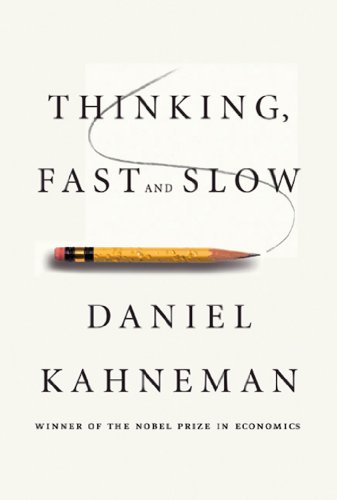
⚡️ What is Thinking, Fast and Slow about?
“Thinking, Fast and Slow” is a masterful exploration of the two systems that drive the way we think and make choices. Daniel Kahneman, a Nobel laureate in Economics, introduces us to System 1, which is fast, intuitive, and emotional, and System 2, which is slower, more deliberate, and more logical. The book’s central thesis is that while we like to believe our decisions are the product of careful reasoning (System 2), they are far more often influenced by the automatic, unconscious judgments of System 1. This leads to predictable errors in judgment, or cognitive biases, that affect everything from our personal lives to our professional decisions. Kahneman’s work provides a comprehensive tour of these biases, explaining why we make them and how, with a little effort, we can learn to recognize them and make better, more rational choices.
🚀 The Book in 3 Sentences
- Our minds operate using two distinct systems: a fast, intuitive System 1 and a slow, analytical System 2.
- System 1, while incredibly efficient, is prone to systematic cognitive biases that lead to errors in judgment and decision-making.
- By understanding the interplay between these two systems, we can learn to recognize our biases and engage our slower thinking to make more rational choices in Thinking, Fast and Slow.
🎨 Impressions
Reading “Thinking, Fast and Slow” was a humbling and eye-opening experience. It felt less like reading a book and more like having a user manual for my own brain. Kahneman’s writing is dense but accessible, filled with compelling examples and experiments that make complex psychological concepts feel tangible and personal. I was constantly struck by how often I could recognize my own irrational behaviors and flawed reasoning in the pages. The book is a landmark achievement that fundamentally changed how I perceive my own thought processes and the world around me. It’s a challenging read, but its insights are invaluable for anyone seeking true self-awareness and a deeper understanding of human nature.
📖 Who Should Read Thinking, Fast and Slow?
This book is essential reading for anyone who makes decisions, which is to say, everyone. Business leaders, investors, and managers will gain crucial insights into strategic and financial decision-making strategies. Students of psychology, economics, and philosophy will find it to be a foundational text. However, it’s equally valuable for individuals seeking personal growth, as it provides powerful techniques for improving self-awareness, overcoming biases, and making better life choices. If you’ve ever wondered why you make the decisions you do, this book holds the answers.
☘️ How the Book Changed Me
\p>Reading “Thinking, Fast and Slow” fundamentally altered my approach to thinking and problem-solving. I’ve become far more skeptical of my initial gut reactions and now actively pause to question my assumptions, especially on important matters. The book has made me a more deliberate decision-maker and a more critical thinker, constantly on the lookout for the cognitive biases that once ruled my unconscious mind.- I now consciously engage System 2 for significant financial and professional choices, actively questioning my first impressions.
- I’ve learned to spot the anchoring effect in negotiations and everyday purchases, saving myself from making poor value judgments.
- I am more forgiving of others’ mistakes, recognizing that many irrational behaviors are a product of our cognitive architecture, not malice.
✍️ My Top 3 Quotes
- “A reliable way to make people believe in falsehoods is frequent repetition, because familiarity is not easily distinguishable from truth.”
- “Intelligence is not only the ability to reason; it is also the ability to find relevant material in memory and to deploy attention when needed.”
- “The experiencing self is the one that answers the question: ‘Does it hurt now?’ The remembering self is the one that answers the question: ‘How was it, on the whole?’”
📒 Summary + Notes
“Thinking, Fast and Slow” by Daniel Kahneman is a profound journey into the machinery of the mind. The book is structured around the central metaphor of two characters, System 1 and System 2, representing the fast and slow modes of thought. System 1 operates automatically and quickly with little or no effort and no sense of voluntary control. System 2 allocates attention to the effortful mental activities that demand it, including complex computations. The core of the book is an exploration of the cognitive biases that arise from the intricate and often lazy interactions between these two systems. Understanding this dynamic is the key to improving our decision-making techniques and gaining a clearer picture of reality.
Part One: Two Systems
Chapter 1: The Characters of the Story
Kahneman introduces the two systems of thought. System 1 is our intuitive, automatic mode of thinking. It’s what we use to drive a car on an empty road or understand a simple sentence. System 2 is our deliberate, analytical mode, used for solving complex problems like 17 x 24. The key insight is that we often mistake the effortless operations of System 1 for conscious, reasoned thought, which leads to errors.
- System 1 is fast, automatic, and emotional.
- System 2 is slow, deliberate, and logical.
- We identify with System 2, but System 1 often runs the show.
- The two systems work together, but their interaction is a source of bias.
Chapter 2: Attention and Effort
This chapter explores the concept of cognitive effort. System 2 requires effort and attention, which are limited resources. When we are cognitively busy (e.g., distracted by a difficult task), our ability to monitor and control System 1 diminishes. This means we are more likely to make intuitive errors, succumb to temptations, or rely on stereotypes when our mental bandwidth is low. Pupillary dilation is even presented as a reliable indicator of cognitive effort.
- Self-control and deliberate thought draw from the same limited budget of attention.
- When you are cognitively busy, you are more likely to make selfish choices, use sexist language, and make superficial judgments.
- System 2 is inherently lazy and avoids effort whenever possible.
- “Ego depletion” occurs after a strenuous act of self-control, making subsequent effort more difficult.
Chapter 3: The Lazy Controller
Kahneman delves deeper into the laziness of System 2. It often endorses suggestions from System 2 with little or no scrutiny. This leads to what he calls “cognitive ease.” When we are in a state of cognitive ease, we are likely to be intuitive, creative, and happy, but also more prone to making mistakes. The “bat and ball” problem, where many people instinctively say 10 cents instead of 5 cents, perfectly illustrates System 2’s failure to check System 1’s answer.
- System 2 is the “lazy controller” that often accepts System 1’s suggestions without critical evaluation.
- Cognitive ease makes us feel good but also makes us more gullible and prone to errors.
- System 2 is mobilized only when a question arises that System 1 cannot answer automatically.
- Flow states are an exception where System 2 is highly engaged without feeling like effort.
Chapter 4: The Associative Machine
This chapter describes how System 1 works as an “associative machine,” creating a coherent network of ideas. It connects thoughts, memories, and emotions automatically. For example, seeing the word “EAT” makes you more likely to recognize the word “SOUP” shortly after. This associative power is efficient but also the source of many biases, as it creates priming effects, where exposure to one stimulus influences the response to a subsequent stimulus, without our awareness.
- System 1 builds a vast network of linked ideas in our mind.
- Priming can influence our actions and emotions in subtle ways (e.g., holding a warm mug makes you feel warmer towards others).
- Ideas that are activated in our mind will also activate other related ideas.
- The associative machine is the root of many of the heuristics and biases discussed later.
Chapter 5: Cognitive Ease
Kahneman explains that cognitive ease (or strain) affects our thinking. When we experience cognitive ease, we are more likely to be intuitive, casual, and trusting. This can be triggered by repeated exposure, clear display, a primed idea, or a good mood. Conversely, cognitive strain, caused by poor lighting, a difficult font, or a bad mood, makes us more vigilant, suspicious, and less likely to rely on our intuition. Marketers and politicians exploit this principle regularly.
- Familiarity breeds liking, a phenomenon known as the mere-exposure effect.
- Things that are easy to read and understand feel more true.
- A good mood puts System 2 on guard, while a bad mood activates it.
- Increased cognitive strain can lead to better analytical performance but reduces creativity.
Chapter 6: Norms, Surprises, and Causes
System 1 is excellent at understanding the normal and detecting violations of normality. It constantly builds a model of the world and expects events to conform to that model. When something surprising happens, System 1 automatically searches for a causal explanation. This tendency to see cause and effect everywhere, even in random data, is a primary source of biased thinking. We are storytellers who seek coherence, often at the expense of statistical reality.
- System 1 is a machine for jumping to conclusions based on limited evidence.
- We have a strong bias to believe and confirm, rather than to doubt.
- Surprise triggers a shift in attention and a search for an explanation.
- We are prone to seeing patterns and intentions where none exist (apophenia).
Chapter 7: A Machine for Jumping to Conclusions
This chapter reinforces that System 1 is designed to jump to conclusions. It does this by suppressing ambiguity and constructing coherent stories based on the information it has, no matter how little. This “WYSIATI” (What You See Is All There Is) principle means we fail to account for information we don’t have. System 1 confidently builds stories from the available evidence, and the lazy System 2 often endorses them without checking for missing data.
- WYSIATI: System 1 does not account for information it does not know.
- We can be confident in a story simply because it is coherent, not because it is complete or accurate.
- This leads to overconfidence in our judgments and predictions.
- The amount of information we have does not necessarily correlate with the quality of our judgment.
Chapter 8: How Judgments Happen
Kahneman explains that many of our judgments are not the result of deliberate calculation but are instead heuristic-driven. A heuristic is a simple procedure for finding adequate, though often imperfect, answers to difficult questions. System 1 is a master of heuristics. It often answers a difficult question by substituting it with an easier one. For example, instead of asking “How happy are you with your life?” we might answer the easier question, “How am I feeling right now?”
- Heuristics are mental shortcuts that allow for quick judgments.
- The intensity of an emotion is a heuristic for the importance of an event.
- We often substitute difficult questions with easier ones without realizing it.
- Targets, questions, and heuristics are the three components of a judgment.
Chapter 9: Answering an Easier Question
This chapter focuses on “heuristics and biases” through the lens of substitution. When faced with a difficult target question (e.g., “How much would you contribute to save dolphins?”), System 1 may substitute it with a heuristic question (e.g., “How much emotion do I feel when I think about dying dolphins?”). This process, called attribute substitution, is automatic and often leads to systematic errors in our judgments, as our answers reflect the easier question, not the one we were originally asked.
- Attribute substitution is a key mechanism behind many biases.
- The heuristic question is often an affective (emotional) one.
- We are often unaware of the substitution, believing we have answered the original question.
- Politicians use this technique by appealing to emotions rather than policy details.
Chapter 10: The Law of Small Numbers
The “law of small numbers” is a bias where we believe that a small sample can accurately represent the larger population. We have a tendency to see patterns in random data from small samples, leading to hasty generalizations. For example, seeing one successful startup from a particular college might make us think that college is a hotbed for entrepreneurship, ignoring the many failures. This is a failure of statistical thinking, as we underappreciate the role of chance and randomness in small datasets.
- We are not intuitively good at grasping the concept of sampling variability.
- We expect small samples to resemble the parent population much more than they do.
- This bias leads to overconfidence in research based on small sample sizes.
- The “hot hand” in basketball is a classic example of seeing patterns in random streaks.
Part Two: Heuristics and Biases
Chapter 11: Anchors
The anchoring effect is a powerful cognitive bias where we rely too heavily on the first piece of information offered (the “anchor”) when making decisions. Even irrelevant numbers can influence our estimates. For example, if you’re asked whether Gandhi was more than 114 years old when he died, your subsequent estimate of his age at death will be higher than if you were asked if he was less than 35. This effect works because the anchor primes our mind with related information.
- Anchors can be numbers or suggestions that heavily influence subsequent judgments.
- The effect is not diminished by paying a monetary incentive for accuracy.
- Negotiations are a classic arena where anchoring is used to set the terms of the deal.
- System 2 can sometimes adjust away from an anchor, but it often fails to do so sufficiently.
Chapter 12: The Science of Availability
The availability heuristic is our tendency to judge the frequency or probability of an event by how easily examples come to mind. Events that are vivid, recent, or emotionally charged are more “available” and thus seem more likely. This is why we overestimate the danger of plane crashes after seeing news coverage but underestimate the danger of car accidents, which are more common but less dramatic. Media coverage plays a huge role in shaping our availability bias.
- We assess the likelihood of risks by the ease with which we can recall similar instances.
- Availability is influenced by personal experience, media coverage, and vividness.
- This heuristic can lead to skewed perceptions of reality and poor risk assessment.
- “Availability cascades” can cause collective public fears or panics based on little evidence.
Chapter 13: Availability, Emotion, and Risk
This chapter expands on the availability heuristic, linking it directly to our emotions and perception of risk. Kahneman and his colleague Paul Slovic found that public fears are not easily changed by factual information about statistics. The availability of frightening images (e.g., nuclear meltdowns, terrorist attacks) creates a powerful emotional response that overrides statistical reasoning. This explains why people are often more afraid of highly publicized but rare events than mundane but common threats.
- Emotions and availability are tightly linked in risk perception.
- Experts are also susceptible to the availability bias, though often to a lesser degree than the public.
- Public policy is often driven by availability cascades rather than rational risk analysis.
- Fear of dread risks (events that kill many people at once) is disproportionately high.
Chapter 14: Tom W’s Specialty
This chapter introduces the concept of representativeness, a heuristic where we judge the probability of something belonging to a class by how much it resembles a stereotype of that class. The classic “Tom W” problem asks for the probability that a description of a shy, introverted student belongs to a particular field of study. People overwhelmingly choose computer science or library science because the description is representative of the stereotype, ignoring the base rates (i.e., how many students are actually in each field).
- Representativeness causes us to ignore base rates and statistical information.
- We prefer coherent stories to incoherent statistics.
- Stereotyping is a form of representativeness, and it can be useful but also lead to serious errors.
- The conjunction fallacy (believing a conjunction of events is more likely than a single event) is a product of this heuristic.
Chapter 15: Linda: Less is More
The “Linda problem” is a famous illustration of the conjunction fallacy. Participants are given a description of Linda, a politically active, single, and outspoken philosophy major. They are then asked which is more probable: that Linda is a bank teller, or that Linda is a bank teller and is active in the feminist movement. A majority of people choose the latter, more specific option, even though it’s mathematically less probable. This happens because the description is more representative of a feminist bank teller than just a bank teller.
- The conjunction fallacy is a robust finding that violates the laws of probability.
- System 1’s drive for coherence and representativeness overrules System 2’s logical understanding.
- Even statisticians fall for this when the problem is presented in a story format.
- “Less is more” – adding detail can make a story more plausible but less likely.
Chapter 16: Causes Trump Statistics
Kahneman argues that our minds are wired to favor causal explanations over statistical ones. We find compelling stories about why things happen much more satisfying than dry statistics. This is why we are more moved by a single, identifiable victim than by a large number of anonymous victims (the “identifiable victim effect”). System 1 seeks causes and creates stories, while System 2 struggles with abstract statistics and often fails to correct the compelling but flawed narrative from System 1.
- We have a strong preference for causal explanations over statistical regularities.
- The identifiable victim effect shows that a single story can be more powerful than statistics.
- System 1 is a genius at finding causes, even for random events.
- This bias makes it difficult for us to understand and accept randomness.
Chapter 17: Regression to the Mean
Regression to the mean is a statistical concept that is often misunderstood. It states that following an extreme event, the next event is likely to be closer to the average. However, our causal-seeking minds invent explanations for this phenomenon. For example, we might praise a pilot for a brilliant landing, and then see a mediocre landing next time, concluding that our praise made him complacent. In reality, it’s just regression to the mean. Failing to understand this leads to erroneous theories about cause and effect.
- Regression to the mean is a ubiquitous statistical phenomenon, not a causal one.
- We invent false causal stories to explain why performance improves or degrades after an extreme event.
- Understanding regression is crucial for interpreting performance in sports, business, and medicine.
- The correlation between two variables is a key factor in the strength of regression.
Chapter 18: Taming Intuitive Predictions
This chapter provides a practical tool for correcting intuitive predictions. When making a prediction, we tend to start with an initial impression (driven by representativeness) and then fail to adjust sufficiently for base rates and other statistical factors. Kahneman suggests a formula: start with an intuitive prediction, then correct it by “regressing” it towards the mean. This involves considering the average outcome and the reliability of your information. This technique helps to tame the overconfidence generated by System 1’s intuitive predictions.
- Intuitive predictions are often extreme and overly confident.
- To make better predictions, you must correct your intuition by regressing towards the mean.
- The strength of your correction should depend on the quality of your evidence and the predictability of the environment.
- Unskillful tasks (like stock picking) require very strong regression, while skillful tasks (like a plumber’s estimate) require less.
Part Three: Overconfidence
Chapter 19: The Illusion of Understanding
Kahneman explores the “illusion of validity,” our tendency to believe we can understand and predict the world, especially the past. We create coherent narratives of past events, which makes them seem predictable in hindsight. This leads to the “I-knew-it-all-along” effect (hindsight bias). We fail to appreciate the role of luck and randomness in outcomes, leading us to be overconfident in our ability to forecast the future based on our supposed understanding of the past.
- We are skilled at creating coherent stories of the past, which gives us an illusion of understanding.
- Hindsight bias makes past events seem more predictable than they actually were.
- We ignore the role of luck and focus on causal narratives.
- This illusion of understanding is a major source of overconfidence in experts.
Chapter 20: The Illusion of Validity
The illusion of validity is the belief that we are good at predicting things when we are not. Kahneman uses his own experience in the Israeli army, trying to predict leadership potential from interviews, as a prime example. Despite a complete lack of evidence that their assessments worked, he and his colleagues remained confident in their judgments. This bias is fueled by our ability to construct coherent stories and our tendency to see patterns in random noise, leading to unwarranted confidence in our own and others’ predictive abilities.
- Experts can be wildly overconfident in their predictions, especially in unpredictable fields.
- Confidence is a feeling, not a reliable indicator of judgment accuracy.
- Cognitive fallacies that make us see patterns contribute to the illusion of validity.
- Unreliable inputs combined with coherent patterns create strong but unfounded feelings of confidence.
Chapter 21: Intuitions Vs. Formulas
This chapter presents a powerful conclusion: simple statistical algorithms consistently outperform human experts in prediction tasks. From predicting academic success to diagnosing heart attacks, formulas that use a few key variables are more reliable than complex human judgment. This is because algorithms are free from the biases, inconsistencies, and emotional noise that plague human decision-making. Despite this, we have a strong bias against algorithms, preferring the human touch, even when it’s demonstrably inferior.
- Statistical algorithms are superior to human intuition in many prediction tasks.
- Algorithms are consistent and free from biases that affect human judgment.
- We have an “algorithm aversion” and a preference for human judgment, even when it’s worse.
- Simple rules often outperform complex human analysis.
Chapter 22: Expert Intuition: When Can We Trust It?
Kahneman clarifies that not all intuition is bad. Expert intuition can be trusted, but only under specific conditions. It develops in environments that are sufficiently regular to be predictable and where the expert has had ample opportunity to practice and learn the regularities through prolonged feedback. A firefighter’s intuition about when a building will collapse is trustworthy; a stock picker’s intuition is not. The key is the ability to learn the patterns of a specific, stable environment.
- Valid expert intuition requires a high-validity environment and lots of practice.
- Chess masters, firefighters, and certain physicians develop valid intuition.
- Most domains of our lives, like social science and stock picking, are low-validity environments.
- Be wary of “experts” in unpredictable fields who claim to have strong intuition.
Chapter 23: The Outside View
Kahneman contrasts the “inside view” (our own specific, detailed assessment of a situation) with the “outside view” (the statistical reality of similar situations). When planning a project, we tend to use the inside view, focusing on our own circumstances and creating an optimistic plan. The outside view, which would look at the average completion time and budget overruns for similar projects, is far more accurate but often ignored. Taking the outside view is a powerful technique for overcoming optimism bias and the planning fallacy.
- The planning fallacy is the tendency to make overly optimistic predictions based on the inside view.
- The outside view, which ignores the specifics of the current case, is a more reliable basis for prediction.
- Priming with the outside view can significantly improve the accuracy of forecasts.
- Shifting from the inside to the outside view is a deliberate and effortful act of System 2.
Chapter 24: The Engine of Capitalism
This chapter discusses optimism and its role in the economy. Kahneman argues that most entrepreneurs are overly optimistic about their chances of success, a bias that is essential for capitalism to function. Without this delusional optimism, few would take the immense risks required to start new businesses. While this leads to many failures, the few successes drive innovation and economic growth. This presents a paradox: individual optimism is a cognitive bias, but collective optimism is a necessary engine of progress.
- Optimism is a widespread and significant cognitive bias.
- Optimistic individuals take more risks and are more resilient.
- Entrepreneurial optimism is a key driver of economic innovation, despite leading to high failure rates.
- Competition and the market select for the few optimists whose bets pay off.
Chapter 25: What Makes a Risk?
Kahneman explores the concept of risk and how our minds perceive it. He argues that people do not naturally think in terms of probabilities. Instead, we evaluate outcomes in terms of gains and losses relative to a reference point. This leads to risk-seeking behavior when facing potential losses (e.g., a double-or-nothing bet to recoup losses) and risk-averse behavior when facing potential gains (e.g., taking a sure gain over a gamble with a higher expected value). This is a foundational element of Prospect Theory.
- Risk is evaluated not in absolute terms, but relative to a reference point.
- We are generally risk-averse in the domain of gains and risk-seeking in the domain of losses.
- The “loss aversion” principle states that losses loom larger than corresponding gains.
- Our emotional response to risk is often disproportionate to the actual probabilities.
Part Four: Choices
Chapter 26: Bernoulli’s Errors
Kahneman critiques the classic economic theory of utility, proposed by Daniel Bernoulli. Bernoulli’s theory suggests that people’s satisfaction (utility) is determined by their wealth. However, Kahneman points out a critical flaw: it ignores reference points. The psychological value of a monetary gain depends not on your total wealth, but on your current reference point. Gaining $100 feels very different if you have $0 versus if you have $1,000,000. This insight is the cornerstone of Prospect Theory.
- Bernoulli’s theory of expected utility is flawed because it ignores reference points.
- Utility is attached to changes in wealth (gains and losses), not to states of wealth.
- The psychological impact of a financial outcome depends on the reference point from which it is viewed.
- This critique laid the groundwork for Kahneman and Tversky’s Prospect Theory.
Chapter 27: Prospect Theory
This chapter details Prospect Theory, the groundbreaking model of decision-making under risk that Kahneman developed with Amos Tversky. It has three key components: 1) Reference Dependence (outcomes are evaluated as gains or losses relative to a reference point). 2) Loss Aversion (losses hurt about twice as much as equivalent gains feel good). 3) Diminishing Sensitivity (the subjective impact of a change diminishes as you move further from the reference point). This theory explains many real-world behaviors that traditional economics cannot.
- Prospect Theory accurately describes how people evaluate risky prospects.
- Loss aversion is a core principle: the pain of a loss is greater than the pleasure of an equal gain.
- The value function is S-shaped, concave for gains (risk aversion) and convex for losses (risk seeking).
- The theory explains phenomena like the endowment effect and the reluctance to sell losing stocks.
Chapter 28: The Endowment Effect
The endowment effect is our tendency to value something we own more than an identical item we do not own. This is a direct consequence of loss aversion. The price we demand to give up an object (our “willingness to accept”) is much higher than the price we would be willing to pay to acquire it (our “willingness to pay”). This is because selling feels like a loss, while buying feels like a gain. This effect has significant implications for markets and negotiations.
- We overvalue what we own due to loss aversion.
- There is a large gap between selling prices and buying prices for the same good.
- The endowment effect explains why people are reluctant to part with possessions.
- It challenges the standard economic assumption of indifference between owning and not owning a good.
Chapter 29: Bad Events
This chapter explores how we evaluate and react to bad events, particularly in the context of policy and law. The concept of the “reference point” is crucial here. A policy that creates losers is much more politically toxic than one that fails to create winners, even if the overall economic impact is the same. Kahneman also discusses the concept of “mental accounting,” where we compartmentalize our money into different accounts, which can lead to irrational financial decisions, like treating a tax refund differently from regular income.
- Loss aversion makes people highly sensitive to potential losses from new policies.
- The asymmetry between gains and losses is a powerful force in public opinion.
- Mental accounting leads us to treat money differently depending on its source or intended use.
- These biases explain why rational cost-benefit analyses are often ignored in policy-making.
Chapter 30: The Fourfold Pattern
Kahneman presents the “Fourfold Pattern” to summarize how people’s attitudes toward risk change depending on the probability of an outcome and whether it’s a gain or a loss. 1) High probability of gains: Risk aversion (settle for a sure gain). 2) Low probability of gains: Risk seeking (buy lottery tickets). 3) High probability of losses: Risk seeking (refuse a small settlement, gamble in court). 4) Low probability of losses: Risk aversion (buy insurance). This pattern explains many seemingly contradictory human behaviors.
- The Fourfold Pattern explains our risk attitudes across different scenarios.
- We are risk-averse when we can gain something that is nearly certain.
- We are risk-seeking when faced with a low probability of a large gain (lotteries) or a high probability of a certain loss (desperate gambles).
- We buy insurance to eliminate the worry of a low-probability, high-impact loss.
Chapter 31: Rare Events
This chapter examines how we perceive and react to rare events. Our intuition is poor at handling low probabilities. We either ignore them completely (e.g., not buying insurance for a flood) or overweight them dramatically (e.g., being terrified of a shark attack). The availability heuristic plays a huge role here; vivid images of a rare event make it seem much more likely. This leads to market inefficiencies and poor personal decisions regarding risk.
- We are not good at intuitively understanding the impact of rare events.
- The probability of a rare event is often either ignored or grossly overweighted.
- Availability and vividness of an image heavily influence our perception of its probability.
- Decision theory that ignores our psychological biases will fail to predict real-world behavior.
Chapter 32: Risk Policies
Kahneman suggests that we can mitigate some of our irrational risk behaviors by adopting “risk policies.” These are broad, pre-decided rules for how to handle certain types of decisions, rather than evaluating each one in isolation. For example, having a policy to always accept a favorable settlement in a lawsuit can prevent the risk-seeking behavior of gambling for a bigger win when facing a high probability of loss. This approach engages System 2 once to set the policy, saving us from biased System 1 reactions later.
- Risk policies are broad rules that can improve decision-making in the long run.
- They help us overcome the narrow framing of individual decisions.
- By making a decision in advance, we can avoid the emotional pull of a specific situation.
- Example: “Always maximize expected value” or “Never buy extended warranties.”
Chapter 33: Keeping Score
This chapter revisits mental accounting and the concept of reference points. Our choices are heavily influenced by how we frame outcomes as gains or losses. For example, a salesperson might frame a $100 discount as a “gain” to the customer, or a $100 surcharge as a “loss.” The choice of frame has a huge impact on the decision due to loss aversion. We also keep mental “ledgers” and make decisions to ensure we come out ahead in a particular transaction, even if it’s irrational in the broader context.
- Framing effects show how our choices are shaped by the presentation of options.
- We are more motivated by the desire to avoid a loss than to achieve a gain.
- Mental accounting involves keeping separate ledgers for different financial transactions.
- Smart marketers and negotiators use framing to influence our decisions.
Chapter 34: Reversals
Kahneman discusses preference reversals, where people’s choices contradict their stated values. For example, people might choose to receive a certain $15 over a 50% chance to win $30, but when asked how much they would pay for each gamble, they value the gamble more highly. This happens because we have two different ways of evaluating: a simple, intuitive choice (System 1) and a more deliberate pricing (System 2). These two systems can produce different answers, leading to inconsistent and irrational behavior.
- Preference reversals demonstrate the inconsistency of human decision-making.
- Joint evaluation (comparing options) can lead to different preferences than separate evaluation.
- Our choices are often context-dependent and can be manipulated by how options are presented.
- This highlights the conflict between our intuitive and more analytical selves.
Part Five: Two Selves
Chapter 35: Two Selves
Kahneman introduces the concept of the “two selves”: the experiencing self and the remembering self. The experiencing self lives in the present moment and knows the story of your life as it unfolds. The remembering self is the one that keeps score, makes decisions, and tells the story of your life after the fact. These two selves have different interests, and the remembering self is often the one that governs our decisions because it’s what we consult when making choices about the future.
- The experiencing self is the “you” in the present moment, feeling pleasure and pain.
- The remembering self is the “you” that tells stories and makes decisions based on memories.
- The remembering self is a storyteller, and it cares about the story’s coherence and key moments, not the total sum of experiences.
- There is often a conflict between what is good for the experiencing self and what the remembering self chooses.
Chapter 36: Life As a Narrative
This chapter elaborates on the remembering self as a storyteller. We construct narratives of our lives, and these narratives are what we use to define our happiness and well-being. The remembering self is not concerned with the duration of an experience but with its most intense moment (the peak) and its end. This “peak-end rule” means that the memory of an experience is disproportionately shaped by these two points, ignoring the total amount of pleasure or pain experienced.
- The remembering self constructs a coherent story of our life, which can be biased.
- The peak-end rule states that we judge past experiences largely based on their most intense moment and their ending.
- The duration of an experience has little to no impact on its remembered evaluation.
- This leads to situations where we choose to repeat a worse experience because it had a better ending.
Chapter 37: Experienced Well-Being
Kahneman discusses the measurement of experienced well-being, which is the happiness of the experiencing self. This can be measured using methods like the Day Reconstruction Method (DRM), where people reconstruct their previous day’s activities and rate their feelings during them. This research shows that experienced well-being is influenced by factors like time pressure, social interaction, and health, but not as much by income (above a certain level). It’s a measure different from life satisfaction, which reflects the remembering self.
- Experienced well-being measures the quality of moment-to-moment experiences.
- The DRM is a tool for measuring the happiness of the experiencing self.
- Key factors for experienced well-being include feeling in control, reducing time pressure, and engaging in social activities.
- There is a distinction between being happy in your life (experiencing self) and being happy with your life (remembering self).
Chapter 38: Thinking About Life
The final chapter contrasts the happiness of the two selves. The remembering self’s evaluation of life (life satisfaction) is influenced by goals, achievements, and major life events, like marriage or career success. The experiencing self’s happiness is more about the quality of daily life, such as spending time with friends or not having a long commute. A major life goal, like raising children, may increase life satisfaction for the remembering self while decreasing the daily experienced well-being of the experiencing self.
- Life satisfaction questions are answered by the remembering self.
- Experienced well-being is determined by the quality of daily life.
- The two selves can have conflicting interests, leading to complex life choices.
- We should be wary of focusing only on the narrative of our lives at the expense of our daily happiness.
Key Takeaways
The insights from “Thinking, Fast and Slow” are profound and have reshaped my understanding of human thought. The book’s primary lesson is the stark realization that our intuitive, fast-thinking self is often in charge, and it’s systematically biased. Recognizing the constant interplay between the fast, intuitive System 1 and the slow, deliberate System 2 is the first step toward clearer thinking. The book arms you with an awareness of the mental shortcuts and biases that lead to errors in judgment, from anchoring and availability to loss aversion and the planning fallacy. By understanding these patterns, you can learn to pause, question your gut feelings, and engage your slower, more analytical mind to make better, more rational decisions in all aspects of your life.
- Your mind has two systems: fast/intuitive (System 1) and slow/analytical (System 2); System 1 is the default and is prone to bias.
- Cognitive biases like anchoring, availability, and representativeness are predictable errors of System 1 that you can learn to spot.
- We are loss-averse; the pain of losing is psychologically twice as powerful as the pleasure of gaining.
- Don’t trust expert intuition in unpredictable fields; simple algorithms often outperform human judgment.
- You have two selves: the one that experiences life and the one that remembers it; they don’t always agree on what makes you happy.
Conclusion
“Thinking, Fast and Slow” is more than just a book; it’s a foundational text for understanding the human mind. Daniel Kahneman provides a masterful, if dense, tour of our cognitive machinery, revealing its surprising limitations and predictable flaws. The book doesn’t promise to eliminate your biases, but it gives you the awareness to recognize them and the tools to question your own thinking. It’s a challenging but incredibly rewarding read that will fundamentally change how you see yourself and the decisions you make. By understanding the battle between your two selves, you can take a small but crucial step toward becoming a more rational, deliberate, and ultimately wiser person. This is a book that every thoughtful person should read and re-read.
More From Daniel Kahneman →
Discover more from AI Book Summary
Subscribe to get the latest posts sent to your email.