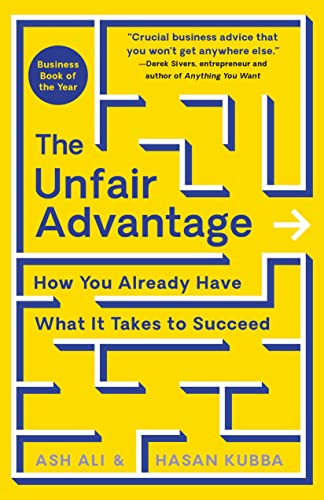
⚡️ What is The Unfair Advantage about?
The Unfair Advantage by Ash Ali and Hasan Kubba is a transformative guide that challenges the conventional notion of success being purely merit-based. The authors argue that everyone possesses unique advantages—often overlooked—that can be leveraged to achieve extraordinary success in business and life. Drawing from their extensive entrepreneurial experience, Ali and Kubba explain how to identify, develop, and maximize these personal advantages to create a competitive edge. The book demystifies the concept of unfair advantages, breaking them down into tangible categories that anyone can recognize and cultivate. Rather than promoting luck or privilege as the sole determinants of success, it offers a practical framework for readers to assess their own strengths and apply them strategically in their entrepreneurial journey, making success more accessible regardless of background or resources.
🚀 The Book in 3 Sentences
- The Unfair Advantage teaches that success comes from leveraging your unique advantages rather than following conventional paths.
- Everyone possesses at least one unfair advantage that can be identified, developed, and maximized for entrepreneurial success.
- By understanding the MILES framework (Money, Intelligence/Insight, Location/Luck, Education, Status), you can strategically build upon your existing strengths.
🎨 Impressions
The Unfair Advantage delivers an empowering message that reframes success as accessible to everyone, not just the privileged few. What impressed me most was the authors’ honesty about the role of advantages while simultaneously providing practical strategies for readers to identify and leverage their own unique strengths. The book strikes an excellent balance between inspiration and actionable advice, making complex entrepreneurial concepts digestible for readers at any stage of their journey. The MILES framework provides a structured approach to something that often seems intangible, transforming abstract advantages into concrete building blocks for success.
📖 Who Should Read The Unfair Advantage?
The Unfair Advantage is essential reading for aspiring entrepreneurs who feel disadvantaged or believe they lack the resources to succeed. It’s particularly valuable for individuals from underrepresented backgrounds in business who need validation that their unique experiences and perspectives can be transformed into competitive advantages. Additionally, the book serves as an excellent guide for early-stage startup founders looking to identify and capitalize on their distinctive strengths, as well as business students seeking a realistic understanding of success factors beyond traditional education and credentials.
☘️ How the Book Changed Me
How my life / behaviour / thoughts / ideas have changed as a result of reading the book.
- I’ve shifted from focusing on my disadvantages to identifying and leveraging my unique unfair advantages in my professional endeavors.
- The book helped me reframe past failures not as lack of ability but as opportunities to better understand my advantages and how to apply them.
- I’ve become more strategic in building complementary partnerships with people whose advantages balance my own.
✍️ My Top 3 Quotes
- “Your unfair advantage is simply the unique edge that you have over others, whether you realize it or not.”
- “Success isn’t about having all the advantages; it’s about maximizing the ones you do have.”
- “The most powerful unfair advantage of all is the self-awareness to know what yours are and how to use them.”
📒 Summary + Notes
The Unfair Advantage presents a revolutionary framework for understanding and leveraging personal advantages in business and life. The authors, both successful entrepreneurs with backgrounds that defied conventional success stories, reveal how they identified and maximized their unique advantages to overcome obstacles and achieve extraordinary success. This comprehensive guide demystifies the concept of unfair advantages, providing readers with practical tools to recognize, develop, and deploy their own distinctive strengths. Through real-world examples, actionable insights, and strategic frameworks, the book empowers readers to transform perceived disadvantages into competitive edges and create their own paths to success.
Chapter 1: The Myth of Meritocracy
The authors challenge the common belief that success is solely based on merit and hard work. They argue that the playing field is never truly level and that various factors beyond our control influence our outcomes. This chapter introduces the concept of The Unfair Advantage as a counterpoint to the meritocracy myth, setting the stage for understanding how to identify and leverage personal advantages that others might overlook. The authors share their own stories of overcoming seemingly insurmountable odds by recognizing and maximizing their unique strengths.
- Society’s narrative of meritocracy often ignores the unseen advantages that contribute to success.
- Recognizing that meritocracy is a myth is the first step toward identifying your own unfair advantages.
- Both authors share personal stories of how they succeeded despite not following traditional paths.
Chapter 2: The Unfair Advantage Mindset
This chapter explores the psychological foundation needed to recognize and leverage unfair advantages. The authors explain that developing the right mindset is crucial for success, as it influences how we perceive opportunities and obstacles. They introduce the concept of the entrepreneurial mindset, characterized by resilience, adaptability, and a willingness to challenge limiting beliefs. The chapter provides practical strategies for cultivating this mindset, including reframing failures as learning opportunities and developing a growth-oriented perspective that views advantages as malleable rather than fixed.
- Your mindset determines whether you recognize opportunities or see obstacles.
- Developing self-awareness is essential for identifying your personal unfair advantages.
- The authors provide exercises to help readers shift from a scarcity mindset to an abundance mindset.
Chapter 3: Introducing the MILES Framework
The authors present the MILES framework as a comprehensive tool for categorizing and understanding different types of unfair advantages. MILES stands for Money, Intelligence/Insight, Location/Luck, Education, and Status. This framework helps readers systematically identify their advantages across multiple domains. Each component of the framework is explained in detail, with examples of how these advantages manifest in real-world business scenarios. The chapter emphasizes that everyone has at least one unfair advantage within the MILES framework, and the key is to recognize it and leverage it effectively.
- The MILES framework provides a structured approach to identifying personal advantages.
- Understanding each component helps you recognize strengths you may have overlooked.
- The authors show how advantages in one area can compensate for disadvantages in another.
Chapter 4: Money and Material Advantages
This chapter focuses on the M in the MILES framework: Money and material advantages. The authors discuss how financial resources can provide significant advantages in business, but also emphasize that lack of money doesn’t preclude success. They explore creative ways to leverage limited financial resources and how to compensate for monetary disadvantages through other advantages. The chapter includes strategies for bootstrapping businesses, alternative funding sources, and case studies of entrepreneurs who succeeded despite minimal financial backing. The authors stress that while money can accelerate success, it’s not the only path to achievement.
- Financial advantages include not just wealth but also access to capital and financial networks.
- Lack of money can foster creativity and resourcefulness that become advantages themselves.
- The authors provide strategies for maximizing limited financial resources through strategic partnerships.
Chapter 5: Intelligence and Insight
This chapter explores the I in MILES: Intelligence and Insight. The authors distinguish between traditional academic intelligence and the practical intelligence that often matters more in business success. They discuss how unique insights gained from personal experiences, cultural backgrounds, and specialized knowledge can become powerful unfair advantages. The chapter emphasizes that intelligence comes in many forms and that unconventional education paths can provide unique perspectives that are valuable in entrepreneurship. The authors provide guidance on how to develop and leverage these insights to create innovative solutions and identify opportunities others might miss.
- Practical intelligence often trumps academic intelligence in entrepreneurial success.
- Unique insights from personal experiences can become powerful competitive advantages.
- The authors explain how to develop pattern recognition skills that lead to valuable insights.
Chapter 6: Location and Luck
Focusing on the L in MILES, this chapter examines how location and luck function as unfair advantages. The authors explain how being in the right place at the right time can create significant opportunities, but also how readers can increase their exposure to “lucky” situations through strategic positioning. They discuss both physical and digital location advantages, including the benefits of being in innovation hubs or having access to specific markets. The chapter provides practical advice on how to maximize location advantages and how to create your own luck through preparation and positioning, challenging the notion that luck is purely random.
- Location advantages include both physical geography and positioning within networks.
- Luck can be cultivated through increasing your exposure to opportunities and being prepared to act.
- The authors share strategies for leveraging digital location advantages in an increasingly online world.
Chapter 7: Education and Expertise
This chapter addresses the E in MILES: Education and Expertise. The authors explore how formal education, specialized training, and self-directed learning can become unfair advantages. They challenge the notion that prestigious degrees are the only path to expertise, highlighting how unconventional education paths and specialized knowledge can provide unique advantages. The chapter includes strategies for acquiring valuable expertise quickly, leveraging existing knowledge, and identifying gaps in your education that can be filled for maximum impact. The authors emphasize that expertise in niche areas can be more valuable than broad general knowledge in certain business contexts.
- Specialized expertise in niche areas often provides greater advantages than general knowledge.
- Self-directed learning can be more valuable than formal education in rapidly changing industries.
- The authors explain how to identify and develop expertise that aligns with market opportunities.
Chapter 8: Status and Social Capital
The final component of the MILES framework, Status and Social Capital, is explored in this chapter. The authors discuss how social connections, reputation, and perceived status can function as powerful unfair advantages. They explain how to build and leverage social capital authentically, without resorting to networking tactics that feel inauthentic. The chapter includes strategies for developing meaningful connections, building credibility in your field, and converting social capital into tangible opportunities. The authors emphasize that status comes in many forms and that cultural capital from diverse backgrounds can be leveraged as unique advantages in business.
- Social capital is built through genuine relationships, not transactional networking.
- Non-traditional forms of status and cultural capital can be leveraged as unique advantages.
- The authors provide strategies for building credibility and reputation from scratch.
Chapter 9: Combining Your Unfair Advantages
This chapter teaches readers how to synthesize their various unfair advantages to create a powerful competitive edge. The authors explain that the true power of The Unfair Advantage concept lies not in individual strengths but in how they combine and amplify each other. They provide frameworks for mapping personal advantages, identifying synergies between different types of advantages, and creating a unique value proposition based on these combinations. The chapter includes exercises to help readers identify their advantage combinations and case studies of successful entrepreneurs who leveraged multiple advantages to achieve extraordinary results.
- The synergy between multiple advantages creates exponential rather than additive benefits.
- Mapping your advantages helps identify gaps that can be filled through partnerships.
- The authors provide a step-by-step process for creating an advantage combination strategy.
Chapter 10: The Unfair Advantage in Action
In this practical chapter, the authors demonstrate how to apply the concepts of unfair advantages in real business scenarios. They provide detailed case studies of entrepreneurs who successfully identified and leveraged their advantages across different industries and business models. The chapter includes specific strategies for using unfair advantages in business planning, marketing, sales, fundraising, and team building. The authors emphasize that application is key and that merely identifying advantages without taking action yields no results. They provide a framework for implementing advantage-based strategies in various business contexts.
- Identifying advantages is only valuable if you translate them into concrete actions.
- Case studies illustrate how different advantage combinations work in various industries.
- The authors provide templates for applying your advantages to specific business challenges.
Chapter 11: Building Your Unfair Advantage
This chapter focuses on how to actively develop and strengthen your unfair advantages over time. The authors reject the idea that advantages are static and unchangeable, providing strategies for consciously building advantages in each area of the MILES framework. They discuss how to create personal development plans that target specific advantage gaps, how to leverage compound growth in advantages, and how to measure progress in advantage development. The chapter emphasizes that building advantages is a long-term process that requires consistent effort and strategic focus, but yields significant returns over time.
- Advantages can be consciously developed through targeted effort and strategic focus.
- The compound effect of small improvements in multiple advantages creates dramatic results.
- The authors provide a framework for tracking and measuring the growth of your advantages.
Chapter 12: The Unfair Advantage for Life
The final chapter expands the application of unfair advantages beyond business to all areas of life. The authors explain how the principles of The Unfair Advantage can be applied to personal development, relationships, health, and overall life satisfaction. They provide a holistic framework for living an advantage-based life that maximizes personal strengths and minimizes the impact of weaknesses. The chapter concludes with a call to action for readers to embrace their unique advantages and use them not just for personal success but also to create positive impact in their communities and the world at large.
- The principles of unfair advantages apply to all areas of life, not just business success.
- Leveraging your advantages leads to greater authenticity and life satisfaction.
- The authors inspire readers to use their advantages to create positive impact beyond personal success.
Key Takeaways
The Unfair Advantage provides a transformative framework for understanding and leveraging personal strengths to achieve success. The book’s key insights challenge conventional notions of meritocracy and offer practical strategies for identifying, developing, and maximizing unique advantages. By applying the MILES framework and combining advantages strategically, readers can create competitive edges that propel them toward their goals regardless of their starting point.
- Everyone possesses at least one unfair advantage that can be leveraged for success.
- The MILES framework (Money, Intelligence/Insight, Location/Luck, Education, Status) provides a comprehensive system for identifying personal advantages.
- Success comes from strategically combining and amplifying multiple advantages rather than excelling in a single area.
- Advantages can be actively developed and strengthened over time through focused effort.
- The unfair advantage mindset shifts focus from overcoming weaknesses to maximizing strengths.
Conclusion
The Unfair Advantage offers a refreshing and empowering perspective on success that challenges the myth of pure meritocracy. By providing readers with a practical framework to identify, develop, and leverage their unique advantages, Ash Ali and Hasan Kubba have created a roadmap for achievement that is accessible to everyone, regardless of background or resources. The book’s greatest strength lies in its ability to transform perceived disadvantages into competitive edges and its emphasis on the power of advantage combinations. Whether you’re an aspiring entrepreneur, a business professional, or simply someone seeking to maximize your potential, this book provides invaluable insights that can transform your approach to success. I highly recommend reading the full book to gain a comprehensive understanding of how to apply these principles in your own life and business.
More From Ash Ali and Hasan Kubba →
Discover more from AI Book Summary
Subscribe to get the latest posts sent to your email.