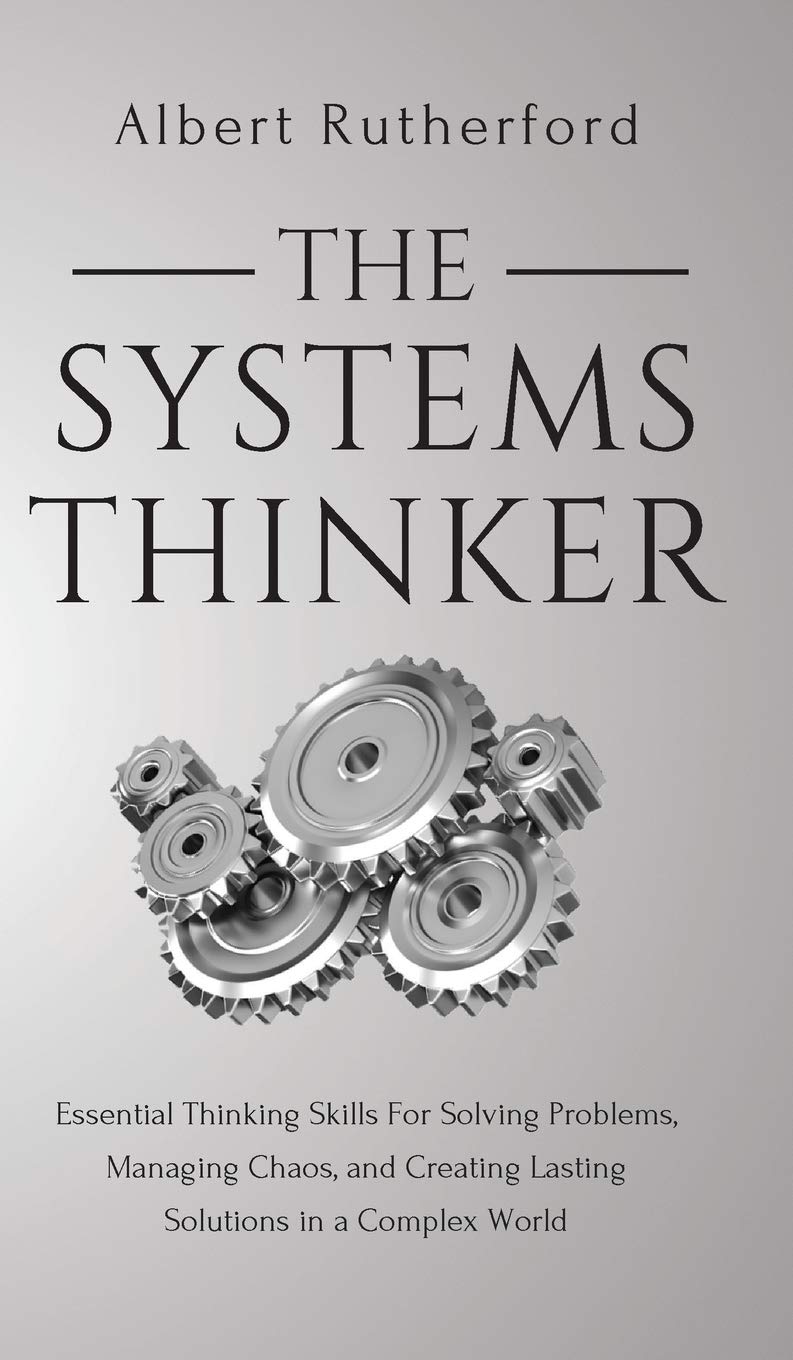
⚡️ What is The Systems Thinker About?
Have you ever noticed how the more you try to fix a specific problem—like a messy house or a low-performing team—the more it seems to resist your efforts? Most of us are taught to look at the world as a collection of isolated events. We see a fire, we pour water on it. But More summaries by Albert Rutherford suggest that this “linear” approach is exactly why we’re constantly stressed and overwhelmed. The Systems Thinker argues that everything is connected in a web of cause-and-effect that isn’t always obvious at first glance.
Rutherford breaks down the complex world of systems theory into something you can actually use while drinking your morning coffee. He doesn’t just want you to understand the math; he wants you to change how you look at your relationships, your business, and even your own habits. It’s about moving from being a person who reacts to the world to someone who understands the underlying architecture of why things happen the way they do. This falls firmly into the world of psychology book summaries because it’s ultimately a book about retraining your brain to see the invisible structures around you.
🚀 The Book in 3 Sentences
- A system is a set of interacting parts that work toward a specific purpose, where the behavior of the whole is different from the sum of its parts.
- Most failures occur because we optimize individual components instead of looking at the interconnections and feedback loops that drive the overall results.
- By identifying recurring patterns called “archetypes,” you can predict how a system will react to changes and find the high-leverage points where small actions create big results.
🎨 Impressions
I’ll be honest: I went into this book thinking it might be a dry academic slog. Systems theory can often feel like reading a manual for a 1980s mainframe. But Rutherford surprised me. He has this way of taking concepts that sound intimidating—like “reinforcing feedback” or “homeostasis”—and making them feel like common sense. I found myself dog-earing the chapter on archetypes because it perfectly explained a project failure I had last year where we tried to “solve” a budget issue but ended up making the work environment toxic.
There’s a certain humbleness to the writing that I appreciated. It doesn’t promise you’ll become a genius overnight; it just admits that the world is messy and gives you a flashlight. One thing that slightly bugged me was that some examples felt a bit recycled from older systems thinking classics like The Fifth Discipline. That said, if you haven’t read those 500-page monsters, this is a much punchier way to get the core insights without the fluff. It’s a grounded, practical guide that respects your time.
📖 Who Should Read The Systems Thinker?
If you’re a manager who feels like you’re playing a never-ending game of Whac-A-Mole with office problems, this is for you. It’s also great for entrepreneurs trying to scale a business without it breaking apart. However, if you’re looking for a step-by-step “get rich quick” guide or a book full of inspirational fluff, you’ll probably find this a bit too technical. This is for the person who wants to understand the why behind the chaos.
☘️ How This Book Changed My Thinking
I used to pride myself on being a “problem solver,” which usually meant I was fast at fixing immediate issues. After reading this, I realized I was often just the guy patching a sinking boat while ignoring the reason why the holes were forming in the first place.
- I stopped looking for a single “person” to blame when things go wrong and started looking at the process that allowed the mistake to happen.
- I’ve become much more patient with delays, realizing that many systems have a built-in lag time before you see the results of your work.
- I now ask “What is the goal of this system?” before I try to change any of the parts, which has saved me from dozens of useless meetings.
✍️ 3 Quotes That Stuck With Me
- “The easy way out usually leads back in.” — This hits hard because it reminds me that the fastest solution is often the one that creates the next problem.
- “Systems are everywhere, even if we don’t choose to see them.” — It’s a bit like the Matrix; once you see the loops, you can’t unsee them.
- “A system is more than the sum of its parts; it is the product of their interactions.” — This shifted my focus from hiring “star players” to building better communication between everyone on my team.
📒 Summary + Notes
Rutherford builds a case for a total paradigm shift. He starts by explaining that our traditional way of thinking—Analysis—is about breaking things down into pieces to understand them. While this works for fixing a car engine, it fails miserably for complex things like families, economies, or ecosystems. For those, you need Synthesis: seeing how pieces fit together and behave as a whole. The narrative arc moves from the basic anatomy of a system (stocks, flows, and goals) into the more psychological aspects of how our mental models blind us to reality.
The core message is that most of what we call “problems” are actually just the natural output of a system’s structure. If you have a system designed for a specific result, it will produce that result regardless of how hard the people inside it work. The author wants you to stop trying to force individuals to be better and start designing structures that make it easy for the system to succeed. By the end of the book, you’re equipped with the “archetypes”—common patterns of failure—that help you spot trouble before it starts.
🧠 Core Ideas Explained Simply
Systems thinking can get academic fast, but here’s how the main concepts actually work in real life.
Stocks and Flows
Imagine your bank account as a bathtub. The water in the tub is the “Stock” (the amount of something you have). The faucet is the “Inflow” (income), and the drain is the “Outflow” (expenses). Systems thinkers don’t just look at how much money is in the tub; they look at the rate of the water coming in versus going out. If you want to increase your savings, you can either turn up the faucet or plug the drain, but ignoring the flows while obsessing over the stock is a recipe for disaster.
The Power of Feedback Loops
Why does a small cold often turn into a full-blown flu, or a tiny stock market dip turn into a crash? That’s reinforcing feedback—where an action produces a result that triggers even more of the same action. On the flip side, balancing feedback is what keeps your body temperature at 98.6 degrees; it’s a loop that resists change. Understanding which loop you’re in tells you whether you need to step on the gas or fix the thermostat.
System Archetypes
These are the “storylines” of systems. One famous one is “Fixes that Fail,” where you apply a quick solution that works for a minute but then creates a bigger problem later (like drinking coffee to fix exhaustion, which leads to a crash, which leads to needing more coffee). Once you recognize these patterns, you stop being surprised by bad outcomes and start looking for the structural flaw.
1: What is Systems Thinking?
Have you ever tried to fix a clock by looking at just one gear? You can’t, because the clock’s function only exists when all the gears are moving together. This chapter establishes that systems thinking is a “holistic” view. It’s the opposite of reductionism. Rutherford argues that our education system teaches us to slice the world into subjects (Math, History, Science), but the real world doesn’t have borders. To be a systems thinker, you have to look at the relationships between the pieces, not just the pieces themselves.
2: The History of Systems Thinking
Where did this way of seeing the world actually come from? It wasn’t just one guy in a lab. Rutherford traces the roots from biology (where researchers realized organisms couldn’t be understood as just a pile of cells) to engineering and social sciences. He highlights the work of pioneers like Ludwig von Bertalanffy and Jay Forrester. It’s a reminder that this isn’t some new-age fad; it’s a rigorous scientific framework that has been helping us manage everything from space missions to global supply chains for decades.
3: Systems and Their Components
Is everything a system? Not quite. A pile of sand isn’t a system because you can remove grains and nothing changes. A system requires three things: elements, interconnections, and a purpose. There’s a moment early on where Rutherford points out that the “purpose” of a system is often different from what the people inside it claim. For example, a company might say its purpose is “innovation,” but if the reward system only pays for short-term profits, the actual purpose of the system is profit. The system doesn’t care about your mission statement; it cares about its structure.
4: Systems Thinking Tools
How do you actually “see” a system that is invisible? You map it. This chapter introduces Causal Loop Diagrams (CLDs). These are simple drawings with arrows showing how one thing leads to another. If “A” causes more of “B,” and “B” causes more of “A,” you’ve found a loop. This was the section I dog-eared most because it gives you a practical way to brainstorm problems with a team. It turns vague arguments into visible maps that everyone can agree on.
5: Feedback Loops
Why do some projects take off while others stagnate? The answer is usually buried in the feedback loops. Reinforcing loops drive growth (or decline), while balancing loops maintain stability. Rutherford explains that the most dangerous loops are the ones we don’t see—like a “success to the successful” loop where one department gets all the funding because they did well once, which starves other departments, making the first department look even better. It’s a self-fulfilling prophecy that eventually breaks the whole company.
6: Mental Models
The world we see isn’t the world that exists; it’s a map inside our heads. Our mental models are the filters we use to process information. If you believe “people are lazy,” you’ll design a system with heavy oversight, which makes people feel distrusted, which makes them act lazy—confirming your model. Rutherford argues that the most powerful way to change a system is to change the mental models of the people in it. If you don’t update the internal software, no amount of external tinkering will work.
7: Systems Archetypes
Patterns repeat because the structures dictate the behavior. Rutherford introduces several archetypes like “Shifting the Burden” (relying on a consultant instead of learning the skill yourself) and “Tragedy of the Commons” (everyone acting in their own interest and destroying a shared resource). Recognizing these is like having a cheat code for life. Instead of being confused by a recurring problem, you can say, “Ah, this is a Shifting the Burden archetype,” and you’ll immediately know how to fix it.
8: Solving Complex Problems with Systems Thinking
So, how do we actually fix things? The final chapter is about finding “leverage points.” In a complex system, the obvious solution is usually wrong. If a road is congested, adding more lanes (the obvious fix) actually makes traffic worse in the long run by encouraging more people to drive. A systems thinker looks for the counter-intuitive spot where a small nudge creates a massive shift. It might be changing the goal of the system or opening up a new flow of information. It’s about being precise rather than just being loud.
⚖️ A Critical Perspective
Honestly, I found the lack of original case studies a bit frustrating. Rutherford is a fantastic synthesizer, but he largely relies on the same examples (like the “Beer Game” or thermostat analogies) that have been in systems thinking books since the 1990s. In 2025, I would have loved to see more discussion on how AI algorithms—which are the ultimate black-box systems—affect our societal feedback loops. The book also tends to make systems mapping look a bit easier than it is in a messy corporate environment where people have competing interests. It’s a great primer, but it occasionally oversimplifies the political difficulty of changing a system.
🔄 How It Compares
Compared to Donella Meadows’ Thinking in Systems, Rutherford’s book is much more accessible for a casual reader or a busy professional. Meadows is the gold standard for depth and philosophy, but Rutherford is better if you want a “weekend read” that you can apply at work on Monday morning. He strips away the heavy academic jargon in favor of actionable frameworks.
🔑 Key Takeaways
These are the lessons that will help you stop reacting to chaos and start managing it.
- Stop blaming people: Most mistakes are caused by bad systems, not bad people. If you keep firing people and the problem persists, the system is the culprit.
- Look for delays: There is almost always a lag between an action and its result. If you don’t account for this, you’ll over-correct and make the system swing wildly out of control.
- Go for the leverage: The most effective way to change a system is often the least obvious. Look for the “bottleneck” or the flow of information that is being blocked.
- Watch your mental models: Your beliefs are part of the system. If you don’t question your own assumptions, you’ll keep building the same broken structures.
💬 Frequently Asked Questions
What is the main argument of The Systems Thinker?
The book argues that linear, cause-and-effect thinking is insufficient for modern problems. Instead, we must use systems thinking to see the interconnections, feedback loops, and delays that drive behavior. By understanding a system’s structure, we can identify high-leverage points for lasting change rather than just treating symptoms.
What are the ‘archetypes’ in systems thinking?
Archetypes are recurring patterns of behavior found across different fields. Common examples include “Fixes that Fail” and “Tragedy of the Commons.” Identifying these patterns allows you to predict how a system will evolve and helps you avoid common pitfalls where short-term fixes lead to long-term disasters.
Is The Systems Thinker worth reading for beginners?
Yes, it is arguably the best entry point for beginners. While it lacks some of the original academic rigor of foundational texts, it excels at translating complex theories into practical, everyday language. It’s a fast-paced guide that focuses on application rather than just abstract theory.
What is the difference between a balancing and reinforcing loop?
A reinforcing loop creates exponential growth or collapse, where an action leads to more of the same (like interest on a bank account). A balancing loop seeks stability or a goal, resisting change to keep the system in equilibrium (like a thermostat maintaining a specific temperature).
How can systems thinking help in business?
In business, it helps leaders see beyond quarterly reports to understand long-term trends. It reveals why certain departments might be in conflict and identifies structural changes—like altering incentives or communication flows—that can improve the entire organization’s performance without requiring constant micro-management.
Conclusion
The world isn’t a collection of snapshots; it’s a movie where every scene is influenced by what happened ten minutes ago and what’s happening off-camera. The Systems Thinker is the lens that helps you see that entire movie. It’s a call to stop being a “problem solver” who just puts out fires and to start being a designer who builds a house that doesn’t catch fire in the first place.
The ONE thing to remember from this book is that structure drives behavior. If you don’t like how your team, your business, or your life is going, don’t just look at the events. Look at the structure. This fundamental shift in perspective is what makes The Systems Thinker such a valuable addition to your shelf of psychology book summaries. Once you start seeing the world in loops, you can never go back to seeing it in straight lines.
More From Albert Rutherford →
Discover more from AI Book Summary
Subscribe to get the latest posts sent to your email.