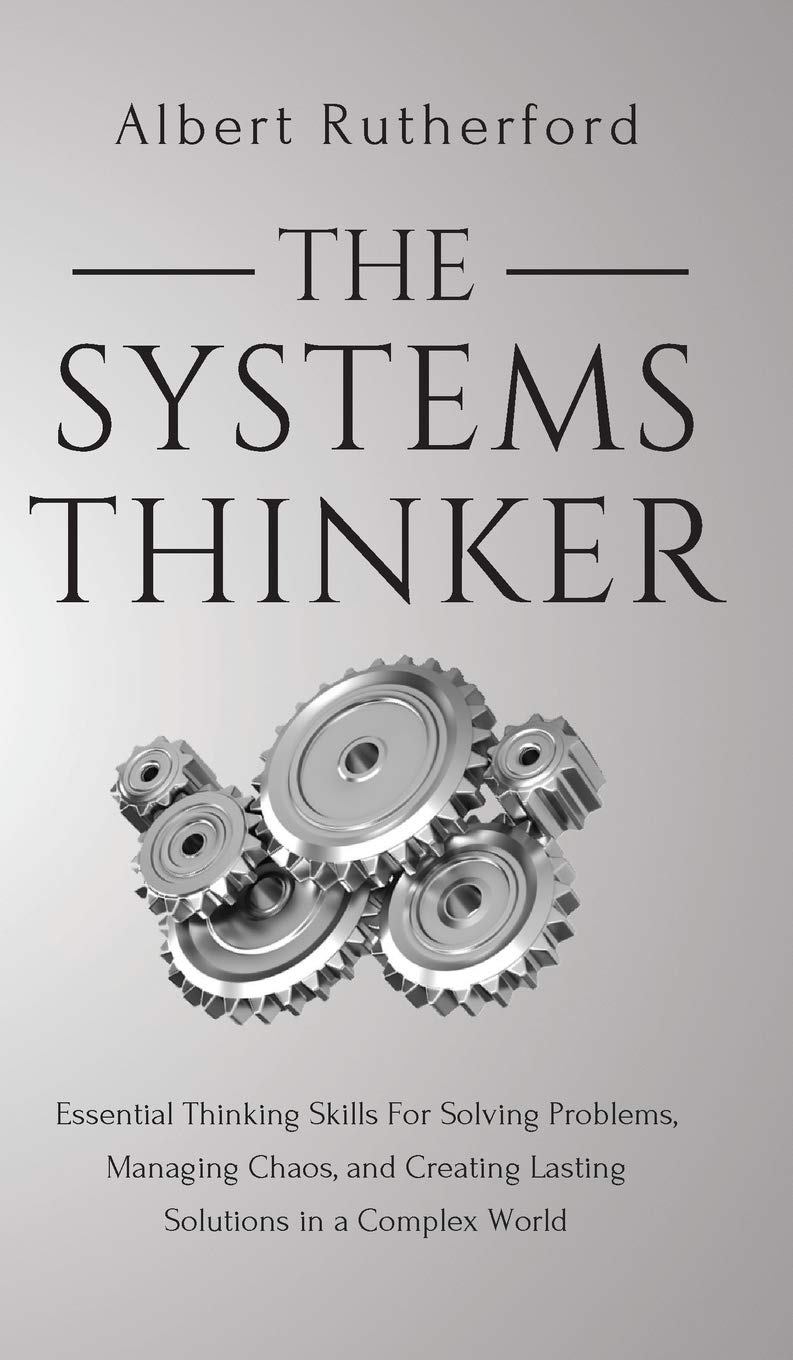
⚡️ What is The Systems Thinker about?
The Systems Thinker is a comprehensive guide to understanding and applying systems thinking principles in everyday life. Albert Rutherford introduces readers to a powerful mental model that helps us see the world as interconnected systems rather than isolated events. The book teaches how to identify patterns, relationships, and feedback loops that drive behavior in complex environments. Through practical examples and exercises, Rutherford demonstrates how systems thinking can transform our approach to problem-solving, decision-making, and creating lasting change. This essential thinking skill enables us to navigate complexity with confidence and develop solutions that address root causes rather than just symptoms.
🚀 The Book in 3 Sentences
- The Systems Thinker teaches us to view problems as part of larger interconnected systems rather than isolated events, revealing hidden relationships and patterns.
- By understanding feedback loops, leverage points, and system archetypes, we can identify where to intervene for maximum impact with minimal effort.
- Mastering systems thinking enables us to create sustainable solutions that address root causes rather than treating symptoms repeatedly.
🎨 Impressions
I found The Systems Thinker to be both enlightening and practical, transforming how I perceive the world around me. Rutherford has a talent for making complex concepts accessible through relatable examples and clear explanations. What impressed me most was how the book bridges abstract theory with concrete application, showing how systems thinking can be immediately applied to personal, professional, and societal challenges.
📖 Who Should Read The Systems Thinker?
The Systems Thinker is essential reading for anyone facing complex problems that seem to resist conventional solutions. It’s particularly valuable for leaders, managers, entrepreneurs, policy makers, and students who need to understand the bigger picture. If you’ve ever felt like you’re solving the same problems repeatedly or that your solutions create unintended consequences, this book will provide you with the mental tools to break those cycles.
☘️ How the Book Changed Me
How my life / behaviour / thoughts / ideas have changed as a result of reading the book.
- I now automatically look for underlying systems and patterns when facing problems, rather than jumping to quick fixes with The Systems Thinker approach.
- I’ve developed patience to observe situations over time, recognizing that many issues are symptoms of deeper systemic structures that need to be addressed.
- I’ve become better at identifying leverage points in my personal and professional life where small actions can produce significant, lasting improvements.
✍️ My Top 3 Quotes
- “The systems thinker sees the forest and the trees simultaneously, understanding how each part influences and is influenced by the whole.”
- “Today’s problems come from yesterday’s solutions, and today’s solutions create tomorrow’s problems—unless we think in systems.”
- “Structure influences behavior. When we change the structure of a system, we change the behavior of its actors, for better or worse.”
📒 Summary + Notes
The Systems Thinker provides a comprehensive framework for understanding and working with complex systems. In this summary, I’ll break down each chapter’s key insights and how they build upon each other to develop your systems thinking capabilities. The book progresses from foundational concepts to practical applications, helping readers develop a new lens through which to view the world.
Chapter 1: Introduction to Systems Thinking
Rutherford opens by defining what systems thinking is and why it matters in our increasingly complex world. He explains that systems thinking is not just a tool but a fundamental shift in how we perceive reality. The chapter contrasts linear thinking with systems thinking, showing how the former often leads to ineffective solutions in complex environments. Rutherford introduces the core principle that systems are made of interconnected parts that work together to produce behavior that no individual component can produce alone.
- Systems thinking helps us see beyond events to patterns and structures that drive behavior
- The difference between linear cause-and-effect and circular causality in systems
- How our mental models shape our perception of systems and our ability to intervene effectively
Chapter 2: Understanding System Components
This chapter breaks down the essential elements that make up any system: elements, interconnections, and purpose or function. Rutherford explains how to identify these components in various contexts, from natural ecosystems to organizations. He emphasizes that understanding a system requires more than just identifying its parts; we must understand how they relate to each other and what function the system as a whole serves. The chapter provides practical exercises for mapping systems in your own life and work.
- Elements are the tangible components of a system, while interconnections are the relationships that govern behavior
- A system’s purpose is determined by its actual behavior, not its stated goals
- How to create simple system diagrams to visualize relationships and flows
Chapter 3: Feedback Loops and System Dynamics
Rutherford introduces the powerful concept of feedback loops, which are the driving forces behind system behavior. He distinguishes between balancing (stabilizing) loops and reinforcing (amplifying) loops, showing how they appear in everyday situations. The chapter explains how these loops create the dynamics we observe in systems, from population growth to business cycles. Understanding feedback loops helps explain why systems often behave counterintuitively and why our interventions sometimes produce the opposite of what we intended.
- Balancing loops maintain stability by counteracting change, while reinforcing loops amplify change in one direction
- Delays in feedback loops are a major source of system problems and unintended consequences
- How to identify feedback loops in your personal and professional life
Chapter 4: Identifying Patterns and Relationships
This chapter focuses on developing the skill of pattern recognition, a crucial ability for systems thinkers. Rutherford explains how to move beyond looking at individual events to identifying patterns over time and the structures that produce them. He introduces tools like behavior-over-time graphs and causal loop diagrams to help visualize and analyze patterns. The chapter demonstrates how identifying patterns early allows us to anticipate future developments and intervene more effectively.
- Events → Patterns → Structure → Mental Model: the hierarchy of systems thinking
- How to distinguish between symptoms and underlying problems
- Using pattern recognition to anticipate future developments and challenges
Chapter 5: Problem-Solving in Complex Systems
Rutherford applies systems thinking to the practical challenge of solving complex problems. He explains why traditional problem-solving approaches often fail in complex systems and introduces a systems-based problem-solving methodology. The chapter covers how to define problems systemically, identify root causes rather than symptoms, and develop solutions that address underlying structures. Rutherford provides a step-by-step process for systems-based problem-solving illustrated with real-world examples.
- The importance of expanding the problem boundary to include relevant system components
- How to identify leverage points where small changes can produce significant improvements
- Why “worse before better” is often necessary when implementing systemic solutions
Chapter 6: Leveraging Systems for Personal Growth
This chapter applies systems thinking to personal development and self-improvement. Rutherford shows how to view your life, habits, and goals as interconnected systems rather than isolated elements. He explains how to design personal systems that support your objectives and how to identify and change limiting patterns. The chapter provides practical frameworks for creating feedback mechanisms that reinforce positive behaviors and for designing environments that naturally lead to better outcomes.
- How habits are formed through reinforcing loops and how to redesign these systems
- Creating personal dashboards to track key metrics and receive feedback on progress
- Designing environments that make desired behaviors easier and undesired behaviors harder
Chapter 7: Systems Thinking in Business
Rutherford demonstrates how systems thinking can transform business decision-making and organizational design. He explains common business challenges through a systems lens, showing how organizational structures, incentive systems, and communication patterns shape behavior and results. The chapter reveals how to identify systemic barriers to growth, innovation, and effectiveness in organizations. Rutherford provides examples of companies that have successfully applied systems thinking to improve performance and sustainability.
- How organizational structure and policies create system behaviors that often undermine stated goals
- The dangers of focusing on local optimization at the expense of global system performance
- Using systems thinking to design organizations that are adaptive, resilient, and innovative
Chapter 8: Creating Sustainable Solutions
This chapter focuses on designing solutions that are effective over the long term rather than just providing temporary fixes. Rutherford explains the principles of sustainable intervention in systems, including how to avoid unintended consequences and ensure that solutions address underlying structures rather than just symptoms. He introduces the concept of “resilience” in systems and how to design solutions that increase rather than decrease a system’s ability to adapt and thrive.
- The importance of considering second- and third-order effects when designing solutions
- How to balance efficiency with resilience in system design
- Strategies for implementing changes that overcome resistance to change in systems
Chapter 9: Managing Chaos and Uncertainty
Rutherford addresses how to apply systems thinking in volatile, uncertain, complex, and ambiguous (VUCA) environments. He explains why complex systems often exhibit chaotic behavior and how to work with rather than against this reality. The chapter introduces concepts like emergence, self-organization, and the edge of chaos—conditions where systems are most adaptive and innovative. Rutherford provides strategies for leading and making decisions in environments where prediction is impossible and outcomes are emergent.
- How to distinguish between complexity (which can be managed) and chaos (which requires different approaches)
- The value of small experiments, probes, and iterative approaches in uncertain environments
- Building antifragile systems that benefit from volatility and uncertainty
Chapter 10: Becoming a Systems Thinker
The final chapter focuses on how to develop and maintain systems thinking as a core skill and mindset. Rutherford provides a roadmap for continued development, including practices, exercises, and habits that strengthen systems thinking capabilities. He addresses common obstacles to systems thinking and how to overcome them. The chapter concludes with reflections on how systems thinking can transform not just how we solve problems but how we see ourselves and our place in the world, fostering greater wisdom and effectiveness in all aspects of life.
- Daily practices that strengthen systems thinking capabilities, such as reflection and pattern journaling
- How to communicate systems insights to others who think more linearly
- The lifelong journey of developing wisdom through a systems thinking lens
Key Takeaways
The Systems Thinker provides essential tools for navigating our complex world. Here are the most important lessons I took away from the book that can transform how you approach problems and decisions.
- System structure drives behavior—change the structure, and you change the outcomes
- Look for feedback loops and delays in systems to understand why problems persist
- Focus on leverage points where small changes can produce significant improvements
- Expand your perspective beyond events to patterns and underlying structures
- Design solutions that increase system resilience rather than just efficiency
Conclusion
The Systems Thinker has transformed how I view and interact with the world around me. By learning to see systems, patterns, and relationships, I’ve become more effective at solving problems and creating lasting change. The principles and tools in this book are not just theoretical—they’re practical skills you can apply immediately in your personal life, work, and community. I highly recommend reading the full book to deepen your understanding and develop these crucial thinking skills. In our increasingly complex world, systems thinking is not just useful; it’s essential for creating a better future.
More From Albert Rutherford →
Discover more from AI Book Summary
Subscribe to get the latest posts sent to your email.