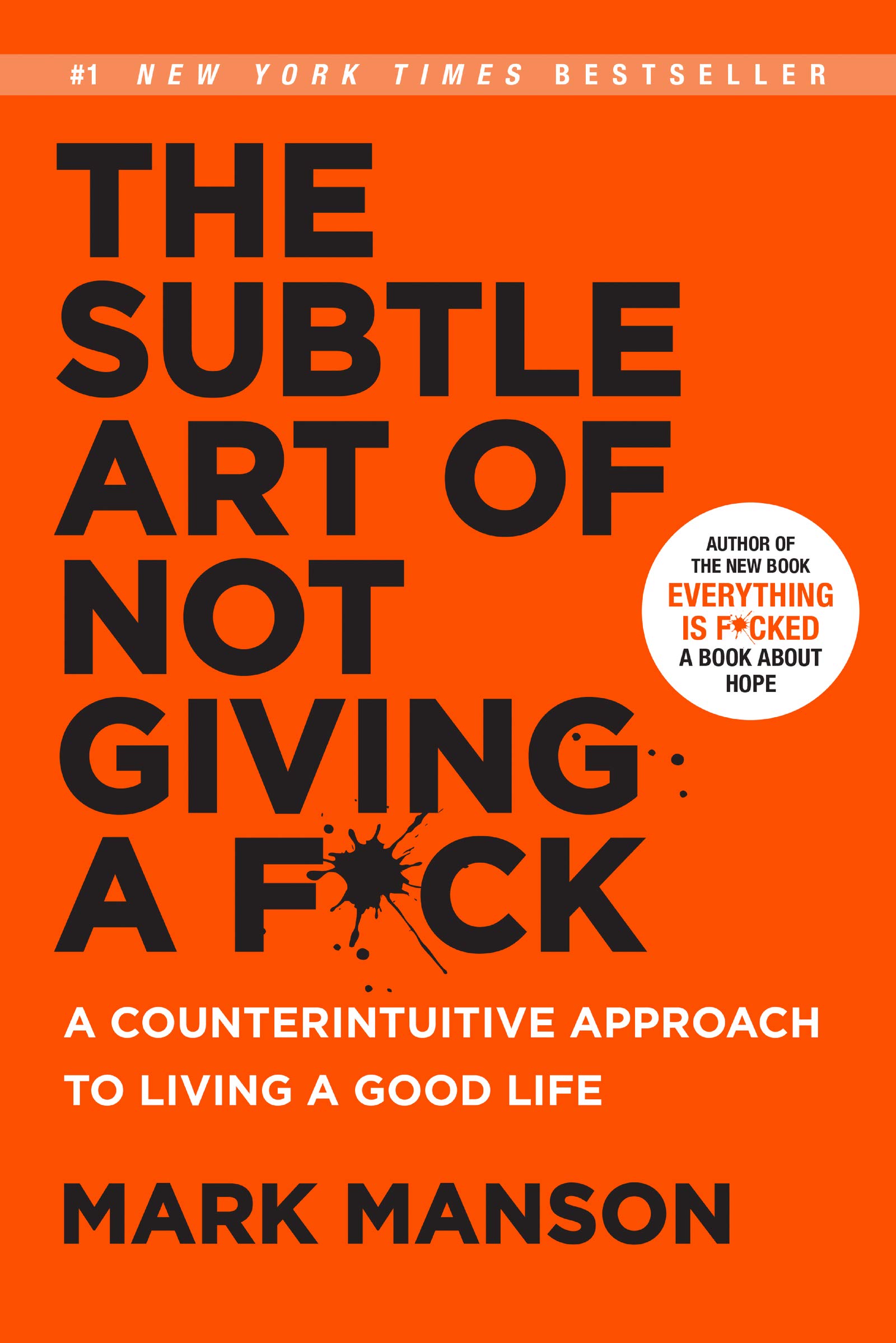
⚡️ What is The Subtle Art of Not Giving a F*ck about?
The Subtle Art of Not Giving a F*ck presents a counterintuitive approach to living a good life. Rather than promoting relentless positivity, Manson argues that true happiness comes from selectively choosing what to care about. The book challenges conventional self-help wisdom by suggesting that we should embrace our limitations, accept negative experiences, and focus only on what truly matters. Through raw humor and brutal honesty, Manson demonstrates how reducing our concerns to a few meaningful areas can lead to a more fulfilling existence.
🚀 The Book in 3 Sentences
- The Subtle Art of Not Giving a F*ck teaches that happiness comes not from avoiding problems but from solving better problems that align with your values.
- Life’s meaning is found not in pursuing extraordinary experiences but in accepting ordinary struggles and finding significance in everyday challenges.
- True freedom emerges when you stop trying to be positive about everything and instead embrace your limitations and selectively choose what matters to you.
🎨 Impressions
What struck me most about The Subtle Art of Not Giving a F*ck was its refreshing honesty and rejection of toxic positivity. Manson’s no-nonsense approach cuts through conventional wisdom like a knife, offering practical wisdom wrapped in profanity-laced humor. The book feels like a conversation with that brutally honest friend who tells you what you need to hear, not what you want to hear.
📖 Who Should Read The Subtle Art of Not Giving a F*ck?
The Subtle Art of Not Giving a F*ck is perfect for anyone feeling overwhelmed by modern life’s expectations and constant pressure to be positive. It’s especially valuable for people-pleasers, perfectionists, and those stuck in the cycle of comparison. If you’ve ever felt exhausted trying to maintain an optimistic facade while struggling internally, this book offers a liberating alternative.
☘️ How the Book Changed Me
How my life / behaviour / thoughts / ideas have changed as a result of reading the book.
- I’ve become much more selective about what I care about, saving my emotional energy for things that truly align with my values
- I’ve stopped pursuing constant positivity and instead embrace negative emotions as valuable feedback mechanisms
- I’ve developed a healthier relationship with failure, seeing it as necessary growth rather than something to avoid at all costs
✍️ My Top 3 Quotes
- “The desire for more positive experience is itself a negative experience. And, paradoxically, the acceptance of one’s negative experience is itself a positive experience.”
- “Who you are is defined by what you’re willing to struggle for.”
- “The Subtle Art of Not Giving a F*ck is not about being indifferent; it’s about being comfortable with being different.”
📒 Summary + Notes
The Subtle Art of Not Giving a F*ck revolutionizes self-help by rejecting the constant pursuit of happiness and instead embracing life’s inherent struggles. Manson argues that problems are inevitable and that the key to a good life is choosing better problems that align with your values. Through honest and often humorous anecdotes, he demonstrates how our cultural obsession with positivity and extraordinary achievement actually makes us miserable, and how embracing our limitations can lead to greater freedom and fulfillment.
Introduction: The Feedback Loop from Hell
Manson introduces the concept of the “Feedback Loop from Hell”—the modern phenomenon where feeling bad about feeling bad creates an endless cycle of negativity. He explains how our social media-driven culture of comparison and constant positivity has created unrealistic expectations that make us feel inadequate. The introduction sets up the book’s central thesis: that the key to happiness isn’t avoiding negative experiences but learning to choose which struggles are worth caring about.
- The constant pursuit of positivity actually makes us more miserable
- Our culture’s obsession with extraordinary achievements makes ordinary life feel insufficient
- Accepting that negative emotions are inevitable is the first step toward breaking the cycle
Chapter 1: Don’t Try
Manson challenges the conventional wisdom that we should always try to be positive and successful. Instead, he argues that we should be selective about what we care about and give our limited “fucks” only to things that truly matter. He shares the story of a Japanese man who survived alone on an island for years, not through extraordinary effort but by accepting his situation and working with it rather than against it.
- Struggle is inevitable, but we can choose which struggles are worth undertaking
- The “subtle art” is not about indifference but about selective investment of your emotional energy
- Accepting limitations and working with them is more effective than fighting against them
Chapter 2: Happiness is a Problem
This chapter redefines happiness not as the absence of problems but as the process of solving problems. Manson argues that the constant pursuit of happiness actually makes us unhappy because it creates an impossible standard. He introduces the concept of the “Pain Paradox”—that suffering is necessary for growth and meaning. True happiness comes from engaging with problems that align with our values and contribute to our sense of purpose.
- Happiness isn’t about avoiding problems but about solving problems that matter to you
- The quality of your life is determined by the quality of your problems
- Constantly chasing positive experiences actually makes those experiences less meaningful
Chapter 3: You Are Not Special
Manson tackles the modern myth of exceptionalism that has been fostered by self-esteem movements and social media. He argues that believing we’re special and destined for greatness actually sets us up for disappointment and prevents us from finding meaning in ordinary life. The chapter emphasizes that acknowledging our ordinariness is not defeatist but liberating, as it allows us to find joy in everyday experiences and realistic achievements.
- The belief that we’re inherently special creates unrealistic expectations and constant disappointment
- True self-esteem comes from accepting our ordinariness while still striving to improve
- Meaning is found not in being extraordinary but in engaging with ordinary struggles in an extraordinary way
Chapter 4: The Value of Suffering
This chapter explores how suffering gives meaning to our lives. Manson argues that we shouldn’t avoid pain but instead choose what we’re willing to suffer for. He introduces the concept of the “Death Religion”—our cultural avoidance of death and suffering that prevents us from living fully. By consciously choosing what struggles we’re willing to endure, we take control of our lives and find deeper meaning in our experiences.
- Conscious suffering for something we value is what gives life meaning
- Our avoidance of discomfort and death prevents us from truly living
- The question isn’t how to avoid suffering but what you’re willing to suffer for
Chapter 5: You Are Always Choosing
Manson challenges the victim mentality that suggests we have no control over our lives. He argues that we are always making choices, even when we think we’re not. The chapter emphasizes the difference between fault and responsibility—while we may not be at fault for everything that happens to us, we are always responsible for how we respond. Taking ownership of our choices, even our defaults, is essential for personal freedom.
- Radical responsibility means accepting you’re always choosing, even your inaction
- Blame keeps us stuck; responsibility moves us forward
- Freedom comes from acknowledging that you have more choices than you believe
Chapter 6: You’re Wrong About Everything
This chapter explores how our certainty about our beliefs and values actually limits our growth. Manson introduces the concept of “Manson’s Law of Avoidance”: the more something threatens your identity, the more you will avoid it. He argues that intellectual humility—the willingness to be wrong—is essential for personal development. By questioning our most cherished beliefs, we open ourselves to growth and deeper understanding.
- Intellectual humility—the willingness to be wrong—is essential for growth
- Our most cherished beliefs often protect our identity rather than reflect reality
- Questioning yourself isn’t a sign of weakness but of strength and confidence
Chapter 7: Failure is the Way Forward
Manson redefines failure not as something to be avoided but as a necessary part of growth and success. He argues that our fear of failure often prevents us from taking risks and living authentically. The chapter explores how the most successful people in history failed repeatedly before achieving their goals. By embracing failure as feedback rather than a judgment of our worth, we free ourselves to take meaningful risks and pursue our values.
- Embracing failure as feedback rather than identity is crucial for growth
- The most meaningful achievements come with the highest risk of failure
- Our fear of failure is often more damaging than failure itself
Chapter 8: The Importance of Saying No
This chapter focuses on the power of rejection and setting boundaries. Manson argues that our freedom comes not from saying yes to everything but from saying no to what doesn’t align with our values. He explains how our fear of missing out and desire for approval often leads us to overcommit and spread ourselves too thin. Learning to say no—both to others and to our own impulses—is essential for focusing on what truly matters.
- Healthy boundaries through saying no create space for what truly matters
- Every yes to something unimportant is a no to something important
- Freedom comes from rejecting what doesn’t align with your values, not from pursuing everything
Chapter 9: …And Then You Die
The final chapter confronts mortality as the ultimate perspective-giver. Manson argues that acknowledging our inevitable death isn’t morbid but liberating, as it helps us focus on what truly matters. He shares the story of his own experience with death and how it transformed his perspective on life. The chapter concludes that the subtle art of not giving a fuck is ultimately about accepting death and, in doing so, living more fully in the present.
- Accepting mortality provides the ultimate clarity on what matters in life
- Death gives meaning to life by creating urgency and perspective
- When we embrace our finitude, we can finally live without the burden of trying to be everything
Key Takeaways
The Subtle Art of Not Giving a F*ck teaches us to be selective about what we care about, embrace life’s struggles, and find meaning in ordinary experiences. Manson’s counterintuitive approach challenges conventional self-help wisdom and offers a refreshing alternative to toxic positivity.
- Selective caring—save your emotional energy for what truly aligns with your values
- Happiness comes not from avoiding problems but from solving better problems
- Embrace failure as feedback rather than a judgment of your worth
- Set boundaries by saying no to what doesn’t matter
- Accept your ordinariness and mortality to live more fully in the present
Conclusion
The Subtle Art of Not Giving a F*ck offers a revolutionary approach to living well by rejecting the constant pursuit of happiness and instead embracing life’s inherent struggles. Manson’s brutal honesty and profanity-laced wisdom cut through conventional self-help nonsense to deliver practical, actionable advice. By learning to be selective about what we care about, accepting our limitations, and finding meaning in ordinary experiences, we can free ourselves from the tyranny of positivity and comparison. If you’re tired of trying to be positive all the time and want a more authentic approach to living well, this book provides the perfect antidote to our culture’s toxic obsession with extraordinary achievement.
More From Mark Manson →
Discover more from AI Book Summary
Subscribe to get the latest posts sent to your email.