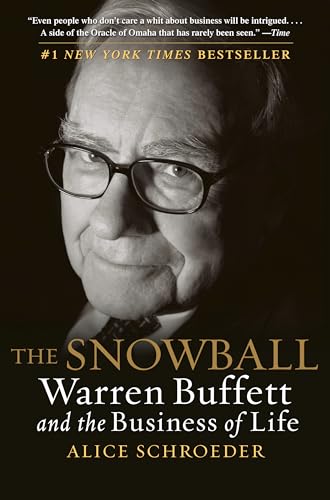
⚡️ What is The Snowball About?
Imagine being so obsessed with numbers that you track your weight on a graph every single day or memorize the populations of every city in Nebraska before you’ve even hit puberty. That’s the guy Alice Schroeder introduces us to in The Snowball. This isn’t your standard “buy low, sell high” manual; it’s an autopsy of a life dedicated to a single, compounding goal. Schroeder spent years with Buffett, and the result is a massive, unflinching look at how he became the world’s most successful investor by treating his entire life like a balance sheet.
The central argument here is that Buffett’s wealth didn’t come from a secret formula or a high-speed algorithm. It came from a psychological refusal to care what other people thought. Whether it was refusing to buy tech stocks during the dot-com bubble or living in the same modest house for sixty years, Buffett lived by an “Inner Scorecard.” If you’re looking for more Investing book summaries, you’ll find plenty that talk about P/E ratios, but More summaries by Alice Schroeder will show you that the math is the easy part—the temperament is what’s hard.
🚀 The Book in 3 Sentences
- Warren Buffett’s success is the result of an relentless “Inner Scorecard” that prioritizes personal standards over external validation.
- The book reveals how compounding applies not just to money, but to knowledge, relationships, and reputation over an eighty-year span.
- It exposes the heavy personal price of a singular focus, showing a man who mastered the global markets but often felt socially paralyzed in his own living room.
🎨 Impressions
I’ll be honest: I didn’t expect a book about a billionaire to be this… lonely? There’s a moment early on where Buffett is devastated by his wife, Susie, leaving him, and he’s so helpless he can’t even figure out how to turn on a stove or buy groceries. It’s a jarring contrast to the guy who can move markets with a single phone call. Schroeder doesn’t pull her punches. She shows the “Oracle” as a fragile, socially awkward genius who used money as a shield against a world he didn’t quite understand.
The sheer length of the book—nearly 1,000 pages—is intimidating, but the narrative flow kept me hooked. It reads more like a Greek tragedy than a business biography. I found myself dog-earing the sections about his childhood the most. Seeing how a kid who was verbally abused by his mother decided to become so rich that no one could ever hurt him again makes the whole “frugal billionaire” persona make a lot more sense. It’s not just about being cheap; it’s about control.
📖 Who Should Read The Snowball?
If you’re a value investor, this is your Bible. But honestly, it’s actually better for people who are obsessed with high performance and want to see the dark side of that trade-off. If you’re looking for a quick “10 steps to get rich” guide, skip this. This is for the reader who wants to understand the psychology of obsession and why “winning” at life isn’t always as simple as having the most points on the board.
☘️ How This Book Changed My Thinking
Before reading this, I thought Buffett was just a really smart guy who liked Coca-Cola and old newspapers. Now, I see him as the ultimate example of what happens when you decide on a “Circle of Competence” and never, ever leave it.
- I stopped worrying about being a “generalist” and started focusing on my own Inner Scorecard—doing things because they’re right, not because they look good.
- I realized that compounding is the most powerful force in the world, but it applies to habits and health just as much as it does to a brokerage account.
- I became much more aware of the “human element” in my own career, realizing that no amount of money compensates for failing the people you live with.
✍️ 3 Quotes That Stuck With Me
- “The big question about how people behave is whether they’ve got an Inner Scorecard or an Outer Scorecard.” — This is the central thesis of his entire life and explains why he doesn’t care about trends.
- “Life is like a snowball. The important thing is finding wet snow and a really long hill.” — It’s the simplest explanation of compounding I’ve ever heard, emphasizing that time is the most important variable.
- “I’ve never had any desire to be anyone else.” — This one hits differently when you realize how much pressure most people feel to conform to social expectations.
📒 Summary + Notes
Buffett’s life is the ultimate case study in the power of focus. From his first paper route to the acquisition of GEICO, he never stopped rolling his snowball. Schroeder argues that his genius wasn’t just math—lots of people are good at math—it was a psychological refusal to be distracted. He built a fortress around his mind, letting in only the information that helped him calculate value while ignoring the noise of Wall Street and popular culture.
By the end of the book, you realize that Berkshire Hathaway isn’t just a company; it’s a monument to Buffett’s personality. Every investment he made reflected his belief in “Margin of Safety” and the “Ovarian Lottery.” He understood that he was lucky to be born with a “big-number brain” in a capitalist society, and he spent the rest of his life making sure he didn’t waste that advantage. The narrative arc takes us from a fearful, skinny kid in Omaha to a man who basically acted as the lender of last resort for the US government in 2008.
🧠 Core Ideas Explained Simply
While the book is a biography, it centers on three massive concepts that Buffett used to build his empire.
The Inner Scorecard
How do you feel when you do something that you know is right, but everyone else thinks is stupid? If you have an Inner Scorecard, you don’t care about the criticism. Buffett used this to avoid the tech bubble in the late 90s. While everyone else was getting rich on dot-com stocks, he sat on the sidelines and was ridiculed for being “out of touch.” When the crash happened, his Inner Scorecard was what saved him while everyone else’s Outer Scorecard led them off a cliff.
The Circle of Competence
Is it better to know a little about everything or everything about one thing? Buffett argues that the size of your circle doesn’t matter as much as knowing where the perimeter is. He only invests in businesses he can understand—usually boring things like insurance, bricks, and candy. By staying inside his circle, he avoids the catastrophic mistakes that come from trying to be too clever in areas where he has no edge.
The Ovarian Lottery
Buffett famously says that if you were born in America in the 20th century with a talent for capital allocation, you won the ultimate lottery. He uses this concept to stay humble and to argue for higher inheritance taxes. He believes that your success is a mix of your own hard work and the massive luck of where and when you were born. This perspective is what drove his decision to give away the vast majority of his fortune to the Gates Foundation.
Part 1: The Less Traveled Road
Have you ever felt like a complete outsider at a party of high-achievers? The book opens at the Sun Valley conference in 1999, where the world’s elite were celebrating the tech boom. Buffett stood up and told them the party was over. He was the only person in the room who wasn’t buying the hype. This section sets the stage: Buffett is a man who is most comfortable when he’s alone with his thoughts, even if those thoughts contradict the most powerful people in the world.
Part 2: The Inner Scorecard
What kind of kid starts five different businesses before high school? This part covers Buffett’s childhood in Omaha and Washington D.C., where he was a “math prodigy” who struggled with a terrifyingly abusive mother. He found solace in numbers and money because they were predictable. He wasn’t just greedy; he was seeking autonomy. By the time he was a teenager, he was making more money than his teachers, all while filing his first tax return and deducting his bicycle as a business expense.
Part 3: The Graham Years
There is a moment early on where Buffett discovers Benjamin Graham’s book, “The Intelligent Investor,” and it’s like he finally found a map to the world. He tracked Graham down at Columbia University and became his star pupil. Graham taught him that a stock isn’t just a ticker symbol—it’s a piece of a business. This section is where the foundation of his wealth was laid. He learned to look for “cigar butts”—beaten-down companies that still had one good puff left in them—and he realized he could make a fortune by being more rational than the market.
Part 4: The Partnership
Could you convince your friends and family to give you their life savings when you’re only twenty-five years old? Buffett did. He started the Buffett Partnership out of his bedroom, and for the next decade, he absolutely crushed the market. He wasn’t even charging a management fee; he only took a cut of the profits above a certain threshold. This was the era of the “Buffett formula”—extreme concentration, deep research, and nerves of steel. He was compounding money at over 20% a year, and the snowball was finally starting to gain serious mass.
Part 5: Berkshire Hathaway
Why would the world’s greatest investor buy a dying textile mill? Buffett calls Berkshire Hathaway his “biggest mistake,” but it eventually became his greatest vehicle. He realized that the textile business was doomed, so he used the cash it generated to buy insurance companies. This gave him “float”—money that belonged to policyholders that he could invest for himself. This section follows the transformation of a small New England mill into a global powerhouse that owns everything from See’s Candies to the Burlington Northern railroad.
Part 6: The Business of Life
What happens when the man who has everything loses the one person who truly understood him? The final chapters are the most emotional. We see Susie Buffett leave him to seek her own life in San Francisco, and later, her battle with cancer. Buffett is portrayed not as a titan of industry, but as a grieving husband who is terrified of being alone. It’s a sobering reminder that while you can compound money forever, time is the one resource you can never get back. The book ends with Buffett deciding to give his wealth away, finally realizing that the “snowball” belongs to the world, not just to him.
⚖️ A Critical Perspective
Schroeder’s focus on Buffett’s personal failings sometimes feels like voyeurism rather than biography. While it humanizes him, you occasionally wonder if 900 pages was strictly necessary to communicate that a genius was bad at his feelings. Furthermore, the book was published in 2008, meaning we miss the last fifteen years of Berkshire’s evolution, which includes major shifts into tech stocks like Apple. It also arguably downplays the sheer degree of luck involved in the post-WWII American economic boom—the “wet snow” Buffett found was exceptionally cold and sticky compared to what investors face in 2025.
🔄 How It Compares
Compared to Robert Hagstrom’s The Warren Buffett Way, which focuses almost entirely on his stock-picking formulas, The Snowball is much more interested in his psychological makeup. Hagstrom gives you the “what,” but Schroeder gives you the “why.” If you want a technical manual, read Hagstrom; if you want to understand the man behind the desk, Schroeder is the only choice.
🔑 Key Takeaways
These are the lessons I took away from Buffett’s long-term approach to life and business.
- Guard your reputation above all else: You can lose money and make it back, but a reputation takes a lifetime to build and five minutes to ruin.
- Choose your heroes wisely: Buffett’s life was shaped by his idolization of Ben Graham; who you look up to determines where you land.
- The power of deferred gratification: The snowball only works if you don’t eat the snow while it’s still a small ball.
- Simplification is a superpower: Buffett succeeded by ignoring 99% of the world and mastering the 1% that he actually understood.
💬 Frequently Asked Questions
What is the main argument of The Snowball?
The book argues that Warren Buffett’s success is a product of his unique psychological temperament rather than just financial intelligence. By adhering to an ‘Inner Scorecard’ and focusing relentlessly on compounding knowledge and capital within his ‘Circle of Competence,’ he achieved unprecedented wealth while largely ignoring social pressures and market trends.
What does the book say about Buffett’s personal life?
It provides a surprisingly candid look at his struggles, particularly his emotional dependency on the women in his life and the pain caused by his wife Susie’s departure. Schroeder portrays him as a man who mastered the business world but was often socially awkward and emotionally vulnerable in his private relationships.
Is The Snowball worth reading for modern investors?
Yes, because it emphasizes timeless principles like the ‘Margin of Safety’ and the importance of temperament over IQ. While the specific stock examples are historical, the psychological discipline required to hold through market volatility is even more relevant in today’s high-speed, often irrational trading environment.
Why did Buffett stop talking to Alice Schroeder?
Though not explicitly detailed in the book itself, reports suggest Buffett was unhappy with how candid and raw the biography was. He had given Schroeder unprecedented access, but seeing his personal vulnerabilities and family tensions in print allegedly caused a rift, highlighting the tension between his public image and private reality.
How long does it take to read The Snowball?
Given it is nearly 1,000 pages, most readers spend several weeks on it. However, because it is written as a narrative biography rather than a textbook, it moves quickly. It’s a significant time investment, but it’s widely considered the most comprehensive account of Buffett’s life ever written.
Conclusion
At the end of the day, The Snowball is a book about the choices we make. We see a man who chose to be the best in the world at one specific thing, and we see exactly what that choice cost him in terms of his family, his health, and his peace of mind. It’s an inspiring story, but it’s also a cautionary one. Buffett’s life proves that you can achieve almost anything if you’re willing to be single-minded enough, but you have to be very careful about what you choose to ignore.
The one thing I’ll carry with me is the image of the snowball itself. It doesn’t start out as a giant; it starts as a tiny handful of snow that just refuses to stop rolling. Whether you’re building a career, a marriage, or an investment portfolio, the lesson is the same: find your wet snow, find your long hill, and just don’t stop. For anyone looking for the ultimate deep dive into the mind of a legend, this remains the gold standard of Investing book summaries.
More From Alice Schroeder →
Discover more from AI Book Summary
Subscribe to get the latest posts sent to your email.