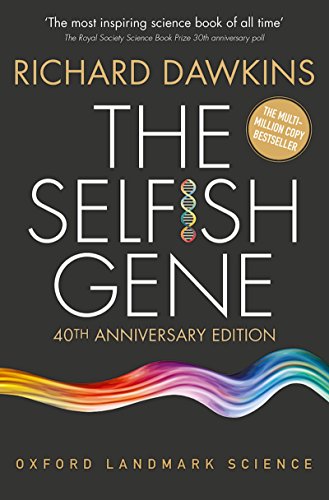
⚡️ What is The Selfish Gene about?
Richard Dawkins’ revolutionary work challenges everything we assume about evolution. Instead of viewing species or individuals as the primary actors in natural selection, this philosophy places the gene at center stage. Dawkins argues that we are essentially “survival machines”—elaborate vehicles built by genes to ensure their own replication and immortality. It’s a perspective that feels almost counterintuitive at first, yet the more you sit with it, the more the pieces of biological complexity snap into focus. More about Richard Dawkins
🚀 The Book in 3 Sentences
- The Selfish Gene proposes that genes—not individuals, groups, or species—are the fundamental unit of natural selection, using organisms as temporary vehicles for their own survival.
- Altruism in nature isn’t truly selfless; it’s genetically selfish behavior where organisms help relatives who share their genes, or engage in reciprocal cooperation that ultimately benefits their genetic lineage.
- Cultural evolution operates through “memes”—ideas that replicate and spread through human minds—creating a second replicator system parallel to genetic evolution.
🎨 Impressions
Reading this guide felt like having my mental furniture rearranged. Dawkins writes with the clarity of someone explaining the obvious after the fact, yet his insights are anything but obvious. There’s something slightly unsettling about viewing yourself as a lumbering robot programmed by microscopic replicators, but there’s also profound beauty in understanding the logic behind nature’s complexity. The book manages to be scientifically rigorous without sacrificing narrative flow—a rare achievement in popular science.
📖 Who Should Read The Selfish Gene?
This book is essential for anyone curious about the mechanics of evolution beyond high school biology. If you’ve ever wondered why animals behave the way they do—why parents sacrifice for children, why bees commit suicide defending the hive, or why sexual reproduction exists—this framework provides the answers. However, if you’re looking for spiritual comfort or human exceptionalism, you might find Dawkins’ mechanistic worldview cold. Those seeking practical self-improvement advice should explore more Self-Help books instead, as this is purely conceptual science.
☘️ How the Book Changed Me
How my life / behaviour / thoughts / ideas have changed as a result of reading the book.
- I stopped viewing human behavior through the lens of individual intention and started seeing the subtle genetic incentives behind our social instincts—why we favor family, why loyalty exists, why we reciprocate kindness.
- I developed a new appreciation for the distinction between genotype and phenotype, understanding that genes are not blueprints but recipes, and that the “extended phenotype” includes everything from beaver dams to bird nests.
- I became more critical of group selectionist explanations in everyday conversations, recognizing that what looks like altruism often camouflages genetic self-interest at the individual or kin level.
✍️ My Top 3 Quotes
- “We are survival machines—robot vehicles blindly programmed to preserve the selfish molecules known as genes.”
- “The gene will enter into complex alliances with other genes, forming coalitions that we recognize as chromosomes, genomes, and ultimately, organisms.”
- “Humans have the ability to simulate the future and hold in their minds alternative images of what might be, a gift that allows us to rebel against the tyranny of the selfish replicators.”
📒 Summary + Notes
The Selfish Gene by Richard Dawkins isn’t about genes having emotions or moral agency. Instead, it presents a rigorous argument for viewing evolution from the gene’s perspective—a shift that explains everything from cellular biology to animal behavior through one elegant principle: genes that successfully replicate become more common. This paradigm shift resolves the longstanding paradox of altruism in nature and provides the foundation for understanding why organisms behave as they do.
Preface: The Gene’s Eye View
Dawkins establishes his central thesis immediately: evolution is best understood from the perspective of the gene, not the individual or species. He acknowledges that while Darwin discovered natural selection, he lacked knowledge of genetics. Had Darwin known about DNA, Dawkins argues, he would have recognized that selection operates primarily on replicators—entities that make copies of themselves—rather than on whole organisms. This preface sets the stage for a radical reimagining of biology that distinguishes between the vehicle (the organism) and the replicator (the gene).
- Core argument: Evolutionary biology suffers from a bias toward the organismal level; correcting this requires viewing bodies as survival machines built by genes for gene preservation.
- Key insight: Unlike other popular science books of its time, this work insists that the gene is the fundamental unit of natural selection because it is the unit that actually persists through generations.
- Practical takeaway: When analyzing any biological trait, ask not “How does this help the species?” but rather “How does this help the gene replicate?”
- Reflection: This reframing immediately challenges our anthropocentric view of evolution, forcing us to see ourselves as temporary vehicles rather than the stars of the show.
Chapter 1: Why Are People?
Dawkins opens by questioning the unit of selection in evolution. Darwin introduced natural selection, but he didn’t know about genes. Dawkins argues that if Darwin had known about DNA, he would have recognized that selection acts primarily on genes rather than individuals or groups. This chapter establishes the “gene’s eye view”—a perspective shift that treats organisms as survival machines built by genes to ensure their own persistence through time. The implications are profound: evolution isn’t about what’s good for the species; it’s about what gets replicated.
- Core argument: Natural selection favors genes that build bodies capable of surviving and reproducing, not individuals or groups for their own sake.
- Key insight: A gene is defined as any portion of chromosomal material that potentially lasts for enough generations to serve as a unit of natural selection.
- Practical takeaway: This perspective helps explain why “for the good of the species” explanations often fail—the gene’s interest and the species’ interest frequently diverge.
- Reflection: Reading this chapter alongside Darwin’s On the Origin of Species highlights how much modern genetics has refined the original theory of evolution.
Chapter 2: The Replicators
The story begins in the primordial soup, where simple chemical accidents created the first replicators—molecules capable of copying themselves. These early replicators competed for raw materials, leading to an evolutionary arms race. Copying errors introduced variation, and natural selection began favoring replicators that built better survival machines around themselves. This chapter traces the origin of life not as a mystical event, but as an inevitable consequence of chemistry under the right conditions.
- Core argument: Life began when molecules accidentally gained the property of self-replication, creating the substrate for evolution.
- Key insight: Stability, fecundity, and longevity are the three essential properties that allow replicators to dominate the gene pool.
- Practical takeaway: Understanding that evolution requires no guiding intelligence—just replication, variation, and selection—demystifies the origin of complexity.
- Reflection: The simplicity of these initial conditions makes the emergence of life seem less miraculous and more statistically inevitable given enough time.
Chapter 3: Immortal Coils
Here Dawkins explains the structure of DNA—the double helix that serves as the modern replicator. Genes are potentially immortal, surviving through copies while individual bodies perish. This chapter clarifies that bodies are temporary and disposable, while genes persist across generations. The “immortality” of genes explains the profound loyalty they command from their survival machines—why parents sacrifice for offspring, why organisms endure hardship to reproduce.
- Core argument: Genes achieve immortality through accurate replication, while bodies are transient vessels discarded after transmitting genetic information.
- Key insight: A gene’s success is measured by its frequency in the gene pool, not by the happiness or longevity of its host organism.
- Practical takeaway: This perspective helps explain the biological imperative to reproduce—it’s the closest we come to the immortality our genes enjoy.
- Reflection: There’s something humbling about recognizing that my body is merely a temporary rented vehicle for genetic information billions of years old.
Chapter 4: The Gene Machine
Dawkins elaborates on how genes build bodies—complex survival machines programmed to protect and propagate their genetic cargo. Genes work as “cartels,” cooperating within chromosomes and bodies because their fates are linked. This chapter introduces the concept of phenotypic effects—how genes influence the world beyond the body through behavior and structure. It sets the stage for understanding that genes control bodies indirectly through protein synthesis, creating sophisticated robots without needing a conscious controlling intelligence.
- Core argument: Bodies are integrated colonies of genes that cooperate because they share a common exit strategy—gametes.
- Key insight: Genes influence behavior through developmental switches, creating instincts that served ancestral environments even if they misfire in modern contexts.
- Practical takeaway: Understanding that behaviors have genetic roots doesn’t mean they’re deterministic, but it does explain why changing habits often fights against deep evolutionary programming.
- Reflection: The concept of genetic cartels helps explain why multicellular life evolved—cooperation among genes created more effective survival machines than lone replicators.
Chapter 5: Aggression: Stability and the Selfish Machine
This chapter tackles animal aggression through game theory, introducing the Evolutionarily Stable Strategy (ESS). Dawkins explores the Hawk-Dove game, showing how aggression levels stabilize in populations not because they’re good for the group, but because alternative strategies get exploited. An ESS is a strategy that, when adopted by most of the population, cannot be bettered by any alternative. This explains why animals rarely fight to the death—unconditional aggression isn’t stable because it costs too much.
- Core argument: Aggression levels in nature represent ESSs—stable equilibria where unilateral deviation from the strategy is punished.
- Key insight: Retaliation strategies (like Retaliator) can be more stable than pure Hawk or Dove because they discourage exploitation without incurring constant combat costs.
- Practical takeaway: This explains why “peace through strength” emerges naturally in animal conflicts—it’s not morality, it’s mathematical stability.
- Reflection: The Hawk-Dove model reveals why limited aggression evolves: total war destroys both parties, making restraint genetically profitable.
Chapter 6: Genesmanship
Dawkins introduces kin selection—why animals help relatives. The concept of “genesmanship” or inclusive fitness explains that helping a sibling (who shares 50% of your genes) can be as genetically profitable as helping yourself, provided the cost-benefit ratio is right. This chapter resolves the paradox of altruism: bees committing suicide to defend the hive, birds warning their flocks of predators at risk to themselves. They’re not being selfless; they’re being genetic accountants, saving copies of their genes that reside in other bodies.
- Core argument: Hamilton’s Rule (rB > C) determines when altruism evolves: when the relatedness (r) times the benefit (B) exceeds the cost (C).
- Key insight: The green beard effect—genes that recognize and help copies of themselves in other organisms—though rare in nature, represents the logical extreme of selfish gene theory.
- Practical takeaway: Understanding kin selection helps explain nepotism and why we feel stronger obligations to family than strangers—it’s not just cultural, it’s ancestral logic.
- Reflection: This chapter demolished my romantic view of animal altruism, replacing it with something more beautiful: a precise mathematical logic underlying social bonds.
Chapter 7: Family Planning
This chapter examines parental investment—the resources parents allocate to offspring. Dawkins argues that genes for prudent family size outcompete genes for reckless overproduction because offspring quality often matters more than quantity. The chapter explores how offspring manipulate parents and vice versa, introducing the concept that parent-offspring relationships contain elements of conflict despite shared genetic interests. Parents must balance current investment against future reproduction, creating complex strategic decisions.
- Core argument: Parents face optimization problems in allocating limited resources among offspring to maximize the number of surviving grandchildren.
- Key insight: The optimal litter size for a parent is often smaller than what an individual offspring would prefer, creating tension in the family unit.
- Practical takeaway: This explains why weaning conflicts occur—offspring want more investment than parents are genetically programmed to give.
- Reflection: The economic logic of parental investment makes family conflicts seem less like moral failures and more like inevitable resource negotiations.
Chapter 8: Battle of the Generations
Expanding on family dynamics, Dawkins explores genetic conflicts between parents and offspring, and among siblings. Because siblings share only 50% of genes on average, they compete for parental resources while parents try to distribute them equitably (from the genetic perspective). This chapter reveals the “tragedy of the commons” within families, where individual selfishness can harm the group. It also discusses genomic imprinting, where genes from mothers and fathers may have conflicting interests, particularly in placental mammals.
- Core argument: Parent-offspring conflict is inevitable because parents value all offspring equally while each offspring values itself more than its siblings.
- Key insight: Genes from fathers and mothers may have different evolutionary interests, especially regarding offspring growth rates, leading to genetic tug-of-wars.
- Practical takeaway: Understanding these conflicts normalizes adolescent rebellion and sibling rivalry as biological strategies rather than moral failures.
- Reflection: It’s fascinating to think that my body contains conflicting genetic factions—paternal genes pushing for more resources, maternal genes advocating restraint.
Chapter 9: Battle of the Sexes
Dawkins applies selfish gene theory to sexual selection and mating strategies. Because eggs are expensive and sperm cheap, females are typically choosier than males, creating asymmetry in parental investment. This chapter explains sexual dimorphism, courtship rituals, and why males often compete while females choose. It also examines sex ratios and the optimal strategies for each sex, including the “sexy son” hypothesis and the evolutionary arms race between male deception and female discrimination.
- Core argument: Sexual asymmetry in investment drives divergent reproductive strategies between males and females.
- Key insight: Fisher’s principle explains why sex ratios tend toward 1:1—any deviation creates frequency-dependent selection favoring the rarer sex.
- Practical takeaway: This analysis reveals why certain mating behaviors persist across cultures—they’re not purely social constructions but evolved strategies.
- Reflection: The cold logic of sexual selection explains phenomena from peacock tails to human dating rituals without invoking mysticism.
Chapter 10: You Scratch My Back, I’ll Ride on Yours
This chapter explores reciprocal altruism—cooperation between non-relatives. Using the Prisoner’s Dilemma from game theory, Dawkins shows how “Tit for Tat” strategies can evolve: cooperate first, then mirror your partner’s previous move. This explains cleaner fish, warning calls, and human friendship. The key is that cooperation must be reciprocal; cheaters are punished by withdrawal of future cooperation. This bridges the gap between genetic selfishness and social cooperation without invoking group selection.
- Core argument: Reciprocal altruism evolves when individuals interact repeatedly, recognize each other, and benefit from mutual cooperation exceeding the costs.
- Key insight: The “shadow of the future”—the expectation of future interaction—is essential for cooperation to stabilize; one-shot encounters favor defection.
- Practical takeaway: This explains the biological basis of trust and reputation—our brains evolved to track who cooperates and who cheats.
- Reflection: Realizing that friendship has genetic foundations doesn’t cheapen it; rather, it reveals how sophisticated evolutionary strategies can produce genuine loyalty.
Chapter 11: Memes: The New Replicators
Perhaps the most famous chapter, Dawkins introduces memes—units of cultural transmission that evolve by natural selection in the environment of human minds. Memes (tunes, catchphrases, fashion, technologies) replicate through imitation and spread when they’re memorable or useful. This creates a new replicator that evolves much faster than genes. Dawkins suggests that with memes, humans have potentially escaped the tyranny of the selfish gene, creating a new evolutionary system based on culture rather than biology.
- Core argument: Culture evolves through memetic replication, creating a Lamarckian system where acquired characteristics can be inherited.
- Key insight: Memes and genes sometimes conflict—celibacy is a meme that survives despite being genetically suicidal.
- Practical takeaway: Being selective about which memes we host in our minds is as important as genetic health—cultural viruses can be as damaging as biological ones.
- Reflection: The meme concept revolutionized how I view social media and viral trends—we’re not just sharing ideas; we’re being colonized by them.
Chapter 12: Nice Guys Finish First
Expanding on Chapter 10, this chapter provides deeper analysis of the Prisoner’s Dilemma and cooperative strategies. Dawkins discusses computer tournaments where “Tit for Tat” won because it was nice (never defected first), retaliatory (punished defection), and forgiving (returned to cooperation after punishing). This refutes the cynical view that only selfishness succeeds. The chapter argues that in the long run, niceness pays off because it builds stable alliances, provided cheaters are adequately punished.
- Core argument: Evolutionary stable cooperative strategies are provable, nice, and forgiving—they create better outcomes than pure selfishness in iterated games.
- Key insight: The success of cooperation depends on the average number of future interactions; stable communities foster niceness.
- Practical takeaway: In business and personal relationships, establish yourself as a cooperator but maintain boundaries—be nice, but don’t be a pushover.
- Reflection: This provides hope that human cooperation isn’t just a veneer over selfishness but an evolutionarily stable strategy.
Chapter 13: The Long Reach of the Gene
Dawkins introduces the “extended phenotype”—the idea that genes express themselves not just within bodies but in the external world. Beaver dams, spider webs, and bird nests are as much expressions of genes as hair color. This chapter argues that the boundary of an organism is arbitrary; genes influence the world at large through their effects. This extends the selfish gene perspective beyond the skin, showing how genes manipulate the environment to ensure their survival.
- Core argument: Phenotypic effects extend beyond the organism’s body into the environment, including other organisms (parasites manipulating hosts).
- Key insight: The distinction between organism and environment is blurred when we recognize that genes modify their external world as deliberately as their internal chemistry.
- Practical takeaway: Technology and architecture are human extended phenotypes—external genetic expression that allows us to modify our environment faster than biological evolution permits.
- Reflection: This perspective unifies biology, showing that beehives, termite mounds, and human cities are all extended phenotypes—external genetic expression.
Epilogue to the 40th Anniversary Edition
Dawkins reflects on the book’s legacy and clarifies common misunderstandings. He emphasizes that “selfish” genes don’t preclude cooperative organisms—in fact, they often necessitate cooperation. He reiterates that the book is about units of selection, not genetic determinism or morality. The epilogue defends the gene-centered view against later criticisms and celebrates the discovery of genes as digital information—immortal replicators that encode the history of life. He concludes by noting that the story of evolution is always the story of replicators, whether genes, memes, or hypothetical alien equivalents.
- Core argument: The selfish gene perspective is about the level at which selection operates, not about selfish individual behavior.
- Key insight: Genes are digital information that can theoretically be decoded to reveal the entire history of life on Earth.
- Practical takeaway: A common mistake is confusing genetic self-interest with conscious selfishness—genes are “selfish” mathematically, not emotionally.
- Reflection: The book remains relevant because it asks the right question: what is the fundamental unit of replication, and what does it “want”?
Key Takeaways
After journeying through this paradigm-shifting framework, several core lessons emerge that restructure how we view biology and behavior.
- The gene’s eye view: Evolution operates on replicators, not vehicles. Understanding this resolves the paradox of altruism and explains why organisms behave in ways that seem to sacrifice individual welfare for genetic success.
- ESS and cooperation: Stable cooperation evolves not through group selection but through strategies like Tit for Tat that make cooperation individually beneficial in the long run.
- Extended phenotypes: Biological influence extends beyond the body. Recognizing that animals modify their environment as genetic expression blurs the line between organism and world.
- Memetic evolution: Humans possess a second inheritance system—culture. This creates unique capacity for rapid adaptation and rebellion against biological imperatives.
- Limitations and criticism: While powerful, gene-centrism sometimes overlooks the complexity of emergent properties in development and the role of epigenetics. Additionally, readers often commit the naturalistic fallacy—assuming that because something evolved, it is morally justified. The book describes what is, not what ought to be.
Conclusion
The Selfish Gene remains essential reading not because it provides comforting answers, but because it asks unsettling questions with crystalline clarity. By shifting our gaze from the organism to the gene, Dawkins reveals the hidden logic of nature—why we love our children, why we cooperate with strangers, why sex exists, and why we die. While critics argue the perspective is reductionist, the framework’s predictive power is undeniable. Whether you’re a biologist, philosopher, or simply curious about why you are the way you are, this book offers a lens that, once adopted, changes how you see every living thing. The genes may be selfish, but understanding them makes us wise.
More From Richard Dawkins →
Discover more from AI Book Summary
Subscribe to get the latest posts sent to your email.