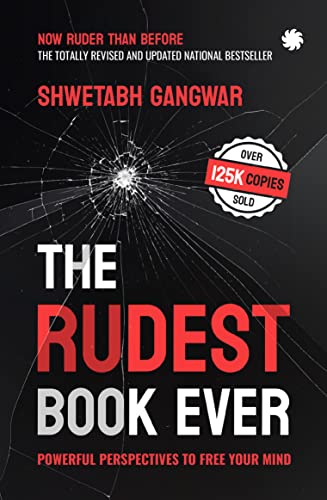
⚡️ What is The Rudest Book Ever About?
Have you ever felt like your brain is just a collection of everyone else’s opinions? That’s the punch-to-the-gut premise of Shwetabh Gangwar’s manifesto. He doesn’t sugarcoat the reality that most of us are essentially walking, talking products of our upbringing, social media feeds, and outdated school systems. It’s a book that lives up to its name by stripping away the fluffy self-help platitudes and replacing them with cold, hard logic. More summaries by Shwetabh Gangwar show his consistent focus on radical self-reliance, but this is arguably his most unfiltered work.
The author argues that we’ve been trained on “what to think” rather than “how to think.” We’ve been fed a diet of specialness and entitlement that makes us miserable the moment the real world doesn’t treat us like the protagonists of a movie. By the time you finish this, you’ll realize that most of your problems stem from a lack of self-respect and an over-reliance on external validation. It’s a foundational text for anyone diving into psychology book summaries because it deals with the very architecture of the self.
🚀 The Book in 3 Sentences
- Society conditions us with ‘what to think’ rather than ‘how to think,’ leaving us with a mind full of borrowed data and no personal logic.
- The pursuit of ‘specialness’ and hero-worship are traps that dismantle your self-respect and make you vulnerable to manipulation.
- True mental freedom requires treating yourself as a ‘product’ that needs objective assessment and constant refinement through rational thought.
🎨 Impressions
I’ll be honest: I went into this expecting a gimmick. The title sounds like clickbait for angry teenagers. But once I got past the aggressive tone, I realized Shwetabh is doing something rare. He’s teaching basic epistemological hygiene. He’s asking, “How do you know what you know?” It’s a refreshing break from the ‘toxic positivity’ that plagues the self-help shelf. I don’t need another book telling me I’m a star; I need a book telling me I’m a mess and explaining why it’s my fault.
There’s a section on “hero-worship” that genuinely made me pause. We’re so used to putting people on pedestals—CEOs, actors, influencers—that we forget they’re just collections of traits. Gangwar’s advice to admire traits rather than people is a massive perspective shift. It’s the difference between wanting to *be* Elon Musk and wanting to *possess* his work ethic. One leads to disappointment, the other to growth. It’s a blunt, no-nonsense guide that feels like a cold shower for your ego.
📖 Who Should Read The Rudest Book Ever?
If you’re stuck in a loop of seeking approval from strangers on the internet, this is your wake-up call. It’s perfect for young adults who feel lost in the ‘specialness’ trap or anyone who feels like their happiness is constantly dictated by others. However, if you’re looking for a gentle, empathetic guide to healing trauma, you won’t find it here. This is for the person who wants to be told the truth, even if it hurts.
☘️ How This Book Changed My Thinking
Before reading this, I didn’t realize how much of my identity was built on “borrowed logic.” I’d adopt opinions simply because they sounded smart or were held by people I admired. Shwetabh’s framework for processing data changed how I react to everything from social media trends to personal insults.
- I stopped looking at rejection as a failure and started seeing it as a data point that says more about the situation than my worth.
- I’ve replaced the ‘Arrival Fallacy’—the idea that I’ll finally be happy when I get X—with a focus on the daily process of being a better ‘product.’
- I no longer engage in hero-worship; I look for specific traits in people to learn from, rather than buying into their entire persona.
✍️ 3 Quotes That Stuck With Me
- “You are a product of your parents, your teachers, your friends, and the society you live in.” — This hits hard because it forces you to audit who actually built the ‘you’ that exists today.
- “Specialness is a disease.” — I love this because it destroys the entitlement that makes us feel like the world owes us a living.
- “Self-respect is the only thing that will keep you sane.” — It reminds me that internal standards are the only defense against a chaotic world.
📒 Summary + Notes
The Rudest Book Ever is a structured demolition of the modern ego. It begins by identifying the core problem: we are socialized to be products, not thinkers. From childhood, we are told what to believe, what to value, and who to look up to. This creates a fragile self-image that breaks the moment it encounters reality. Shwetabh builds his case by showing how this lack of personal logic leads to ‘Arrival Fallacy’ (thinking happiness is a destination) and ‘Enmeshment’ (losing yourself in others).
As the book progresses, it shifts from identifying the rot to providing the cure: self-respect. Unlike self-esteem, which often relies on external praise, self-respect is about your internal relationship with yourself. It’s about being a person you would actually like to hang out with. By the end, the author wants you to realize that your mind is your only true sanctuary, and keeping it clear of ‘weird data’ and hero-worship is your most important job.
🧠 Core Ideas Explained Simply
While the tone is aggressive, the underlying concepts are rooted in cognitive behavioral principles and stoicism.
The ‘How to Think’ Framework
School teaches you the answers, but it doesn’t teach you the process of questioning. Learning how to think means developing a mental filter that asks: Is this my opinion? Is this based on fact or emotion? Does this align with my observed reality? It’s about becoming a scientist of your own life rather than a blind follower.
Admiration vs. Inspiration
Why do we deify celebrities? Admiration puts people on a pedestal and makes us feel inferior. Inspiration, however, is about identifying a specific skill or habit and trying to replicate it. You don’t need a hero; you need a blueprint. When you stop admiring the person, you stop being blinded by their flaws and start learning from their successes.
The Arrival Fallacy
Have you ever thought, “Once I get that promotion, I’ll be happy”? That’s the Arrival Fallacy. It’s the lie that a specific milestone will permanently change your state of being. Gangwar argues that satisfaction is found in the ‘product’ (you) functioning well, not in the accolades the product receives.
1: You are a Product
You aren’t a mystical soul or a unique snowflake; you’re a product of your environment. Shwetabh opens with the claim that every belief you hold was likely handed to you by someone else. If you grew up in a different house, you’d have different gods and different politics. Acknowledging this isn’t depressing—it’s liberating. It means you can choose to “re-manufacture” yourself.
2: Learn How to Think
Why is it that we spend sixteen years in school learning *what* to think, but not a single afternoon learning *how* to think? This chapter argues that our brains are currently like open dumpsters for data. We need to build a processing plant. Learning how to think involves:
- Recognizing personal biases.
- Questioning the source of every piece of ‘weird data’ (unverified information).
- Building a personal logic system that doesn’t crumble under social pressure.
3: The Dunning-Kruger Effect
Imagine a guy who has read one Wikipedia article and now thinks he can out-debate a doctor. That’s the Dunning-Kruger effect in action. Shwetabh explains that the less you know, the more confident you are. He uses this to humble the reader, suggesting that our absolute certainty about our “opinions” is often just a symptom of our ignorance. Real wisdom starts with saying “I don’t know.”
4: People are Not Special
There is a massive lie circulating in our culture, and it’s the idea that everyone is special. Shwetabh argues that this ‘specialness’ is a burden. It makes you feel like life owes you something. When the world ignores your ‘special’ self, you get bitter. If you accept that you are ordinary, you can actually work on becoming extraordinary through effort rather than entitlement.
5: Stop Looking for Heroes
Do you have a hero you’d defend to the death? Shwetabh asks why we feel the need to worship flawed human beings. When we create heroes, we stop thinking critically. We excuse their mistakes and try to copy their lives, which is impossible because we aren’t them. He suggests looking for “inspired traits” instead of “heroic people.”
6: The Problem with “What to Think”
The author draws a line in the sand between data and wisdom. Being fed “what to think” turns you into a parrot. It’s why people get so angry when their beliefs are challenged; they don’t *own* those beliefs, so they feel like their very existence is under attack. If you build your own logic, a challenge to your ideas is just an opportunity to refine them.
7: Rejections
Getting told “no” usually feels like a personal attack on your soul. Shwetabh recontextualizes rejection as mere information. If you ask someone out and they say no, it’s not a verdict on your value as a human; it’s a statement of their preference. Don’t let rejection stop your ‘product’ from moving forward.
8: Admiration
Admiration is a sneaky form of self-sabotage. When you admire someone too much, you subconsciously decide that you are inferior to them. It stops you from acting. You become a spectator of someone else’s life. Shwetabh wants you to kill the fan inside you and start being the creator of your own experience.
9: Satisfaction
Think about the last time you achieved a big goal. How long did the happiness last? An hour? A day? Shwetabh explores the Arrival Fallacy here, explaining that humans are wired to keep moving. Satisfaction doesn’t come from the trophy; it comes from knowing that your ‘product’ is operating at its highest capacity.
10: Self-Respect
Self-respect is often confused with being an arrogant jerk. In reality, it’s about having a set of standards that you refuse to break for anyone. It’s the ability to be alone with yourself and not hate the company. Without self-respect, you are just a leaf in the wind, constantly changing to please whoever is looking at you.
11: Relationship Advice (Enmeshment)
Entering a relationship often feels like two people trying to merge into one blob. Shwetabh calls this enmeshment, and it’s toxic. A relationship should be two complete individuals walking the same path, not two halves trying to make a whole. If you need someone else to complete you, you’re just a broken product looking for a spare part.
12: The Screen
Your phone is currently winning the war for your attention. This chapter is a warning about the “weird data” we consume through screens. We are constantly comparing our ‘behind-the-scenes’ with everyone else’s ‘highlight reel.’ It’s a recipe for misery. Shwetabh urges us to put the screen down and deal with our own reality.
13: Conclusion
The book ends with a simple call to action: start thinking. The rudeness was necessary to break through the noise of a society that wants you to be a mindless consumer. Your mind is your only weapon in this life; don’t let it go to waste.
⚖️ A Critical Perspective
While the ‘tough love’ approach is effective, the book occasionally oversimplifies complex psychological issues. Shwetabh treats the human mind like a logical computer, but for people dealing with deep-seated trauma or clinical depression, simply “choosing to think differently” isn’t always possible. The advice on relationships is solid but ignores the nuance of emotional vulnerability, sometimes making it sound like any form of dependence is a weakness. It’s a great manual for self-optimization, but it shouldn’t replace professional therapy for those who need it.
🔄 How It Compares
Compared to Mark Manson’s The Subtle Art of Not Giving a F*ck, this book is much more focused on the *process* of thinking. While Manson focuses on what to care about, Gangwar focuses on how to analyze the data that informs those cares in the first place. It’s less about philosophy and more about mental engineering.
🔑 Key Takeaways
These are the fundamental shifts required to reclaim your mind:
- Identify your ‘borrowed logic’—make a list of things you believe only because you were told to.
- Replace hero-worship with trait-analysis; learn skills, not idols.
- Treat rejection as data, not a death sentence.
- Recognize that happiness is not a destination (Arrival Fallacy), but a byproduct of a well-functioning mind.
💬 Frequently Asked Questions
What is the main argument of The Rudest Book Ever?
The main argument is that humans are conditioned to be ‘products’ who are told what to think rather than how to think. This leads to a lack of self-respect and a dependence on external validation. Shwetabh argues for a return to personal logic and radical self-reliance to find true satisfaction.
Is the book actually rude or offensive?
The book isn’t rude for the sake of being mean; it’s ‘rude’ because it delivers blunt, uncomfortable truths. It attacks the reader’s ego and the idea that everyone is ‘special’. It’s offensive only to those who are deeply invested in their own sense of entitlement or social conditioning.
What is the ‘How to Think’ framework Shwetabh mentions?
It is a mental process where you audit the information (weird data) you receive from society. Instead of blindly accepting beliefs, you question their source, check them against reality, and filter them through your own logical standards. It’s about becoming an active processor of information rather than a passive consumer.
What does the book say about hero-worship?
Gangwar claims that hero-worship is dangerous because it stops critical thinking and creates a sense of inferiority. He suggests replacing it with ‘trait-based inspiration’. You should admire specific qualities in a person—like discipline or creativity—rather than putting the entire flawed human being on a pedestal.
Who is the target audience for this book?
The book is primarily targeted at young adults and anyone feeling lost in the modern world of social media comparison. It’s for people who are tired of soft self-help and want practical, logical advice on building self-respect and mental clarity. It’s especially useful for those prone to seeking external approval.
Conclusion
Ultimately, The Rudest Book Ever isn’t about being a jerk to others; it’s about being brutally honest with yourself. It’s a call to stop being a passive recipient of your life and start being the active architect of it. Shwetabh Gangwar reminds us that the world doesn’t owe us happiness or a sense of importance. We have to earn our own respect by cleaning out the garbage from our minds and building a life based on our own logic.
If you carry one thing away from this summary, let it be the realization that you are allowed to dismantle your identity and start over. You don’t have to be the version of yourself that your parents or your Instagram feed created. By applying the principles of psychology book summaries like this one, you can finally start thinking for yourself. Put the screen down, stop looking for heroes, and go do the work.
More From Shwetabh Gangwar →
Discover more from AI Book Summary
Subscribe to get the latest posts sent to your email.