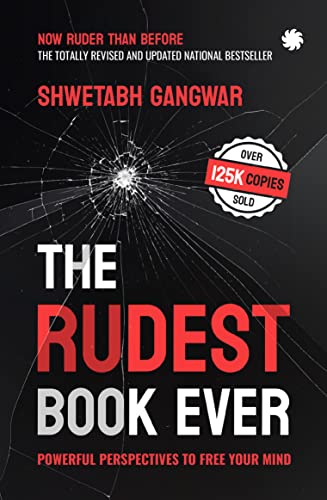
⚡️ What is The Rudest Book Ever about?
The Rudest Book Ever by Shwetabh Gangwar is a brutal, no-nonsense guide to self-improvement that throws political correctness out the window. It’s not a gentle, feel-good book; it’s a verbal slap designed to wake you up from your conditioned slumber. The core premise is that you are a product of your genes, upbringing, and environment, and you’ve likely been programmed to be weak, compliant, and unhappy. Gangwar uses his signature blunt and often profane style to force you to engage in radical self-honesty. The book aims to dismantle your false beliefs, fragile ego, and dependency on external validation. It’s a manual for developing an analytical, self-reliant mindset capable of navigating life’s challenges with clarity and strength, ultimately leading you toward genuine contentment rather than the fleeting pursuit of happiness.
🚀 The Book in 3 Sentences
- The Rudest Book Ever is a call to deconstruct your conditioned self by embracing radical honesty and questioning everything you’ve been taught.
- It teaches you to build unshakable mental fortitude by taking complete ownership of your life, setting firm boundaries, and detaching your self-worth from external outcomes.
- The ultimate goal is to cultivate a state of self-reliance and inner contentment, free from the need for societal approval and capable of handling any problem life throws your way.
🎨 Impressions
Reading The Rudest Book Ever felt like a much-needed, albeit harsh, dose of reality. Shwetabh Gangwar’s tone is intentionally abrasive, and it works as a powerful tool to cut through the noise of typical self-help fluff. I found the bluntness incredibly refreshing; it’s like having a brutally honest friend who tells you what you need to hear, not what you want to hear. The book forces you to confront uncomfortable truths about yourself and society. While the language can be jarring, the underlying message is pure gold. It’s not about being rude for the sake of it; it’s about being direct because the truth is often uncomfortable. This approach makes the lessons stick in a way that gentle encouragement never could, making it a truly transformative read for those ready to listen.
📖 Who Should Read The Rudest Book Ever?
This book is for anyone tired of conventional, sugar-coated advice and ready for a raw, unfiltered perspective on personal growth. It’s ideal for young adults feeling lost or stuck, individuals struggling with people-pleasing tendencies, or anyone who feels like a victim of their circumstances. If you’re at a point where you’re willing to question your own beliefs and embrace discomfort to become stronger, The Rudest Book Ever is your manual. It’s not for the faint of heart or those easily offended by strong language. It’s for the person who is done making excuses and is genuinely ready to take control of their own mind and life.
☘️ How the Book Changed Me
\p>Reading The Rudest Book Ever fundamentally shifted my perspective on responsibility and personal boundaries. Before, I often found myself blaming external factors for my dissatisfaction and struggled to say ‘no’ without feeling guilty. The book’s emphasis on radical self-ownership was a wake-up call. I stopped seeing myself as a passive recipient of life’s events and started viewing myself as the primary agent in my own story. This wasn’t an overnight change, but a gradual rewiring of my thought process that has led to more decisive action and, frankly, more peace of mind.- I became much more aware of my own conditioned responses and now actively question my initial reactions to situations.
- I started setting and enforcing clear personal boundaries in both my personal and professional life, which has reduced my stress levels significantly.
- I’ve learned to detach my self-worth from other people’s opinions and the outcomes of my efforts, focusing instead on the process and my own growth.
- I approach problems with a more analytical and less emotional mindset, looking for solutions rather than dwelling on the problem itself.
✍️ My Top 3 Quotes
- “You are not a tree. If you don’t like where you are, move.”
- “Respect is earned, not demanded. You earn it by how you behave, not by what you say.”
- “Happiness is a fleeting emotion, contentment is a state of being. Don’t chase happiness, build contentment.”
📒 Summary + Notes
My deep dive into The Rudest Book Ever revealed a systematic process for dismantling the conditioned self and rebuilding a stronger, more authentic version. Shwetabh Gangwar acts as a drill sergeant, forcing you to confront the uncomfortable truths about your programming. The book is structured to first break you down by exposing your weaknesses and societal conditioning, then build you back up with principles of self-discipline, analytical thinking, and emotional resilience. It’s a journey from being a reactive product of your environment to becoming a proactive architect of your own life. The following chapter-by-chapter summary distills these core lessons and mental toughness techniques.
Chapter 1: The Problem with You
The book opens by immediately putting you on the defensive. Gangwar states that the primary problem in your life is you. He argues that you are a delusional, conditioned entity who believes you have free will, but your decisions are largely driven by subconscious programming from your upbringing and environment. This chapter is a direct assault on your ego, designed to make you defensive and, hopefully, curious. The goal is to make you realize that your perception of reality is flawed and that you are operating on a faulty operating system installed by others. It’s a shocking but necessary first step to force you to question everything you hold true about yourself.
- Your biggest problem is your ignorance about your own ignorance.
- You are not as unique or special as you think; you are a product of predictable programming.
- The first step to change is accepting that you are the problem and you need to fix yourself.
- Gangwar uses harsh language to break through your mental defenses and bypass your ego.
- This chapter sets the tone: this will not be a comfortable journey, but it will be a necessary one.
Chapter 2: Deconstructing Your Identity
Here, Gangwar breaks down the components that form your identity: your genes, your upbringing, and your environment. He explains that these three factors have created a unique cocktail of strengths, weaknesses, biases, and desires that you mistake for your ‘true self’. Your values, beliefs, and even your preferences are not entirely your own; they have been heavily influenced by your parents, culture, and life experiences. The chapter urges you to analyze these influences objectively. By understanding where your programming comes from, you can begin to separate which parts of your identity are authentic and which are merely conditioned responses, giving you the power to change what you no longer wish to keep.
- Your identity is a constellation of influences, not a fixed, singular entity.
- Genes provide the hardware, but upbringing and environment install the software.
- Many of your deepest beliefs are just inherited opinions you’ve never questioned.
- True self-awareness begins with understanding the origins of your thoughts and behaviors.
- Deconstruction is not about self-hatred, but about gaining clarity and control over your own mind.
Chapter 3: The Power of Introspection
This chapter champions introspection as the primary tool for self-discovery. Gangwar argues that most people live their lives looking outward for answers—blaming others, seeking validation—when the real answers lie within. Introspection, in this context, is not casual daydreaming but a rigorous, analytical process of examining your own thoughts, emotions, and motivations. It’s about asking yourself ‘why’ you feel a certain way or ‘why’ you want a certain thing. The author suggests that this practice is difficult and painful because it forces you to confront your own flaws and irrationalities. However, it is the only way to break free from external control and start living a life guided by your own conscious principles.
- Introspection is the surgical tool for removing your conditioned beliefs.
- You must be willing to face uncomfortable truths about your own motives and desires.
- Stop comparing yourself to others; the only valid comparison is with who you were yesterday.
- Ask ‘why?’ relentlessly until you reach the root cause of your behavior.
- Journaling and meditation are practical techniques for facilitating deep introspection.
Chapter 4: Self-Discipline: Your Inner Police Force
Gangwar uses the powerful metaphor of an inner police force to describe self-discipline. He argues that your mind, like a country, has internal criminals—your destructive tendencies, procrastination, and irrational impulses. Without a strong internal police force (self-discipline), these criminals will run rampant, leading to chaos and misery. This chapter is about taking responsibility for policing your own mind. It means consciously choosing to do what is necessary and beneficial in the long term, even when it’s difficult or unpleasant in the short term. Self-discipline is not about punishment; it’s about creating order, focus, and alignment between your actions and your goals.
- Your mind needs a governing system to manage its chaotic and destructive impulses.
- Self-discipline is the act of aligning your current actions with your long-term vision.
- It’s about saying ‘no’ to your immediate gratification-seeking self.
- Building discipline is like building a muscle; it starts small and gets stronger with consistent practice.
- Without self-discipline, you are a slave to your whims and external circumstances.
Chapter 5: Boundaries: The Art of Saying No
This chapter is a masterclass in setting and enforcing personal boundaries, a topic Gangwar considers critical for self-respect. He explains that a lack of boundaries is an open invitation for others to disrespect and exploit you. Boundaries are not about being mean or aggressive; they are about clearly communicating what is and is not acceptable treatment of you. This applies to all relationships: family, friends, romantic partners, and colleagues. The author emphasizes that setting boundaries will be difficult initially, as people who benefited from your lack of them will push back. However, holding firm is essential for protecting your mental peace and maintaining your autonomy.
- Your boundaries define the terms of engagement for how others can treat you.
- Saying ‘no’ is not selfish; it is an act of self-preservation and self-respect.
- People who get angry when you set boundaries are the ones who were disrespecting them.
- You are responsible for teaching people how to treat you by what you allow.
- Strong boundaries lead to healthier, more respectful relationships and a stronger sense of self.
Chapter 6: Understanding People
Gangwar shifts focus to understanding others, advocating for an analytical and evidence-based approach over an emotional one. He encourages you to become a ‘people scientist’—observing human behavior without judgment to understand the underlying motivations. People are driven by their own programming, insecurities, and desires, just like you. By understanding this, you can stop taking things personally and start predicting and navigating social situations more effectively. This chapter teaches you to look past what people say and see what they do. Actions, not words, reveal true character and intent. This objective lens helps you avoid being manipulated or disappointed by unrealistic expectations.
- Stop judging people and start analyzing their behavior as a scientist would.
- Most people are not thinking about you; they are consumed by their own insecurities and problems.
- Separate the person from their behavior; understand that their actions are a result of their own conditioning.
- Listen more than you talk, and pay attention to non-verbal cues and patterns of behavior.
- Understanding human nature protects you from emotional manipulation and unnecessary drama.
Chapter 7: Navigating Failure and Rejection
Failure and rejection are inevitable parts of life, and this chapter provides a framework for dealing with them. Gangwar’s advice is simple yet profound: detach your identity from outcomes. A failed project or a rejection from a person does not diminish your inherent worth. He argues that you should view failure as data—as feedback on what didn’t work, not as a judgment on your character. Rejection is simply a mismatch of expectations or desires, not a reflection of your value. By adopting this mindset, you can become resilient. You learn to get back up, analyze the failure, learn from it, and try again, without the emotional devastation that paralyzes most people.
- Failure is a necessary step in the process of learning and growth.
- Your self-worth should be internal and non-negotiable, not dependent on external validation.
- See rejection as redirection—a sign that something better is out there for you.
- Don’t celebrate failure, but extract the lesson from it and move on quickly.
- The more you detach your ego from outcomes, the more fearless and effective you become.
Chapter 8: The Pursuit of Contentment vs. Happiness
In this chapter, Gangwar distinguishes between happiness and contentment, arguing that the former is a fleeting emotion while the latter is a stable state of being. Happiness is often tied to external events—a new purchase, a compliment, a success—and is therefore temporary and unreliable. Chasing it leads to a perpetual cycle of highs and lows. Contentment, on the other hand, is an internal state of peace and acceptance that is not dependent on external circumstances. It comes from self-awareness, self-acceptance, and living in alignment with your own values. The author advises focusing on building a life that fosters contentment through discipline, meaningful work, and strong boundaries, rather than chasing the temporary high of happiness.
- Happiness is a reaction; contentment is a state of mind.
- Chasing happiness is a fool’s errand because it is inherently fleeting.
- Contentment is built on a foundation of self-respect, discipline, and purpose.
- True peace comes from accepting what you cannot control and focusing on what you can.
- Stop seeking pleasure and start building a life you don’t need to escape from.
Chapter 9: Problem-Solving and Embracing Pain
Gangwar posits that pain and problems are not aberrations but fundamental components of life that should be embraced, not avoided. He argues that avoiding pain leads to weakness and stagnation, while confronting it builds resilience and character. This chapter is about developing a proactive problem-solving mindset. Instead of complaining or being overwhelmed by a challenge, you should approach it analytically: define the problem, break it down into smaller parts, and systematically work on a solution. Pain, in this context, is a signal that something needs to change or that you are growing. By learning to lean into discomfort and tackle problems head-on, you develop the mental toughness required to handle anything life throws at you.
- Pain is a teacher and a catalyst for growth, not something to be feared.
- Running away from your problems only makes them bigger and more frightening.
- Develop a systematic approach to problem-solving instead of reacting emotionally.
- The most meaningful growth happens outside of your comfort zone.
- Embrace the struggle; it is what forges a strong and capable mind.
Chapter 10: Conclusion: Your Place in the Universe
The final chapter puts your personal journey into a broader, more philosophical context. Gangwar encourages you to acknowledge your smallness in the grand scheme of the universe. This isn’t meant to be demoralizing but liberating. When you realize that your problems, in the cosmic scale, are insignificant, you can let go of your ego and anxiety. The conclusion ties all the book’s themes together: by deconstructing your conditioned self, building discipline, and embracing reality, you can find your authentic place in the world. It’s not about becoming a god-like figure, but about becoming a fully realized, self-reliant human who lives with purpose, integrity, and a profound sense of inner peace, content with their existence.
- Accepting your insignificance in the universe frees you from the burden of your own ego.
- The goal is not to be the best in the world, but to be the best version of yourself.
- Focus on your own growth and contribution, and let go of the need for external recognition.
- True freedom comes from understanding your nature and living in harmony with reality.
- The journey of self-improvement is lifelong; there is always more to learn and room to grow.
Key Takeaways
The core message of The Rudest Book Ever is a powerful call for radical self-reliance. It’s about taking complete ownership of your mind, your emotions, and your life. The book strips away all excuses and forces you to confront the reality that you are the only one who can fix your problems. The most crucial lessons revolve around the importance of brutal honesty, the necessity of firm boundaries, and the power of an analytical mindset. By internalizing these principles, you can build a resilient foundation for a life of contentment and purpose, free from the whims of external validation and societal pressure.
- Radical Self-Honesty is the non-negotiable starting point for any meaningful change.
- Firm Boundaries are essential for protecting your energy and earning self-respect.
- Detach Your Identity from external outcomes like success, failure, and rejection.
- Embrace Problems as opportunities for growth and develop a systematic approach to solving them.
- Pursue Contentment through internal discipline, not fleeting happiness from external sources.
Conclusion
In conclusion, The Rudest Book Ever is a challenging but incredibly rewarding read for anyone brave enough to face its unfiltered truths. Shwetabh Gangwar doesn’t just give you advice; he provides a new framework for thinking about yourself and the world. It’s a book that demands to be actively read, reflected upon, and applied. If you’re tired of feeling like a victim of your circumstances and are ready to do the hard work of becoming a stronger, more self-aware individual, this book is your blueprint. It’s not a gentle nudge but a forceful push in the right direction. I highly recommend picking up a copy of The Rudest Book Ever if you’re ready to stop making excuses and start taking control.
More From Shwetabh Gangwar →