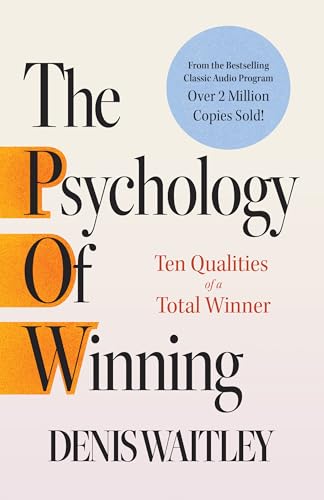
⚡️ What is The Psychology of Winning About?
What if I told you that most people are accidentally training themselves to lose every single day? In this classic, More summaries by Denis Waitley argues that winning isn’t about the scoreboard or the bank account; it’s a total internal orientation. I first picked this up thinking it would be another rah-rah motivational speech, but it’s actually a rigorous breakdown of how top-tier performers—from Apollo astronauts to Olympic gold medalists—actually think. Waitley isn’t interested in luck. He’s interested in the specific, repeatable mental patterns that create what he calls the “Total Winner.”
The central thesis is remarkably simple: your self-image acts as a thermostat for your performance. If you see yourself as a “struggling artist” or a “middle-manager type,” your brain will sabotage any effort to rise above that level to keep you “safe” within your comfort zone. This book is a manual for recalibrating that thermostat. If you’ve enjoyed other psychology book summaries on our site, you’ll recognize the foundations of cognitive behavioral shifts here, but with a much sharper edge toward high-stakes performance.
🚀 The Book in 3 Sentences
- Winning is a learned habit of internal self-expectancy, not a result of external circumstances or genetic luck.
- The human brain cannot distinguish between a vividly imagined event and a real one, meaning mental rehearsal is just as vital as physical practice.
- Total winners take 100% responsibility for their internal reactions to external events, effectively choosing their own mindset regardless of the chaos around them.
🎨 Impressions
I’ll be honest: some parts of this book feel very “1970s corporate training video.” The language is occasionally dated, and Waitley loves a good alliteration a bit too much. But once you get past the vintage vibe, the core insights are terrifyingly accurate. There’s a moment early on where he talks about how most people are “Double Losers”—people who lose and then blame everyone else—and it forced me to look at my own habits. It wasn’t a comfortable read, which is usually a sign that a book is hitting on something true.
What surprised me most was the emphasis on self-talk. I used to think affirmations were a bit woo-woo, but Waitley frames them as “self-directives.” He’s not saying you should lie to yourself; he’s saying you need to give your subconscious better instructions. The way he bridges the gap between high-level NASA psychology and everyday life is what makes this stick. It’s practical, even if it’s a bit old-school in its delivery.
📖 Who Should Read The Psychology of Winning?
This is for the person who feels like they’re hitting an invisible ceiling. If you’re working harder than everyone else but staying in the same place, the problem is likely your internal software, not your external effort. Athletes and high-stakes sales professionals will get the most immediate value here. However, if you’re looking for a deep, academic dive into neurological pathways with peer-reviewed citations on every page, you should probably skip this. This is a practitioner’s guide, not a textbook.
☘️ How This Book Changed My Thinking
Before reading this, I viewed winning as a destination—something that happens *after* you do the work. Now, I see it as a prerequisite. You have to win in your head before you can win in the world.
- I stopped using the phrase “I’ll try” and replaced it with “I am.” It sounds small, but it stops giving my brain an “out” for failure.
- I started using “mental movies” before big presentations. I don’t just imagine it going well; I imagine the specific feelings of confidence and the actual words I’ll say.
- I’ve become much more aggressive about weeding out “loser language” in my social circle—those people who think life is something that just happens to them.
✍️ 3 Quotes That Stuck With Me
- “Winners dwell on their goals; losers dwell on their problems.” — This perfectly captures why some people stay stuck in a loop of complaining while others just move on.
- “You must imagine it first, before you can achieve it.” — This isn’t just optimism; it’s a directive for how the human nervous system functions.
- “Winning is not a sometime thing; it’s an all-the-time thing.” — It’s a reminder that character and mindset don’t have an ‘off’ switch.
📒 Summary + Notes
The Psychology of Winning is built on the idea that human beings are goal-seeking mechanisms. Just like a guided missile, we need a target to lock onto. If we don’t choose a target, we default to whatever the environment provides, which is usually mediocrity. Waitley walks through ten specific traits that he’s observed in high-performers, ranging from self-esteem to self-projection. It’s less of a list and more of an ecosystem; you can’t really have high self-discipline without high self-direction.
By the end of the book, Waitley wants you to believe that your life is a self-fulfilling prophecy. He uses the concept of “Self-Expectancy” as the engine. If you expect to fail, you’ll unconsciously look for reasons to quit. If you expect to win, your brain will scan the environment for opportunities that everyone else misses. It’s a shift from being a reactive person to a proactive architect of your own reality. The “Total Winner” isn’t the guy with the most trophies; it’s the person who has mastered their internal world so completely that external success becomes inevitable.
🧠 Core Ideas Explained Simply
Waitley uses a lot of psychology concepts, but they really boil down to how your brain handles imagination and responsibility.
The Cybernetic Mechanism
Think of your brain like the autopilot on a plane. Once you set the coordinates, the autopilot doesn’t care if the destination is a tropical island or a volcano; it just does its job to get you there. Most people have their “coordinates” set to ‘just get by’ or ‘don’t fail.’ Waitley argues you have to manually override these settings every day through visualization and positive self-talk to ensure your “autopilot” is actually taking you somewhere you want to go.
Self-Expectancy
Does the coach of a winning team go into a game hoping they don’t lose, or expecting to win? It’s a subtle shift in energy. Waitley suggests that winners have a “positive addiction” to success. They don’t just want it; they expect it as a natural consequence of who they are and the work they’ve put in. This isn’t arrogance; it’s a calm, quiet confidence that overrides fear.
The Winner’s Edge
In horse racing, the horse that wins by a nose gets ten times the prize money of the horse that comes in second. Do they run ten times faster? No. They run a tiny fraction faster. This is the “Winner’s Edge.” In life, the difference between a total winner and a runner-up isn’t a massive gap in talent; it’s a 2% or 3% difference in mental preparation and self-discipline that leads to exponential results.
1: Positive Self-Awareness
What if the biggest barrier to your success isn’t your lack of resources, but your lack of internal data? Waitley starts the journey by highlighting that winners are hyper-aware of their potential and their current habits. They don’t live in a fog. They know exactly what they’re good at and where they’re leaking energy. While losers try to “find themselves,” winners are busy *creating* themselves based on a clear assessment of their current reality.
2: Positive Self-Esteem
Waitley makes a bold claim: you can’t possibly love or respect anyone else more than you love yourself. He views self-esteem as the iron-clad foundation of the winning personality. This isn’t about being narcissistic; it’s about having a deep-seated sense of worth that doesn’t depend on your last paycheck or a compliment from your boss. Without this, every setback feels like a personal indictment rather than just a temporary hurdle. He suggests that self-esteem is a choice you make before you even step out of bed.
3: Positive Self-Control
Imagine you’re the pilot of a jet, but you’ve let the wind dictate your destination. That’s how most people live, reacting to the news, the economy, or their spouse’s bad mood. Total winners practice self-control by realizing that while they can’t control the “wind” (external events), they have absolute control over the “sails” (their internal response). Waitley emphasizes that you are the captain of your soul, and if you don’t take the controls, someone else will.
4: Positive Self-Motivation
Why do some people seem to have an endless reservoir of energy while others can barely get through a Monday? The secret is in the “motive.” Winners are pulled by their desires, while losers are pushed by their fears. Fear-based motivation works for a little while, but it eventually leads to burnout and anxiety. Desire-based motivation, on the other hand, is sustainable. Waitley suggests moving away from “I have to” and toward “I want to.”
5: Positive Self-Expectancy
There’s a moment mid-thought where you decide how a meeting is going to go before you even walk through the door. Waitley calls this the most powerful tool in the winner’s kit. He cites studies showing that our bodies actually react to our expectations. If you expect a stressful day, your cortisol levels will spike before anything bad even happens. Winners use this to their advantage by expecting success, which primes their brain to recognize the paths that lead to it.
6: Positive Self-Image
Can you ever really outperform your own mental image of yourself? Waitley says no. He describes the self-image as the “blueprint” for your life. If the blueprint is small and cramped, you’ll never build a mansion, no matter how much material (hard work) you have. He encourages “role-playing” the person you want to become until the blueprint is updated to match your goals. You have to see yourself as the winner before the world gives you the trophy.
7: Positive Self-Direction
A ship without a rudder is just a floating piece of wood at the mercy of the tide. Waitley points out that many people have goals, but very few have *direction*. Direction is the daily application of your long-term goals. Winners have a “magnificent obsession”—a purpose that is bigger than their daily problems. This purpose acts as a filter, helping them say ‘no’ to distractions that don’t serve the mission. Do you have a goal for today that connects to where you want to be in five years?
8: Positive Self-Discipline
Self-discipline is often viewed as a form of punishment, but Waitley reframes it as “mental rehearsal.” It’s the ability to practice in your mind until the physical action becomes automatic. He highlights that winners don’t just work hard; they practice with a specific intensity. This chapter is where the rubber meets the road—it’s about the bridge between the internal thought and the external result. It’s the grit that keeps you going when the initial excitement of a new goal wears off.
9: Positive Self-Dimension
What good is winning if you lose your health, your family, or your soul in the process? Waitley takes a surprising turn here, arguing for a holistic view of winning. He talks about the importance of being “total”—having a sense of humor, staying humble, and maintaining physical health. A winner who is burnt out and alone isn’t really a winner. This section serves as a necessary check on the “win at all costs” mentality that ruins so many high-achievers.
10: Positive Self-Projection
Imagine walking into a room and instantly changing the energy just by being there. That’s self-projection. Waitley explains that we are always “broadcasting” our internal state to others through our body language, tone, and eye contact. Winners project confidence and warmth because they actually feel it inside. You can’t fake this for long. True self-projection comes from a place of integrity—when your internal world and your external actions are in perfect alignment.
⚖️ A Critical Perspective
The Psychology of Winning is unapologetically individualistic. It largely ignores systemic barriers, poverty, and luck, operating under the assumption that the mind is the *only* thing that matters. While this is empowering for the individual, it can feel a bit reductive in a modern context where we recognize how environment and privilege play massive roles. Additionally, the advice on “positive thinking” can sometimes border on toxic positivity, potentially leading readers to suppress valid negative emotions rather than processing them. It’s a great tool for high-performance, but it’s not a complete philosophy for a complex life.
🔄 How It Compares
Compare this to As a Man Thinketh by James Allen. While Allen’s work is poetic and philosophical, Waitley’s approach is much more practical and performance-oriented. Allen focuses on the *character* of the man; Waitley focuses on the *mechanics* of the winner. If Allen is the philosopher in the garden, Waitley is the coach on the sidelines with a stopwatch.
🔑 Key Takeaways
The lessons here are about shifting from a passenger to a pilot in your own mind.
- The brain cannot distinguish between a vividly imagined event and a real one—use this for mental rehearsal.
- Winners are motivated by desire (pull) rather than fear (push).
- Your self-image is the “governor” on your performance; to change the result, you must first change the mental blueprint.
- Winning is a 360-degree lifestyle that includes health, relationships, and ethics, not just a bank balance.
💬 Frequently Asked Questions
What is the main argument of The Psychology of Winning?
Denis Waitley argues that winning is a conscious mental choice and a set of internal habits rather than a result of luck or external circumstances. He identifies ten specific qualities, such as self-esteem and self-expectancy, that allow individuals to program their subconscious minds for high-level success and consistent performance.
What are the 10 qualities of a total winner?
The ten qualities are: Positive Self-Awareness, Self-Esteem, Self-Control, Self-Motivation, Self-Expectancy, Self-Image, Self-Direction, Self-Discipline, Self-Dimension, and Self-Projection. Together, these traits form a holistic internal framework that Waitley believes is necessary for anyone to reach their full potential and achieve a balanced, successful life in any competitive field.
Is The Psychology of Winning still relevant in 2025?
Yes, because the core principles of cognitive behavioral psychology and neuroplasticity support Waitley’s claims about self-talk and visualization. While the examples might feel dated, the underlying mechanics of how the human brain processes goals, fear, and self-image remain constant regardless of the technological or social environment of the reader.
What is the difference between a winner and a loser according to Waitley?
The primary difference is their reaction to external events. Losers view themselves as victims of circumstance and dwell on their problems. Winners take total responsibility for their internal state and dwell on their goals. This internal shift allows winners to remain proactive and resourceful even when faced with significant setbacks.
Who should read this book?
This book is ideal for athletes, entrepreneurs, and professionals who feel they are underperforming their potential. It is particularly useful for those who struggle with self-doubt or procrastination. It provides a practical, step-by-step mental training program for anyone looking to increase their resilience, focus, and overall sense of personal agency.
Conclusion
Reading The Psychology of Winning is like sitting down with a high-performance coach who refuses to let you make excuses. Denis Waitley died in 2025 as one of the true titans of the self-help movement, and this book remains his masterwork. It’s a reminder that the most important conversation you’ll ever have is the one you’re having with yourself right now. Are you telling yourself a story about why you can’t, or are you preparing for the moment you will?
If there’s one thing to take away, it’s that your brain is always listening to your instructions. Most people are accidental saboteurs of their own dreams because they haven’t learned to manage their internal broadcast. By applying even a few of the principles in this psychology book summary, you can start turning that autopilot toward a destination you actually want. Don’t just read about winning; start practicing the psychology of a winner today.
More From Denis Waitley →
Discover more from AI Book Summary
Subscribe to get the latest posts sent to your email.