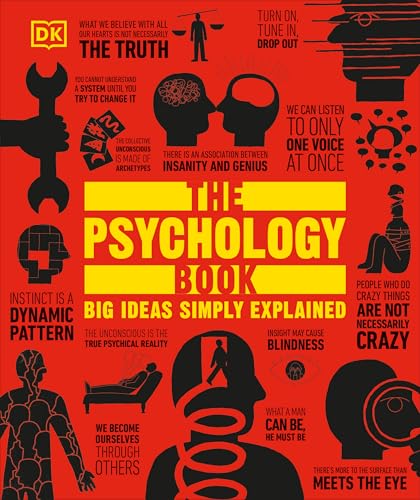
⚡️ What is The Psychology Book About?
I remember picking this up and thinking it looked like a high-end textbook, but it’s actually more like a curated tour through the attic of the human mind. This massive volume from More summaries by DK attempts something gutsy: it tries to condense every major psychological theory from the last 150 years into digestible, visual chunks. It isn’t just a list of names; it’s a story of how we stopped guessing about why people act weird and started actually measuring it.
The central argument of the book is that psychology isn’t a single “truth” but a constantly evolving conversation between different schools of thought. From the early days of philosophers wondering if the soul lived in the heart, to modern neuroscientists tracking blood flow in the brain, the author’s case is that understanding ourselves requires looking at all these perspectives at once. If you’ve ever enjoyed Psychology book summaries, you’ll know that one theory usually contradicts the next, and this book embraces that chaos beautifully.
🚀 The Book in 3 Sentences
- The human experience can be broken down into observable patterns of behavior, cognitive processes, and social influences that are often invisible to the naked eye.
- The field has shifted from purely philosophical musings to a rigorous science that uses experiments to debunk common-sense myths about memory, authority, and personality.
- By studying the “Big Ideas” of the past, we gain a toolkit to navigate modern life, from improving our learning habits to understanding our own biases in social situations.
🎨 Impressions
Honestly, I didn’t expect a book this thick to be so readable. It’s built like a “greatest hits” album where every page turn introduces a new rockstar of the mind. I’ve read deeper books on specific topics, like Cialdini’s work on influence, but nothing else gives you this kind of bird’s-eye view. The “mind maps” and flowcharts are what really sold me—they take a messy concept like Jung’s collective unconscious and make it look like a logical circuit board.
There’s a specific moment early on where the book covers Pavlov, and for the first time, I didn’t just see a guy with a bell; I saw how my own smartphone notifications are basically just digital dog whistles. It’s that kind of book. It makes you look at your daily habits and go, “Oh, so that’s why I do that.” It can be a little overwhelming if you try to read it cover-to-cover in one sitting, but it’s the perfect companion for a Sunday morning when you want to feel a bit smarter without getting a headache.
📖 Who Should Read The Psychology Book?
If you’re a student who feels buried by dry textbooks, this is your escape hatch. It’s also perfect for the curious generalist who wants to know why people join cults, why we forget where we put our keys, and why we’re so prone to follow the crowd. However, if you’re looking for a deep, technical guide on clinical neurobiology or a step-by-step self-help manual, you’ll probably find this too broad. It’s an encyclopedia with soul, not a deep-sea dive into one specific ocean.
☘️ How This Book Changed My Thinking
Before I read this, I viewed psychology as a bit “soft”—just a bunch of people talking about their feelings on a couch. Now, I see it as a rigorous attempt to map the software of the human animal.
- I stopped blaming my “lack of willpower” and started looking at my environment through the lens of Behaviorism.
- I realized my memories aren’t video recordings; they’re creative reconstructions that I probably shouldn’t trust 100%.
- I’ve become much more aware of “bystander apathy” in groups, which has made me more likely to step up when I see something wrong.
✍️ 3 Quotes That Stuck With Me
- “The curious paradox is that when I accept myself just as I am, then I can change.” — This Carl Rogers quote is the ultimate antidote to the toxic self-improvement culture.
- “If you change the way you look at things, the things you look at change.” — Wayne Dyer (paraphrasing the cognitive shift) reminds me that my perspective is a choice.
- “The unexamined life is not worth living.” — This classic Socrates line sets the tone for the entire book’s mission of self-discovery.
📒 Summary + Notes
The Psychology Book doesn’t just list facts; it tracks the intellectual war for the human soul. It starts with the philosophers who asked “Who are we?” and moves into the laboratory era where guys like Wundt tried to measure the speed of a thought. The narrative then shifts into the dark, messy world of the unconscious with Freud and Jung, before swinging violently the other way toward Behaviorism—the idea that our “mind” doesn’t matter, only what we do.
As the book progresses, it enters the “Cognitive Revolution,” treating the brain like a computer that processes information. Finally, it lands in social and developmental psychology, looking at how we grow and how we’re influenced by the people around us. By the end, the author wants you to believe that there is no “normal”—there is only a spectrum of human experience influenced by biology, upbringing, and society. Are we really the masters of our own fate, or just biological machines responding to stimuli?
🧠 Core Ideas Explained Simply
Because this book covers so much ground, it helps to look at the three pillars that hold up most of the modern field.
Classical vs. Operant Conditioning
Think of Classical Conditioning (Pavlov) as learning by association—your mouth waters when you see a pizza box. Operant Conditioning (Skinner) is learning by consequence—you work hard because you want the paycheck. One is about what happens before the behavior, and the other is about what happens after. Most of our modern world, from social media likes to loyalty cards, is built on these two simple concepts.
The Cognitive Dissonance Theory
Ever found yourself making excuses for a bad habit? That’s Leon Festinger’s big idea. When our beliefs don’t match our actions, it creates a mental itch that we have to scratch by either changing our behavior or (more likely) lying to ourselves. It explains why people stay in bad relationships or defend clearly wrong decisions—we’d rather be wrong than feel inconsistent.
The Milgram Experiment
What would you do if a guy in a lab coat told you to give a stranger a painful electric shock? Stanley Milgram’s horrifying discovery was that most of us would do it. This concept flipped the script on “evil” by showing that ordinary people can do terrible things if they feel they aren’t responsible for their actions. It’s a sobering reminder that our social environment often trumps our individual character.
1: Philosophical Roots
Long before labs existed, philosophers were the original shrinks. This section takes us back to the Greeks, specifically Galen’s theory of the “four humors.” It sounds ridiculous today—the idea that you’re grumpy because you have too much “black bile”—but it was the first real attempt to link personality to biology. It shows that humans have always sensed that our moods have physical roots.
The book then jumps to René Descartes, who famously claimed “I think, therefore I am.” This created the “mind-body dualism” that psychology has been trying to solve ever since. Is the mind just the brain working, or is it something separate? This chapter dog-eared my brain because it reminds us that we are still asking the same questions as people in tunics 2,000 years ago.
2: Behaviorism
What if your “inner life” was actually just a myth? That was the radical claim of Behaviorism. John B. Watson and B.F. Skinner argued that if we can’t see it or measure it, it doesn’t belong in science. They treated the human brain as a “black box”—you don’t need to know what’s inside to know that if you press a button and get a cookie, you’ll press the button again.
- The “Little Albert” experiment showed that fear is often a learned response, not an innate trait.
- The “Skinner Box” proved that unpredictable rewards (like slot machines) are more addictive than predictable ones.
- Conditioning happens whether you believe in it or not.
3: Psychotherapy
Ever wondered why everyone mentions their mother the moment they sit on a therapist’s couch? You can thank Sigmund Freud for that. This section moves from the rigid external world of Behaviorism into the dark, swampy waters of the unconscious. Freud argued that we are mostly driven by urges we don’t even know we have, tucked away in our “Id.”
The book does a great job of showing how Freud’s students, like Carl Jung and Alfred Adler, took his ideas and ran in different directions. Jung introduced the idea of archetypes—universal symbols that show up in every culture’s myths and dreams. It’s fascinating to see how these theories, while often unscientific by today’s standards, gave us a language to talk about our hidden selves. Do you ever feel like you’re wearing a “mask” in public? That’s Jung’s concept of the Persona.
4: Cognitive Psychology
Imagine your brain as a computer processor with limited RAM. That’s essentially the Cognitive Revolution. In the 1950s, psychologists got tired of just looking at behavior and wanted to know how we actually think, remember, and solve problems. This is where George Miller’s “Magical Number Seven” comes in—the idea that our short-term memory can only hold about seven pieces of info at a time.
This chapter also digs into the “Eye-witness Testimony” work by Elizabeth Loftus. She showed that our memories are incredibly easy to manipulate. If someone asks “How fast was the car going when it *smashed* into the other one?” versus “hit,” you will actually remember the car going faster. This section was a wake-up call for me: our brains are efficient, but they are also masters of cutting corners.
5: Social Psychology
Why do good people do terrible things when they’re in a group? This is the most “cinematic” part of the book. It covers the infamous experiments that showed just how fragile our moral compass is. We see the Stanford Prison Experiment, where ordinary students turned into abusive guards in just a few days, and the Asch Conformity test, where people would swear a short line was long just because everyone else said so.
It’s not all doom and gloom, though. This section also explores how we can use these social triggers for good. By understanding things like “In-group bias,” we can start to dismantle the invisible walls we build between “us” and “them.” Have you ever noticed how you’re nicer to people who wear the same sports jersey as you? That’s social psychology in action.
6: Developmental Psychology
How do we go from crying infants to complex adults? Jean Piaget is the star here, showing that kids don’t just know “less” than adults; they actually think in a completely different way. They go through stages of development where their logic literalizes the world before they can handle abstract concepts. This section is a goldmine for parents.
The book also covers the “Attachment Theory” experiments with monkeys. It proved that babies need touch and comfort more than they even need food. It’s a powerful reminder that our early childhood “blueprints” often dictate how we handle relationships for the rest of our lives. Are you “anxiously attached” or “securely attached”? The seeds were likely sown before you could even talk.
7: Psychology of Difference
What actually makes you “you” compared to everyone else? This final section looks at personality, intelligence, and “abnormal” psychology. It covers the “Big Five” personality traits—Openness, Conscientiousness, Extraversion, Agreeableness, and Neuroticism—which is currently the most scientifically backed way to measure who someone is. It’s a lot more accurate than those Myers-Briggs tests you see online.
This part of the book also looks at how we define “madness.” It shows how our labels for mental health have changed over time, reminding us that “normal” is often just a social agreement. It ends with a look at modern positive psychology, shifting the focus from “what’s wrong with us” to “how can we flourish.”
⚖️ A Critical Perspective
While this book is a masterpiece of design, it does suffer from being a bit too “nice” to every theory. It gives Freud and the humors almost as much visual weight as modern, evidence-based neuroscience, which might confuse a casual reader about what is actually true today. Furthermore, it avoids the “replication crisis”—the fact that many famous experiments in this book, like the Stanford Prison Experiment, have been heavily criticized or failed to be repeated in recent years. It’s a great history book, but don’t take every “big idea” as gospel without checking the modern receipts.
🔄 How It Compares
Compared to Thinking, Fast and Slow by Daniel Kahneman, this book is much broader but much shallower. Kahneman focuses specifically on the “bugs” in our mental software, whereas this book is a general map of the entire computer factory. If you want a deep dive into one thing, go with Kahneman; if you want to know how all the different parts of psychology fit together, stick with the authors’ case here.
🔑 Key Takeaways
These are the lessons that shift how you view your own brain every day.
- Environment is Everything: Most of your “choices” are actually responses to your surroundings. If you want to change your life, change your room first.
- Memory is a Story: Don’t treat your memories as cold facts. They are colored by your current mood and new information.
- The Group Changes You: You are likely more conformist than you think. Awareness of this is the only way to resist it.
- Labels are Fluid: What we call “mental illness” or “personality” has changed every few decades and will continue to change.
💬 Frequently Asked Questions
What is the main argument of The Psychology Book?
The book argues that psychology is a multifaceted science that has evolved from philosophical speculation to empirical study. It suggests that there is no single way to explain human behavior, but rather a collection of theories—behavioral, cognitive, and social—that together provide a complete map of the mind.
Is The Psychology Book suitable for beginners?
Absolutely. It is specifically designed for beginners, using the “Big Ideas Simply Explained” format. It avoids heavy jargon and uses visual aids, flowcharts, and pull-out quotes to make complex theories like Jung’s archetypes or Skinner’s conditioning accessible to anyone without a prior degree in the field.
Does the book cover modern psychological research?
While it covers history excellently, it does include modern sections on positive psychology and cognitive neuroscience. However, it is primarily a historical survey. It captures the “classics” of the field, though it may lack the very latest 2024–2025 breakthroughs in gut-brain axis research or neuroplasticity.
What is the difference between psychology and psychiatry in this book?
The book focuses on psychology—the study of the mind and behavior—rather than psychiatry, which is the medical branch focused on treating disorders with medication. While it touches on clinical therapy, its main goal is to explain the underlying theories of how “normal” and “abnormal” minds function.
Which chapter is the most practical for daily life?
The Cognitive Psychology chapter is arguably the most practical. It offers insights into how memory works, how we solve problems, and the cognitive biases that lead us to make poor decisions. Understanding these mental shortcuts can immediately improve how you study, work, and interact with others.
Conclusion
At the end of the day, The Psychology Book is a reminder that you are a mystery even to yourself. We spend our lives living inside our heads, yet we rarely take the time to look at the blueprints of the building. This book provides those blueprints. It takes the intimidation factor out of a science that can sometimes feel like it’s written in code.
If you take away one thing, let it be this: your mind is not a fixed object. It is a work in progress, influenced by your history, your biology, and the people sitting next to you right now. Whether you’re interested in self-improvement or just want to understand why the world is so chaotic, this is one of the most useful Psychology book summaries you can keep on your shelf. It won’t give you all the answers, but it will certainly help you ask better questions about what it means to be human.
More From DK →
Discover more from AI Book Summary
Subscribe to get the latest posts sent to your email.