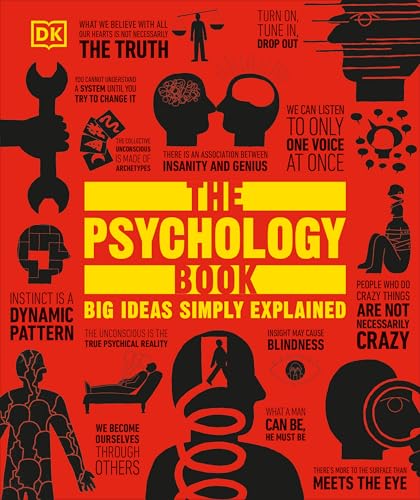
⚡️ What is The Psychology Book about?
The Psychology Book by DK is a comprehensive and visually stunning guide that demystifies the complex world of psychology. It’s not a narrative but a chronological exploration of the field’s most significant ideas, theories, and thinkers. The book’s primary goal is to make psychology accessible to everyone, using easy-to-understand language, clear diagrams, and engaging infographics to explain everything from philosophical roots to modern cognitive neuroscience. It functions as a visual encyclopedia, breaking down over 100 groundbreaking concepts into digestible, bite-sized chunks. It’s a journey through the history of how we have come to understand the human mind, behavior, and consciousness, showing how different schools of thought built upon or challenged one another. This book serves as both an excellent introduction for novices and a handy reference guide for those already familiar with the subject.
🚀 The Book in 3 Sentences
- The Psychology Book chronologically maps the history of psychological thought, from ancient philosophy to the cutting-edge science of the mind.
- It simplifies the core ideas of major thinkers like Freud, Jung, Skinner, and Pavlov, making their profound theories easy to grasp.
- Ultimately, it provides a foundational toolkit for understanding human behavior, both in ourselves and in others, by explaining the mechanisms behind our thoughts and actions.
🎨 Impressions
I was genuinely impressed by how The Psychology Book transforms a potentially dense and academic subject into an engaging and visually rich experience. As a visual learner, the combination of concise text, timelines, and bold graphics was incredibly effective for retention. It felt less like reading a textbook and more like exploring a curated museum exhibit for the mind. The book’s structure, which presents ideas chronologically, provides a clear narrative of how psychological understanding has evolved. This contextual approach is brilliant, as it shows you not just *what* the theories are, but *why* they emerged when they did. It’s a testament to the idea that complex subjects can be made accessible without being dumbed down, a feat DK accomplishes masterfully.
📖 Who Should Read The Psychology Book?
This book is perfect for anyone with a curiosity about the human mind but who finds traditional psychology textbooks intimidating or dry. Students just starting a psychology course will find it to be an invaluable supplementary guide. Professionals in fields like marketing, management, or design who want to understand user or consumer behavior will benefit greatly. Moreover, it’s an essential read for anyone on a journey of self-discovery, looking to understand their own thoughts, emotions, and behaviors through a scientific lens. If you’ve ever wondered why we do what we do, The Psychology Book is your starting point.
☘️ How the Book Changed Me
Reading The Psychology Book fundamentally shifted my perspective on human interaction and my own internal monologue. It provided a vocabulary and framework for things I had felt but could never articulate. I now see patterns of behavior, cognitive biases, and social dynamics with much greater clarity.
- I’ve become more aware of my own cognitive biases, like confirmation bias, and actively challenge my initial assumptions.
- My empathy has increased, as I can now better understand the potential psychological roots of people’s actions rather than just reacting to the surface-level behavior.
- I’ve started applying The Psychology Book techniques, like breaking down habits using behaviorist principles of reinforcement, to make positive personal changes.
- I have a newfound appreciation for the complexity of the mind and am less judgmental of both myself and others.
- It sparked a deeper interest in neuroscience and the biological underpinnings of consciousness.
✍️ My Top 3 Quotes
- “The mind is like an iceberg; it floats with one-seventh of its bulk above water.” – A powerful summary of Freud’s model of the conscious and unconscious mind.
- “Behavior is what a man does, not what he thinks, feels, or believes.” – This encapsulates the core tenet of Behaviorism, focusing on observable actions.
- “The good life is a process, not a state of being. It is a direction not a destination.” – This quote, reflecting Carl Rogers’ humanistic approach, resonated deeply as a life philosophy.
📒 Summary + Notes
The journey through The Psychology Book begins with the philosophical inquiries of ancient Greece, laying the groundwork for centuries of debate. It then moves through the major schools of thought, each contributing a unique piece to the puzzle of the human mind. The book is structured thematically within a loose chronological order, making it easy to follow the evolution of ideas. Below are the summaries of its core sections, which I’ve treated as chapters for this review.
Chapter 1: Philosophical Roots
This section explores the foundational questions that predated formal psychology. It covers thinkers like Plato, who theorized about the soul and reason, and Aristotle, who linked the mind to the body. The chapter highlights René Descartes and his famous declaration, “I think, therefore I am,” which firmly separated mind (res cogitans) and body (res extensa), creating the mind-body problem that would puzzle philosophers and psychologists for centuries. It sets the stage for psychology’s eventual emergence as a science distinct from philosophy and physiology.
- The mind-body problem is introduced as a central dilemma: are mind and body separate or one and the same?
- John Locke’s idea of the mind as a tabula rasa (blank slate) challenged the notion of innate knowledge.
- These early debates established the fundamental questions about consciousness, free will, and knowledge that psychology seeks to answer.
Chapter 2: Behaviorism
This chapter details the radical shift towards observable behavior as the only legitimate subject of scientific study. It begins with Ivan Pavlov’s accidental discovery of classical conditioning through his experiments with dogs, showing how a neutral stimulus can elicit a reflexive response. It then covers John B. Watson, who founded behaviorism, and B.F. Skinner, who developed the theory of operant conditioning, explaining how reinforcement and punishment shape voluntary behavior. This school of thought rejected the study of mental processes, focusing exclusively on stimulus-response relationships.
- Classical Conditioning (Pavlov) explains how we learn to associate neutral stimuli with automatic responses.
- Operant Conditioning (Skinner) demonstrates how the consequences of our behavior (rewards/punishments) increase or decrease the likelihood of that behavior recurring.
- Behaviorism’s legacy is immense, providing the basis for many modern therapies and behavioral training techniques.
Chapter 3: Psychotherapy and Psychodynamic Psychology
This section dives into the revolutionary work of Sigmund Freud, the father of psychoanalysis. It explains his model of the mind (id, ego, superego), his theory of the unconscious, and the importance of childhood experiences in shaping adult personality. The chapter also introduces his dissenting followers, like Carl Jung, who proposed concepts like the collective unconscious and archetypes, and Alfred Adler, who focused on feelings of inferiority and the drive for superiority. These thinkers brought the unconscious and internal conflicts to the forefront of psychological study.
- Freud’s talking cure (psychoanalysis) aimed to make the unconscious conscious by exploring repressed memories and dreams.
- Jung expanded the psyche to include a collective unconscious shared by all humanity, populated by universal archetypes.
- These theories, while often criticized for lack of empirical evidence, profoundly influenced our culture and the concept of talk therapy.
Chapter 4: Cognitive Psychology
This chapter charts the “cognitive revolution,” a movement that brought the study of the mind back into focus, but this time as an information-processing system. It covers key figures like Jean Piaget, who mapped the stages of cognitive development in children, and George Miller, who identified the limits of our working memory. The book explains concepts like schemas (mental frameworks), memory encoding and retrieval, and how we process information. This approach views the mind as a computer, using metaphors of input, processing, storage, and output to explain complex mental activities.
- Piaget’s stages of development (sensorimotor, preoperational, etc.) provide a roadmap for how a child’s understanding of the world evolves.
- The Atkinson-Shiffrin model of memory divides memory into sensory, short-term, and long-term stores.
- Cognitive psychology provides the foundation for understanding learning, problem-solving, and decision-making.
Chapter 5: Social and Developmental Psychology
This section examines how we are shaped by our social environment and how we develop across the lifespan. It landmark studies like Stanley Milgram’s obedience experiment, which revealed the power of authority, and Solomon Asch’s conformity experiments, showing how we succumb to group pressure. It also explains Leon Festinger’s theory of cognitive dissonance, the discomfort of holding conflicting beliefs. Developmentally, it revisits Erik Erikson’s psychosocial stages and John Bowlby’s attachment theory, which emphasizes the critical importance of early bonds with caregivers.
- Cognitive Dissonance explains why we change our attitudes or beliefs to align with our actions, reducing internal conflict.
- Bowlby’s Attachment Theory demonstrates how early relationships form an internal “working model” for future relationships.
- This chapter highlights that we are fundamentally social creatures, and our development cannot be understood in isolation.
Key Takeaways
The most profound lessons from The Psychology Book are not just facts, but new ways of seeing the world. It provides a multi-faceted lens for understanding the complexities of human nature. The book teaches that there is no single “right” way to view the mind; rather, different theories offer different, valuable perspectives. It underscores the idea that much of our behavior is driven by unconscious forces, learned associations, and social pressures we are barely aware of. Ultimately, it empowers the reader with knowledge, offering a path to greater self-awareness and a more compassionate understanding of others.
- The primary takeaway from The Psychology Book is that psychology is a tapestry of competing and complementary theories, not a single monolithic truth.
- Understanding the historical context of psychological theories helps us appreciate their strengths and limitations.
- Many of our daily actions and decisions are influenced by unconscious biases and learned behaviors that we can identify and modify.
- Human development is a lifelong process shaped by an intricate interplay of biology, psychology, and social environment.
- Gaining psychological literacy is a powerful tool for personal growth, improved relationships, and professional success.
Conclusion
>In conclusion, The Psychology Book is an exceptional resource that succeeds brilliantly in its mission to make a vast and complex field accessible, engaging, and visually memorable. It is more than just a summary of ideas; it’s a coherent story of humanity’s quest to understand itself. Whether you are a student, a professional, or simply a curious individual, this book provides an essential foundation for navigating the human experience. It equips you with the language and concepts to explore your own inner world and better comprehend the people around you. I highly recommend picking up a copy; it’s a reference you will return to again and again.More From DK →
Discover more from AI Book Summary
Subscribe to get the latest posts sent to your email.