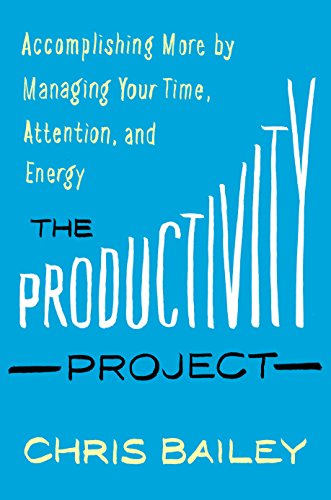
⚡️ What is The Productivity Project About?
I’ve spent years reading every productivity hack under the sun, but this book hit me differently. Instead of just giving me another sterile system to follow, Chris Bailey spent an entire year using himself as a human guinea pig. He worked ninety-hour weeks, lived in total isolation, and even drank nothing but water for a month just to see what happened to his output. The central argument of The Productivity Project is simple but profound: productivity isn’t about how much you do; it’s about how much you accomplish by managing three specific levers: time, attention, and energy.
Most of us treat productivity like a game of Tetris, trying to jam as many blocks into our day as possible. Bailey suggests we’re looking at it backward. If you have all the time in the world but zero energy, you aren’t going to get anything done. If you have energy but can’t focus your attention, you’ll just spend the day spinning your wheels on low-value tasks. This is a must-read in our collection of Productivity book summaries because it moves the needle from ‘busy-ness’ to actual results.
🚀 The Book in 3 Sentences
- True productivity is the intersection of time, attention, and energy—if one is missing, the whole system collapses.
- The Rule of 3 is the ultimate daily filter: identify the three things you want to have accomplished by the end of the day and ignore the rest until they’re done.
- Working less can actually help you achieve more because it forces you to use your limited energy on high-impact tasks rather than filler work.
🎨 Impressions
Honestly, I found the first few chapters a bit basic, but then Bailey hits you with the data from his experiments. There’s something incredibly refreshing about an author who admits that working 90 hours a week made him less productive than working 20. It’s the kind of honesty you don’t get from most ‘hustle culture’ gurus. I dog-eared the section on Biological Prime Time because it finally explained why I feel like a zombie at 2:00 PM no matter how much coffee I drink.
It’s a conversational read. It feels like you’re grabbing a beer with a guy who just spent a year obsessing over his calendar so you don’t have to. While some of the advice on diet and sleep feels a bit like ‘common sense,’ seeing it through the lens of productivity—rather than just health—makes it much easier to actually implement. I didn’t love the section on ‘future self’ visualization, which felt a bit fluffy, but the practical tactics for managing interruptions were worth the price of the book alone.
📖 Who Should Read The Productivity Project?
If you feel like you’re constantly busy but never actually ‘done,’ this is for you. It’s perfect for freelancers or knowledge workers who have autonomy over their schedules. However, if you’re in a rigid 9-to-5 where you have zero control over your meetings or environment, some of the ‘energy management’ tips might be harder to pull off. If you’re looking for a hardcore technical manual on project management, skip this—it’s more about personal optimization than corporate systems.
☘️ How This Book Changed My Thinking
Before I read this, I viewed my day as an 8-hour block of potential work. Now, I view it as a series of energy waves that I need to surf correctly.
- I stopped scheduling important creative work in the afternoon and moved it all to my 8:00 AM window.
- I actually started working fewer hours on purpose to trigger Parkinson’s Law and get things done faster.
- I quit the habit of ‘clearing the decks’ with small tasks first; I now tackle the big three before I even open my email.
✍️ 3 Quotes That Stuck With Me
- “Productivity is not about doing more, it’s about doing the right things.” — This is the central mantra that kills the ‘busyness’ trap.
- “Our brains are for having ideas, not for holding them.” — A perfect reminder that external systems (like notebooks) are better than our faulty memories.
- “Busyness is no different from laziness when it doesn’t lead to results.” — This one actually stung when I first read it.
📒 Summary + Notes
The Productivity Project is essentially a roadmap for intentionality. Bailey walks us through the realization that time management is a relic of the industrial age. In a world where we’re paid for our ideas and focus, the clock is the wrong metric. He builds a case that you need to audit your life to find your ‘High Impact Tasks’—the 20% of work that yields 80% of your value—and then ruthlessly protect the energy and attention you need to do them.
The book moves from the internal (mindset and goals) to the tactical (managing distractions and caffeine) and finally to the biological (sleep and exercise). By the end, the author wants you to believe that being productive is actually an act of self-care. It’s about creating enough space in your life so that you can work intensely when you’re working, and then completely shut off when you’re not. It’s the opposite of the ‘always-on’ culture that leads to burnout.
1: Where to Start
Why do you actually want to be productive? Bailey starts here because without a ‘why,’ you’ll never stick to a system. He argues that productivity is simply the intersection of time, attention, and energy. If you have 5 hours (time) and plenty of coffee (energy) but you’re scrolling TikTok (no attention), you aren’t productive. You have to define your values first, or you’ll just become more efficient at things that don’t matter.
2: Not Every Task Is Created Equal
Have you ever noticed that some tasks feel like a marathon while others feel like a sprint? Bailey introduces the idea of Highest-Impact Tasks (HITs). He suggests a simple exercise: list everything you do in a month and ask yourself, ‘If I could only do one thing on this list, which one adds the most value to my work?’ Then pick the next two. Those are your big wins. Everything else is just maintenance.
3: Three Daily Tasks
The Rule of 3 is the simplest, most effective tool in the book. At the start of the day, before you check email, decide which three things you want to have finished by the time the sun goes down. Do the same for your week. It forces you to prioritize when you still have the mental capacity to think clearly, rather than reacting to the fires that pop up throughout the day.
4: Ready for Prime Time
What if your 10:00 AM is worth three times as much as your 4:00 PM? This is your Biological Prime Time (BPT). Bailey tracked his energy levels for weeks and found that we all have windows where our focus is naturally sharp. You shouldn’t waste your BPT on low-level ‘maintenance’ like filing expenses or cleaning your inbox. Save your most cognitively demanding work for those peak energy hours.
5: Cozying Up to Ugly Tasks
Procrastination isn’t a character flaw; it’s a reaction to a task that triggers one of six ‘triggers’: boredom, frustration, difficulty, lack of structure, lack of personal meaning, or lack of intrinsic reward. If you’re avoiding something, look at the triggers. If it’s unstructured, give it a deadline. If it’s boring, go work in a nice cafe. By identifying why you’re avoiding the work, you can manipulate the task to make it more palatable.
6: Meet Yourself… from the Future
We treat our ‘future selves’ like strangers. It’s why we’re so happy to volunteer for a presentation three weeks from now that we’d never do today. Bailey cites research showing that our brain actually sees our future self as a different person. To fix this, you have to find ways to connect with that person—visualize them, write to them, or just realize that you’re currently screwing them over by procrastinating today.
7: The Internet Is Killing Your Productivity
Is your phone an extension of your brain or a leash? Bailey experiments with disconnecting and finds that the internet is the ultimate attention-drain. He suggests ‘quarantining’ your internet usage: disconnect while doing deep work, use airplane mode more often, and treat the web as a tool rather than a default state of being. It’s about regaining the ability to be alone with your thoughts.
8: The Time Economy
The industrial revolution taught us that more hours equal more widgets. But we don’t live in that world anymore. In the knowledge economy, productivity is about value, not volume. Bailey argues that we need to stop measuring our success by how long we sat in a chair and start measuring it by the quality of the problems we solved.
9: Working Less
Here’s the counter-intuitive part: working fewer hours often makes you more productive. Why? Because it forces you to spend your limited energy more wisely. When you have a 12-hour workday, you can afford to waste time. When you only have 6, you get down to business immediately. This is Parkinson’s Law in action—work expands to fill the time available.
10: Energy Enlightenment
Manage your energy, not your time. Bailey emphasizes that your most important activities should happen when your energy is highest. If you’re a night owl, stop trying to join the 5:00 AM club. It’s about self-awareness—protecting your peak hours like they’re sacred, because they are.
11: Cleaning House
Don’t let ‘maintenance tasks’ bleed into your whole week. Bailey suggests batching them into a single ‘Maintenance Day.’ Do the laundry, answer the boring emails, buy the groceries, and clean the house all at once. This prevents these low-impact tasks from interrupting your flow during the days when you’re supposed to be doing high-value work.
12: The Zen of Productivity
Can you be productive and calm at the same time? Bailey argues that you should aim for ‘zen-like’ focus by reducing the noise. This means shrinking low-impact tasks so you have more space for the big stuff. It’s not just about doing things fast; it’s about doing them with a sense of peace and single-mindedness.
13: Shrinking the Unimportant
Most of our ‘busy work’ is just a distraction. Things like checking email or attending pointless meetings can be shrunk, delegated, or eliminated. Bailey challenges us to look at our calendars and be honest: how much of this actually contributes to my long-term goals? If it doesn’t, it needs to go on a diet.
14: Removing the Important
The hardest word in the English language isn’t some archaic Latin derivative—it’s ‘no.’ To be truly productive, you have to say no to good things so you can say yes to great things. Bailey suggests calculating the value of your time. If you knew an hour of your life was worth $100, would you still spend it arguing on Twitter? Probably not.
15: Emptying Your Brain
Your brain is a terrible filing cabinet. Bailey is a huge fan of the ‘brain dump’—getting every task, worry, and idea out of your head and onto paper. This lowers your stress levels because your brain stops looping over the things it’s afraid it will forget. Once it’s on paper, your mind is free to actually focus on the work in front of you.
16: Rising Up
A weekly review is your ‘pulling back the lens’ moment. Every week, sit down and look at what you accomplished, what you missed, and what’s coming up. This keeps you from drifting. Without a review, you’re just reacting to whoever shouts the loudest in your inbox.
17: Making Room
Let your mind wander on purpose. Bailey argues that daydreaming is actually a productivity tool because it’s where your best creative connections happen. Whether it’s taking a shower, going for a walk, or just staring out a window, you need to give your brain ‘unstructured time’ to process information. You can’t be in ‘output mode’ 24/7.
18: Becoming More Deliberate
Focus is a muscle. You can’t expect to have a deep, two-hour work session if you’ve spent the rest of the day training your brain to seek novelty through 15-second videos. Being deliberate means choosing one thing and sticking with it, even when it gets boring or difficult.
19: Attention Hijackers
Distractions are everywhere, but most of them are preventable. Bailey mentions the ’20-second rule’: if you make a distraction 20 seconds harder to reach (like putting your phone in another room), you’re significantly less likely to use it. It’s about designing your environment so that the right choice is the easiest choice.
20: The Art of Doing One Thing
Multitasking is a myth. Our brains don’t do two things at once; they just switch back and forth very quickly, losing energy and focus each time. Bailey advocates for ‘single-tasking’—giving 100% of your attention to one task until it’s done. You’ll work faster and make fewer mistakes. It sounds simple, but in 2025, it’s practically a superpower.
21: The Meditation Chapter
Meditation isn’t just for monks; it’s weightlifting for your attention. Bailey addresses the myths—no, it doesn’t take forever, and no, you don’t have to stop thinking. It’s just the practice of noticing when your mind has wandered and bringing it back. That ‘bringing it back’ motion is exactly what you need to stay focused during a difficult work task.
22: Refueling
You can’t drive a Ferrari on low-grade fuel. Bailey experiments with his diet and finds that processed sugars and heavy meals lead to massive energy crashes. He suggests eating smaller, whole-food meals to keep your blood sugar stable. If your energy is stable, your focus stays stable. It’s basic biology applied to business.
23: Drinking for Energy
Caffeine is a drug, and we should treat it like one. Bailey suggests using caffeine strategically rather than habitually. Drink it right before a big task, not just because it’s 9:00 AM. Also, hydrate like your life depends on it—even mild dehydration can tank your cognitive performance by double digits.
24: The Exercise Pill
Exercise isn’t just about your waistline; it’s about your brain. Working out increases the blood flow to your prefrontal cortex, which is the part of your brain responsible for executive function and focus. Bailey found that on days he exercised, he was significantly more productive, even though the workout ‘took’ time away from his desk.
25: Sleeping Your Way to Productivity
Sleep is the ultimate productivity hack. For every hour of sleep you lose, you lose about two hours of productive capacity the next day. Bailey argues that an 8-hour sleep schedule is non-negotiable for anyone who wants to perform at a high level. If you’re tired, you’re just moving slower and making more mistakes, which takes even more time to fix later.
26: The Final Step
Happiness comes before productivity, not after it. Bailey concludes by reminding us to be kind to ourselves. If you have a bad day and get nothing done, beating yourself up just wastes even more energy. Productivity is a marathon, not a sprint. Take care of your mind, reward yourself for the wins, and remember why you’re doing this in the first place.
⚖️ A Critical Perspective
While the book is incredibly practical, it does suffer a bit from ‘Young Bachelor Syndrome.’ Many of Bailey’s experiments—like working 90 hours a week or spending 10 days in total isolation—are only possible if you don’t have kids, a mortgage, or a boss breathing down your neck. The advice on energy management is gold, but he occasionally oversimplifies how much control the average employee has over their environment. Furthermore, some of the sections on diet and exercise feel a bit ‘lite’ compared to the depth he goes into regarding attention management.
🔄 How It Compares
If you’ve read David Allen’s Getting Things Done, you’ll find this much more accessible and less focused on ‘filing systems.’ While Allen focuses on the process of handling tasks, Bailey focuses on the biology of the person doing the tasks. It’s more personal and experimental than the rigid corporate systems you’ll find in traditional time management books.
🔑 Key Takeaways
Here are the core pillars to remember when your day feels like it’s spinning out of control:
- The Holy Trinity: Productivity is Time + Attention + Energy. If you’re missing one, you’re just being busy.
- The Rule of 3: Define your success before the day starts. If you don’t pick your priorities, someone else will.
- BPT is King: Find your Biological Prime Time and guard it with your life. Use it for the 20% of work that actually moves the needle.
- Strategic Laziness: Working more hours is often a trap. Use constraints to force yourself into high-efficiency modes.
💬 Frequently Asked Questions
What is the main argument of The Productivity Project?
The book argues that productivity isn’t about working more hours, but about intentionally managing your time, attention, and energy. Chris Bailey posits that by identifying your highest-impact tasks and aligning them with your peak energy levels, you can accomplish more in less time while maintaining a sense of calm.
What is the ‘Rule of 3’ in productivity?
The Rule of 3 is a prioritization tactic where you decide on three main goals you want to achieve by the end of the day. This simple constraint prevents you from getting overwhelmed by a long to-do list and ensures that your limited energy is focused on your most important tasks.
Is The Productivity Project worth reading?
Yes, especially if you find traditional time management systems too rigid. It offers a more holistic, biological approach to output. While some advice is common sense, the author’s personal experiments provide unique data and a relatable perspective that makes the tactics much easier to implement in daily life.
What does Bailey mean by Biological Prime Time?
Biological Prime Time (BPT) refers to the specific hours of the day when your energy levels and ability to focus are naturally at their peak. Bailey suggests tracking your energy for several weeks to identify these windows and then scheduling your most cognitively demanding work during these periods for maximum efficiency.
How does the internet affect productivity according to the book?
Bailey views the internet as a massive drain on attention and energy. He argues that the constant novelty of the web trains our brains to be distracted. To counter this, he recommends disconnecting during deep work sessions and treating the internet as a tool to be used deliberately rather than a default habit.
Conclusion
At the end of the day, The Productivity Project isn’t a book about how to become a robot. It’s actually a book about how to become more human. By understanding our biological limits—our need for sleep, our fluctuating energy, and our fragile attention—we can stop fighting ourselves and start working in a way that feels natural. The biggest takeaway for me was that being ‘productive’ should actually lead to more free time and less stress, not just a bigger pile of finished work.
If you’re tired of the ‘rise and grind’ mentality but still want to achieve big things, pick up a copy of the book. It’s a grounded, science-backed guide that prioritizes results over busyness. Just remember: it doesn’t matter how fast you’re running if you’re headed in the wrong direction. Stop, breathe, find your three things, and protect your energy. Your future self will thank you. For more insights like these, check out our other Productivity book summaries.
More From Chris Bailey →
Discover more from AI Book Summary
Subscribe to get the latest posts sent to your email.