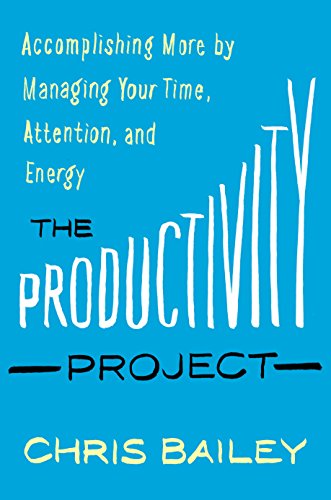
⚡️ What is The Productivity Project about?
The Productivity Project is Chris Bailey’s fascinating account of a year-long journey he dedicated to uncovering the secrets of true productivity. Instead of just rehashing existing theories, he conducted a series of intense, often quirky, experiments on himself—from working 90-hour weeks to meditating for 10 hours a day and living in total isolation. The book is the culmination of these experiments, revealing that productivity isn’t about doing more things but about doing the right things. Bailey distills his findings into a practical guide focused on managing three core resources: time, attention, and energy. It’s a deeply personal yet universally applicable exploration of how we can work more deliberately, accomplish what truly matters, and live more meaningful lives.
🚀 The Book in 3 Sentences
- The Productivity Project reveals that managing your attention and energy is more crucial than managing your time alone.
- True productivity comes from intentionally focusing on high-impact tasks and ruthlessly eliminating the trivial.
- By conducting a year of self-experiments, Chris Bailey proves that working smarter, not harder, is the key to accomplishing more without burning out.
🎨 Impressions
What struck me most about The Productivity Project is its refreshing honesty and scientific approach. It’s not a preachy list of commandments but a vulnerable account of trial and error. I loved how Bailey blends research with his personal experiences, making the concepts feel both credible and relatable. The book avoids the one-size-fits-all trap, instead offering a menu of strategies and encouraging readers to experiment and find what works for them. It’s less about a rigid system and more about developing a productive mindset, which I found far more empowering and sustainable in the long run.
📖 Who Should Read The Productivity Project?
This book is perfect for anyone who feels constantly busy but isn’t seeing meaningful results. If you’ve tried other productivity systems and failed, The Productivity Project offers a new perspective grounded in self-awareness. It’s ideal for knowledge workers, freelancers, students, and anyone looking to reclaim their focus and time from the distractions of the modern world. If you’re a self-proclaimed productivity nerd who loves data-driven strategies, you will devour this book.
☘️ How the Book Changed Me
\p>Reading this book fundamentally shifted my relationship with work and focus. I moved from a mindset of “doing more” to “doing what matters,” and the impact has been profound. I no longer measure my day by how many items I checked off a list, but by the progress I made on my most important goals. The Productivity Project gave me the permission and the framework to be more deliberate with my resources.- I started tracking my energy levels to identify my Biological Prime Time (BPT) and now protect that time fiercely.
- I adopted the Rule of Three daily, which has brought immense clarity and intention to my mornings.
- I became much more aware of my procrastination triggers and now actively design tasks to make them less intimidating.
- I finally internalized that getting 8 hours of sleep isn’t a luxury; it’s a core component of high performance.
- I now say “no” to low-impact requests with much more confidence, freeing up time for what truly counts.
✍️ My Top 3 Quotes
- “Productivity isn’t about doing more things—it’s about doing the right things.”
- “Busyness is no different from laziness when it doesn’t lead you to accomplish anything.”
- “The more you invest in yourself, the more you’ll be able to handle everything that life throws at you.”
📒 Summary + Notes
The Productivity Project is structured around Chris Bailey’s year of experiments, offering a rich tapestry of insights. The book is broken down into logical parts, starting with the foundational concepts and progressively moving to more advanced techniques and the final, holistic view of a productive life. Each chapter presents a new lesson, backed by Bailey’s personal journey, scientific research, and actionable advice. It’s a masterclass in understanding that productivity is a skill that can be cultivated, not an innate talent.
Chapter 1: Where to Start
This chapter lays the foundation by arguing that productivity is about managing your time, attention, and energy. Bailey emphasizes the importance of having a strong “why” behind your desire to be more productive. He prompts you to consider your values and what you would do with more free time, ensuring your productivity goals are aligned with what’s truly meaningful to you. This connection to your values is the fuel that will sustain your efforts.
- The three pillars of productivity are time, attention, and energy.
- Your motivation for being productive must be tied to your core values.
- Ask yourself: if you had more time, what would you do that is meaningful to you?
- A good productivity system is worthless without a meaningful reason to use it.
Chapter 2: Not Every Task Is Created Equal
Bailey introduces the Pareto Principle, or the 80/20 rule, which states that 80% of your results come from 20% of your efforts. The key is to identify and focus on these highest-impact tasks. He challenges the reader to distinguish between tasks that provide immense value and those that just keep you busy. This chapter is a call to work smarter, not harder, by investing your best resources in the activities that yield the greatest returns.
- Focus on the 20% of tasks that generate 80% of your results.
- Differentiate high-impact tasks (e.g., planning) from low-impact tasks (e.g., checking email).
- Productivity is a function of the impact of your tasks, not the quantity.
- Continuously ask yourself if what you’re doing is the most valuable use of your time.
Chapter 3: Three Daily Tasks
Here, Bailey presents one of the most powerful and simple techniques from the book: the Rule of Three. At the start of each day, you decide on the three things you want to accomplish by the end of it. This practice forces you to prioritize and brings intentionality to your day. It’s not about creating a massive to-do list but about focusing your energy on what will make you feel most productive and fulfilled.
- Every morning, identify three things you will accomplish today.
- Ask: “What will I regret not doing by day’s end?”
- This rule helps you separate the urgent from the important.
- It provides a sense of accomplishment and direction, even on chaotic days.
Chapter 4: Ready for Prime Time
This chapter is all about discovering your Biological Prime Time (BPT). Bailey explains that our energy levels fluctuate throughout the day, and we have a specific window when we have the most focus and creativity. He suggests tracking your energy levels for a week to identify this golden window. The key takeaway is to schedule your most challenging, high-impact tasks during your BPT and save low-energy tasks for other times.
- Your Biological Prime Time is when your energy and focus levels are at their peak.
- Track your energy levels every hour for a week to find your BPT.
- Schedule your highest-impact tasks to coincide with your BPT.
- Protect your BPT fiercely; it’s your most valuable asset for deep work.
Chapter 5: Cozying Up to Ugly Tasks
Bailey tackles procrastination head-on by identifying its six triggers: a task is boring, frustrating, difficult, unstructured, lacks personal meaning, or is unengaging. Instead of fighting procrastination with willpower alone, he suggests making the task more appealing. You can do this by changing your environment, breaking the task down, or pairing it with something you enjoy. It’s about making the “ugly” task a little less ugly.
- Procrastination is triggered by boredom, frustration, difficulty, lack of structure, ambiguity, and lack of personal meaning.
- Identify which trigger is causing you to procrastinate on a specific task.
- Manipulate the task to make it less intimidating (e.g., work in a coffee shop).
- Sometimes, the best strategy is to just start for two minutes.
Chapter 6: Meet Yourself… from the Future
This chapter is about connecting with your future self. Bailey argues that we often treat our future selves like strangers, offloading difficult tasks and poor habits onto them. He suggests getting in touch with this future self by imagining their needs and desires. This practice builds empathy for your future self and motivates you to make better decisions today, whether it’s saving money, exercising, or completing a dreaded task.
- Don’t give your future self a problem you wouldn’t give a stranger.
- Imagine what your future self would thank you for doing today.
- Small actions now (like saving or exercising) have a massive compounding effect.
- Connecting with your future self helps you overcome present bias.
Chapter 7: The Internet Is Killing Your Productivity
Bailey discusses how the internet, while a powerful tool, can be a massive productivity killer. He shares several strategies for reclaiming your time and attention, such as disconnecting from the internet during deep work, using airplane mode, and unsubscribing from unnecessary email lists. The core message is to treat the internet as a “nicety, not a necessity,” and to be deliberate about when and how you engage with it.
- The internet should be a tool you use intentionally, not a constant distraction.
- Disconnect completely when working on demanding tasks.
- Unsubscribe from newsletters and notifications that don’t serve you.
- Use the “20-second rule”: make distractions harder to access.
Chapter 8: The Time Economy
In this chapter, Bailey provides a brief history of time management, noting that it became crucial during the Industrial Revolution when time equaled money. He argues that while time management is still important, it’s no longer enough. In our knowledge economy, managing our attention and energy is arguably more critical for achieving high levels of productivity and performance. We’ve moved from an economy of time to an economy of attention.
- Time management became important during the Industrial Revolution.
- In today’s knowledge economy, attention and energy are the new currencies of productivity.
- Managing your time well is pointless if you’re distracted and exhausted.
- The most productive people manage all three resources in tandem.
Chapter 9: Working Less
This chapter challenges the glorification of “busyness.” Bailey experimented with working 90-hour weeks and then 20-hour weeks and found his productivity was highest in the latter. He argues that busyness is not the same as productivity. Working fewer hours creates a sense of urgency, forcing you to focus only on what’s truly important and eliminate the rest. It’s a powerful argument for working smarter and more deliberately, not just longer.
- Busyness is often a trap that makes us feel productive without actually being productive.
- Working fewer hours can increase your productivity by forcing you to prioritize.
- Creating artificial deadlines makes tasks less boring and more engaging.
- Measure your productivity by your results, not by the hours you work.
Chapter 10: Energy Enlightenment
Bailey doubles down on the importance of energy management in this chapter. He reiterates that your Biological Prime Time is sacred and should be protected for your most meaningful work. He also discusses how different tasks consume different amounts of energy and suggests matching your energy level to the task’s difficulty. By managing your energy, you can bring more focus and vitality to everything you do.
- Your most valuable hours are those when you have the most energy.
- Guard your Biological Prime Time for your most important and challenging work.
- Match your energy level to the difficulty of the task at hand.
- Productivity is about bringing your best energy to your most important tasks.
Chapter 11: Cleaning House
This chapter is about tackling all those small, nagging maintenance tasks that clutter our minds and to-do lists. Bailey suggests batching these tasks together and doing them all at once, perhaps on a designated “maintenance day.” This includes things like cleaning, errands, and answering non-urgent emails. By grouping them, you reduce the context-switching cost and free up mental space for more important work.
- Batch all your maintenance tasks together and do them in one go.
- Designate a specific time or day for chores, errands, and admin work.
- Don’t aim for perfection with maintenance tasks; “good enough” is fine.
- Completing a batch of small tasks provides a significant sense of progress.
Chapter 12: The Zen of Productivity
Bailey explores the idea of finding a Zen-like state in your work. This involves decreasing the time spent on low-impact tasks and increasing the quality of time spent on high-impact ones. He also emphasizes the importance of creating space for your mind to wander, which is where creativity and insight often emerge. Activities like showering, running, or reading in a cafe can be incredibly productive for generating new ideas.
- Spend less time on low-impact tasks and more time on what truly matters.
- Create “attentional space” between your work and life to let your mind recharge.
- Letting your mind wander is crucial for creativity and problem-solving.
- Intentionally disconnect to allow for Zen-like moments of clarity.
Chapter 13: Shrinking the Unimportant
This chapter provides practical strategies for dealing with low-impact tasks that you can’t eliminate entirely. Bailey suggests you can either shrink them, delegate them, or automate them. He categorizes these tasks into those that drain your attention (like email) and those that drain your time (like meetings). The goal is to regain control over how you spend your two most valuable resources: time and attention.
- For unavoidable low-impact tasks, try to shrink, delegate, or eliminate them.
- Identify which tasks drain your time versus which drain your attention.
- Set strict time limits for tasks like checking email or social media.
- Question every meeting: is it necessary, and can the goals be achieved another way?
Chapter 14: Removing the Important
One of the most powerful productivity hacks, according to Bailey, is learning to say no. Every time you say no to a low-impact commitment, you are saying yes to a more valuable one. He encourages you to be ruthless in protecting your time and to focus only on what is essential. He even suggests asking yourself how much you would pay to buy back an hour of your life, which can put the value of your time into perspective.
- Saying “no” is one of the most effective productivity strategies.
- For every “no” to a low-impact task, you say “yes” to a high-impact one.
- Focus on what is essential and eliminate everything else.
- Consider outsourcing or hiring help for tasks that aren’t worth your time.
Chapter 15: Emptying Your Brain
Bailey advocates for the practice of a “brain dump,” which involves getting all of your tasks, ideas, and worries out of your head and onto paper (or a digital tool). This act of externalizing your thoughts reduces stress, improves focus, and helps you get organized. It frees up your mind’s RAM to focus on the present moment instead of trying to hold onto a dozen different to-dos.
- Regularly “brain dump” everything on your mind to reduce stress.
- Writing down tasks frees up mental space for focus and creativity.
- Keep notepads handy everywhere to capture ideas as they arise.
- Externalizing your worries can limit them to a specific time, making them less intrusive.
Chapter 16: Rising Up
To gain perspective on your progress, Bailey recommends conducting a weekly review. This is a time to look back at what you accomplished, what went well, and what could be improved. It’s a chance to celebrate your wins and course-correct for the week ahead. This regular practice ensures you stay aligned with your long-term goals and don’t get lost in the day-to-day shuffle.
- Schedule a weekly review to reflect on your accomplishments and challenges.
- Use this time to celebrate your progress and identify areas for improvement.
- A weekly review helps you stay on track with your bigger goals.
- It’s a powerful tool for continuous improvement and self-awareness.
Chapter 17: Making Room
This chapter is a continuation of the “Zen of Productivity” theme. Bailey emphasizes the importance of allowing your mind to wander. He lists several activities that foster this state, such as exercising, meditating, taking a shower, walking in nature, and spending time with loved ones. These aren’t wasted moments; they are essential for incubating ideas, solving complex problems, and recharging your creative batteries.
- Intentionally schedule time to let your mind wander.
- Activities like exercise, meditation, and nature walks are productive for your brain.
- Your best ideas often come when you’re not actively trying to think.
- Making room for unstructured thought is crucial for creativity.
Chapter 18: Becoming More Deliberate
Bailey introduces the concept of the “attention muscle.” Just like a bicep, your ability to focus can be strengthened with practice. The key is to be more deliberate about when and how you focus. When you decide to work on a task, commit to it fully. Over time, this practice will increase your stamina for deep focus and make you less susceptible to distractions.
- Your ability to pay attention is like a muscle that can be trained.
- Practice deliberate focus by committing fully to a single task.
- Start with short bursts of focused work and gradually increase the duration.
- The more you train your attention muscle, the stronger it becomes.
Chapter 19: Attention Hijackers
In this chapter, Bailey focuses on preventing interruptions before they happen. He notes that it can take up to 25 minutes to refocus after an interruption. The biggest culprits are our smartphones, with their constant notifications and alerts. His advice is to be proactive: turn off all notifications, put your phone in another room, and create a distraction-free work environment to protect your focus.
- It takes, on average, 25 minutes to regain focus after an interruption.
- Proactively eliminate distractions before they have a chance to hijack your attention.
- Turn off all notifications on your phone and computer.
- Keep your phone out of sight and out of reach while working.
Chapter 20: The Art of Doing One Thing
Bailey makes a strong case against multitasking, arguing that it’s a myth. Instead, he champions single-tasking—the art of doing one thing at a time with your full attention. When you single-task, you not only produce higher-quality work but also complete it faster. This practice is also one of the best ways to strengthen your attention muscle and become more deliberate in your work.
- Multitasking is a myth; what you’re actually doing is task-switching, which is inefficient.
- Embrace single-tasking to improve the quality and speed of your work.
- Single-tasking is a powerful workout for your attention muscle.
- Group similar tasks together to minimize the cost of context-switching.
Chapter 21: The Meditation Chapter
Bailey demystifies meditation, arguing that it’s a powerful tool for improving productivity. He debunks common myths, such as the idea that meditation makes you less motivated or is too hard to start. He provides a simple guide: find a quiet place, sit upright, focus on your breath, and gently return your attention to it whenever it wanders. Even a few minutes a day can have a significant impact on your focus and calm.
- Meditation makes you more productive, not less.
- It’s easier to start than you think; just focus on your breath for a few minutes.
- When your mind wanders, gently guide it back without judgment.
- Regular meditation practice improves your ability to focus and manage stress.
Chapter 22: Refueling
This chapter focuses on the role of diet in managing your energy levels. Bailey’s experiments led him to two simple but powerful conclusions: eat more unprocessed foods and stop eating when you’re full. By nourishing your body with the right fuel and avoiding overeating, which can cause sluggishness, you can maintain more stable energy levels throughout the day.
- Your diet has a direct impact on your energy and productivity.
- Eat more whole, unprocessed foods for sustained energy.
- Stop eating when you feel full to avoid the post-meal energy crash.
- What you eat for lunch can make or break your afternoon productivity.
Chapter 23: Drinking for Energy
Bailey turns his attention to what we drink. His key advice is to drink more water, less alcohol and sugary drinks, and to be strategic with caffeine. He suggests drinking green tea instead of coffee for a more balanced energy boost and using caffeine strategically before important tasks that require high focus, like a presentation or a deep work session.
- Drink more water throughout the day to stay hydrated and alert.
- Avoid sugary drinks and excessive alcohol, which drain your energy.
- Use caffeine strategically before high-focus tasks, not habitually.
- Green tea can provide a smoother energy boost than coffee.
Chapter 24: The Exercise Pill
Bailey describes exercise as a “magic pill” for productivity. He explains that physical activity not only boosts your energy levels but also improves your focus and mood. Even a small amount of exercise can have a significant impact. The key is to find a way to fit some form of physical activity into your daily routine, whether it’s a brisk walk, a gym session, or a quick workout at home.
- Exercise is one of the best things you can do for your energy and focus.
- Regular physical activity improves your mood and cognitive function.
- Even a 10-minute walk can boost your energy and creativity.
- Schedule exercise like you would any other important appointment.
Chapter 25: Sleeping Your Way to Productivity
This chapter is a passionate plea for the importance of sleep. Bailey cites a study that found for every hour of sleep you lose, you lose two hours of productivity the next day. He argues that sleep is not a luxury but a fundamental pillar of high performance. He offers tips for improving sleep hygiene, such as creating a nighttime ritual, avoiding screens before bed, and making your bedroom a cool, dark, and quiet sanctuary.
- For every hour of sleep you miss, you lose two hours of productivity.
- Aim for 7-8 hours of quality sleep per night.
- Create a relaxing bedtime ritual to signal to your body that it’s time to sleep.
- Avoid blue light from screens for 2-3 hours before bed.
Chapter 26: The Final Step
In the final chapter, Bailey reveals the ultimate productivity secret: happiness. He argues that the happier you are, the more productive you will be. He shares several research-backed strategies for boosting your happiness, such as practicing gratitude, journaling about positive experiences, and being kind to yourself. The final step is to stop chasing productivity for its own sake and to focus on living a happy, meaningful life, which is the true foundation of sustainable achievement.
- Happiness is the greatest productivity booster of all.
- Practice gratitude by recalling three good things that happened each day.
- Be kind to yourself and celebrate your accomplishments.
- Disconnect from the pursuit of productivity to recharge and find joy.
Key Takeaways
The Productivity Project is a treasure trove of actionable advice, but a few core principles stand out as truly transformative. The biggest shift is moving from a time-centric view to a holistic one that includes attention and energy. The book teaches you to be more intentional, proactive, and self-aware in how you work and live. It’s not about finding a perfect system but about building a set of tools and a mindset that allows you to focus on what’s truly important.
- True productivity is about managing your time, attention, and energy in harmony.
- Identify and work on your highest-impact tasks during your Biological Prime Time.
- The Rule of Three is a simple yet powerful tool for daily intentionality.
- Procrastination can be managed by understanding and manipulating its triggers.
- Ruthlessly eliminate low-impact tasks by saying “no” and protecting your focus.
- Happiness, sleep, and health are not sacrifices for productivity; they are the foundation of it.
Conclusion
Chris Bailey’s The Productivity Project is more than just a book of tips; it’s a compelling invitation to become the scientist of your own life. It encourages you to question assumptions, run experiments, and discover what truly makes you effective and fulfilled. By blending personal stories with scientific research, Bailey provides a roadmap that is both inspiring and practical. If you’re ready to move beyond busyness and start accomplishing what really matters, this book is an essential guide. It will equip you with the strategies and the mindset to not only do more, but to be more.
More From Chris Bailey →
Discover more from AI Book Summary
Subscribe to get the latest posts sent to your email.