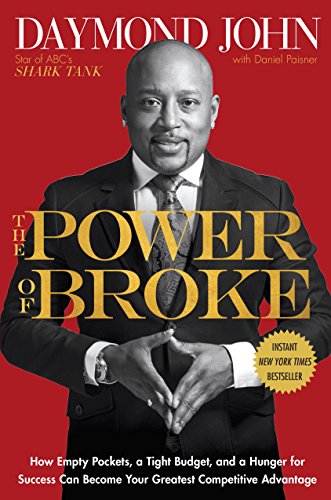
⚡️ What is The Power of Broke About?
Ever wonder why some people with massive venture capital funding flame out while a kid in a basement builds a global empire? I used to think money was the fuel for every great idea, but More summaries by Daymond John completely flipped that script for me. The central thesis of the book is that having nothing to lose makes you dangerous, creative, and incredibly efficient. When you don’t have a checkbook to solve a problem, you have to use your brain, and that’s where the real magic happens.
Daymond John, the guy we all know from Shark Tank and the founder of FUBU, walks us through how he started with a $40 budget and a few hats on a street corner in Queens. It’s one of my favorite entrepreneurship book summaries because it doesn’t worship at the altar of “scaling” or “funding.” Instead, it celebrates the raw, gritty hustle of someone who has no choice but to succeed. He argues that “broke” isn’t just a bank balance; it’s a mindset that forces you to be authentic and resourceful.
🚀 The Book in 3 Sentences
- The lack of capital is actually a competitive advantage because it prevents you from making expensive mistakes and forces you to connect deeply with your customers.
- Success is governed by the “SHARK” mindset: Set a goal, Homework, Amore (passion), Remember you are the brand, and Keep swimming.
- Desperation is the ultimate catalyst for innovation; when your back is against the wall, you find solutions that people with money simply overlook.
🎨 Impressions
I’ll be honest, I expected this to be another “ra-ra” motivational book with a celebrity name on the cover. I was wrong. It’s surprisingly tactical. John doesn’t just talk about himself; he profiles about a dozen other entrepreneurs—from high-flying DJs to cupcake bakers—who used their lack of funds to outmaneuver the giants. It’s the kind of book that makes you feel like your small bank account is actually a loaded weapon, not a handicap.
What really stuck with me was the idea of “creative desperation.” We’ve all been there—trying to figure out how to make something work when the “proper” way is too expensive. John makes a compelling case that those “workarounds” are actually your brand’s unique DNA. If you have too much money, you just buy the standard solution, and then you look exactly like everyone else. Why would you want to be a carbon copy when being broke forces you to be an original?
📖 Who Should Read The Power of Broke?
This is a must-read if you’re currently sitting on a “great idea” but waiting for an investor to say yes before you start. It’s for the person who feels stuck because they don’t have an MBA or a rich uncle. However, if you’re looking for a deep technical manual on accounting or legal structures, you should probably look elsewhere. This is about the psychological and strategic edge of the underdog.
☘️ How This Book Changed My Thinking
Before I read this, I viewed “fundraising” as the first real step of a business. Now, I see it as a potential trap that can kill creativity before it starts.
- I stopped looking at my tight marketing budget as a limitation and started seeing it as a filter that forces me to only do things that actually move the needle.
- I realized that being “the brand” is more important than having a fancy logo; people buy from people they relate to, and being broke makes you very relatable.
- I’ve started asking “How can I do this for zero dollars?” as a first resort, even when I have the money to pay for it.
✍️ 3 Quotes That Stuck With Me
- “The power of broke is about making sure that every single step you take is a deliberate one.” — This reminded me that when you have no money, you can’t afford to be sloppy.
- “Money doesn’t solve problems; it only magnifies them.” — This hits differently when you realize a bad business model just becomes a more expensive bad business model with funding.
- “Desperation breeds innovation.” — It’s the simplest explanation for why the hungriest person in the room usually wins.
📒 Summary + Notes
The core philosophy here is that money is a sedative. When you have it, you get soft. You stop listening to your customers because you can just buy ads to replace them. You stop innovating because you can buy off-the-shelf software. The book argues that the most successful ventures are those that maintain a “broke mindset” even after they’ve made millions. It’s about staying hungry and staying lean, no matter what the balance sheet looks like.
John builds his case by breaking down the SHARK framework and then backing it up with real-world examples. He shows that the common thread among winners isn’t a silver spoon, but a specific type of resourcefulness. Whether it’s Steve Aoki building a record label from his apartment or Gigi Butler starting a cupcake shop with $33 in the bank, the story is always the same: they had to get creative because they had no other choice. By the end of the book, you’re convinced that your biggest perceived weakness—your lack of funds—is actually your greatest weapon.
Introduction: The Power of Broke
Why do most startups fail within the first five years? John argues it isn’t always because they ran out of money, but often because they had too much of it at the wrong time. He takes us back to his early days in Hollis, Queens, where he was sewing wool hats and selling them on the street. He didn’t have a marketing department; he had his friends wearing the hats in music videos. He didn’t have a retail store; he had a car trunk.
This section sets the stage: if you have $100,000 to start a business, you might spend $20,000 on a logo and a website before you even know if people want your product. If you have $40, you spend it on the product and go find a customer immediately. Which one do you think learns faster? The book establishes that being broke forces a “near-instant feedback loop” that is essential for survival.
Chapter 1: The SHARK Mindset
What does it actually mean to think like a shark? John breaks it down into five key pillars that serve as the foundation for the rest of the book. It starts with setting a goal—not a vague one, but a specific, measurable target. He notes that without a destination, you’re just swimming in circles, wasting the very energy you need to survive.
- Set a goal: Define exactly what success looks like.
- Homework: Know your industry better than anyone else.
- Amore: If you don’t love it, you’ll quit when the money stays gone.
- Remember you are the brand: Your personal story is your edge.
- Keep swimming: Persistence is the only thing that guarantees you stay in the game.
Chapter 2: The Power of Authenticity
Have you ever noticed how big corporations try so hard to sound “hip” and fail miserably? That’s because authenticity can’t be bought; it has to be lived. John explains that when you’re broke, you are naturally authentic. You’re in the trenches with your customers because you’re one of them. This creates a level of trust and loyalty that a multi-million dollar ad campaign can never replicate.
He uses the story of Mo Bridges (Mo’s Bows) to illustrate this. Mo was a kid who wanted better bow ties, so he and his grandmother started making them. He wasn’t a “corporate entity”; he was a kid with a passion. That story was so powerful that it landed him on Shark Tank and eventually a deal with the NBA. Would people have cared as much if it were just another factory-made tie? Probably not.
Chapter 3: Optimizing the Hustle
Can you really outwork someone who has ten times your resources? Absolutely, if you optimize your energy. John talks about the importance of being “the first one in and the last one out,” but with a twist. It’s not just about hours; it’s about the intensity of those hours. When you’re broke, every hour represents a potential meal or a rent payment, so the stakes are naturally higher.
He highlights how successful entrepreneurs use their constraints to find “shortcuts” that aren’t actually shortcuts—they’re just smarter ways of doing things. For instance, instead of buying expensive market research, they talk to 50 people on the street. Instead of hiring a PR firm, they send personal emails to bloggers. This lean approach doesn’t just save money; it builds a more robust, agile business.
Chapter 4: The Case Studies of Broke
What do a cupcake baker, a world-class DJ, and an extreme sports star have in common? This chapter is a series of deep dives into people like Gigi Butler and Steve Aoki. Gigi Butler’s story is incredible: she had $33 in her bank account when she opened her first cupcake shop. She did the plumbing herself. She used her cleaning business to fund the ingredients. Because she couldn’t afford a failure, she obsessively focused on the quality of her product.
Steve Aoki’s story is equally compelling. Despite his father being a wealthy founder of Benihana, Steve didn’t take a dime. He built his record label, Dim Mak, by sleeping on floors and promotion through pure grassroots effort. This chapter hammers home the point: the power of broke is universal. It works in any industry, at any age, as long as you embrace the struggle rather than trying to buy your way out of it.
Chapter 5: Rising and Grinding
Is there a point where you stop being “broke”? According to John, you should never stop *feeling* that way. Even as he sits in his office today, he tries to maintain that same sense of urgency he had on the streets of Queens. He discusses the concept of “intentional broke”—artificially creating constraints to keep the innovation alive within a large company.
He warns against the “luxury trap.” As soon as you start getting comfortable, you stop looking for the edges. You start hiring people to do things you used to do yourself, and you lose touch with the ground floor. The goal isn’t to be broke forever, but to keep the *power* of broke as your guiding light regardless of how many zeros are in your bank account.
⚖️ A Critical Perspective
While the book is incredibly inspiring, I think it glosses over the crushing reality of systemic poverty. There is a difference between being “temporarily broke” while having a social safety net or a strong network, and being in a position where $40 isn’t just a budget—it’s your life savings. John’s examples are high-energy success stories, which can lead to a bit of survivor bias. He also tends to simplify complex market dynamics into “just hustle harder,” which might not be enough in heavily regulated or capital-intensive industries like biotech or aerospace.
🔄 How It Compares
If you compare this to Zero to One by Peter Thiel, the difference is night and day. Thiel focuses on technology and the “monopoly” power of massive innovation, often requiring significant investment to reach escape velocity. John, on the other hand, is much more aligned with the “solopreneur” or “lifestyle business” crowd where the focus is on immediate cash flow and personal branding rather than creating a world-changing piece of infrastructure.
🔑 Key Takeaways
These are the lessons you can apply whether you have $0 or $1,000,000 in your pocket.
- Constraint creates focus: Stop complaining about what you don’t have and start using the boundaries of your situation to find a unique path.
- You are the brand: In a world of infinite choices, people buy into the “why” and the “who” before they buy the “what.”
- Homework is your highest ROI: Being broke means you have more time than money; spend that time becoming the undisputed expert in your niche.
- Stay hungry: The moment you feel like you’ve “made it” is the moment you become vulnerable to someone who is still using the power of broke.
💬 Frequently Asked Questions
What is the main argument of The Power of Broke?
The book argues that a lack of financial resources is a strategic advantage. It forces entrepreneurs to be more creative, efficient, and authentic. Without money to mask mistakes, you are forced to build a solid business foundation from day one, focusing on customer needs rather than expensive distractions.
What does the SHARK acronym stand for?
SHARK stands for Set a goal, Homework, Amore (passion), Remember you are the brand, and Keep swimming. This framework represents the mindset necessary to succeed when you don’t have capital. It emphasizes preparation, personal connection, and relentless persistence as the primary drivers of business growth.
Is The Power of Broke actually worth reading for established owners?
Yes, because it serves as a wake-up call against corporate complacency. Established owners often lose their edge by throwing money at problems. John explains how to maintain an “intentional broke” mindset to drive internal innovation and stay competitive against hungrier, leaner startups that are moving faster.
How did Daymond John use the power of broke for FUBU?
Daymond John started FUBU with just $40. Because he couldn’t afford traditional advertising, he convinced hip-hop artists to wear his clothes in music videos for free. This grassroots approach created an organic buzz and level of street credibility that no paid marketing campaign could ever achieve.
Can the power of broke work in 2025?
Absolutely—it’s more relevant than ever. With the rise of free AI tools and social media, the cost of starting a business has plummeted. The “broke” entrepreneur today can use these tools to outpace slow, capital-heavy corporations that are still stuck in traditional, expensive workflows.
Conclusion
At the end of the day, The Power of Broke is a reminder that your potential isn’t defined by your bank account. It’s defined by your willingness to outwork, outthink, and outmaneuver the competition. When you have everything to gain and nothing to lose, you operate with a level of clarity that wealthy people simply can’t match. You aren’t just building a business; you’re building a survival mechanism that will carry you through the inevitable ups and downs of the market.
If you’re waiting for the “perfect time” or the “perfect investment” to start, you’re doing it wrong. The perfect time is when you’re hungry and have no other options. That’s when you’ll do your best work. So, stop looking for a check and start looking for a problem to solve with your own two hands. Trust me, the view from the top is much better when you know you climbed every inch of the mountain without a lift.
More From Daymond John →
Discover more from AI Book Summary
Subscribe to get the latest posts sent to your email.