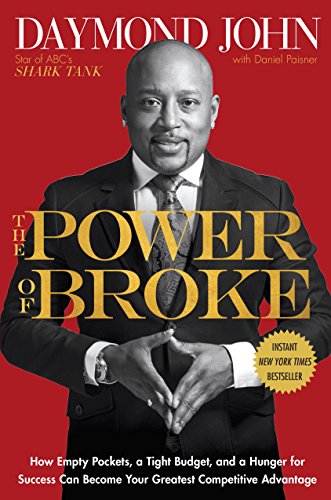
⚡️ What is The Power of Broke about?
The Power of Broke is Daymond John’s revolutionary business philosophy that demonstrates how having limited resources can actually become your greatest competitive advantage. Drawing from his personal experience building FUBU from the ground up with just $40, John reveals how being broke forces entrepreneurs to be more resourceful, creative, and connected to their customers. The book outlines a step-by-step approach to transforming financial constraints into innovative solutions, emphasizing that true success comes not from having abundant capital but from maximizing every available resource. John argues that hunger and necessity drive innovation in ways that unlimited funding never could, making this an essential read for aspiring entrepreneurs and business owners looking to thrive regardless of their financial starting point.
🚀 The Book in 3 Sentences
- The Power of Broke teaches that financial limitations foster creativity, resourcefulness, and a stronger connection to customers that money can’t buy.
- Success comes from leveraging your constraints rather than wishing them away, using hunger and necessity as driving forces for innovation and growth.
- By embracing the mindset of having nothing to lose, entrepreneurs can take calculated risks, think outside conventional boundaries, and build authentic businesses that resonate deeply with their target audience.
🎨 Impressions
Reading The Power of Broke completely transformed my perspective on entrepreneurship and resource constraints. Daymond John’s authentic storytelling combined with practical business wisdom creates a powerful narrative that’s both inspiring and actionable. What impressed me most was how John reframes poverty and financial limitations not as obstacles but as catalysts for innovation, forcing entrepreneurs to develop the grit and creativity necessary for sustainable success. His personal journey from humble beginnings to business empire exemplifies the principles he teaches, making this book a compelling blend of memoir and business strategy guide.
📖 Who Should Read The Power of Broke?
The Power of Broke is essential reading for aspiring entrepreneurs, small business owners, and anyone with limited resources looking to launch a venture. It’s particularly valuable for those who feel discouraged by their lack of funding or connections, as John provides a roadmap for turning perceived disadvantages into competitive advantages. Additionally, established business owners who have become complacent with their resources will benefit from rediscovering the hunger and scrappiness that often accompanies early-stage entrepreneurship, making this book relevant to businesspeople at all stages of their journey.
☘️ How the Book Changed Me
How my life / behaviour / thoughts / ideas have changed as a result of reading the book.
- I’ve stopped viewing my limited budget as a disadvantage and now see it as a catalyst for creativity, forcing me to find innovative solutions where others might simply throw money at problems.
- The book transformed my approach to customer relationships, teaching me to live alongside my customers rather than just selling to them, resulting in deeper insights and more authentic product development.
- I’ve embraced the ‘rise and grind’ mentality, understanding that consistent, passionate effort trumps sporadic bursts of activity, fundamentally changing my work ethic and approach to business challenges.
✍️ My Top 3 Quotes
- “When you’ve got nothing to lose, you’ve got everything to gain. Sometimes it takes having your back against the wall, leveraging your last dollar, and having no place to go but up, up, up if you expect something to happen.”
- “Being broke is the one thing that forces you to get up off your ass and make something happen. It’s the one thing that won’t let you make excuses.”
- “The Power of Broke isn’t about how much money you have—it’s about how you think about the money you don’t have. It’s about leveraging what you do have: your passion, your creativity, and your determination.”
📒 Summary + Notes
The Power of Broke introduces a revolutionary business philosophy that challenges conventional thinking about resources and success. Daymond John argues that having limited financial resources actually creates advantages that wealthy entrepreneurs can’t replicate, including greater creativity, stronger customer connections, and more efficient resource allocation. The book combines John’s personal story of building FUBU from the ground up with practical strategies that any entrepreneur can implement, regardless of their starting point. By embracing constraints rather than fighting them, readers learn to transform what appears to be a disadvantage into their greatest competitive edge, developing the mindset and skills necessary for sustainable business success in any economic climate.
Chapter 1: The Power of Broke: An Introduction
Daymond John opens with his personal story of starting FUBU with just $40, introducing the core concept that being broke forces innovation. He explains how financial constraints forced him to be creative, resourceful, and deeply connected to his customers in ways that well-funded competitors couldn’t match. John argues that having limited resources eliminates the temptation to spend money on problems that could be solved more creatively, establishing the foundation for his entire philosophy. The chapter sets up the paradox that having nothing to lose actually gives entrepreneurs everything to gain, as desperation breeds innovation and determination.
- Financial constraints create a powerful sense of urgency that drives entrepreneurs to find creative solutions rather than simply throwing money at problems.
- John shares how he mortgaged his home for $100,000 to start FUBU, demonstrating that calculated risks are essential when resources are limited.
- The chapter establishes that hunger is a powerful motivator that money can’t buy, giving broke entrepreneurs a distinct advantage over their well-funded counterparts.
Chapter 2: Set the Goal
John emphasizes that success begins with a clear, specific, and compelling goal that serves as your north star. He explains how broke entrepreneurs can’t afford to waste resources on vague aspirations, detailing how to create goals that are both ambitious and achievable. The chapter provides practical frameworks for setting objectives that align with your passion and market needs, emphasizing the importance of writing down your goals and sharing them with others. John illustrates how having a crystal-clear target allows you to focus your limited resources most effectively, preventing the scattered approach that plagues many early-stage businesses.
- Effective goals must be specific, measurable, and time-bound, providing clear direction for your limited resources and energy.
- John shares his ‘goal hierarchy’ system, showing how to break down big aspirations into smaller, actionable steps that build momentum.
- The chapter emphasizes that authentic goals aligned with your personal passion are more sustainable than those driven purely by financial motives, which is crucial when facing the challenges of building with limited resources.
Chapter 3: Do the Math
This chapter focuses on the importance of understanding your numbers, even when you’re not a financial expert. John argues that broke entrepreneurs must become intimately familiar with their business metrics because they can’t afford to make financial mistakes. He provides practical advice on creating lean budgets, calculating unit economics, and understanding cash flow without expensive software or accountants. The chapter emphasizes that financial literacy isn’t optional for resource-constrained entrepreneurs—it’s a survival skill that enables better decision-making and helps avoid the common pitfalls that sink many startups.
- John introduces the $40 test, a framework he used to validate FUBU’s concept by asking whether he could move the business forward with just $40, forcing ruthless prioritization.
- The chapter provides simple but effective methods for tracking key metrics without expensive systems, including custom spreadsheets and manual record-keeping.
- John emphasizes that understanding your break-even point and unit economics is non-negotiable for broke entrepreneurs, as it determines how long you can survive and where to focus your limited resources.
Chapter 4: Hello, Mr. Customer
John dedicates this chapter to the critical importance of customer intimacy, arguing that broke entrepreneurs have a natural advantage in building deep customer relationships. He explains how limited resources force you to get closer to your customers, understand their needs more intimately, and co-create solutions with them rather than guessing from a distance. The chapter provides practical strategies for gathering customer insights without expensive market research, emphasizing the value of direct feedback and observation. John illustrates how FUBU’s success came directly from being embedded in the hip-hop community they served, creating products that solved real problems for real people.
- Living with your customers is John’s core strategy for understanding their needs, which naturally occurs when you can’t afford formal market research or expensive product development processes.
- The chapter introduces the ‘customer co-creation’ model, showing how to involve your target audience in product development and refinement, creating stronger loyalty and better products.
- John shares how he personally wore FUBU products and solicited feedback in neighborhood gatherings, demonstrating that authentic customer connections are more valuable than expensive advertising campaigns.
Chapter 5: Make it Real
This chapter focuses on execution and the importance of creating tangible proof points for your business concept. John argues that broke entrepreneurs must focus on creating minimum viable products and gathering real-world feedback rather than perfecting offerings in isolation. He provides practical advice on prototyping, testing, and iterating with limited resources, emphasizing that done is better than perfect when you’re working with constraints. The chapter illustrates how FUBU’s early success came from creating samples that customers could see, touch, and experience, building credibility and gathering invaluable feedback that shaped the brand’s direction.
- John introduces the ‘three-sample rule’, explaining how creating just three high-quality prototypes can provide enough credibility to attract partners, customers, and early sales.
- The chapter provides creative strategies for prototyping on a shoestring budget, including bartering skills, leveraging unused capacity, and partnering with complementary businesses.
- John emphasizes the importance of gathering real-world feedback quickly and cheaply, showing how to set up simple testing mechanisms that provide direction without breaking the bank.
Chapter 6: The Power of Zero
John explores the concept of starting from zero and how this position of apparent weakness can be transformed into significant strength. He explains how having no resources forces entrepreneurs to focus exclusively on activities that generate immediate value and revenue, eliminating wasteful pursuits. The chapter provides strategies for bootstrapping, creative financing, and resource leveraging that allow businesses to grow without traditional funding. John illustrates how the discipline of operating with zero creates habits of efficiency and creativity that persist even after resources become available, giving these businesses a sustainable competitive advantage.
- The ‘zero-based thinking’ approach forces entrepreneurs to justify every expenditure and activity, creating a culture of efficiency that well-funded competitors often lack.
- John shares creative financing strategies he used for FUBU, including factoring receivables, strategic partnerships, and pre-selling to generate cash flow without traditional loans or investments.
- The chapter emphasizes that starting from zero builds stronger business fundamentals, as every aspect of the operation must generate value from day one, creating a more resilient enterprise.
Chapter 7: Shark Bites: Daymond’s Lessons
John distills his key business lessons into actionable principles that any entrepreneur can apply, regardless of their resources. Drawing from his experiences on Shark Tank and building multiple businesses, he provides insights into common pitfalls and success factors. The chapter covers topics like branding, negotiation, partnership building, and scaling—all through the lens of resource constraints. John emphasizes that the principles of business success remain constant regardless of funding levels, but broke entrepreneurs must apply them with greater precision and creativity. This section serves as a practical guide to executing business fundamentals when you have limited margin for error.
- John introduces his five S’s of success: Set, Seek, Secure, Share, and Serve, providing a framework for business growth that works especially well for resource-constrained entrepreneurs.
- The chapter provides negotiation strategies for the underdog, showing how to leverage your unique position and create win-win scenarios when you have less bargaining power.
- John shares branding insights that don’t require big budgets, emphasizing authenticity, consistency, and community connection over expensive advertising campaigns.
Chapter 8: The Power of Broke: The Shark Tank Effect
John explores how the principles of The Power of Broke apply in the high-stakes environment of Shark Tank, both for entrepreneurs seeking investment and for the Sharks themselves. He provides behind-the-scenes insights into how resource-constrained entrepreneurs can effectively pitch their businesses and attract investment. The chapter reveals how the most successful Shark Tank pitches embody the principles of the book—demonstrating resourcefulness, customer intimacy, and creative problem-solving. John also explains how he evaluates businesses through the lens of The Power of Broke, looking for entrepreneurs who have maximized their limited resources before seeking funding.
- The ‘Shark Tank pitch formula’ John outlines emphasizes showing how you’ve leveraged limited resources creatively, as this demonstrates the entrepreneurial mindset investors value most.
- John explains that the most successful pitches focus on solving real customer problems with minimal resources, rather than showcasing complex technology or expensive production.
- The chapter provides practical advice for entrepreneurs seeking funding, emphasizing that demonstrating resourcefulness and bootstrapping success often attracts better terms than simply showing a need for capital.
Chapter 9: The Power of Broke in Action
The final chapter showcases real-world examples of entrepreneurs who have successfully applied The Power of Broke principles across various industries. John shares inspiring stories of business owners who turned limitations into innovations, creating thriving enterprises despite significant resource constraints. These case studies illustrate the universal applicability of the book’s principles, from tech startups to service businesses to product companies. The chapter demonstrates that The Power of Broke isn’t just a theory but a practical approach that has worked for countless entrepreneurs, providing readers with both inspiration and concrete examples they can emulate in their own ventures.
- John features the story of a catering business that started with a home kitchen and built a national brand by focusing on authentic customer relationships rather than expensive commercial space.
- The chapter includes a tech startup that created innovative products by repurposing existing technology, demonstrating how constraints can drive creativity rather than hinder it.
- John shares how a service business bootstrapped its growth through strategic partnerships and creative marketing, showing that The Power of Broke principles apply across all business models.
Key Takeaways
The Power of Broke offers transformative insights that can revolutionize how entrepreneurs approach business building. Daymond John’s philosophy turns conventional wisdom on its head by demonstrating that resource constraints create competitive advantages rather than limitations. The most impactful lessons include the importance of customer intimacy, creative resource utilization, and maintaining a hungry mindset even after achieving success. These principles apply not only to starting a business but to sustaining innovation and growth throughout the entrepreneurial journey, making this book relevant for businesspeople at all stages.
- Financial constraints force innovation by eliminating the option to simply spend money on problems, leading to more creative and sustainable solutions.
- Building deep customer relationships is more valuable than expensive marketing, and broke entrepreneurs naturally develop this advantage out of necessity.
- Maintaining a ‘rise and grind’ mindset and operational discipline even after achieving success creates long-term competitive advantages that money can’t buy.
- Starting with zero resources builds stronger business fundamentals and habits of efficiency that persist throughout the company’s growth trajectory.
Conclusion
The Power of Broke offers a revolutionary perspective on entrepreneurship that challenges the notion that success requires abundant resources. Daymond John demonstrates through his personal journey and countless examples that constraints can be catalysts for innovation, creativity, and authentic customer connections. By embracing the principles outlined in this book, entrepreneurs can transform their perceived disadvantages into their greatest competitive advantages, building businesses that are resilient, innovative, and deeply connected to their customers. Whether you’re just starting out or looking to reinvigorate an established business, The Power of Broke provides a roadmap for leveraging what you have to achieve extraordinary results, proving that success is determined not by the resources you possess but by how resourcefully you use them.
More From Daymond John →
Discover more from AI Book Summary
Subscribe to get the latest posts sent to your email.