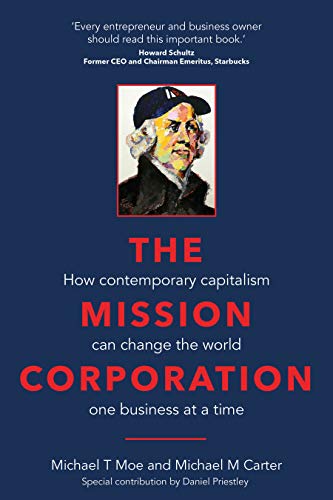
⚡️ What is The Mission Corporation About?
Remember the 1980s mantra that a company’s only job was to make money for its shareholders? Daniel Priestley, Michael Moe, and Michael Carter argue that those days are officially dead. I finished this book feeling like I’d just read a post-mortem on old-school capitalism and a birth certificate for something far more exciting. The authors make a compelling case that the most profitable companies of the next decade won’t be the ones chasing margins, but the ones obsessed with solving a specific, massive problem for the world.
In this business book summaries collection, we’ve seen plenty of frameworks for growth, but this one hits differently. Priestley, known for his pragmatic approach to scaling, teams up with venture capital heavyweights to show that a “mission” isn’t just a fluffy statement on a lobby wall; it’s a competitive advantage that attracts the best talent and the cheapest capital. If you’ve enjoyed More summaries by Daniel Priestley, you’ll recognise his signature focus on visibility and ecosystems, but applied here to the very soul of the company structure.
🚀 The Book in 3 Sentences
- The Mission Corporation is a business model where social impact and high profitability are structurally linked rather than being separate departments.
- By focusing on one of the UN’s Sustainable Development Goals or a similar global challenge, companies can attract a “talent density” that traditional firms simply can’t compete with.
- Profit is redefined as a metric of how efficiently a company is solving its chosen mission, providing the resources to scale that solution globally.
🎨 Impressions
Honestly, I went into this thinking it might be another Corporate Social Responsibility (CSR) manual filled with platitudes. I was wrong. It’s actually quite a cold-blooded business book wrapped in a warm-hearted philosophy. The authors aren’t telling you to be nice for the sake of it; they’re telling you that if you don’t have a mission, you’re going to get crushed by the rising cost of customer acquisition and the total refusal of Gen Z to work for “soulless” entities.
What struck me most was the section on capital. The authors argue that billions of dollars are sitting in ESG (Environmental, Social, and Governance) funds looking for a home, and most businesses are simply invisible to that money because they haven’t codified their mission. It’s a bit frustrating at times because it assumes every business *can* have a world-changing mission—I’m not sure my local dry cleaner needs to solve climate change—but for anyone building a scalable startup, it’s a vital blueprint.
📖 Who Should Read The Mission Corporation?
This is essential reading for founders who feel like they’re on a treadmill of endless growth without a clear “why.” If you’re struggling to hire top-tier talent without paying astronomical salaries, the chapters on People will be a revelation. However, if you’re a solopreneur looking for quick tactical hacks to increase this month’s sales, you might find the high-level focus on “Global Missions” a bit too abstract for your current needs.
☘️ How This Book Changed My Thinking
Before reading this, I viewed “giving back” as something you did after you made your first million. Now, I see that waiting until you’re successful to have a mission is a massive strategic blunder that actually makes reaching that first million harder.
- I stopped thinking of “purpose” as a marketing expense and started seeing it as a recruitment and retention tool.
- I began evaluating business ideas based on their “Mission Potential”—if the company wins, does the world actually get better?
- I realised that “profit” isn’t the enemy of “impact”; it’s the evidence that your impact is sustainable and scalable.
✍️ 3 Quotes That Stuck With Me
- “Profit is the applause you get for creating a solution that works for the world.” — This reframes the entire tension between money and meaning.
- “The best people don’t work for money once they have enough; they work for a mission they believe in.” — A stark reminder that you can’t outbid a mission-driven company for talent.
- “Capital is moving away from companies that do harm and towards companies that solve problems.” — This hits home for anyone looking for investment in the current market.
📒 Summary + Notes
The core thesis of the book is that we are entering the “Age of the Mission Corporation.” The authors break this down into a specific structural shift. In the old model, you had charities (all mission, no profit) and traditional corporations (all profit, no mission). The Mission Corporation sits in the middle, using the aggressive, scalable tools of capitalism to drive a specific social or environmental outcome. Why does this work now? Because the internet has made transparency unavoidable and consumers are voting with their wallets like never before.
The book’s narrative arc moves from the “why” (the failure of Milton Friedman’s shareholder primacy) to the “how” (The 5P Framework). The authors want you to believe that the most significant wealth creation in history will come from solving the biggest problems, like education, healthcare, and sustainability. By the end, they make the case that being a “good” company is no longer about charity—it’s about survival in a world where the best employees and investors simply won’t tolerate anything less.
1: The Death of Shareholder Primacy
What happens when the rules of the game change while you’re still playing the old version? The authors argue that the 50-year reign of “profit at all costs” has led to systemic fragility. When a company exists solely to pump up its stock price, it hollows out its culture and loses its connection to its customers. The chapter sets the stage by showing that “Legacy Corporations” are increasingly struggling to innovate because they lack a soul to inspire their teams.
2: What is a Mission Corporation?
The authors define the “Mission Corporation” as a dual-engine vehicle. Think of it like a hybrid car: one engine is the mission (the “Why”) and the other is the profit model (the “How”). This isn’t about donating 1% of profits to a local charity. It’s about a company like Tesla, where every car sold directly advances the mission of transitioning the world to sustainable energy. Is your product itself the solution to the problem? If not, you aren’t a Mission Corporation yet.
3: Purpose: The North Star
How do you find a purpose that doesn’t sound like a Hallmark card? The book suggests looking at the UN Sustainable Development Goals (SDGs). These are 17 massive problems the world has agreed need solving. When you align your company with one of these, you aren’t just making a claim—you’re joining a global movement. A strong purpose acts as a filter; it helps you say “no” to profitable opportunities that distract you from your main objective.
4: People: Attracting the A-Team
There is a moment early in this chapter where the authors point out that the most talented people on earth are now “mission-seekers.” In a world of remote work and global competition, money is a commodity. If you want the developer who can do the work of ten people, you won’t get them with a ping-pong table and free snacks. You get them by giving them a problem worth solving. Mission Corporations enjoy a “talent discount”—people will often take less money to work on something that matters, reducing the company’s burn rate while increasing its brainpower.
5: Planet: Sustainability as Strategy
Is sustainability a cost or a competitive edge? The authors argue it’s the latter. Companies that ignore their environmental footprint are actually building “carbon debt” that will be called in by future regulations and taxes. By being proactive, Mission Corporations future-proof their supply chains. They aren’t just “saving the trees”—they’re reducing waste and increasing efficiency in a way that actually boosts the bottom line over the long term.
6: Profit: The Fuel for Scale
This was the chapter I dog-eared most. It’s a blunt defense of high margins. If you have a mission to fix the ocean but you’re barely breaking even, you can’t hire the best scientists or buy the best equipment. Profit is what allows a mission to go from a local pilot to a global standard. The authors challenge the reader: if your mission is important, isn’t it your moral obligation to be as profitable as possible so you can reach more people?
7: Power: Governance and Leadership
Who actually runs the show? This section looks at how to bake the mission into the legal DNA of the company. It covers things like B-Corp certification and mission-aligned boards. The goal is to ensure that even if the founder leaves or the company goes public, the mission isn’t sold out for a quick quarterly gain. It’s about building a structure where the power of the corporation is harnessed for the mission, not just the executives.
8: The Ecosystem: Building a Tribe
No company is an island, especially not one trying to change the world. Priestley’s influence is clear here, as the chapter focuses on partnerships. A Mission Corporation should be the center of an ecosystem of suppliers, customers, and even competitors who all want the same problem solved. When your mission is clear, you don’t just have customers; you have advocates who will do your marketing for you because they want to see you win.
9: Scaling Impact: Going Global
Does a mission-driven company scale differently? Yes, because it can leverage global networks that are closed to purely commercial interests. Governments and NGOs are often willing to partner with Mission Corporations because their goals align. This chapter provides a roadmap for taking a local impact model and using technology and capital to “copy-paste” it into new markets, creating a compounding effect of good.
10: The Future of Capitalism
The book ends with a vision of a world populated by millions of Mission Corporations. The authors argue that this is the only way to solve the “Great Challenges” of our time. Capitalism is the most powerful tool ever created for coordinating human effort; we don’t need to get rid of it—we just need to give it a better set of instructions. It’s a hopeful, high-energy finish that makes you want to go out and rewrite your company’s articles of association immediately.
⚖️ A Critical Perspective
While the book is incredibly inspiring, it occasionally glosses over the brutal trade-offs founders face. There’s a slight “have your cake and eat it too” vibe that ignores the reality that mission-driven decisions often carry higher short-term costs that can kill a startup before it reaches scale. Additionally, the reliance on the UN’s SDGs as a framework might feel a bit too “corporate” for grassroots entrepreneurs. It also doesn’t fully address the risk of “mission wash”—where companies use this framework as a sophisticated PR shield for otherwise standard business practices.
🔄 How It Compares
Compare this to Built to Last by Jim Collins. While Collins focuses on the internal “Core Ideology” that keeps a company going for 100 years, The Mission Corporation focuses on the external impact that makes the company relevant in the first place. Priestley and his co-authors are more concerned with how a company interacts with global crises, making it a more “active” and modern take on the visionary company model.
🔑 Key Takeaways
If you’re looking to transition your business or start a new one, keep these four shifts in mind:
- Mission-Market Fit: Just as you need Product-Market Fit, you need a mission that resonates with the current cultural and global zeitgeist.
- The Talent Magnet: Use your mission as your primary recruitment tool; if you can’t explain why your work matters in one sentence, you’ll always overpay for mediocre staff.
- Profit as Proof: Treat your bank balance as a scoreboard for the problem you are solving, not just a way to buy a bigger house.
- Ecosystem over Competition: Stop trying to crush rivals and start trying to solve the problem; often, your “competitors” are actually potential allies in the broader mission.
💬 Frequently Asked Questions
What is the main argument of The Mission Corporation?
The book argues that traditional profit-only business models are failing because they cannot attract the best talent, capital, or customer loyalty. The “Mission Corporation” model integrates social impact into the core business strategy, proving that solving world problems is actually the most direct path to high profitability and long-term sustainability.
How does a Mission Corporation differ from CSR?
CSR is usually a side department that “does good” using the profits generated by a potentially neutral or harmful business. A Mission Corporation makes its money *by* solving the problem. If the company stops doing its mission-driven work, its entire revenue stream disappears because the product and the mission are one.
Is The Mission Corporation worth reading for small business owners?
Yes, especially if you plan to scale. While some concepts feel geared toward high-growth startups, the core idea—that purpose attracts better people and more loyal customers—is universal. Small business owners can use these principles to differentiate themselves in a crowded market and build a more motivated team.
What are the ‘5 Ps’ in the Mission Corporation framework?
The framework consists of Purpose (the mission), People (culture and talent), Planet (environmental impact), Profit (financial sustainability), and Power (governance and leadership). The authors argue that a truly successful modern business must balance and optimize all five pillars simultaneously to remain competitive and impactful.
Does a Mission Corporation have to be a non-profit?
No, and the authors strongly argue it *should* be for-profit. They believe that the scale and speed of private capital are necessary to solve global issues. By being highly profitable, a Mission Corporation can reinvest in its growth, pay higher salaries, and prove to the market that doing good is good business.
Conclusion
The Mission Corporation isn’t just another business book; it’s a call to action for the next generation of entrepreneurs. It challenges us to stop building “hustles” and start building institutions that our kids can be proud of. By shifting our focus from the quarterly report to the global goal, we actually unlock a level of energy and innovation that traditional companies can’t even dream of.
If there’s one thing you should remember from Daniel Priestley’s work here, it’s that the world’s biggest problems are also the world’s biggest business opportunities. Don’t shy away from the “big issues” because you think they’re for governments or charities. The future belongs to the founders who realize that their most profitable move is to fix something that’s broken for everyone. Check out our business book summaries for more ways to align your strategy with the future of work.
More From Daniel Priestley →
Discover more from AI Book Summary
Subscribe to get the latest posts sent to your email.