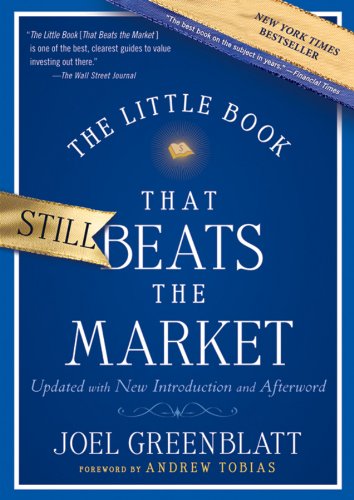
⚡️ What is The Little Book That Still Beats the Market About?
Have you ever felt like the stock market is just a giant casino where the house always wins? I used to think that way until I picked up this book. More summaries by Joel Greenblatt show his knack for making complex finance feel like common sense, but this one is the crown jewel. In it, Greenblatt argues that beating the most sophisticated investors on Wall Street doesn’t require a Ph.D. or a Bloomberg terminal—it just requires the discipline to follow two simple numbers. It’s easily one of my favorite investing book summaries because it strips away the ego of finance and replaces it with a cold, hard formula.
The central thesis is what he calls the “Magic Formula.” It’s a system designed to find above-average companies selling at below-average prices. Greenblatt, who ran Gotham Capital and saw returns of 40% annually for two decades, isn’t just theorizing here. He’s giving you the literal blueprint he used to crush the market. Why don’t more people do it? Because it’s boring, it’s counter-intuitive, and sometimes it doesn’t work for years at a time. But if you’ve got a long-term horizon, I’ve found this is probably the most logical way to approach the stock market without losing your mind.
🚀 The Book in 3 Sentences
- Investing isn’t about guessing which stock will go to the moon; it’s about buying a share of a business that earns a lot of money relative to what you paid for it.
- The Magic Formula ranks companies based on two metrics: Return on Capital (how good the business is) and Earnings Yield (how cheap the stock is).
- Success requires the emotional fortitude to stick with the strategy during the inevitable months or years when it underperforms the broader market.
🎨 Impressions
I’ll be honest: when I first saw the title, I thought it was total clickbait. The prose is written so simply—almost like he’s explaining it to a middle-schooler—that I nearly dismissed it. But that’s actually Greenblatt’s genius. He doesn’t hide behind jargon. There’s a moment early on where he explains why a gum business is valuable, and it clicked for me more than any textbook ever could. I’ve read dozens of finance books, and this is the one I keep coming back to because it focuses on the only things that actually matter: profits and price.
What frustrated me, though, was the realization of how much time I’d wasted chasing “growth” stocks that didn’t actually make any money. Greenblatt’s logic is cold. It’s clinical. He doesn’t care about the CEO’s vision or the “disruptive” potential of a new app. He only cares about the math. It’s refreshing, but it’s also a bit of a reality check for anyone who likes the thrill of the gamble. It turns investing from a sport into a chore, but as he points out, that’s exactly why it works.
📖 Who Should Read The Little Book That Still Beats the Market?
If you’re a DIY investor who is tired of losing money on “hot tips,” you need this book yesterday. It’s perfect for the person who wants a systematic way to build a portfolio without spending 40 hours a week reading balance sheets. However, if you’re looking for a get-rich-quick scheme or you’re someone who panics the moment your portfolio drops by 5%, skip this. You’ll likely quit the formula right before it starts working, which is the fastest way to lose money.
☘️ How This Book Changed My Thinking
Before reading this, I was a “narrative” investor. I bought stocks because I liked the product or thought the industry was cool. After Greenblatt, I realized I was just an amateur playing against pros with better data.
- I stopped looking at stock charts and started looking at Earnings Yield like a business owner would.
- I developed a much higher tolerance for “ugly” companies that are unloved by the news but have massive returns on capital.
- I realized that most professional money managers are actually trapped by their own benchmarks, giving individual investors a massive edge if we just stay patient.
✍️ 3 Quotes That Stuck With Me
- “Choosing individual stocks without any idea of what you’re looking for is like running through a dynamite factory with a burning match.” — This really hammered home the danger of blind speculation.
- “The secret to successful investing is relatively simple: figure out what something is worth and then pay a lot less for it.” — It sounds obvious, but it’s the one thing most people ignore.
- “If the formula worked every month, everyone would do it. The fact that it doesn’t is why it keeps working.” — This is the ultimate paradox of value investing.
📒 Summary + Notes
The book’s narrative arc is a steady build from curiosity to conviction. Greenblatt starts by teaching you how to value a small local business—a lemonade stand or a gum shop—to illustrate that a stock is just a piece of a real company. He then introduces the concept of “Mr. Market,” the manic-depressive business partner who offers to buy or sell your shares at different prices every day. The goal isn’t to follow Mr. Market’s lead, but to take advantage of his mood swings. When he’s depressed, you buy; when he’s euphoric, you sell.
As the book progresses, it introduces the math. You aren’t just looking for cheap stocks (low P/E) because many cheap stocks are cheap for a reason—they’re bad businesses. Conversely, you aren’t just looking for high-quality businesses because they’re often too expensive. The “Magic Formula” is the synthesis of these two ideas. By the end of the book, Greenblatt wants you to believe that the market is inefficient in the short term but remarkably rational in the long term. If you buy a basket of 20-30 of these high-quality, cheap stocks and hold them for a year, you’re essentially betting on the gravity of math.
🧠 Core Ideas Explained Simply
The Magic Formula relies on two heavy-lifting concepts that sound technical but are actually quite intuitive once you strip away the Wall Street fluff.
Return on Capital (ROC)
Think of this as the efficiency of a business’s “money machine.” If I give you $100 and you use it to make $40 in profit every year, your ROC is 40%. That’s a great business. If your neighbor takes $100 and only makes $2, they have a bad business. Greenblatt wants us to buy the 40% machines because they have a competitive advantage that allows them to turn capital into high profits.
Earnings Yield
How much are you getting for your money? If a company earns $10 per share and the stock price is $50, your earnings yield is 20%. If the stock price is $200, your yield is only 5%. You want the highest yield possible. It’s the same logic as looking for the best interest rate on a savings account, except you’re looking at the earnings of a company relative to its market price.
Chapter 1: The Jason Story
How do you explain the concept of “intrinsic value” without using boring accounting terms? Greenblatt tells the story of Jason, a kid who starts a gum-selling business. He uses this analogy to show that a business is worth the sum of its future profits, discounted back to today. It’s a brilliant way to ground the reader in the reality that stocks aren’t just tickers on a screen; they represent real cash being generated by real activity. If Jason can sell his gum business for more than it’s worth based on its earnings, he should. If he can buy it for less, he’s got a bargain.
Chapter 2: The Foundation
What is the actual goal of investing? Greenblatt argues it’s not to “win” against others, but to build a steady stream of future income. He emphasizes that you must compare every investment against a “risk-free” rate, like a 10-year Treasury bond. If an investment doesn’t offer significantly more than that, why bother with the risk? He sets a hard floor—if you aren’t earning at least 6% on your money, you’re better off in bonds. This chapter sets the stakes: investing is a survival game where you only play when the odds are heavily in your favor.
Chapter 3: Mr. Market
Is the market always right? Absolutely not, according to the legend of Mr. Market. Borrowing from Benjamin Graham, Greenblatt explains that the stock market is essentially a partner who offers you prices based on his emotions. Some days he’s so happy he’ll pay you double what your business is worth. Other days he’s so scared he’ll sell it to you for pennies. The secret to wealth isn’t being smarter than Mr. Market; it’s simply being more emotionally stable. You wait for him to get depressed about a good company, and then you pounce.
Chapter 4: The Formula Revealed
What if you could combine the two most important factors of investing into one list? Here, we get the first look at the Magic Formula. It’s remarkably simple: rank all stocks by Return on Capital, then rank them all by Earnings Yield. Add those two ranks together. The companies with the lowest combined score are your winners. It’s a way to systematically identify the “cheap but good” companies that everyone else is ignoring. It removes the need for “feeling” or “intuition,” which are usually just masks for bias.
Chapter 5: Why ROC Matters
Why isn’t a cheap price enough on its own? Greenblatt explains that a low price (high earnings yield) might just mean the business is dying. By adding Return on Capital to the mix, you’re filtering for quality. A company with high ROC likely has some sort of moat—a brand, a patent, or an efficient process—that prevents competitors from stealing its profits. You want to buy companies that are good at making money, not just companies that are on the clearance rack because they’re broken.
Chapter 6: The Backtest Results
Does this actually work in the real world? Greenblatt presents the data from 1988 to 2004, and the results are staggering. The Magic Formula returned roughly 30.8% per year compared to the S&P 500’s 12.3%. If you had invested $11,000 using this formula, it would have grown to over $1 million in 17 years. He doesn’t just show the wins, though; he shows that the formula works across different company sizes, although it tends to perform best with smaller, less-scrutinized stocks where the bargains are more extreme.
Chapter 7: The Catch
Why doesn’t everyone use this if it’s so effective? This is the most important chapter in the book. The formula doesn’t work every year. In fact, it often underperforms for two or three years at a time. This is its greatest protection. If it worked all the time, everyone would use it, and the prices of these bargains would be bid up until the advantage disappeared. The fact that it’s painful to follow is exactly what keeps it profitable for the few who have the stomach to stick with it.
Chapter 8: The Long Horizon
How long do you have to wait for the market to realize it’s wrong? Greenblatt suggests that while Mr. Market is crazy in the short term, he almost always gets the price right within 2 to 3 years. This timeframe is crucial. Most professional investors are judged on monthly or quarterly performance. If they underperform for a year, they lose their jobs. This “short-termism” forces them to avoid the very stocks the Magic Formula loves, leaving the door wide open for individual investors who can afford to wait.
Chapter 9: The Step-by-Step Guide
How do you actually do this starting Monday morning? Greenblatt gives us the tactical steps:
- Go to MagicFormulaInvesting.com (his free site).
- Set a minimum market cap (he suggests $50 million or more).
- Buy 5 to 7 of the top-ranked stocks.
- Repeat this every few months until you have a portfolio of 20 to 30 stocks.
- Sell each stock after holding for exactly one year.
Chapter 10: Diversification and Taxes
Is 30 stocks enough to be safe? Greenblatt argues that while you want to be concentrated enough to beat the market, you need enough variety to survive a blow-up in a single industry. He also offers a clever tax tip: sell your losers just before the one-year mark (to claim short-term capital losses) and sell your winners just after the one-year mark (to pay lower long-term capital gains taxes). It’s a simple way to boost your net returns without taking any extra investment risk.
Chapter 11: Market Efficiency
Is the stock market “efficient” like professors claim? Greenblatt laughs at the idea. If the market were efficient, prices wouldn’t swing 50-100% in a single year while the underlying business barely changes. He argues that people are emotional, and as long as humans are involved in trading, there will always be pockets of irrationality. The formula is simply a tool to exploit that human nature. It assumes the market is usually wrong in the moment but eventually right over time.
Chapter 12: Implementation Challenges
What are the biggest obstacles to your success? It’s not the math—it’s you. Greenblatt warns that when the news is scary and your Magic Formula stocks are dropping, you’ll be tempted to “tweak” the system or sell everything. He stresses that you must trust the process. You are buying a basket of businesses, not a line on a chart. If you can’t commit to the strategy for at least 5 years, he says you’re better off just buying an index fund and walking away.
Chapter 13: Updating the Data
Does the formula still beat the market today? In the revised edition, Greenblatt looks at the data from 2005 to 2009—a period that included the worst financial crisis since the Great Depression. Even during this chaotic time, the formula continued to outperform the S&P 500 significantly. It proved that the principles of value and quality are timeless, even when the world feels like it’s falling apart. The “Still” in the title is earned by the formula’s resilience through the 2008 crash.
⚖️ A Critical Perspective
While I love the logic, the book oversimplifies a few things that could trip you up. First, the formula uses EBIT (Earnings Before Interest and Taxes), which can hide a lot of sins in companies with massive debt loads. Also, the ROC calculation doesn’t always distinguish between a company with a genuine “moat” and one that just had a lucky one-time earnings boost. In 2025, with high-frequency trading and AI scanners, the “bargains” are found and closed much faster than they were in the 90s. It still works, but don’t expect the 30% returns of the past; you’re more likely looking at a healthy 3-5% edge over the S&P 500.
🔄 How It Compares
Compared to Benjamin Graham’s The Intelligent Investor, this book is much more accessible but less comprehensive. Graham teaches you how to think like an investor, while Greenblatt gives you a specific, mechanical system to follow. It’s like the difference between learning the theory of internal combustion and being handed the keys to a Ferrari.
🔑 Key Takeaways
These are the core lessons you should carry into your next trade.
- The market is there to serve you, not to instruct you; ignore the daily noise.
- Earnings Yield (EBIT/EV) is a better metric than P/E because it accounts for debt.
- Underperformance is the “moat” of value investing; if it always worked, it would stop working.
- Consistency beats brilliance; a simple formula followed perfectly is better than a complex one followed poorly.
💬 Frequently Asked Questions
What is the main argument of The Little Book That Still Beats the Market?
The book argues that individual investors can consistently outperform market averages by using a mechanical system called the “Magic Formula.” This system identifies high-quality companies with high returns on capital that are currently trading at bargain prices, essentially buying more earnings for less money.
Does the Magic Formula actually still work in 2025?
Yes, but with caveats. While the core principles of buying quality at a discount are timeless, the massive outperformance seen in the 90s has narrowed. Increased market efficiency means the “magic” provides a smaller edge, but it still tends to beat simple indexing over long 5-10 year cycles.
Is the Magic Formula suitable for beginners?
Absolutely. Greenblatt intentionally wrote the book for his children, using simple analogies. The execution—buying a basket of 20-30 stocks and holding them for a year—is straightforward, though the emotional discipline required to stick with it during market downturns can be challenging for novices.
What are the two metrics used in the Magic Formula?
The formula uses Earnings Yield (EBIT/Enterprise Value) to measure how cheap a stock is, and Return on Capital (EBIT/Net Working Capital + Net Fixed Assets) to measure business quality. By ranking stocks on both, you find companies that are both productive and undervalued.
Why do most people fail to beat the market with this book?
Psychology is the main barrier. The formula often selects “ugly” companies that are currently unpopular. When these stocks underperform for a year or two, most investors lose faith and abandon the strategy right before the mean reversion happens, missing the eventual gains.
Conclusion
At the end of the day, The Little Book That Still Beats the Market is an exercise in humility. It asks you to admit that you aren’t smarter than the collective wisdom of the market, but you can be more disciplined. By automating your decisions through ROC and Earnings Yield, you bypass the fear and greed that ruin most portfolios. It’s not about finding the next big tech giant; it’s about finding the boring, unloved companies that are churning out cash while everyone else is looking the other way.
If you take away nothing else, remember this: the market is a giant voting machine in the short term, but a weighing machine in the long term. If you consistently buy weight at a discount, you will win. This book is the best manual I’ve found for making that happen. It’s a foundational text in our investing book summaries for a reason—it works, provided you have the patience to let the math do its job.
More From Joel Greenblatt →
Discover more from AI Book Summary
Subscribe to get the latest posts sent to your email.