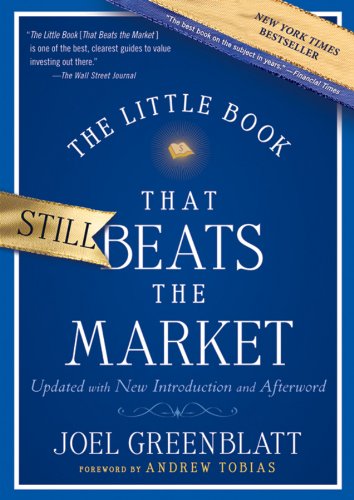
⚡️ What is The Little Book That Still Beats the Market about?
The Little Book That Still Beats the Market is Joel Greenblatt’s brilliant guide to value investing, distilled into a simple yet powerful strategy he calls the “Magic Formula.” Greenblatt, a renowned hedge fund manager and professor, argues that individual investors can consistently outperform the market by following a disciplined, rules-based approach. The core idea is to buy good businesses (those with high returns on capital) at bargain prices (those with high earnings yields). The book demystifies stock picking, replacing complex analysis with a straightforward formula that anyone can apply. It’s not about quick tips or hot stocks; it’s about timeless principles, patience, and the discipline to stick with a strategy even when it feels uncomfortable. This book provides the roadmap for doing exactly that, making sophisticated investing accessible to everyone.
🚀 The Book in 3 Sentences
- You can beat the market by systematically buying companies that earn a high return on their capital and are available at a high earnings yield.
- The Magic Formula is a simple, backtested strategy that ranks stocks based on these two metrics to identify high-quality bargains.
- The biggest challenge isn’t finding the stocks, but having the emotional discipline to hold onto the strategy through periods of inevitable underperformance.
🎨 Impressions
Reading The Little Book That Still Beats the Market felt like having a seasoned, no-nonsense mentor demystify the world of finance for me. Greenblatt’s writing is incredibly clear, witty, and free of jargon, making complex concepts feel like common sense. I was impressed by how he took the sophisticated strategies of legendary investors like Benjamin Graham and Warren Buffett and made them accessible to a complete novice. The “magic” isn’t a secret trick; it’s the disciplined application of sound, logical principles. The book’s power lies in its simplicity and its profound focus on investor psychology, preparing you for the real challenge: sticking with the plan when your emotions are screaming at you to quit.
📖 Who Should Read The Little Book That Still Beats the Market?
This book is perfect for the individual investor who feels overwhelmed by the market and wants a concrete, proven strategy. It’s for beginners who are just starting their investing journey and need a solid foundation, as well as for experienced investors who have been chasing returns without a systematic process. If you want to understand The Little Book That Still Beats the Market strategies and learn how to build wealth over the long term without becoming a full-time stock analyst, this book is your essential guide. It’s for anyone who believes there must be a better way than simply buying and holding an index fund.
☘️ How the Book Changed Me
\p>This book fundamentally shifted my approach from speculative guessing to systematic investing. I stopped trying to find the next hot stock and started focusing on buying wonderful businesses at fair prices. It taught me that success in investing isn’t about being the smartest person in the room; it’s about being the most disciplined. The psychological framework Greenblatt provides has been invaluable, helping me to view market downturns not as threats, but as opportunities.- I now build my portfolio using a checklist based on the Magic Formula techniques, focusing on quality and price.
- I’ve learned to embrace periods of underperformance, understanding they are a normal part of a successful long-term strategy.
- I no longer panic during market volatility; instead, I see it as a chance to buy great companies at even bigger discounts.
- I spend far less time watching the financial news and more time simply executing my pre-defined plan.
✍️ My Top 3 Quotes
- “Choosing individual stocks without any idea of what you’re looking for is like running through a dynamite factory with a burning match. You may live, but you’re still an idiot.”
- “It ain’t the things we don’t know that get us in trouble. It’s the things we know that ain’t so.” — Artemis Ward
- “Figure out what something is worth and then pay a lot less.”
📒 Summary + Notes
The Little Book That Still Beats the Market introduces a revolutionary yet simple approach to stock market investing. Joel Greenblatt’s central thesis is that the market is inefficient in the short term, often mispricing stocks based on emotion rather than fundamentals. By exploiting this inefficiency with a disciplined strategy, any investor can achieve superior returns. The book is structured to first convince you of the need for a strategy, then reveal the “Magic Formula,” and finally, arm you with the psychological tools to stick with it. The following chapter-by-chapter summary breaks down these core investing strategies and techniques.
Chapter 1: A Quick Disclaimer
Greenblatt opens with a crucial disclaimer: this book won’t make you a great investor overnight. He emphasizes that while the formula is simple, success requires discipline, patience, and a long-term perspective. He argues that most professionals fail to beat the market, leaving self-investment as the only real alternative for those seeking above-average returns. This chapter sets a realistic tone, preparing the reader for the fact that the strategy will face periods of underperformance, which is the ultimate test of any investor. It’s about building a deep understanding so you can stick with the plan when things get tough.
- The key to success is a strategy you truly understand and can stick with.
- Most professionals can’t help you beat the market consistently.
- You must take control of your own investing to achieve superior results.
- Patience and discipline are more important than intelligence.
Chapter 2: The Magic Formula
This chapter introduces the heart of the book: the Magic Formula. Greenblatt explains it with a simple analogy of buying a stake in a local business. The formula aims to find companies that are both good and cheap. “Good” is measured by a high Return on Capital (ROC), indicating a business that generates large profits relative to the capital invested. “Cheap” is measured by a high Earnings Yield (EY), which is essentially the inverse of the P/E ratio (earnings divided by price). By combining these two, the formula systematically identifies high-quality businesses available at bargain prices, creating a powerful recipe for market-beating returns.
- Buy good companies (high Return on Capital) at bargain prices (high Earnings Yield).
- Return on Capital measures how efficiently a business uses its capital to generate profits.
- Earnings Yield tells you how much you are earning for the price you are paying.
- The formula is a relative ranking system, not an absolute one.
Chapter 3: The Magic Formula in Practice
Greenblatt presents compelling backtested data to prove the formula’s effectiveness. From 1988 to 2004, a portfolio using the Magic Formula achieved an annualized return of 30.8%, vastly outperforming the S&P 500’s 12.3%. He explains the methodology: ranking a large universe of stocks by ROC and EY, then combining the ranks to find the best overall candidates. While he stresses that past performance doesn’t guarantee future results, the logic is sound. The strategy works because it forces you to buy what is unpopular and cheap, and sell what is popular and expensive, which is the cornerstone of successful value investing.
- Backtesting shows the formula has dramatically outperformed the market for decades.
- The strategy involves ranking stocks by two key metrics and combining the results.
- The success is rooted in buying out-of-favor stocks that the market has mispriced.
- The formula’s logic is timeless, even if specific returns will vary.
Chapter 4: A Step-by-Step Guide
This chapter provides the practical, actionable steps for implementing the Magic Formula. Greenblatt breaks it down into a simple process: First, build a list of companies (e.g., those with a market cap over a certain size). Second, rank them by Return on Capital. Third, rank them by Earnings Yield. Fourth, combine the rankings to find the companies with the best combined scores. He advises building a portfolio of 20 to 30 stocks to diversify away company-specific risk. He also mentions that he created a free website to help investors easily run this screen, making it incredibly accessible for anyone to get started with these powerful techniques.
- Create a universe of stocks to choose from (e.g., largest 3,500 US companies).
- Rank all stocks by Return on Capital (highest is #1).
- Rank all stocks by Earnings Yield (highest is #1).
- Invest in 20-30 companies with the best combined ranking score.
- Sell each stock after one year and replace it with a new top-ranked stock.
Chapter 5: Everyone Deserves to Be Rich
Greenblatt makes a passionate case for why this strategy is so important for the average person. He highlights the incredible power of compounding and how even small, consistent investments can grow into substantial wealth over time. He argues that the stock market is one of the greatest wealth-creation tools ever invented, yet most people fail to take advantage of it properly. By providing a simple, proven formula, he democratizes the process, showing that you don’t need to be a Wall Street genius to secure your financial future. The message is empowering: you have the ability to take control of your financial destiny.
- The power of compounding can turn modest savings into significant wealth.
- The stock market is the best vehicle for long-term growth for most people.
- This formula makes sophisticated investing accessible to everyone, not just the wealthy.
- Taking control of your investments is a crucial step toward financial independence.
Chapter 6: The Most Important Thing
What is the most important thing in investing? According to Greenblatt, it’s the margin of safety. This is the core principle pioneered by Benjamin Graham. It means buying an asset for significantly less than its intrinsic value. This discount protects you from being wrong, from bad luck, or from the market’s irrationality. The Magic Formula is essentially a systematic way of finding stocks with a built-in margin of safety. By focusing on high earnings yields, you are ensuring you are paying a low price for the earnings the business generates, which provides a crucial cushion that dramatically improves your chances of making money over the long run.
- Margin of safety is the single most important concept in investing.
- It involves buying assets for less than they are conservatively worth.
- This discount protects you from downside risk and errors in judgment.
- The Magic Formula’s focus on high earnings yield is a practical application of this principle.
Chapter 7: This Won’t Work!
In this crucial chapter, Greenblatt addresses the biggest psychological hurdle: the formula will not work all the time. He presents data showing that, on average, the strategy underperforms the market in 5 out of every 12 months. In one out of every four years, it will lag behind the market. This is where most investors fail. They start a strategy, see it underperform for a few months, and abandon it for something that looks better. Greenblatt’s point is that you must know this is coming and be prepared to stick with the plan. The long-term outperformance comes from enduring these short-term periods of pain.
- The Magic Formula will underperform the market in the short term.
- Statistically, it underperforms in about 42% of any given year.
- Quitting during a period of underperformance is the biggest mistake an investor can make.
- Understanding and accepting this fact is essential for long-term success.
Chapter 8: The Nasty, Difficult, and Ugly Truth
Why will the formula underperform? Because the stocks it selects will often look terrible. Greenblatt calls this the “nasty, difficult, and ugly truth.” The stocks will be in out-of-favor industries, facing negative headlines, and appearing to have bleak prospects. They will not feel good to buy. This is precisely why they are cheap. The market is pessimistic about their future and has driven their prices down. The Magic Formula forces you to be a contrarian, to buy what others are selling. Your job isn’t to love the companies, but to recognize that the bad news is likely already priced in, making them a bargain.
- The formula’s top-ranked stocks will often be in struggling industries.
- These companies will typically have recent bad news and a poor outlook.
- They will not feel comfortable or easy to buy; in fact, it should feel hard.
- This ugliness is the very reason for their bargain price and future potential return.
Chapter 9: The Good News
After the ugly truth, Greenblatt delivers the good news: over the long term, Mr. Market gets it right. While prices can swing wildly in the short term based on emotion, over a period of two to three years, a stock’s price tends to gravitate toward its true underlying value. For the high-quality businesses you buy with the Magic Formula, this means their price will eventually rise to reflect their earnings power. This happens for several reasons: smart money recognizes the bargain and buys in, the company may buy back its own shares, or it might get acquired by another company. Patience is rewarded as the market corrects its short-term mistakes.
- Over a 2-3 year period, the market usually recognizes a company’s true value.
- Patience is the key that unlocks the returns from bargain purchases.
- The price can correct as smart investors buy, through share buybacks, or via a merger.
- The long-term logic of buying good businesses cheaply eventually wins out.
Chapter 10: For Those Who Are Still Skeptical
Greenblatt anticipates and addresses the skepticism of more analytical readers. Why use last year’s earnings? What if the business is in decline? He argues that while using last year’s earnings isn’t perfect, it’s a surprisingly good proxy for future earnings on average. By buying a portfolio of 20-30 stocks, you diversify away the risk of any one company having a temporary earnings drop. The formula’s strength is its robustness and simplicity. It’s not about perfect analysis; it’s about using a heuristic that works more often than not. He compares it to Graham’s net-net strategy, which also worked beautifully on average without deep analysis of each individual stock.
- Using last year’s earnings is a simple but effective estimate on average.
- Building a diversified portfolio mitigates the risk of any single stock’s earnings falling.
- The formula’s power is in its broad application, not in perfect individual stock analysis.
- It’s a probabilistic strategy that works over a large group of stocks over time.
Chapter 11: Alternative Formulas
Could other simple formulas work? Greenblatt discusses this, acknowledging that other value metrics like low Price-to-Book (P/B) or low Price-to-Earnings (P/E) ratios have also been shown to outperform the market. However, he argues that the Magic Formula is superior because it combines a measure of quality (ROC) with a measure of price (EY). A low P/E stock might be a bargain, or it might be a low-quality business in permanent decline. By filtering for high ROC first, you ensure you are only looking at good businesses. This combination of quality and value is what gives the Magic Formula its edge over simpler, one-dimensional strategies.
- Many simple value strategies have historically beaten the market.
- However, most only look at price (e.g., low P/E) and ignore quality.
- The Magic Formula’s key innovation is combining quality (high ROC) with price (high EY).
- This two-pronged approach helps avoid “value traps”—cheap stocks that are cheap for a good reason.
Chapter 12: What Have We Learned?
Greenblatt concludes the main part of the book with a concise summary of the key lessons. The core takeaway is that beating the market is possible if you have a sound strategy and the discipline to follow it. He recaps the importance of viewing stocks as ownership pieces of a business, the need for a margin of safety, and the power of buying good companies at bargain prices. He reiterates that the biggest challenge is not intellectual, but emotional. Success comes from understanding why your strategy works and having the fortitude to stick with it through the inevitable periods of doubt and underperformance.
- Beating the market is achievable with a systematic, long-term approach.
- Always buy businesses for less than they are worth (margin of safety).
- Focus on buying high-quality companies at low prices.
- Your greatest challenge will be psychological; discipline is your most important asset.
Afterword & Appendix: A Final Word & A Detailed Look
In the afterword, Greenblatt provides an update on the formula’s performance in the years since the first edition was published, confirming its continued success. He also discusses the importance of a long-only strategy. The appendix is a treasure trove for those who want to go deeper, detailing the specific calculations for the metrics. He defines Return on Capital as EBIT / (Net Working Capital + Net Fixed Assets) and Earnings Yield as EBIT / Enterprise Value. Using these pre-tax, debt-adjusted figures allows for a more accurate comparison between different companies, making the formula even more robust by removing distortions from different tax rates and capital structures.
- The formula’s principles have continued to work well in the years following the first edition.
- The strategy is designed to be long-only; shorting the opposite side is extremely risky.
- Return on Capital is calculated as EBIT / (Net Working Capital + Net Fixed Assets).
- Earnings Yield is calculated as EBIT / Enterprise Value, which accounts for debt.
Key Takeaways
The lessons from The Little Book That Still Beats the Market are profound yet simple. The book provides a complete framework for achieving market-beating returns. It’s not about finding a secret, but about applying timeless wisdom with unwavering discipline. The most important lessons are about process, temperament, and patience. By internalizing these concepts, you can transform your approach to investing and put yourself on a path to long-term financial success.
- The Magic Formula—buying high ROC and high EY stocks—is a proven long-term strategy.
- Psychological discipline is more important than analytical brilliance; you must stick with your plan.
- Always insist on a margin of safety to protect your capital and enhance your returns.
- Think like a business owner, not a renter of stock certificates.
- Embrace contrarian thinking; the best opportunities are found where others are fearful.
Conclusion
Joel Greenblatt’s The Little Book That Still Beats the Market is a timeless masterpiece that simplifies the complex world of investing into an elegant and actionable formula. It’s a powerful reminder that success in the market doesn’t require a genius IQ or inside information, but rather a sound strategy, a long-term horizon, and the emotional fortitude to see it through. The book arms you with the knowledge to build wealth systematically and the psychological armor to protect you from your own worst instincts. If you are serious about beating the market and taking control of your financial future, this book isn’t just recommended—it’s essential reading.
More From Joel Greenblatt →