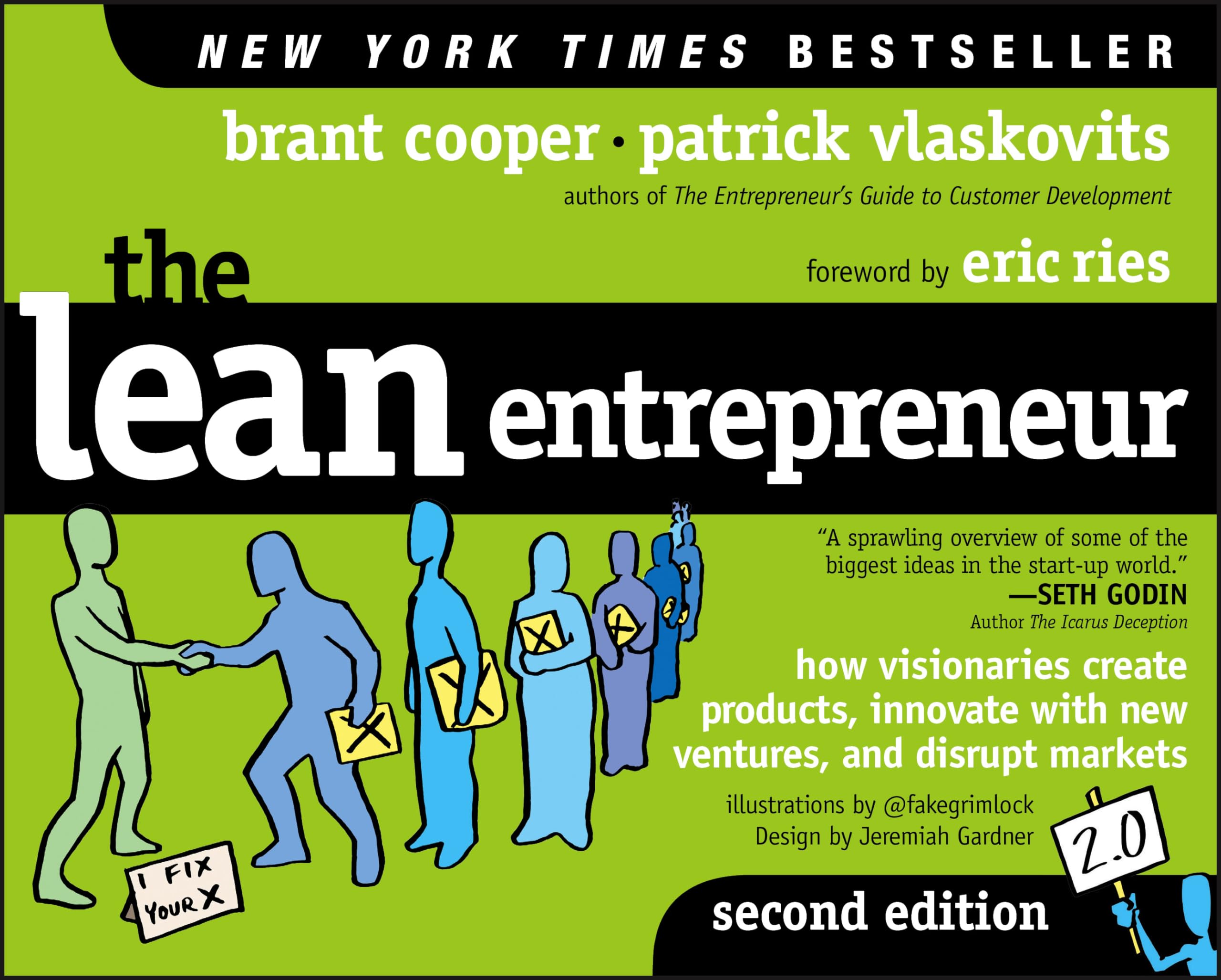
⚡️ What is The Lean Entrepreneur About?
What if the biggest threat to your startup isn’t the competition, but your own ‘vision’? We’ve been fed this narrative of the lone genius—the Steve Jobs figure who sees the future and builds it while the rest of us catch up. But as More summaries by Brant Cooper; Patrick Vlaskovits point out in The Lean Entrepreneur, that story is often a hallucination that leads straight to a cliff. This book isn’t just a sequel to the ‘lean’ movement; it’s the tactical manual for those of us who found the original theories a bit too abstract for Monday morning. It sits comfortably among other business book summaries as a reality check for anyone trying to disrupt a market.
The central thesis is simple but stinging: you are probably wrong about what your customers want. Cooper and Vlaskovits argue that entrepreneurship is less about ‘building’ and more about ‘discovery.’ They introduce a framework that helps you stop guessing and start creating value by identifying exactly where you sit on the innovation spectrum. If you’ve ever felt like you were ‘pivoting’ just for the sake of it, this book explains why your compass was broken from the start.
🚀 The Book in 3 Sentences
- True entrepreneurship is the act of creating new value under conditions of extreme uncertainty, not just managing a small version of a big company.
- The ‘Innovation Spectrum’ dictates your strategy: if you’re doing something brand new, you need discovery; if you’re improving something existing, you need efficiency.
- Value is only created when you solve a ‘must-have’ problem for a specific group of people, which requires rigorous validation before you write a single line of code or hire a sales team.
🎨 Impressions
I read this book shortly after finishing Eric Ries’s work, and honestly, it felt like someone finally turned the lights on in the room. While other books talk about the ‘why,’ this one gets into the ‘how’ with a grit that’s rare in business writing. I found the section on the ‘Innovation Spectrum’ particularly eye-opening because it explains why some lean tactics work for a SaaS startup but fail for a local bakery. It’s a nuanced take that admits one size doesn’t fit all.
There’s a refreshing lack of cheerleading here. The authors aren’t trying to sell you on the ‘magic’ of startups; they’re trying to save you from wasting three years of your life on a product nobody wants. I’ll admit, some of the corporate innovation examples felt a bit dry compared to the scrappy startup stories, but the logic holds up regardless of company size. It’s the kind of book that makes you want to immediately go out and interview five customers—and then realize you’ve been asking them all the wrong questions.
📖 Who Should Read The Lean Entrepreneur?
If you’re a founder who feels like you’re ‘building’ into a void, you need this. It’s also vital for product managers who are tired of being told to ‘be more innovative’ without a clear path on how to do that. However, if you’re looking for a motivational ‘rah-rah’ book that tells you to just follow your passion, you’ll probably find this too clinical. This is for the person who wants a spreadsheet and a script for customer discovery, not a pep talk.
☘️ How This Book Changed My Thinking
Before reading The Lean Entrepreneur, I used to think that a ‘vision’ was a fixed point you fought toward. Now, I see it as a hypothesis that needs to be brutally tested at every step.
- I stopped asking people ‘Would you use this?’ and started looking for evidence of their current pain points.
- I realized that ‘efficiency’ in a startup is actually a trap if you haven’t discovered the right market yet.
- I began classifying my ideas based on where they land on the Innovation Spectrum before deciding how much time to invest in them.
✍️ 3 Quotes That Stuck With Me
- “The visionary’s curse is the belief that their internal vision is the same thing as external reality.” — This hit me hard because it describes almost every failed project I’ve ever seen.
- “You don’t need a lot of data; you need the right data.” — A great reminder that 1,000 vanity metrics aren’t worth as much as five honest customer conversations.
- “Innovation is the creation of new value, not just new stuff.” — It’s a subtle distinction that separates the hobbyists from the entrepreneurs.
📒 Summary + Notes
The book starts by dismantling the myth of the visionary, arguing that the ‘hero’ narrative we love so much is actually survivorship bias in action. Most visionaries fail because they refuse to adapt their idea to the real world. To counter this, the authors provide a framework built on three pillars: Discovery, Validation, and Efficiency. They want you to move from a state of ‘unknown-unknowns’ to a business model that is repeatable and scalable. It’s a journey from being an artist with a dream to a scientist with a business.
What makes the author’s case compelling is the emphasis on the ‘Value Stream.’ This isn’t just about the product; it’s about the entire experience from the moment a customer hears about you to the moment they get value. By mapping this out early, you can find the bottlenecks that have nothing to do with your features. By the end, the book makes you believe that while you can’t guarantee success, you can absolutely engineer the elimination of failure.
🧠 Core Ideas Explained Simply
There are a few concepts in here that act as the ‘operating system’ for the entire lean philosophy.
The Innovation Spectrum
Are you building a faster horse or a flying car? The authors argue that your strategy depends on how ‘new’ your idea is. If it’s brand new (disruptive), you spend all your time on discovery. If it’s just a better version of something existing (sustaining), you focus on efficiency. Many founders fail because they use ‘disruptive’ tactics for ‘sustaining’ products, or vice-versa.
The Customer Discovery Script
How do you talk to a stranger without sounding like a sleazy salesman? The book provides a literal blueprint for interviewing. The key is to never mention your solution. Instead, you focus entirely on the customer’s past behavior. If they haven’t spent money or time trying to solve the problem yet, it’s not a real problem.
The Value Stream Map
Think of this as the ‘path’ a customer takes to get to their ‘aha!’ moment. Most people focus on the product, but the friction usually happens before they even log in. Mapping the value stream helps you see that your marketing, onboarding, and support are all part of the ‘product’ that needs to be lean.
Part I: The Visionary
Why do we celebrate people who ‘never gave up’ on a bad idea until it accidentally worked? The book opens by challenging the ‘Founder as God’ narrative. They argue that vision is actually a starting point, not a destination. If your vision is so rigid that it can’t survive a conversation with a customer, it’s not a vision—it’s a delusion.
I loved the distinction made here between the ‘Visionary’ and the ‘Entrepreneur.’ The visionary sees what *could* be, but the entrepreneur figures out how to make it *sustainable*. Does your product solve a ‘must-have’ pain or a ‘nice-to-have’ convenience? If you can’t answer that honestly, you’re just a visionary waiting for a miracle.
Part II: The Innovation Spectrum
Is there a difference between starting a dry cleaners and starting the next SpaceX? Absolutely, and this section maps those differences. The authors break down innovation into a spectrum ranging from ‘sustaining’ (incremental improvements) to ‘disruptive’ (creating new markets). Your position on this line dictates your entire burn rate and team structure.
- Sustaining Innovation: Improving existing products for existing customers. Focus on efficiency.
- Disruptive Innovation: Creating new value for new customers. Focus on discovery.
- The Middle Ground: This is where most startups die because they try to do both and end up doing neither.
Part III: The Lean Entrepreneur
What does a lean entrepreneur actually do on a Tuesday morning? They aren’t just ‘building’—they are running experiments. The authors define the role as someone who manages uncertainty. This requires a shift from ‘execution mode’ (where you follow a plan) to ‘search mode’ (where you look for a plan that works).
There’s a moment early on where they talk about the ‘Myth of the Lean Startup.’ Some people think ‘lean’ means ‘cheap.’ It doesn’t. It means ‘efficient use of capital to find the truth.’ If you spend $10,000 to find out an idea is bad, that’s better than spending $1,000,000 to find out the same thing three years later. Do you have the stomach to kill your darlings for the sake of the data?
Part IV: The Value Stream
Imagine your business as a series of pipes. If there’s a clog in the ‘Acquisition’ pipe, it doesn’t matter how great your ‘Retention’ pipe is. The value stream is the end-to-end process of delivering value. The authors insist that you map this out visually. It’s not just a funnel; it’s a loop.
I found this chapter particularly useful because it highlights that ‘value’ is subjective. What you think is the core feature might just be noise to the customer. By mapping the stream, you identify the ‘Value-Add’ steps versus the ‘Waste’ steps. Are you building features that people actually pay for, or are you just polishing the pipes?
Part V: The Discovery Phase
How do you find your first ten customers? Hint: It’s not through Facebook ads. The discovery phase is about getting out of the building. The goal is to find ‘Early Evangelists’—people who have the problem so badly that they are already trying to solve it with a ‘MacGyvered’ solution.
The authors provide a breakdown of the ‘Empathy Map.’ You need to understand what your customer hears, sees, thinks, and feels. This isn’t just fluffy marketing talk; it’s the foundation of your product requirements. If you can’t describe your customer’s day-to-day life better than they can, you haven’t done enough discovery. Why should they trust you to solve their problem if you don’t even understand it?
Part VI: The Validation Phase
Validation is where the rubber meets the road—and where most founders start to sweat. This is when you ask for a commitment. It could be an email address, a pre-order, or a letter of intent. If people say ‘I love it!’ but won’t give you anything in return, you haven’t validated anything. You’ve just been complimented.
There’s a great section here on MVPs (Minimum Viable Products). The authors emphasize that an MVP isn’t a ‘half-baked’ product; it’s an experiment. Sometimes an MVP is a landing page. Sometimes it’s a manual service that you perform behind the scenes (the ‘Wizard of Oz’ approach). The goal is to test the ‘Leap of Faith’ assumptions before you scale.
Part VII: The Efficiency Phase
Once you’ve found something that works, can you make it work at scale? This is the only phase where traditional management actually becomes useful. Once you have a repeatable business model, you focus on optimizing the value stream. This is where you worry about unit economics, churn rates, and LTV (Lifetime Value).
But wait—there’s a warning. If you move into the efficiency phase too early, you freeze a broken model. I’ve seen this happen a dozen times: a company scales their sales team before they’ve even fixed the product-market fit, and they just end up scaling their losses. Efficiency is the reward for successful discovery and validation, not a substitute for it.
Part VIII: The Experimentation Framework
What if you could turn every business decision into a science experiment? The final part of the book provides the actual templates and worksheets for running ‘Lean Sprints.’ They advocate for a structured process: Hypothesis, Experiment, Metric, Result. If you can’t state what you expect to happen before you do it, you’re just ‘doing stuff,’ not experimenting.
This chapter felt like the ‘cheat sheet’ for the whole book. It brings all the theory down to earth with practical examples of how to track your progress. It’s not about being ‘right’; it’s about being ‘less wrong’ over time. Do you have a system for learning, or are you just relying on your gut?
⚖️ A Critical Perspective
While The Lean Entrepreneur is brilliant for software and services, I found its application to deep-tech or hardware a bit oversimplified. It’s easy to ‘iterate’ a landing page, but you can’t exactly ‘lean’ your way through building a new jet engine or a pharmaceutical drug where regulation and physical laws don’t allow for quick pivots. Additionally, the book leans heavily on corporate innovation examples toward the end, which might feel disconnected for a solo founder trying to survive on a credit card. It also assumes a level of emotional detachment from your ‘vision’ that is easier to write about than to actually practice when it’s your life’s work on the line.
🔄 How It Compares
Compared to Eric Ries’s The Lean Startup, this book is much more tactical and prescriptive. While Ries focuses on the high-level philosophy and organizational structure, Cooper and Vlaskovits give you the actual interview scripts and mapping techniques. If Ries is the architect, these guys are the site foremen showing you where the pipes go.
🔑 Key Takeaways
These are the lessons that will actually save you money and time if you apply them today.
- Your vision is a set of untested assumptions, not a blueprint for reality.
- The goal of a startup is to reach ‘Validated Learning’ as cheaply and quickly as possible.
- If you can’t find ‘Early Evangelists’ who are already trying to solve the problem, the market might not exist yet.
- Efficiency is the enemy of innovation in the early stages; don’t optimize a product that no one wants.
💬 Frequently Asked Questions
What is the main difference between The Lean Entrepreneur and The Lean Startup?
The Lean Entrepreneur provides much more tactical, ‘how-to’ guidance than Eric Ries’s original book. It introduces the Innovation Spectrum and specific customer discovery scripts, making it a practical manual for founders rather than just a conceptual framework for management teams.
What is the ‘Innovation Spectrum’ mentioned in the book?
It’s a framework that places projects based on their level of uncertainty. One end is ‘sustaining’ innovation (improving existing markets), while the other is ‘disruptive’ (creating new ones). Your position on the spectrum determines whether you should focus on efficiency or discovery.
Does the ‘lean’ method only work for tech startups?
No, the authors argue that lean principles apply to any organization creating value under uncertainty. This includes big corporations, non-profits, and even local small businesses. The key is applying the right ‘lean’ tactics based on where you sit on the innovation spectrum.
How do the authors define ‘Value Stream Mapping’?
It is the process of visualizing the entire journey a customer takes to receive value from your company. It covers everything from discovery and acquisition to onboarding and retention, helping founders find friction points that aren’t necessarily related to the product features.
Can I use this book if I’m an ‘intrapreneur’ in a large company?
Yes, the book actually has several sections dedicated to corporate innovation. It explains how to build cross-functional teams and bypass traditional ‘ROI-based’ accounting that often kills new ideas before they have a chance to be validated by the market.
Conclusion
At the end of the day, The Lean Entrepreneur is a call to humility. It asks us to set aside our egos and our ‘visionary’ fantasies in favor of something much more powerful: the truth. It’s about building a bridge between what we think the world needs and what the world is actually willing to pay for. If you take only one thing from this book, let it be this: you don’t find a market; you discover it through a series of disciplined failures.
I still think about the ‘Innovation Spectrum’ every time I start a new project. It’s the ultimate filter for deciding how to spend my time and money. Whether you’re a solo founder or a corporate leader, the message of the book is clear: structure doesn’t kill creativity; it gives it a place to live. If you’re serious about building something that lasts, stop being a visionary and start being an entrepreneur by checking out more business book summaries and putting these experiments into practice.
More From Brant Cooper; Patrick Vlaskovits →
Discover more from AI Book Summary
Subscribe to get the latest posts sent to your email.