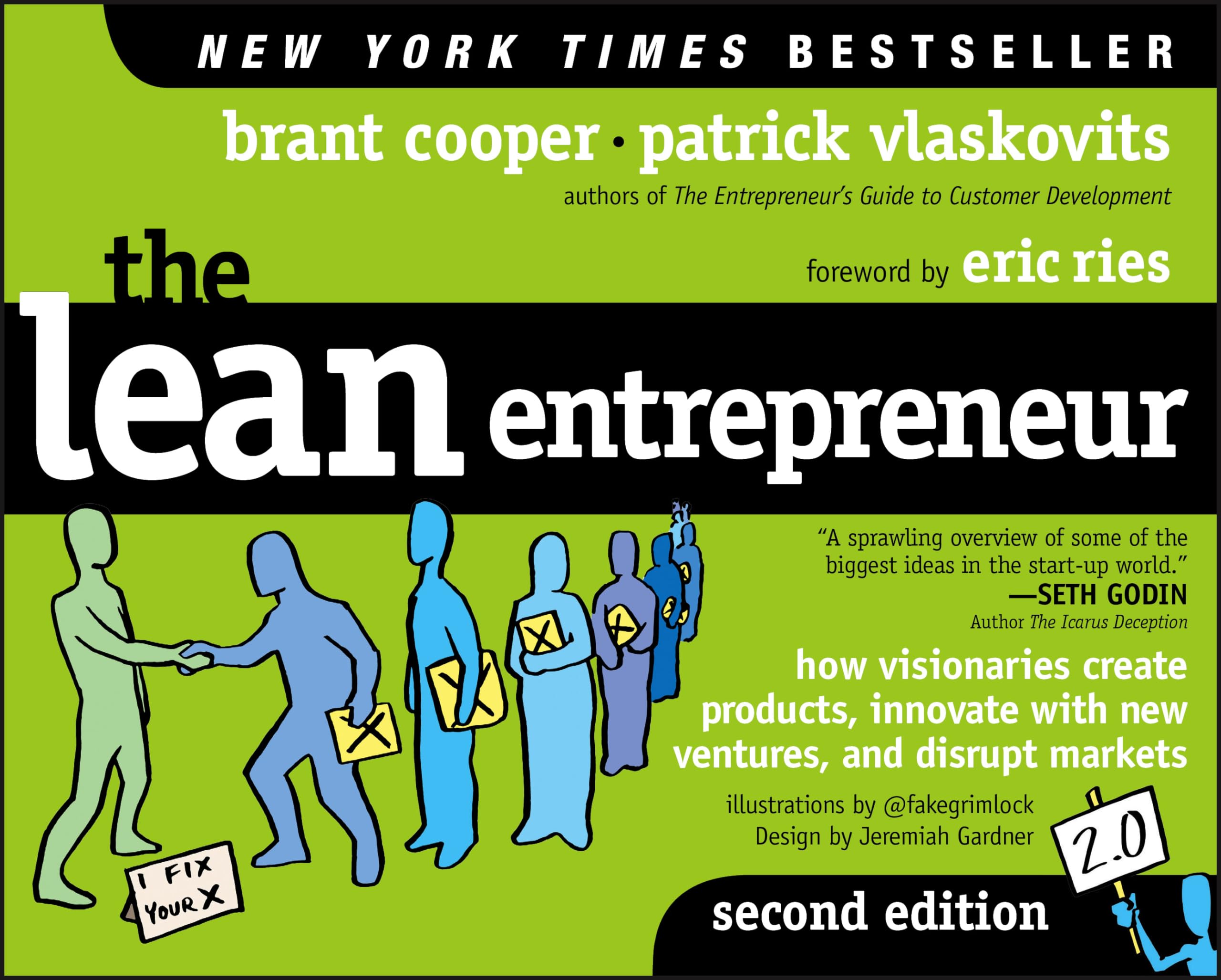
⚡️ What is The Lean Entrepreneur about?
The Lean Entrepreneur focuses on applying lean principles to entrepreneurship in established companies and startups alike. It teaches how to navigate extreme uncertainty by systematically testing hypotheses, iterating quickly, and validating learning before scaling. The book provides a framework for innovation accounting that helps entrepreneurs measure progress meaningfully while avoiding vanity metrics. Cooper and Vlaskovits demonstrate how traditional business planning fails in today’s dynamic markets and offer practical techniques for building sustainable business models through continuous experimentation and customer-centric development.
🚀 The Book in 3 Sentences
- The Lean Entrepreneur provides a scientific methodology for building products and ventures under conditions of extreme uncertainty through continuous experimentation and validated learning.
- It introduces innovation accounting as a way to measure progress meaningfully when traditional metrics fail, helping entrepreneurs make data-driven decisions about pivoting or persevering.
- The book demonstrates how lean startup strategies can be applied not just in startups but within large organizations to disrupt markets and create sustainable growth through customer-centric development.
🎨 Impressions
The Lean Entrepreneur masterfully bridges the gap between lean manufacturing principles and modern entrepreneurship. What impressed me most was its practical approach to innovation—moving beyond theory to actionable techniques for testing business hypotheses. The authors effectively demonstrate how traditional business planning fails in uncertain markets while providing a clear framework for navigating ambiguity. The book’s strength lies in its real-world examples and specific methodologies that any entrepreneur can implement immediately to reduce risk and accelerate learning.
📖 Who Should Read The Lean Entrepreneur?
The Lean Entrepreneur is essential reading for startup founders, corporate innovators, product managers, and anyone launching new products or ventures. It’s particularly valuable for those operating in highly uncertain markets where traditional business planning falls short. The book also serves as an excellent resource for intrapreneurs working within large organizations who need to drive innovation despite bureaucratic constraints. Anyone seeking a systematic approach to validating business ideas and reducing the risk of failure will benefit immensely from this practical guide.
☘️ How the Book Changed Me
Reading The Lean Entrepreneur transformed my approach to business development and innovation. I’ve shifted from elaborate planning to rapid experimentation, fundamentally changing how I evaluate opportunities.
- I now view business ideas as testable hypotheses rather than certainties, leading to more disciplined and less emotional decision-making.
- I’ve implemented innovation accounting in my projects, focusing on actionable metrics rather than vanity indicators that don’t drive real progress.
- I’ve embraced the concept of the Minimum Viable Product (MVP) as a learning tool rather than a reduced version of the final product, accelerating my path to market validation.
✍️ My Top 3 Quotes
- “The Lean Entrepreneur is not about being cheap; it’s about being less wasteful with time, money, and human effort while increasing speed and learning.”
- “Validated learning is the process of demonstrating empirically that a team has discovered valuable truths about a startup’s present and future business prospects.”
- “A startup is not a smaller version of a large company. A startup is a temporary organization designed to search for a repeatable and scalable business model.”
📒 Summary + Notes
The Lean Entrepreneur introduces a systematic approach to innovation that applies lean principles to entrepreneurship. This comprehensive guide teaches how to navigate uncertainty through continuous experimentation, validated learning, and innovation accounting. The following chapter summaries capture the essence of each section, highlighting key concepts that form the foundation of this transformative methodology.
Chapter 1: The New Science of Innovation
This chapter introduces the fundamental shift from traditional business planning to a scientific approach to entrepreneurship. It explains how modern entrepreneurs operate in environments of extreme uncertainty where conventional management theories fail. The authors establish entrepreneurship as a management discipline focused on learning rather than execution.
- Validated learning as the primary measure of progress in uncertain environments
- The contrast between traditional management and startup management approaches
- How entrepreneurship is more about structured experimentation than visionary leadership
Chapter 2: The Lean Entrepreneur
This chapter defines the lean entrepreneur as someone who applies systematic methods to innovation. It outlines the core principles of lean thinking: eliminating waste, accelerating learning, and making evidence-based decisions. The authors emphasize that this approach applies to both startup founders and intrapreneurs in large organizations.
- The five principles of lean entrepreneurship and their practical applications
- How lean thinking transforms the innovation process from art to science
- Case studies of successful lean entrepreneurs across different industries
Chapter 3: Vision
The chapter explores how to establish a clear vision while remaining flexible in execution. It discusses the importance of defining the destination without prescribing every step of the journey. The authors introduce the concept of the strategic vision as a compass that guides decision-making amid uncertainty.
- Balancing long-term vision with short-term adaptability in entrepreneurial ventures
- Techniques for communicating vision effectively to stakeholders and team members
- The relationship between vision, strategy, and tactics in lean entrepreneurship
Chapter 4: The Lean Canvas
This chapter presents the Lean Canvas as a one-page business model tool designed specifically for startups. It explains how this framework helps entrepreneurs map their assumptions and identify the riskiest parts of their business model. The authors detail each component of the canvas and provide guidance on how to use it effectively.
- The nine building blocks of the Lean Canvas and their interconnections
- How to identify and prioritize riskiest assumptions using the canvas
- Practical techniques for iterating the canvas based on customer feedback
Chapter 5: Problem
Focusing on understanding customer problems before building solutions, this chapter emphasizes the importance of problem validation. It provides methodologies for identifying real customer pain points and distinguishing between problems worth solving and distractions. The authors stress that many startups fail by building solutions to non-existent problems.
- Techniques for customer discovery and problem interviews
- How to differentiate between symptoms and root causes of customer problems
- Methods for quantifying the severity and frequency of target problems
Chapter 6: Solution
This chapter explores how to develop solutions that effectively address validated problems. It introduces the concept of the Minimum Viable Product (MVP) as a tool for learning rather than just a reduced version of the final product. The authors provide a framework for designing MVPs that maximize learning while minimizing development effort.
- The different types of MVPs and when to use each one
- How to design learning experiments that test solution hypotheses
- Techniques for measuring customer response to MVPs and extracting actionable insights
Chapter 7: Unique Value Proposition
This chapter focuses on crafting compelling value propositions that differentiate your solution in the market. It explains how to identify and communicate the unique benefits your product offers to customers. The authors provide frameworks for testing value propositions before full-scale product development.
- Techniques for articulating unique value in customer-centric language
- Methods for testing value propositions through customer interviews and landing pages
- How to differentiate between features, benefits, and value in your messaging
Chapter 8: Channels
The chapter examines how to reach customers effectively through various channels. It explores both direct and indirect channels, emphasizing the importance of testing channel assumptions early. The authors provide frameworks for selecting and optimizing channels based on customer behavior and acquisition costs.
- The spectrum of customer channels from physical to digital
- Techniques for testing channel hypotheses with minimal investment
- How to measure and optimize channel effectiveness in the context of lean startups
Chapter 9: Revenue Streams
This chapter explores different revenue models and how to test pricing assumptions. It emphasizes that revenue models are hypotheses that need validation, not fixed decisions. The authors provide frameworks for experimenting with pricing and revenue generation early in the development process.
- Various revenue models and their applicability to different types of products
- Techniques for testing pricing hypotheses through customer interviews and experiments
- How to align revenue models with customer value perception and business sustainability
Chapter 10: Cost Structure
Focusing on understanding and optimizing the cost drivers of your business model, this chapter provides tools for identifying fixed and variable costs. It explains how lean startups can minimize costs while maximizing learning. The authors emphasize the importance of understanding the economics of the business model from the outset.
- Techniques for identifying and categorizing cost drivers in your business model
- How to design cost structures that support rapid experimentation and learning
- Methods for testing cost assumptions through financial modeling and real-world experiments
Chapter 11: Key Metrics
This chapter introduces innovation accounting as a way to measure progress in startups. It explains how to identify actionable metrics that provide genuine insights rather than vanity metrics that mislead. The authors provide frameworks for setting up measurement systems that support decision-making.
- The difference between vanity metrics and actionable metrics
- How to design a measurement system that supports validated learning
- Techniques for cohort analysis and other methods for tracking customer behavior over time
Chapter 12: Unfair Advantage
The chapter explores how to identify and develop sustainable competitive advantages. It explains that unfair advantages are not easily copied and provide long-term protection for the business. The authors provide frameworks for discovering and leveraging unique advantages that competitors cannot easily replicate.
- Types of sustainable advantages that startups can develop
- How to identify and leverage unfair advantages in your business model
- Techniques for testing and strengthening competitive advantages through experimentation
Chapter 13: The Lean Startup Machine
This chapter integrates all previous concepts into a coherent implementation framework. It outlines the build-measure-learn feedback loop as the engine of lean startups. The authors provide guidance on organizing teams and processes to support continuous innovation and validated learning.
- The build-measure-learn feedback loop and its application in practice
- How to organize teams to maximize learning and experimentation
- Techniques for accelerating the feedback loop through small batches and continuous deployment
Chapter 14: The Lean Startup Machine in Action
Through detailed case studies, this chapter demonstrates how the lean startup methodology works in real-world scenarios. It provides examples of successful implementations across different industries and contexts. The authors analyze how companies applied lean principles to overcome specific challenges.
- Case studies of successful implementations in various industries
- Analysis of how companies applied lean principles to solve specific problems
- Lessons learned from real-world applications of the lean startup methodology
Chapter 15: The Lean Startup Machine at Scale
The final chapter explores how to scale lean startup principles within larger organizations. It addresses the challenges of maintaining innovation as companies grow. The authors provide strategies for creating structures that support continuous innovation at scale while preserving the benefits of lean thinking.
- Strategies for scaling innovation in larger organizations
- How to create structures that support continuous experimentation as companies grow
- Techniques for balancing efficiency and innovation in mature organizations
Key Takeaways
The Lean Entrepreneur provides a comprehensive framework for navigating uncertainty through systematic experimentation and validated learning. The book’s core principles transform how we approach innovation, measurement, and scaling in modern business environments.
- Innovation accounting replaces traditional metrics with actionable measurements that drive genuine learning and progress
- The build-measure-learn feedback loop accelerates innovation by minimizing time between experiments
- Validated learning is the primary measure of progress in uncertain environments, not outputs or vanity metrics
- Lean startup strategies apply equally to intrapreneurs in large organizations as to startup founders
- Continuous experimentation reduces risk by testing assumptions before significant resource commitment
Conclusion
The Lean Entrepreneur revolutionizes how we approach innovation in uncertain environments. By providing a scientific methodology for entrepreneurship, Cooper and Vlaskovits equip readers with practical tools to navigate ambiguity, test assumptions, and build sustainable business models. Whether you’re launching a startup or driving innovation within an established company, the principles in this book will transform your approach to product development and business strategy. I highly recommend implementing The Lean Entrepreneur techniques to reduce risk and accelerate your path to market success.
More From Brant Cooper; Patrick Vlaskovits →
Discover more from AI Book Summary
Subscribe to get the latest posts sent to your email.