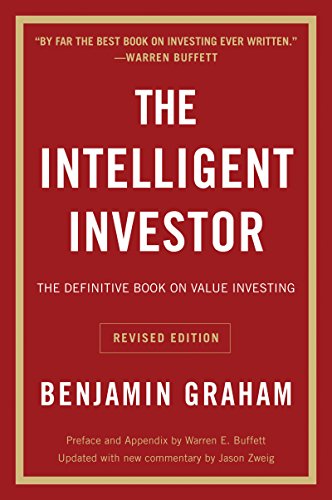
⚡️ What is The Intelligent Investor about?
“The Intelligent Investor” by Benjamin Graham is the definitive guide on value investing, a philosophy focused on long-term wealth preservation and growth rather than speculative gains. It teaches you to develop a disciplined, rational approach to the market, treating stock ownership as a stake in a real business. The core of The Intelligent Investor revolves around three powerful concepts: the distinction between investment and speculation, the allegory of “Mr. Market” to understand market mood swings, and the principle of “margin of safety” to protect your capital. This book isn’t about finding the next hot stock; it’s about building a robust framework that allows you to profit from the market’s irrationality while minimizing risk. It’s a foundational text that has shaped generations of successful investors, including Warren Buffett.
🚀 The Book in 3 Sentences
- True investing involves thorough analysis, ensuring the safety of your principal, and aiming for adequate returns, fundamentally separating it from speculation.
- An intelligent investor capitalizes on the market’s mood swings by buying assets for less than their intrinsic value, a concept known as the margin of safety.
- Success in investing comes not from intelligence or analytics alone, but from the character and discipline to stick to your principles, especially when market sentiment is against you.
🎨 Impressions
Reading “The Intelligent Investor” felt like attending a masterclass from a wise, patient grandfather who has seen every market cycle. The book is dense and requires focus, but its principles are timeless and profoundly logical. It completely shifted my perspective from chasing prices to understanding value. Graham’s strategies are not glamorous, but they are built on a foundation of common sense and risk aversion that is incredibly reassuring in today’s volatile market. The most striking impression is how much of investing is psychological; the book is as much about managing your own emotions as it is about analyzing balance sheets. The Intelligent Investor provides the mental armor needed to navigate Wall Street’s noise.
📖 Who Should Read The Intelligent Investor?
This book is essential reading for anyone serious about long-term investing, from beginners to seasoned professionals. It’s perfect for individuals who are tired of the stress of market timing and speculative trading and want a more reliable, systematic approach to building wealth. If you want to understand the foundational principles that have guided legends like Warren Buffett, this is your starting point. It is not for those seeking quick, high-risk trading strategies or “get rich quick” schemes. It’s for the patient, the rational, and those who wish to become true partners in the businesses they own.
☘️ How the Book Changed Me
\p>This book fundamentally reshaped my relationship with the stock market, moving me from an emotional speculator to a disciplined investor. The concepts provided a mental framework that has brought immense clarity and calm to my financial decision-making. I no longer see market downturns as a threat but as an opportunity presented by a manic-depressive business partner, Mr. Market. The focus on value over price has become my North Star. The strategies from The Intelligent Investor have given me the confidence to build a portfolio that I can hold for decades, regardless of the headlines.- I stopped checking my portfolio daily, freeing myself from the anxiety of short-term price fluctuations.
- I now analyze companies based on their intrinsic value and financial health, not on market hype or momentum.
- I implemented a simple, disciplined asset allocation plan, which has removed the guesswork from my investment decisions.
- I learned to view a bear market not as a catastrophe, but as a “clearance sale” on high-quality assets.
- I developed a deep appreciation for the “margin of safety,” which has become a non-negotiable rule in every investment I consider.
✍️ My Top 3 Quotes
- “In the short run, the market is a voting machine but in the long run, it is a weighing machine.”
- “The intelligent investor is a realist who sells to optimists and buys from pessimists.”
- “The essence of investment management is the management of risks, not the management of returns.”
📒 Summary + Notes
“The Intelligent Investor” provides a comprehensive blueprint for a rational, low-risk approach to investing. Its core philosophy is built on the pillars of discipline, patience, and a deep understanding of the difference between price and value. The book introduces powerful techniques for analyzing securities and constructing a portfolio that can withstand market turbulence. Graham’s wisdom is timeless, teaching investors to protect their capital first and then seek adequate, not extraordinary, returns. By following his principles, one can learn to behave intelligently as an investor, leveraging market folly for personal gain rather than becoming a victim of it.
Chapter 1: Investment versus Speculation
Graham establishes the most critical distinction in the book: the difference between an investment operation and a speculative one. An investment is a thorough analysis promising safety of principal and an adequate return. Speculation, on the other hand, is betting on price movements without such a foundation. He warns that many people who think they are investing are actually speculating, often with disastrous results.
- An investment operation is one which, upon thorough analysis, promises safety of principal and an adequate return.
- Speculation involves betting on future price movements without adequate analysis of the underlying asset.
- Graham advises that if you must speculate, do so with a separate, small portion of your capital (no more than 10%).
- Never confuse the two; treating speculation as investment is a primary cause of financial loss.
- The intelligent investor’s first job is to determine whether they are investing or speculating at any given moment.
Chapter 2: The Investor and Inflation
This chapter tackles the complex relationship between inflation and investment returns. Graham acknowledges that inflation erodes the purchasing power of money, making it a hidden tax on investors. He examines how different asset classes—stocks, bonds, and real estate—have historically performed during inflationary periods. He concludes that while stocks are generally a better hedge than bonds, they are not a perfect one.
- Inflation is a persistent risk that destroys the real value of fixed-income investments like bonds.
- Common stocks offer better protection against inflation than bonds because corporate earnings can potentially rise with prices.
- However, stocks are not a guaranteed hedge, as inflation can hurt corporate profits and lead to lower valuation multiples.
- Graham cautions against making investment decisions based solely on inflation predictions, which are notoriously unreliable.
- The best defense is a diversified portfolio and focusing on companies with the power to raise prices during inflationary times.
Chapter 3: A Century of Stock-Market History
Graham provides a historical overview of the stock market from the early 20th century to the time of writing. He uses this data to illustrate the market’s cyclical nature, showing periods of immense optimism (bull markets) followed by devastating pessimism (bear markets). The key lesson is that history repeats itself, and market extremes are a recurring feature that the intelligent investor can exploit.
- Market history shows a clear pattern of alternating bull and bear markets, driven by human psychology.
- Bull markets are characterized by high valuations and speculative fervor, while bear markets offer bargains.
- The past century demonstrates that stocks, over the long run, provide higher returns than bonds but with greater volatility.
- Investors who buy at the peak of bull markets often take many years, or even decades, to break even.
- Understanding this history helps the intelligent investor maintain perspective and avoid being swept up in prevailing sentiment.
Chapter 4: General Portfolio Policy
Here, Graham outlines the foundational asset allocation strategy for the “defensive” or passive investor. He introduces the simple yet powerful concept of maintaining a 50/50 split between stocks and high-grade bonds. This mechanical approach forces investors to buy low and sell high automatically through periodic rebalancing, protecting them from their own emotional tendencies.
- The defensive investor should maintain a core portfolio of 50% in stocks and 50% in bonds.
- This allocation should be rebalanced whenever the ratio drifts by more than 5%, forcing you to sell what’s high and buy what’s low.
- This simple policy prevents the common mistake of going all-in on stocks during a bull market and all-in on bonds during a bear market.
- For the “enterprising” investor, the allocation can vary between 25% and 75% in stocks, based on market conditions.
- The bond component provides crucial psychological and financial stability, allowing the investor to hold stocks during severe downturns.
Chapter 5: The Defensive Investor and Common Stocks
Graham delves into the specific types of common stocks suitable for the defensive investor. He warns against chasing popular “growth” stocks, which are often overpriced and carry high risk. Instead, he recommends a portfolio of large, prominent, and conservatively financed companies with a long history of dividend payments. He provides a set of quantitative filters to identify such companies.
- Defensive investors should avoid popular growth stocks, as their high prices offer no margin of safety.
- Instead, focus on large, established companies with a strong financial condition and a long record of paying dividends.
- Graham suggests a set of rules: adequate diversification, strong finances, and continuous dividend payments for at least 10 years.
- The price paid should not be excessive; he provides a formula limiting the price-to-earnings and price-to-book ratios.
- For most defensive investors, a simple index fund is a superior alternative to picking individual stocks.
Chapter 6: Portfolio Policy for the Enterprising Investor
This chapter outlines the approach for the more active, “enterprising” investor who is willing to dedicate time and effort to achieve superior returns. Graham emphasizes that this path is difficult and requires significant knowledge and discipline. The enterprising investor’s goal is to buy stocks that are selling for less than their intrinsic value, often by finding bargains in unpopular or neglected areas of the market.
- The enterprising investor aims to achieve better-than-average results through diligent research and analysis.
- This is a demanding path that requires treating investing as a full-time business; it is not for the semi-committed.
- Opportunities can be found in “bargain” issues: stocks that are undervalued relative to their net asset value or earnings power.
- Graham suggests looking in less glamorous areas, such as “secondary” companies or those undergoing “special situations.”
- The enterprising investor must be prepared to do the work that others are not willing to do to find these hidden gems.
Chapter 7: The Policy of the Investor
Graham reiterates the core message of investor behavior. He introduces the famous allegory of “Mr. Market,” a manic-depressive business partner who offers to buy or sell your share of the business every day at wildly varying prices. The intelligent investor should ignore Mr. Market’s mood swings and only take advantage of him when his prices are irrationally low.
- Mr. Market is your business partner who is sometimes euphoric and sometimes deeply depressed about the value of your shared business.
- You should never be influenced by his mood; instead, use it to your advantage.
- Buy from Mr. Market when he is pessimistic and offering absurdly low prices.
- Sell to Mr. Market when he is irrationally optimistic and offering absurdly high prices.
- The rest of the time, the intelligent investor should be perfectly comfortable ignoring Mr. Market completely.
Chapter 8: The Investor and Market Fluctuations
This chapter expands on the Mr. Market concept, providing practical advice on how to behave during market fluctuations. Graham argues that the true investor welcomes market declines because they provide an opportunity to buy good stocks at bargain prices. He introduces the concept of “dollar-cost averaging” as a systematic way to take advantage of volatility.
- The intelligent investor should view market downturns as buying opportunities, not causes for panic.
- Dollar-cost averaging—investing a fixed amount of money at regular intervals—is a powerful technique for the defensive investor.
- This strategy ensures you buy more shares when prices are low and fewer when they are high, automatically lowering your average cost.
- Investors should have a firm policy on what to do in a falling market, ideally one that involves buying, not selling.
- Market fluctuations are a fact of life; the key is to have a policy that makes them work for you, not against you.
Chapter 9: Investing in Investment Funds
Graham turns his attention to mutual funds, evaluating their role for both defensive and enterprising investors. He concludes that for the vast majority of people, a low-cost index fund is the most sensible and effective choice. He is highly critical of most actively managed funds, which often charge high fees and fail to beat the market over the long run.
- The best choice for most defensive investors is a low-cost index fund that tracks a broad market average.
- Actively managed funds have a poor track record of outperforming the market, especially after their fees are deducted.
- Investors should be wary of funds with high sales loads and excessive operating expenses.
- An index fund provides instant diversification and eliminates the risk of picking a poorly performing fund manager.
- Graham’s endorsement of index funds was prescient and remains the cornerstone of modern passive investing advice.
Chapter 10: The Investor and His Advisers
In this chapter, Graham discusses the role of financial advisers. He acknowledges that a good adviser can be valuable but warns that finding one is difficult. He argues that investors must have enough knowledge to evaluate their adviser’s advice. Ultimately, the responsibility for investment decisions rests with the investor themselves.
- The primary responsibility for an investment’s outcome always lies with the investor, not the adviser.
- Investors should be skeptical of advisers who promise unusually high returns or rely on market forecasts.
- A good adviser should focus on sound investment principles, such as diversification and a margin of safety.
- The investor must learn enough to distinguish between sound advice and salesmanship.
- Ultimately, the best adviser may be the disciplined principles outlined in the book itself.
Chapter 11: Security Analysis for the Lay Investor
Graham simplifies the complex process of security analysis for the non-professional. He explains that the goal is not to predict the future perfectly but to establish a “central value” or range of values for a stock based on its past performance and financial position. This analysis provides a basis for determining if a stock offers a margin of safety at its current price.
- Security analysis for the lay investor should focus on establishing a rough idea of a stock’s intrinsic value.
- This involves analyzing key financial metrics like earnings, assets, and dividends over a period of several years.
- The goal is not precise calculation but to determine if the current price is significantly below the estimated value.
- Graham warns against relying too heavily on future earnings projections, which are inherently uncertain.
- A simple, quantitative approach is often more effective than complex, qualitative judgments for the average investor.
Chapter 12: Things to Consider About Per-Share Earnings
This chapter provides a critical look at earnings per share (EPS), a metric that is often misused by investors. Graham argues for using an average of past earnings over several years rather than just the most recent year. This smooths out cyclical fluctuations and one-off events, providing a more realistic picture of a company’s earning power.
- Investors should be wary of relying on a single year’s earnings, which can be distorted by business cycles or accounting tricks.
- Graham advocates for using the average earnings over the past 7 to 10 years to get a more stable measure of earning power.
- This approach prevents investors from overpaying for a stock based on a temporarily high earnings year.
- The Price-to-Earnings (P/E) ratio should be calculated based on this average earnings figure, not the trailing twelve months.
- Capital structure changes, like issuing new shares, can also distort per-share earnings and must be considered.
Chapter 13: A Comparison of Four Listed Companies
Graham applies the principles from previous chapters to a real-world analysis of four different companies. He demonstrates how to evaluate their financial stability, earnings record, dividend history, and valuation. This practical example shows how the quantitative filters can be used to separate high-quality, reasonably priced companies from speculative and overvalued ones.
- This chapter serves as a case study, applying Graham’s analytical framework to actual companies.
- He compares companies across different industries to show how the principles are universally applicable.
- The analysis highlights the importance of financial strength, consistent earnings, and a reasonable price relative to assets and earnings.
- It demonstrates how to spot red flags, such as excessive debt or erratic earnings.
- The key takeaway is that a disciplined, quantitative approach can reveal significant differences in quality and value that are not apparent from stock price alone.
Chapter 14: Stock Selection for the Defensive Investor
Graham presents a more detailed and stricter set of criteria for the defensive investor who chooses to select individual stocks rather than buy an index fund. These “seven quality and price criteria” are a checklist designed to ensure that the investor buys a diversified portfolio of high-quality companies at a reasonable price, maximizing the chance of a satisfactory outcome.
- Criterion 1: Adequate size of the enterprise (e.g., annual sales of at least $100 million, adjusted for inflation).
- Criterion 2: Strong financial condition (current assets at least twice current liabilities).
- Criterion 3: Earnings stability (positive earnings for the past 10 years).
- Criterion 4: Dividend record (uninterrupted payments for at least 20 years).
- Criterion 5: Moderate earnings growth (increase of at least one-third in per-share earnings over the past 10 years).
- Criterion 6 & 7: Moderate price (price no more than 15 times average earnings and no more than 1.5 times book value).
Chapter 15: Stock Selection for the Enterprising Investor
For the enterprising investor, Graham outlines several approaches to finding undervalued stocks. He focuses on “bargain” issues, which are stocks trading for less than their intrinsic value. These can be found in companies that are unpopular, neglected, or temporarily out of favor. He describes how to search for these opportunities by screening for low price-to-earnings or low price-to-book ratios.
- The enterprising investor should look for “bargains,” defined as stocks selling for less than their intrinsic value as indicated by asset value or earnings power.
- One approach is to search for companies with low P/E ratios that also have reasonable financial strength and earnings stability.
- Another approach is to find companies whose stock price is less than their net current asset value (a very conservative measure).
- Graham also discusses “special situations,” like arbitrage or liquidations, which are more complex but can offer high returns.
- The key is to do the work that others neglect, finding value where others are not looking.
Chapter 16: Convertible Issues and Warrants
This chapter covers more complex financial instruments: convertible bonds and preferred stocks, as well as stock warrants. Graham explains that these hybrid securities combine features of both stocks and bonds. While they can be attractive in certain situations, he generally advises the defensive investor to avoid them due to their complexity and the potential for dilution of value for common shareholders.
- Convertible securities are bonds or preferred stocks that can be converted into a predetermined number of common shares.
- They offer the safety of a bond with the upside potential of a stock, but this comes at a price, usually a lower yield.
- Warrants give the holder the right to buy common stock at a fixed price in the future.
- Graham is generally cautious about these instruments for the defensive investor, as they can be difficult to value and can dilute the value of existing shares.
- For the enterprising investor, they can present special situation opportunities if analyzed carefully.
Chapter 17: Four Extremely Instructive Cases
Graham presents four case studies of real companies to illustrate important lessons in corporate finance and investment. These cases highlight the dangers of poor capital structure, the perils of aggressive accounting, the importance of shareholder-friendly management, and the potential for value to be hidden in complex corporate structures. They serve as cautionary tales for the investor.
- The cases demonstrate how corporate malfeasance or poor financial decisions can destroy shareholder value.
- One case shows the risk of a company with an excessive amount of senior securities (bonds/preferred stock) relative to common stock.
- Another highlights how accounting manipulation can create a false impression of earnings growth.
- The cases teach the investor to look beyond the numbers and scrutinize the quality of earnings and the integrity of management.
- They reinforce the importance of a strong financial position and a conservative capital structure.
Chapter 18: A Comparison of Eight Pairs of Companies
Building on the previous chapter, Graham compares eight pairs of companies from similar industries to show how superior financial discipline and a conservative approach lead to better long-term performance. In each pair, one company is a large, well-financed leader, while the other is a smaller, more speculative competitor. The results overwhelmingly favor the more conservative companies.
- These comparisons powerfully demonstrate the advantages of investing in industry leaders with strong financials.
- The larger, more conservatively financed companies consistently showed better long-term stability and returns.
- The smaller, more speculative companies often had periods of excitement but were more prone to failure and severe losses.
- This supports Graham’s advice for the defensive investor to stick to large, prominent, and conservatively financed companies.
- The lesson is that in business, as in investing, slow and steady often wins the race.
Chapter 19: Shareholders and Managements
Graham discusses the relationship between shareholders and corporate management. He argues that shareholders should be more active and demand that management act in their best interests. This includes ensuring fair compensation, avoiding wasteful spending, and maintaining a dividend policy. He advocates for shareholders to think like owners, not passive spectators.
- Shareholders are the true owners of the company and should hold management accountable for its performance.
- Management’s primary duty is to act in the long-term interests of the shareholders.
- Investors should be wary of companies with excessive executive compensation or a history of poor capital allocation.
- A consistent and reasonable dividend policy is a sign of a shareholder-friendly management.
- Graham encourages shareholders to be more engaged and to vote their shares to promote good corporate governance.
Chapter 20: “Margin of Safety” as the Central Concept of Investment
In the final chapter, Graham brings all his teachings together under the single, unifying concept of the “margin of safety.” This is the cornerstone of his entire philosophy. The margin of safety is the difference between the estimated intrinsic value of a stock and its market price. Buying with a margin of safety protects the investor from bad luck, errors in judgment, and the unpredictable future.
- The margin of safety is the most important concept in investment; it is the secret to sound investing.
- It is achieved by buying an asset for significantly less than its conservatively calculated intrinsic value.
- This discount provides protection against unforeseen adverse events and the inherent uncertainty of the future.
- The wider the margin of safety, the safer the investment and the greater the potential for return.
- All the other principles in the book—diversification, analyzing financials, avoiding speculation—are designed to help the investor achieve a margin of safety.
Key Takeaways
The core lessons from “The Intelligent Investor” are timeless principles for building wealth prudently. The book teaches that investing success is not about brilliance but about discipline and the right mindset. By internalizing these key takeaways, any investor can develop a robust framework for navigating the complexities of the financial markets and achieving their long-term financial goals. The strategies are simple to understand but require emotional fortitude to execute.
- The margin of safety is paramount: always buy assets for less than they are worth to protect against downside risk.
- Distinguish rigorously between investment and speculation; never speculate with money you cannot afford to lose.
- Embrace the “Mr. Market” allegory to remain emotionally detached and capitalize on market irrationality instead of being a victim of it.
- For most investors, a simple, diversified portfolio of low-cost index funds is the most reliable path to success.
- Asset allocation is critical; a balanced portfolio of stocks and bonds provides stability and forces a disciplined rebalancing strategy.
Conclusion
“The Intelligent Investor” is more than just a book; it’s a foundational philosophy for a lifetime of successful investing. Its wisdom lies not in complex formulas but in its profound understanding of market psychology and risk. By teaching us to be patient, disciplined, and rational, Graham provides the tools to transform market volatility from a threat into an opportunity. While the examples may be dated, the principles are eternal and more relevant than ever. For anyone serious about mastering the art of investing, reading and re-reading The Intelligent Investor is an indispensable step on that journey.
More From Benjamin Graham →
Discover more from AI Book Summary
Subscribe to get the latest posts sent to your email.