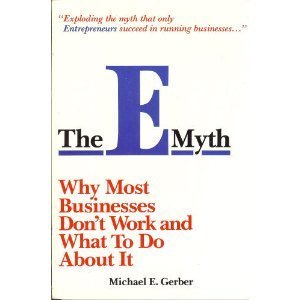
⚡️ What is The E-Myth Revisited About?
Have you ever wondered why that incredibly talented baker you know ended up hating her own bakery within six months? Michael E. Gerber has the answer, and it’s not because the ovens broke. In this classic, he dismantles the myth that being good at a technical skill means you’re good at running a business based on that skill. It’s a wake-up call for anyone who feels like they’ve traded a 9-to-5 for a 24/7 nightmare. You can find more summaries by Michael E. Gerber on our site if this resonates with your current struggle.
The central thesis is that a truly successful business isn’t built on the back of an extraordinary person doing everything. Instead, it’s a systems-dependent machine that can be operated by ordinary people. Gerber’s approach is essential reading in our business book summaries collection because it forces you to stop being the “doer” and start being the architect. If you don’t change your perspective, you aren’t an entrepreneur; you’re just a technician with a very expensive, very demanding boss: yourself.
🚀 The Book in 3 Sentences
- Most small businesses are started by “technicians in an entrepreneurial seizure” who make the fatal assumption that knowing the work is the same as knowing how to build a business that does that work.
- A business should be designed as a scalable, repeatable prototype—much like a franchise—where the system runs the business and people run the system.
- The owner must transition from working “in” the business (doing the technical tasks) to working “on” the business (designing the systems and future strategy).
🎨 Impressions
Reading this book felt like someone finally turned the lights on in a messy room. I’ve spoken to so many founders who are burnt out, and Gerber’s description of the “Entrepreneurial Myth” explains exactly why. He’s blunt, occasionally repetitive, and uses a fictional dialogue with a pie-shop owner named Sarah that can feel a bit cheesier than I’d like. But the core logic? It’s bulletproof. It’s the difference between owning a job and owning an asset.
What really hit home was the idea of the three personalities: the Entrepreneur, the Manager, and the Technician. I realized I spend way too much time in Technician mode, thinking that if I just work harder, the business will grow. Gerber argues that’s a trap. The Manager craves order and the Entrepreneur craves vision, but the Technician just wants to get the work done. If you don’t balance these, you’re doomed to stay small and stressed. It’s a frustrating realization, but a necessary one if you actually want freedom.
📖 Who Should Read The E-Myth Revisited?
If you are a freelancer who is tired of trading time for money, this is your roadmap to scaling. It’s also perfect for the small business owner who feels like they can’t take a vacation because the whole place would burn down without them. However, if you’re a “solopreneur” who truly loves doing the craft and has zero desire to ever hire anyone or scale, you might find Gerber’s obsession with franchising and systems a bit cold. But for anyone wanting to build something bigger than themselves? It’s non-negotiable.
☘️ How This Book Changed My Thinking
Before reading this, I thought my value was in my output. Now, I see my value is in the systems I create that produce that output.
- I stopped asking “How do I do this?” and started asking “How can this get done without me?”
- I began documenting every repetitive task as if I were going to hand it to a new hire tomorrow, even if I’m not ready to hire yet.
- I realized that a business that depends on my brilliance is a business that’s destined to fail because I’m not scalable.
✍️ 3 Quotes That Stuck With Me
- “The Technician’s fatal assumption: If you understand the technical work of a business, you understand a business that does that technical work.” — This is the gut punch that starts the whole book.
- “Your business is not your life.” — A simple reminder that we often forget when we’re drowning in emails.
- “The system runs the business. The people run the system.” — This is the golden rule of scalability.
📒 Summary + Notes
Michael E. Gerber builds a case for the “Franchise Prototype” model. He isn’t saying you have to buy a McDonald’s; he’s saying you should act as if you’re going to franchise your own business 5,000 times. Why? Because that mindset forces you to create order, predictability, and systems that don’t rely on specialized, expensive talent. If your business requires a genius to run, you can’t grow. If it requires a solid system, the sky is the limit.
The book follows a narrative arc from the realization of the “Technician Trap” through the three stages of business growth: Infancy, Adolescence, and Maturity. By the end, Gerber wants you to believe that your primary aim isn’t just to make money, but to create a business that serves your life, rather than consumes it. It’s a transition from being a worker-bee to being a strategic leader who orchestrates a symphony of systems.
1: The Entrepreneurial Myth
Why do we assume that a great graphic designer will be a great owner of a design firm? Gerber calls this the “Fatal Assumption.” Most people don’t start businesses because they want to be entrepreneurs; they start them because they want to escape a boss. They have an “entrepreneurial seizure” and decide to do the technical work for themselves. But suddenly, they aren’t just designing; they’re also the janitor, the accountant, and the salesperson. They haven’t created a business; they’ve created a nightmare job.
2: The Entrepreneur, the Manager, and the Technician
Imagine three people fighting for the steering wheel of a car. The Entrepreneur lives in the future and loves “what if.” The Manager lives in the past and loves order and planning. The Technician lives in the present and just wants to get the work done. In most small business owners, the Technician is winning 70% of the time, the Manager has 20%, and the Entrepreneur is lucky to get 10%. Without balance, the business is a mess of shortsightedness and chaos.
3: Infancy: The Technician Phase
In the beginning, you are the business. You do everything. Customers love you because they get the “master’s touch.” But this is a trap. You’re working twelve-hour days, seven days a week. Infancy ends when the owner realizes the business cannot continue this way without breaking them. If you don’t move past this stage, you don’t have a business—you have a job where you are the most demanding employee you’ve ever had.
4: Adolescence: Getting Some Help
The moment you hire your first employee is usually when the wheels fall off. Why? Because most owners practice “management by abdication.” You hire someone and just hand them the keys because you’re tired of doing the work. You don’t give them a system; you just hope they’re as good as you are. When they inevitably fail to meet your invisible standards, you take the work back, fire them, and decide “you just can’t find good help these days.”
5: Beyond the Comfort Zone
Ever feel like your business is a cage with your name on it? Every owner has a comfort zone. The Technician’s zone is how much they can do themselves. The Manager’s is how many people they can personally supervise. When the business grows beyond this, the owner usually tries to shrink it back down to a size they can control. Gerber argues this is a mistake. You shouldn’t shrink the business; you should grow your own capacity by building better structures.
6: Maturity and the Entrepreneurial Perspective
IBM didn’t become a giant by accident; they acted like a giant when they were still in a garage. This is the Entrepreneurial Perspective. Instead of asking “What work has to be done?” (the Technician’s question), you ask “How must the business work?” Mature businesses are started with the end in mind. They are built as a model that works, rather than a place where people just show up to work.
7: The Turn-Key Revolution
What if the real product of your business wasn’t what you sell, but the business itself? Ray Kroc didn’t just sell hamburgers; he sold a system for selling hamburgers called McDonald’s. This was the “Turn-Key Revolution.” The business becomes a product that works perfectly every time, regardless of who is behind the counter. If you can’t “turn the key” and have the business run without you, you don’t own a product; you own a project.
8: The Franchise Prototype
Does your business rely on extraordinary people, or an extraordinary system? If you need a superstar to make your business work, you’re in trouble because superstars are expensive and rare. A franchise prototype is built so that it can be operated by people with the lowest possible skill level necessary. That sounds harsh, but it’s the only way to scale. You build the “expertise” into the system, not the person.
9: Working on Your Business, Not in It
I’ve dog-eared this chapter more than any other. Gerber lists rules for the prototype: it must provide consistent value, it must be documented in manuals, and it must look orderly. Your job is to be the scientist in the laboratory, testing the business model to see what works, then writing down the recipe so someone else can cook the meal. If you spend your day cooking, you’ll never have time to open a second restaurant.
10: The Business Development Process
Suppose you wanted to improve your sales. How would you do it? Gerber breaks it down into Innovation, Quantification, and Orchestration. Innovation is trying something new (like a specific greeting). Quantification is measuring the results (did sales go up?). Orchestration is making that new thing the standard “how we do it here” so it happens every time. It’s a continuous loop that turns a chaotic shop into a finely tuned machine.
11: Your Business Development Program
How do you actually start building this thing? Gerber outlines a seven-step program that takes you from your personal goals down to the systems you use for daily tasks. It’s not just about business; it’s about a Life Plan. You have to know what you want your life to look like before you can build a business that supports it. Otherwise, you’re just building a random machine that might end up crushing you.
12: Your Primary Aim
Who do you want to be when you’re dead? It’s a heavy question, but Gerber insists you answer it. Your “Primary Aim” is the vision for your life. Most owners have no vision, so their business becomes their life by default. When you know what you want—freedom, wealth, time with family—you can finally see the business as a tool to get those things, rather than the thing itself.
13: Your Strategic Objective
How big does your business need to be to give you the life you want? This chapter is about setting benchmarks. You need to know your gross revenue targets, your profit margins, and exactly what your “product” is. Remember, the product isn’t the commodity (the pie); it’s the feeling the customer gets (the experience). If you don’t know what you’re really selling, you’ll never be able to systematize the delivery of it.
14: Your Organizational Strategy
Most small businesses organize around people, which is a recipe for disaster. If “Bob” leaves and takes all his knowledge with him, you’re screwed. Instead, you need to organize around functions. You create an Org Chart with “Position Contracts” instead of job descriptions. Even if you are the only person in the company, you should sign your name to every box. As you grow, you “hire” someone to take over one of your boxes, handing them the system for that role.
15: Your Management Strategy
What if management didn’t require “managing” people? Gerber argues that a great management system is a marketing tool. It’s a system designed into your prototype to produce a specific result. You don’t manage people; you manage the system that people use. This takes the personality out of it and puts the focus on the process. It’s about creating an environment where doing the work well is the natural outcome of the setup.
16: Your People Strategy
How do you get people to care as much as you do? You don’t. Instead, you create a “game” worth playing. People want to work for something that has a clear structure and a clear way to win. Your People Strategy is about communicating your idea and your standards so clearly that the right people want to join the game. It’s about building a culture where the work itself is a way for people to test and improve themselves.
17: Your Marketing Strategy
Why do people really buy from you? Gerber says it’s rarely for the reasons you think. Marketing is about demographics (who they are) and psychographics (why they buy). You have to become a student of the “science” of marketing. If you don’t quantify your marketing—testing colors, words, and responses—you’re just guessing. A mature business knows exactly which levers to pull to get a predictable stream of customers.
18: Your Systems Strategy
Everything is a system. Gerber breaks it down into Hard Systems (tools and tech), Soft Systems (ideas and people), and Information Systems (data). This final chapter is a call to action. You have to stop thinking about acting and start acting. A man of knowledge lives by doing. The business you build will be a reflection of the person you become in the process of building it.
⚖️ A Critical Perspective
Gerber’s advice is incredibly powerful for brick-and-mortar or traditional service businesses, but I found it a little rigid for the modern digital economy. In 2025, the rise of AI and automation makes his “system-dependent” argument more relevant than ever, yet his focus on low-skill labor feels dated. Today’s best companies often rely on highly creative, autonomous talent that doesn’t always want to follow a 50-page manual for every task. Additionally, he completely ignores the “Solopreneur” path where high-profit, low-headcount businesses thrive without needing to become a franchise-style prototype. It’s a great book, but take the “low-skill” part with a grain of salt if you’re in a creative field.
🔄 How It Compares
While Zero to One by Peter Thiel focuses on the “What” of innovation and building a monopoly, The E-Myth Revisited is all about the “How” of daily operations and scalability. Thiel wants you to build something unique; Gerber wants you to build something that runs without you. If you’re a visionary with a mess of a business, read Gerber first to get control, then read Thiel to find your edge.
🔑 Key Takeaways
The lessons here are about shifting from a doer to a designer.
- Document Everything: If it’s not in an operations manual, it’s just an opinion, and opinions aren’t scalable.
- Hire for Systems, Not Talent: Build a process so good that a person with average skills can produce extraordinary results.
- The Org Chart is First: Design the positions the company needs to function, then fill those boxes with people (or yourself) temporarily.
- Quantify Your Marketing: Don’t guess why people buy; measure the demographics and the results of every change you make.
💬 Frequently Asked Questions
What is the main argument of The E-Myth Revisited?
The main argument is that most small businesses are started by people with technical skills (technicians) rather than entrepreneurial ones. These owners end up working for their business rather than on it. To succeed, they must build a systems-dependent model that operates predictably without their constant technical input.
What is the technician trap according to Gerber?
The technician trap is the belief that because you are good at a specific task—like coding, baking, or law—you are qualified to run a business that does that task. This leads to burnout because the owner spends all their time doing the work instead of building the company structure.
Is The E-Myth Revisited still relevant in 2025?
Absolutely. While the examples (like pie shops or IBM) are older, the core principles of systematization and working “on” the business are more relevant now due to automation. In a world of AI, the ability to design and manage systems is a primary competitive advantage for any small business owner.
What are the three personalities in the E-Myth?
The three personalities are the Entrepreneur (the visionary/future-focused), the Manager (the planner/order-focused), and the Technician (the doer/present-focused). Gerber argues that most business failures happen because the Technician dominates the owner’s time, leaving no room for strategic growth or necessary organizational planning.
Who should read The E-Myth Revisited?
It’s best for small business owners who feel overwhelmed, freelancers looking to scale into an agency, or anyone planning to start a business. It provides a blueprint for creating freedom rather than just a job, making it essential for those who value long-term scalability and personal time.
Conclusion
At its heart, this book is about freedom. It’s about the hard truth that if your business depends on you, you don’t own a business—you own a job where you are the worst boss in the world. Gerber’s “Franchise Prototype” mindset is a radical shift that forces you to value your time and your systems more than your individual technical brilliance. It’s a painful transition for most of us who take pride in our “mastery,” but it’s the only path to a business that actually serves you.
If you take only one thing away from The E-Myth Revisited, let it be the distinction between working *in* and working *on*. Spend one hour this week acting like the Entrepreneur. Stop doing the work, and start designing the way the work gets done. Your future, non-burnt-out self will thank you. For more insights on building a life and business that works, check out our other business book summaries.
More From Michael E. Gerber →
Discover more from AI Book Summary
Subscribe to get the latest posts sent to your email.