- The continuous loop of Innovation, Quantification, and Orchestration drives business improvement
- Businesses grow through three stages: Infancy, Adolescence, and Maturity
- Successful businesses behave as mature organizations from the very beginning
- Innovation creates new ideas, Quantification measures results, Orchestration implements improvements
- Continuous improvement becomes part of the business culture and identity
Chapter 6: The Business Development Program
This chapter presents the seven-step Business Development Program that transforms any business into a well-systematized operation. The program begins with determining your Primary Aim – what you want your life to be – and works through Strategic Objectives, Organizational Strategy, Management Strategy, People Strategy, Marketing Strategy, and Systems Strategy. Each step builds upon the previous one, creating a comprehensive framework for business success. Gerber emphasizes that the business should support your life goals rather than consume them, challenging the traditional notion that business ownership requires sacrificing personal fulfillment.
- The seven-step program creates a comprehensive approach to business development
- Begin with Primary Aim – defining what you want your life to be
- Develop strategies for organization, management, people, marketing, and systems
- The business should support life goals, not consume them
- Systematic development creates sustainable business success and personal fulfillment
Key Takeaways
The E-Myth Manager provides essential insights for building successful businesses that work independently of their owners. The book’s core principles challenge conventional thinking about entrepreneurship and offer practical frameworks for systematic business development. These takeaways encapsulate the most valuable lessons that can transform any business owner’s approach to management and growth, providing a roadmap for creating sustainable, scalable enterprises.
- The E-Myth Manager reveals that technical competence doesn’t equal business competence, requiring owners to develop management skills
- Successful businesses require three distinct roles: Entrepreneur, Manager, and Technician, each needing separate attention
- Systematization through documented processes allows businesses to operate independently of the owner’s constant involvement
- Thinking like a franchisor forces development of comprehensive systems and eliminates business dependency on individual expertise
- Continuous improvement through Innovation-Quantification-Orchestration creates lasting business value and growth
Conclusion
The E-Myth Manager provides a transformative framework for understanding why businesses fail and how to build enterprises that truly work. Michael Gerber’s insights challenge conventional assumptions about entrepreneurship and offer practical solutions for creating systematized businesses. The book’s emphasis on separating the roles of Entrepreneur, Manager, and Technician, combined with its systematic approach to business development, makes it an invaluable resource for any business owner. By implementing The E-Myth Manager principles, entrepreneurs can create businesses that not only succeed financially but also provide the personal freedom and fulfillment they originally sought. The path to business success lies not in working harder, but in working smarter through systematization and strategic thinking.
More From Michael E. Gerber →
- Think like a franchisor even if you never plan to franchise your business
- The six criteria for business duplication include consistent value and low-skill operability
- Business Format Franchises have 95% success rates compared to conventional businesses
- Comprehensive systems eliminate dependency on individual expertise and personality
- Documentation and standardization create predictable business outcomes
Chapter 5: Innovation, Quantification, Orchestration
The Innovation-Quantification-Orchestration loop represents the continuous improvement cycle that successful businesses must maintain. Innovation involves creating new ideas and approaches, Quantification measures and evaluates results, and Orchestration implements improvements systematically. This chapter explains how businesses evolve through different growth stages – Infancy, Adolescence, and Maturity – and the specific management challenges at each stage. Gerber emphasizes that businesses must behave as if they are already mature and successful from the beginning, rather than growing into success over time.
- The continuous loop of Innovation, Quantification, and Orchestration drives business improvement
- Businesses grow through three stages: Infancy, Adolescence, and Maturity
- Successful businesses behave as mature organizations from the very beginning
- Innovation creates new ideas, Quantification measures results, Orchestration implements improvements
- Continuous improvement becomes part of the business culture and identity
Chapter 6: The Business Development Program
This chapter presents the seven-step Business Development Program that transforms any business into a well-systematized operation. The program begins with determining your Primary Aim – what you want your life to be – and works through Strategic Objectives, Organizational Strategy, Management Strategy, People Strategy, Marketing Strategy, and Systems Strategy. Each step builds upon the previous one, creating a comprehensive framework for business success. Gerber emphasizes that the business should support your life goals rather than consume them, challenging the traditional notion that business ownership requires sacrificing personal fulfillment.
- The seven-step program creates a comprehensive approach to business development
- Begin with Primary Aim – defining what you want your life to be
- Develop strategies for organization, management, people, marketing, and systems
- The business should support life goals, not consume them
- Systematic development creates sustainable business success and personal fulfillment
Key Takeaways
The E-Myth Manager provides essential insights for building successful businesses that work independently of their owners. The book’s core principles challenge conventional thinking about entrepreneurship and offer practical frameworks for systematic business development. These takeaways encapsulate the most valuable lessons that can transform any business owner’s approach to management and growth, providing a roadmap for creating sustainable, scalable enterprises.
- The E-Myth Manager reveals that technical competence doesn’t equal business competence, requiring owners to develop management skills
- Successful businesses require three distinct roles: Entrepreneur, Manager, and Technician, each needing separate attention
- Systematization through documented processes allows businesses to operate independently of the owner’s constant involvement
- Thinking like a franchisor forces development of comprehensive systems and eliminates business dependency on individual expertise
- Continuous improvement through Innovation-Quantification-Orchestration creates lasting business value and growth
Conclusion
The E-Myth Manager provides a transformative framework for understanding why businesses fail and how to build enterprises that truly work. Michael Gerber’s insights challenge conventional assumptions about entrepreneurship and offer practical solutions for creating systematized businesses. The book’s emphasis on separating the roles of Entrepreneur, Manager, and Technician, combined with its systematic approach to business development, makes it an invaluable resource for any business owner. By implementing The E-Myth Manager principles, entrepreneurs can create businesses that not only succeed financially but also provide the personal freedom and fulfillment they originally sought. The path to business success lies not in working harder, but in working smarter through systematization and strategic thinking.
More From Michael E. Gerber →
- Businesses should be designed as turn-key operations with complete documented systems
- Owners must work on their business, not in it, according to The E-Myth Manager principles
- Every business should be developed as a prototype that can be replicated
- Systems and processes should be documented so others can operate the business
- Turn-key businesses create lasting value beyond the owner’s personal involvement
Chapter 4: The Business Format Franchise
This chapter delves deeper into the franchise model as the ultimate expression of a well-systematized business. Gerber explains that even if you never plan to franchise your business, thinking like a franchisor forces you to develop comprehensive systems and processes. The Business Format Franchise approach provides a framework for creating businesses that work consistently regardless of who operates them. The chapter outlines the six criteria that every business must meet to be successfully duplicated: providing consistent value, being operable by people with low skill levels, demonstrating precision and order, capturing work in operations manuals, providing consistent customer experience, and using consistent codes and standards.
- Think like a franchisor even if you never plan to franchise your business
- The six criteria for business duplication include consistent value and low-skill operability
- Business Format Franchises have 95% success rates compared to conventional businesses
- Comprehensive systems eliminate dependency on individual expertise and personality
- Documentation and standardization create predictable business outcomes
Chapter 5: Innovation, Quantification, Orchestration
The Innovation-Quantification-Orchestration loop represents the continuous improvement cycle that successful businesses must maintain. Innovation involves creating new ideas and approaches, Quantification measures and evaluates results, and Orchestration implements improvements systematically. This chapter explains how businesses evolve through different growth stages – Infancy, Adolescence, and Maturity – and the specific management challenges at each stage. Gerber emphasizes that businesses must behave as if they are already mature and successful from the beginning, rather than growing into success over time.
- The continuous loop of Innovation, Quantification, and Orchestration drives business improvement
- Businesses grow through three stages: Infancy, Adolescence, and Maturity
- Successful businesses behave as mature organizations from the very beginning
- Innovation creates new ideas, Quantification measures results, Orchestration implements improvements
- Continuous improvement becomes part of the business culture and identity
Chapter 6: The Business Development Program
This chapter presents the seven-step Business Development Program that transforms any business into a well-systematized operation. The program begins with determining your Primary Aim – what you want your life to be – and works through Strategic Objectives, Organizational Strategy, Management Strategy, People Strategy, Marketing Strategy, and Systems Strategy. Each step builds upon the previous one, creating a comprehensive framework for business success. Gerber emphasizes that the business should support your life goals rather than consume them, challenging the traditional notion that business ownership requires sacrificing personal fulfillment.
- The seven-step program creates a comprehensive approach to business development
- Begin with Primary Aim – defining what you want your life to be
- Develop strategies for organization, management, people, marketing, and systems
- The business should support life goals, not consume them
- Systematic development creates sustainable business success and personal fulfillment
Key Takeaways
The E-Myth Manager provides essential insights for building successful businesses that work independently of their owners. The book’s core principles challenge conventional thinking about entrepreneurship and offer practical frameworks for systematic business development. These takeaways encapsulate the most valuable lessons that can transform any business owner’s approach to management and growth, providing a roadmap for creating sustainable, scalable enterprises.
- The E-Myth Manager reveals that technical competence doesn’t equal business competence, requiring owners to develop management skills
- Successful businesses require three distinct roles: Entrepreneur, Manager, and Technician, each needing separate attention
- Systematization through documented processes allows businesses to operate independently of the owner’s constant involvement
- Thinking like a franchisor forces development of comprehensive systems and eliminates business dependency on individual expertise
- Continuous improvement through Innovation-Quantification-Orchestration creates lasting business value and growth
Conclusion
The E-Myth Manager provides a transformative framework for understanding why businesses fail and how to build enterprises that truly work. Michael Gerber’s insights challenge conventional assumptions about entrepreneurship and offer practical solutions for creating systematized businesses. The book’s emphasis on separating the roles of Entrepreneur, Manager, and Technician, combined with its systematic approach to business development, makes it an invaluable resource for any business owner. By implementing The E-Myth Manager principles, entrepreneurs can create businesses that not only succeed financially but also provide the personal freedom and fulfillment they originally sought. The path to business success lies not in working harder, but in working smarter through systematization and strategic thinking.
More From Michael E. Gerber →
- Every business owner is simultaneously an Entrepreneur, Manager, and Technician
- The Entrepreneur creates vision and dreams about the future of the business
- The Manager focuses on organization, planning, and system development
- The Technician performs the actual technical work of the business
- Success requires deliberate separation and balance of these three roles
Chapter 3: The Turn-Key Revolution
The Turn-Key Revolution concept introduces the idea that businesses should be designed like franchises, with complete systems that can be replicated and operated by others. Gerber emphasizes that business owners should work on their business rather than in it, creating documented processes and procedures that make the business turn-key. This approach eliminates dependency on the owner and creates value that extends beyond personal involvement. The chapter explains how to develop prototype businesses that can be duplicated, scaled, and eventually sold or franchised with predictable success.
- Businesses should be designed as turn-key operations with complete documented systems
- Owners must work on their business, not in it, according to The E-Myth Manager principles
- Every business should be developed as a prototype that can be replicated
- Systems and processes should be documented so others can operate the business
- Turn-key businesses create lasting value beyond the owner’s personal involvement
Chapter 4: The Business Format Franchise
This chapter delves deeper into the franchise model as the ultimate expression of a well-systematized business. Gerber explains that even if you never plan to franchise your business, thinking like a franchisor forces you to develop comprehensive systems and processes. The Business Format Franchise approach provides a framework for creating businesses that work consistently regardless of who operates them. The chapter outlines the six criteria that every business must meet to be successfully duplicated: providing consistent value, being operable by people with low skill levels, demonstrating precision and order, capturing work in operations manuals, providing consistent customer experience, and using consistent codes and standards.
- Think like a franchisor even if you never plan to franchise your business
- The six criteria for business duplication include consistent value and low-skill operability
- Business Format Franchises have 95% success rates compared to conventional businesses
- Comprehensive systems eliminate dependency on individual expertise and personality
- Documentation and standardization create predictable business outcomes
Chapter 5: Innovation, Quantification, Orchestration
The Innovation-Quantification-Orchestration loop represents the continuous improvement cycle that successful businesses must maintain. Innovation involves creating new ideas and approaches, Quantification measures and evaluates results, and Orchestration implements improvements systematically. This chapter explains how businesses evolve through different growth stages – Infancy, Adolescence, and Maturity – and the specific management challenges at each stage. Gerber emphasizes that businesses must behave as if they are already mature and successful from the beginning, rather than growing into success over time.
- The continuous loop of Innovation, Quantification, and Orchestration drives business improvement
- Businesses grow through three stages: Infancy, Adolescence, and Maturity
- Successful businesses behave as mature organizations from the very beginning
- Innovation creates new ideas, Quantification measures results, Orchestration implements improvements
- Continuous improvement becomes part of the business culture and identity
Chapter 6: The Business Development Program
This chapter presents the seven-step Business Development Program that transforms any business into a well-systematized operation. The program begins with determining your Primary Aim – what you want your life to be – and works through Strategic Objectives, Organizational Strategy, Management Strategy, People Strategy, Marketing Strategy, and Systems Strategy. Each step builds upon the previous one, creating a comprehensive framework for business success. Gerber emphasizes that the business should support your life goals rather than consume them, challenging the traditional notion that business ownership requires sacrificing personal fulfillment.
- The seven-step program creates a comprehensive approach to business development
- Begin with Primary Aim – defining what you want your life to be
- Develop strategies for organization, management, people, marketing, and systems
- The business should support life goals, not consume them
- Systematic development creates sustainable business success and personal fulfillment
Key Takeaways
The E-Myth Manager provides essential insights for building successful businesses that work independently of their owners. The book’s core principles challenge conventional thinking about entrepreneurship and offer practical frameworks for systematic business development. These takeaways encapsulate the most valuable lessons that can transform any business owner’s approach to management and growth, providing a roadmap for creating sustainable, scalable enterprises.
- The E-Myth Manager reveals that technical competence doesn’t equal business competence, requiring owners to develop management skills
- Successful businesses require three distinct roles: Entrepreneur, Manager, and Technician, each needing separate attention
- Systematization through documented processes allows businesses to operate independently of the owner’s constant involvement
- Thinking like a franchisor forces development of comprehensive systems and eliminates business dependency on individual expertise
- Continuous improvement through Innovation-Quantification-Orchestration creates lasting business value and growth
Conclusion
The E-Myth Manager provides a transformative framework for understanding why businesses fail and how to build enterprises that truly work. Michael Gerber’s insights challenge conventional assumptions about entrepreneurship and offer practical solutions for creating systematized businesses. The book’s emphasis on separating the roles of Entrepreneur, Manager, and Technician, combined with its systematic approach to business development, makes it an invaluable resource for any business owner. By implementing The E-Myth Manager principles, entrepreneurs can create businesses that not only succeed financially but also provide the personal freedom and fulfillment they originally sought. The path to business success lies not in working harder, but in working smarter through systematization and strategic thinking.
More From Michael E. Gerber →
⚡️ What is The E-Myth Manager about?
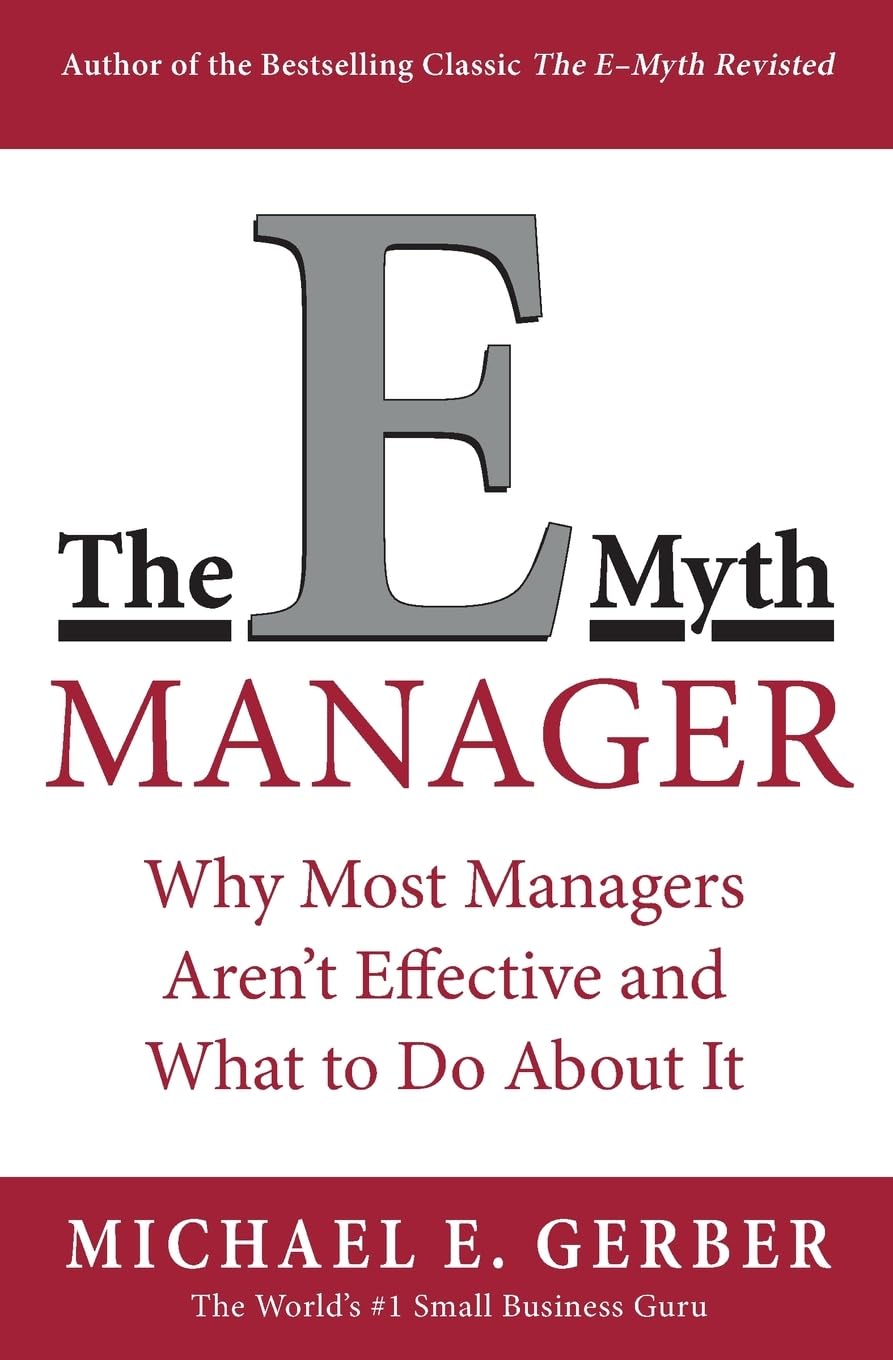
The E-Myth Manager by Michael E. Gerber addresses the fundamental misunderstanding that most managers have about what it takes to successfully run a business. The book reveals why typical management approaches fail and provides a systematic framework for creating businesses that work without the owner being constantly involved. Gerber emphasizes that effective management is not about working harder, but about working smarter through systematization and strategic thinking. The The E-Myth Manager concept challenges conventional wisdom about entrepreneurship and management by showing that technical expertise alone is not enough to build a successful business.
🚀 The Book in 3 Sentences
- The The E-Myth Manager reveals that most business failures stem from owners confusing technical skills with management abilities.
- Successful businesses require a systematic approach that transforms chaos into order through documented processes and clear organizational structures.
- True business success comes from creating systems that work independently of the owner, allowing for sustainable growth and personal freedom.
🎨 Impressions
Reading The E-Myth Manager was a revelation that completely changed my perspective on business management and entrepreneurship. Gerber’s insights into why businesses fail and how to build systems that actually work are both profound and practical. The book exposes the dangerous assumption that being good at a job automatically qualifies someone to run a business in that field. This straightforward approach to understanding the fundamental principles of business success makes The E-Myth Manager an essential read for anyone serious about building a sustainable enterprise.
📖 Who Should Read The E-Myth Manager?
The E-Myth Manager is essential reading for entrepreneurs, small business owners, and managers who want to understand why their businesses struggle despite their best efforts. The book is particularly valuable for technical professionals who have started their own businesses but find themselves overwhelmed by the management demands. Anyone looking to build a business that can operate successfully without their constant involvement will benefit enormously from Gerber’s systematic approach. Whether you’re just starting out or have been running a business for years, The E-Myth Manager provides the foundational principles needed for sustainable success.
☘️ How the Book Changed Me
How my life / behaviour / thoughts / ideas have changed as a result of reading the book.
- I now understand that being technically skilled doesn’t automatically make me a good manager or business owner, fundamentally changing my approach to The E-Myth Manager principles
- I’ve learned to systematize my work processes and create documented procedures that anyone can follow
- I now focus on building business systems rather than just doing the work myself, aligning with The E-Myth Manager philosophy
- I’ve shifted from working in my business to working on my business, following the core The E-Myth Manager strategy
- I now prioritize creating scalable processes that can grow with my business ambitions
✍️ My Top 3 Quotes
- “The The E-Myth Manager explains why most small businesses don’t work and what to do about it.”
- “If you want to work in a business, get a job in someone else’s business! But don’t go to work in your own.”
- “Your business is not your life… Recognize that the purpose of your life is not to serve your business, but that the primary purpose of your business is to serve your life.”
📒 Summary + Notes
The E-Myth Manager revolutionizes our understanding of why businesses fail and provides a systematic approach to building successful enterprises. The book challenges the common misconception that technical expertise automatically translates to business success, revealing the three distinct personalities that exist within every business owner. Gerber’s framework helps entrepreneurs understand the fundamental difference between working in a business versus working on a business, providing practical strategies for creating systems that work independently of the owner’s constant involvement.
Chapter 1: The E-Myth
The first chapter introduces the core concept that gives the book its name – the Entrepreneurial Myth. Gerber explains that most small businesses fail because owners believe that being technically competent in their field automatically qualifies them to run a successful business. This fatal assumption leads to confusion between the roles of entrepreneur, manager, and technician. The chapter reveals that business failure isn’t due to lack of effort or technical skill, but rather a fundamental misunderstanding of what it takes to build a business that works systematically.
- The Entrepreneurial Myth is the false belief that technical competence equals business competence
- Most business owners are actually technicians who have become entrepreneurs by necessity
- The fatal assumption that doing the work means you can manage a business doing that work
Chapter 2: The Three Faces of the Manager
This chapter explores the three distinct personalities that every business owner must embody: the Entrepreneur, the Manager, and the Technician. Gerber explains that successful business management requires balancing these three roles effectively. The Entrepreneur dreams and envisions the future, the Manager organizes and plans, while the Technician does the actual work. Most owners get trapped in the Technician role, doing all the work themselves and preventing business growth. The key insight is learning to separate these roles and develop systems that can function without the owner’s constant involvement.
- Every business owner is simultaneously an Entrepreneur, Manager, and Technician
- The Entrepreneur creates vision and dreams about the future of the business
- The Manager focuses on organization, planning, and system development
- The Technician performs the actual technical work of the business
- Success requires deliberate separation and balance of these three roles
Chapter 3: The Turn-Key Revolution
The Turn-Key Revolution concept introduces the idea that businesses should be designed like franchises, with complete systems that can be replicated and operated by others. Gerber emphasizes that business owners should work on their business rather than in it, creating documented processes and procedures that make the business turn-key. This approach eliminates dependency on the owner and creates value that extends beyond personal involvement. The chapter explains how to develop prototype businesses that can be duplicated, scaled, and eventually sold or franchised with predictable success.
- Businesses should be designed as turn-key operations with complete documented systems
- Owners must work on their business, not in it, according to The E-Myth Manager principles
- Every business should be developed as a prototype that can be replicated
- Systems and processes should be documented so others can operate the business
- Turn-key businesses create lasting value beyond the owner’s personal involvement
Chapter 4: The Business Format Franchise
This chapter delves deeper into the franchise model as the ultimate expression of a well-systematized business. Gerber explains that even if you never plan to franchise your business, thinking like a franchisor forces you to develop comprehensive systems and processes. The Business Format Franchise approach provides a framework for creating businesses that work consistently regardless of who operates them. The chapter outlines the six criteria that every business must meet to be successfully duplicated: providing consistent value, being operable by people with low skill levels, demonstrating precision and order, capturing work in operations manuals, providing consistent customer experience, and using consistent codes and standards.
- Think like a franchisor even if you never plan to franchise your business
- The six criteria for business duplication include consistent value and low-skill operability
- Business Format Franchises have 95% success rates compared to conventional businesses
- Comprehensive systems eliminate dependency on individual expertise and personality
- Documentation and standardization create predictable business outcomes
Chapter 5: Innovation, Quantification, Orchestration
The Innovation-Quantification-Orchestration loop represents the continuous improvement cycle that successful businesses must maintain. Innovation involves creating new ideas and approaches, Quantification measures and evaluates results, and Orchestration implements improvements systematically. This chapter explains how businesses evolve through different growth stages – Infancy, Adolescence, and Maturity – and the specific management challenges at each stage. Gerber emphasizes that businesses must behave as if they are already mature and successful from the beginning, rather than growing into success over time.
- The continuous loop of Innovation, Quantification, and Orchestration drives business improvement
- Businesses grow through three stages: Infancy, Adolescence, and Maturity
- Successful businesses behave as mature organizations from the very beginning
- Innovation creates new ideas, Quantification measures results, Orchestration implements improvements
- Continuous improvement becomes part of the business culture and identity
Chapter 6: The Business Development Program
This chapter presents the seven-step Business Development Program that transforms any business into a well-systematized operation. The program begins with determining your Primary Aim – what you want your life to be – and works through Strategic Objectives, Organizational Strategy, Management Strategy, People Strategy, Marketing Strategy, and Systems Strategy. Each step builds upon the previous one, creating a comprehensive framework for business success. Gerber emphasizes that the business should support your life goals rather than consume them, challenging the traditional notion that business ownership requires sacrificing personal fulfillment.
- The seven-step program creates a comprehensive approach to business development
- Begin with Primary Aim – defining what you want your life to be
- Develop strategies for organization, management, people, marketing, and systems
- The business should support life goals, not consume them
- Systematic development creates sustainable business success and personal fulfillment
Key Takeaways
The E-Myth Manager provides essential insights for building successful businesses that work independently of their owners. The book’s core principles challenge conventional thinking about entrepreneurship and offer practical frameworks for systematic business development. These takeaways encapsulate the most valuable lessons that can transform any business owner’s approach to management and growth, providing a roadmap for creating sustainable, scalable enterprises.
- The E-Myth Manager reveals that technical competence doesn’t equal business competence, requiring owners to develop management skills
- Successful businesses require three distinct roles: Entrepreneur, Manager, and Technician, each needing separate attention
- Systematization through documented processes allows businesses to operate independently of the owner’s constant involvement
- Thinking like a franchisor forces development of comprehensive systems and eliminates business dependency on individual expertise
- Continuous improvement through Innovation-Quantification-Orchestration creates lasting business value and growth
Conclusion
The E-Myth Manager provides a transformative framework for understanding why businesses fail and how to build enterprises that truly work. Michael Gerber’s insights challenge conventional assumptions about entrepreneurship and offer practical solutions for creating systematized businesses. The book’s emphasis on separating the roles of Entrepreneur, Manager, and Technician, combined with its systematic approach to business development, makes it an invaluable resource for any business owner. By implementing The E-Myth Manager principles, entrepreneurs can create businesses that not only succeed financially but also provide the personal freedom and fulfillment they originally sought. The path to business success lies not in working harder, but in working smarter through systematization and strategic thinking.
More From Michael E. Gerber →