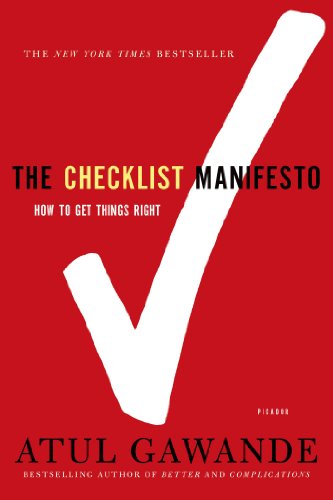
⚡️ What is The Checklist Manifesto About?
Ever feel like the smarter we get, the more we mess up? It’s a weird paradox of the modern world. We have more knowledge than any generation in history, yet we still see planes crash, patients get the wrong medicine, and massive software projects collapse under their own weight. In More summaries by Atul Gawande, the author argues that the problem isn’t a lack of skill or “game-changing” technology. It’s that the sheer volume of knowledge has exceeded our ability to deliver it consistently. This is a core theme in management book summaries: the gap between what we know and what we actually do.
Gawande is a surgeon, and he writes with the clarity of someone who has held a human heart in his hands. He doesn’t offer a magic pill. Instead, he points to the humble checklist—the kind of thing your grandma uses for groceries—as the most sophisticated tool we have for managing extreme complexity. Why? Because our brains are spectacular at solving creative problems but notoriously flaky at remembering the boring, repetitive steps that actually keep people alive. He builds a case that professionalism in the 21st century requires a shift from the “Lone Hero” model to a culture of disciplined, humble routine.
🚀 The Book in 3 Sentences
- Expertise is no longer enough to prevent failure because the modern world is too complex for any single brain to track every variable.
- Checklists aren’t just memory aids; they are social tools that empower teams to communicate and catch errors before they become catastrophes.
- By automating the routine, we free up our mental bandwidth to handle the truly unpredictable challenges that require human intuition.
🎨 Impressions
I’ll be honest: I didn’t expect a book about lists to be a page-turner. But Gawande is a master storyteller. He weaves together stories of crashing Boeing 299s, emergency C-sections, and the construction of massive skyscrapers in a way that makes the “boring” checklist feel like a life-and-death drama. I found myself dog-earing pages about the “Master Builder” and how we’ve transitioned into an era where nobody can know everything. It’s a humbling read for anyone who prides themselves on being an expert.
What really hit me was the section on the “Save.” There’s a moment where a surgeon forgets a simple step, and a junior nurse—empowered by a checklist—calls him out. It’s awkward. It’s tense. But it saves the patient. It made me realize that my own resistance to checklists was just my ego talking. I thought I was too smart for a list; Gawande proved I’m exactly the person who needs one most. It’s not a manual on how to write a to-do list; it’s a philosophy of how to live and work with humility.
📖 Who Should Read The Checklist Manifesto?
This is essential for anyone in a high-stakes environment where a small mistake can lead to a big disaster—surgeons, pilots, engineers, and project managers. If you’re a solo creative who works on intuition alone, you might find the first half fascinating but the second half a bit too “corporate.” However, if you’ve ever looked at a finished project and thought, “I can’t believe I forgot that simple detail,” you need to read this book immediately.
☘️ How This Book Changed My Thinking
Before reading this, I viewed checklists as something for interns or the “lesser-skilled.” I thought “real” pros just knew what to do. Now, I see checklists as a mark of a true professional.
- I stopped trying to memorize my weekly workflows and built a “Launch Checklist” for my client projects to ensure I never miss the small stuff.
- I realized that the best checklists aren’t exhaustive manuals—they’re just 5 to 9 items that handle the most critical, easily-missed steps.
- I started valuing “teamwork over hierarchy,” encouraging colleagues to call out errors regardless of their rank.
✍️ 3 Quotes That Stuck With Me
- “The volume and complexity of what we know has exceeded our individual ability to deliver its benefits correctly, safely, or reliably.” — This is the central thesis that makes you realize your brain needs an external assist.
- “Checklists seem lowly and simplistic, but they help us overcome the fallibility of human memory and attention.” — I love the juxtaposition of “lowly” and the power it provides.
- “We are all susceptible to the ‘Master Builder’ myth—the idea that one person can lead and coordinate everything alone.” — This hit me hard as a reminder to delegate and build systems.
📒 Summary + Notes
The core argument of the book is that we are living in an era of “Extreme Complexity.” Gawande divides failures into two types: errors of ignorance (where we don’t know how to solve a problem) and errors of ineptitude (where we have the knowledge but fail to apply it correctly). Most modern failures, he argues, are the latter. We have the cure; we just forgot to administer the right dose at the right time. The Checklist Manifesto isn’t just about surgery; it’s about the universal struggle to execute on what we already know.
Gawande takes us on a journey from the aviation industry’s early days to the intense environments of modern ICUs. He shows that when systems become too complex for one person to handle, we have two choices: give more power to a central authority (which usually fails) or distribute the power to the front lines through communication and checklists. He wants us to believe that the future of safety and efficiency doesn’t lie in more training, but in better systems that account for human flaws. By the end of the book, the checklist isn’t a piece of paper—it’s a cultural artifact that represents discipline and mutual respect.
🧠 Core Ideas Explained Simply
These concepts are the scaffolding that holds Gawande’s entire argument together.
Ignorance vs. Ineptitude
Failure comes in two flavors. Ignorance means the world hasn’t figured out the solution yet (like a cure for a new virus). Ineptitude means the solution exists, but we failed to use it. Think of a chef who knows the recipe but forgets the salt because the kitchen was too loud. The checklist is the primary weapon against ineptitude, ensuring that what we *know* actually happens.
READ-DO vs. DO-CONFIRM
Did you know there are two ways to use a checklist? In a READ-DO list, you read each step and then perform it (like a Lego manual). In a DO-CONFIRM list, you perform the tasks from memory but then stop at a “pause point” to verify everything was done correctly. Most professionals prefer DO-CONFIRM because it doesn’t slow down their flow, but still provides a safety net.
The PAUSE Point
What is a “pause point” exactly? It’s a pre-determined moment in a workflow where everyone must stop and talk. In surgery, it’s right before the first incision. In your work, it might be right before you hit “send” on a major proposal. Without these designated stops, momentum carries you right over the cliff before you realize you forgot your parachute.
Introduction: The Problem of Extreme Complexity
Why does a child surviving 30 minutes underwater change everything we know about medicine? Gawande opens with a story of a miracle save that only happened because dozens of experts coordinated perfectly. He notes that in the 1950s, a doctor could do almost everything with a black bag. Today, a single hospital stay can involve 178 individual tasks per patient per day. When the complexity of the task outpaces the capacity of the human mind, we need something more than just “trying harder.”
1: The Problem of Extreme Complexity
Is the human brain actually built for the 21st century? This chapter explores the idea that we have entered an era where “super-specialization” is the norm. We have specialized doctors for every organ, yet people still die from simple infections. Gawande highlights that the more specialized we become, the more we lose sight of the big picture. We focus on the high-level problems and forget to wash our hands. It’s a sobering look at how elite education can actually make us more prone to basic errors.
2: The Checklist
Picture a 1935 airfield where the “Model 299″—the most advanced plane of its time—crashes during a demonstration. Why? Because the pilot, an elite expert, forgot to release a new locking mechanism on the controls. The plane was deemed “too much airplane for one man to fly.” Instead of longer training, the pilots created a simple list on an index card for takeoff, flight, and landing. That plane became the B-17 Flying Fortress, and it flew 1.8 million miles without a single accident. The lesson? Even the best can’t fly without a list.
3: The End of the Master Builder
How does a skyscraper stay standing when thousands of different people are working on it at once? Gawande visits a construction site to see how they handle complexity. He discovers that they don’t have a single “Master Builder” who knows everything. Instead, they have “submittal schedules” and “communication checklists.” If a plumber finds a problem that affects the electrician, there’s a system to force them to talk. This shift from “Command and Control” to “Coordinate and Communicate” is the secret to building the impossible.
4: The Idea
Is it possible that the biggest problem isn’t technical, but social? Gawande realizes that in the operating room, the hierarchy often prevents people from speaking up. He looks at how checklists can break this. If everyone in the room has to introduce themselves by name and role at the start of a surgery, they are much more likely to speak up when they see a mistake later. The checklist becomes a tool for “social leveling,” ensuring that the best idea wins, not the highest salary.
5: The First Try
Gawande gets a call from the World Health Organization (WHO) to help reduce surgical deaths globally. He and his team try to create a universal checklist. This chapter is a raw look at the messy process of design. Their first version was too long, too clunky, and surgeons hated it. They realized that a checklist isn’t a list of everything you *could* do; it’s a list of the things you *must* do that you are most likely to forget. It was a failure that led to their biggest breakthrough.
6: The Checklist Factory
You’d think making a list is easy, right? Wrong. Gawande goes to Boeing to meet Dan Boorman, the man who designs flight checklists. He learns the strict rules of the “Checklist Factory”:
- Keep it between 5 and 9 items.
- Use simple, large-font text.
- Fits on one page.
- No unnecessary jargon.
7: The Test
What happens when you actually run the numbers across eight diverse hospitals? The results were staggering. In every single hospital—from high-tech facilities in Seattle to resource-strapped clinics in Tanzania—the surgical safety checklist worked. Major complications dropped by 36% and deaths fell by 47%. These weren’t incremental gains; these were massive shifts. Yet, surprisingly, some doctors still resisted using it. Why? Because it felt “beneath them.” This chapter explores the battle between data and ego.
8: The Hero in the Age of Checklists
What does it mean to be a “hero” today? Gawande points to “Sully” Sullenberger and the Miracle on the Hudson. Sullenberger didn’t just “vibe” his way into the river. He and his co-pilot worked through an emergency checklist in seconds, divided tasks, and maintained a disciplined routine. We often think of heroes as people who improvise wildly. Gawande argues that the modern hero is the person who has the discipline to follow the system when everyone else is panicking.
9: The Save
The book ends with a scene that almost didn’t make it into my notes: Gawande’s own patient starts bleeding out on the table. In the heat of the moment, the adrenaline is pumping, and things start to go sideways. He realizes that even he, the guy who wrote the book on checklists, almost missed a critical step. The checklist saved his patient’s life. It’s a powerful, personal admission that none of us are above the need for a safety net. It brings the whole book home with a reminder that we are all fallible.
⚖️ A Critical Perspective
While the book is incredibly persuasive, I found Gawande’s focus a bit narrow at times. He relies heavily on aviation and medicine, which are linear and highly regulated. If you’re in a creative field like painting or philosophy, a checklist might actually stifle the “happy accidents” that lead to breakthroughs. Furthermore, in 2025, we face a new problem: checklist fatigue. With every app and project management tool bombarding us with tasks, the risk is that we stop thinking and just start clicking boxes to make them go away. Gawande doesn’t quite address how to keep a checklist from becoming a mindless bureaucratic burden.
🔄 How It Compares
Compare this to “The 7 Habits of Highly Effective People.” While Covey focuses on your character and internal values, Gawande focuses entirely on the external systems of execution. Covey wants you to be a better person; Gawande just wants you to make fewer mistakes. If Covey is the “why,” Gawande is the “how” at its most granular, practical level.
🔑 Key Takeaways
These are the lessons you can start using before you even finish your next cup of coffee.
- Complexity requires communication, not just expertise. Force your team to talk at pre-defined “pause points.”
- The best checklists are short. If it’s more than 10 items, you won’t use it when things get stressful.
- Empower the “lowest” person in the room. If the intern sees a mistake, the system must allow them to stop the process.
- Distinguish between routine tasks (checklist-able) and complex problems (judgment-required). Use the list for the former to save brainpower for the latter.
💬 Frequently Asked Questions
What is the main argument of The Checklist Manifesto?
The book argues that human knowledge has become too complex for any one individual to manage alone. To prevent avoidable failures (ineptitude), we must use simple, disciplined checklists to ensure that critical steps are never missed, especially in high-pressure environments like medicine, aviation, and construction.
How do you create an effective checklist?
An effective checklist should be short (5-9 items), focused on “killer” steps that are easily missed, and used at specific pause points. It should use simple language, fit on one page, and be either a READ-DO or DO-CONFIRM format to match the user’s natural workflow.
Is a checklist better than a standard operating procedure (SOP)?
Yes, because an SOP is often too long to be used in the heat of the moment. A checklist is a condensed, actionable version of an SOP designed for real-time execution. It doesn’t replace training; it supplements it by acting as a cognitive net for memory lapses.
Can checklists work for creative or non-technical jobs?
Absolutely. While they shouldn’t dictate the creative process itself, checklists are perfect for the “administrative” parts of creative work—like checking audio levels before recording a podcast or ensuring all assets are exported in the right format for a design project, freeing the mind for creativity.
Does using a checklist make you less of an expert?
Gawande argues the opposite: using a checklist is the mark of a true professional. Experts in high-stakes fields like aviation and skyscraper construction rely on them precisely because they understand how fallible the human mind is, making them more reliable and skilled than those who don’t.
Conclusion
At the end of the day, The Checklist Manifesto isn’t really about pieces of paper. It’s about a fundamental shift in how we view ourselves as workers and as people. We want to believe we are invincible, that our years of training and our high IQs will protect us from making stupid mistakes. But they won’t. The world is just too big and too fast now. Accepting our fallibility isn’t a sign of weakness; it’s the ultimate form of competence.
I walked away from this book feeling a weird sense of relief. It’s okay that I can’t remember everything. It’s okay that I need a list. By embracing these simple tools, we actually become more capable of doing the complex, beautiful work we were meant to do. Whether you’re a CEO or a stay-at-home parent, there is a profound power in the pause. If you want to get things right in an increasingly chaotic world, start by making a list.
More From Atul Gawande →
Discover more from AI Book Summary
Subscribe to get the latest posts sent to your email.