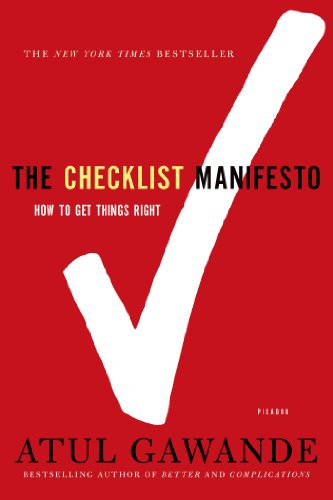
⚡️ What is The Checklist Manifesto about?
The Checklist Manifesto by Atul Gawande is a compelling exploration of how a surprisingly simple tool—the checklist—can help us manage the overwhelming complexity of modern professional life. Gawande, a surgeon, chronicles his journey of discovering how checklists have reduced errors in high-stakes fields like aviation and construction, and his own mission to implement them in the medical world. The book argues that the volume of knowledge has surpassed our individual ability to manage it consistently, leading to failures not from ignorance, but from ineptitude. We know what to do, but we fail to apply that knowledge correctly under pressure. Through vivid stories and rigorous analysis, Gawande demonstrates that a well-designed checklist is not a sign of incompetence but a tool for cultivating discipline, fostering teamwork, and ultimately, achieving mastery in an increasingly complex world. It’s a call for humility and a system to ensure we get the dumb stuff right so we can focus on the hard stuff.
🚀 The Book in 3 Sentences
- In an age of immense complexity, our failures are often due to ineptitude (not applying knowledge correctly) rather than ignorance (not having the knowledge).
- The solution proposed in The Checklist Manifesto is the deceptively simple yet powerful checklist, which acts as a cognitive net to catch mental flaws and ensure critical steps are not missed.
- Effective checklists are not about dumbing down work but about empowering professionals, enhancing communication, and instilling the discipline needed to consistently achieve excellence.
🎨 Impressions
I was initially skeptical; a whole book about checklists sounded tedious. However, Gawande’s storytelling is masterful, transforming a mundane topic into a riveting narrative about human fallibility and the pursuit of perfection. The most profound impression was realizing that checklists are not about rote memorization but about creating a culture of discipline and teamwork. The examples from diverse fields like aviation, skyscraper construction, and investment banking brilliantly illustrate the universal applicability of this tool. What struck me most was the psychological barrier to adoption—our ego’s resistance to being “told what to do” by a simple list. This book fundamentally shifted my perspective from seeing checklists as a crutch for the weak to a tool for the wise, a way to free up mental bandwidth for the truly novel and challenging problems we face.
📖 Who Should Read The Checklist Manifesto?
\p>The Checklist Manifesto is essential reading for any professional in a high-stakes, high-complexity field. Surgeons, pilots, engineers, and project managers will find its lessons immediately applicable. However, its wisdom extends far beyond these domains. Entrepreneurs juggling multiple responsibilities, software developers managing complex code deployments, and even students organizing their research can benefit immensely. If you are responsible for tasks where skipping a step can lead to significant consequences, this book is for you. It’s also a must-read for leaders and managers looking to build more resilient, communicative, and effective teams by implementing simple yet powerful systems to manage complexity and reduce preventable errors.☘️ How the Book Changed Me
\p>Reading The Checklist Manifesto fundamentally altered my approach to work and personal projects. I moved from a reliance on memory and intuition to a system-based approach. I no longer see creating a checklist as a burdensome task but as an investment in quality and peace of mind. It has made me more humble, acknowledging that I can’t remember everything, and more collaborative, as I now build checklists that require team input and communication.- I now create a pre-project checklist for every major initiative, ensuring I’ve considered risks, resources, and key stakeholders before starting.
- I’ve implemented a “pause point” checklist at the end of each workday to review tasks and prepare for the next, which has dramatically reduced my feeling of being overwhelmed.
- I’ve introduced communication checklists in team meetings to ensure everyone has a chance to speak and key decisions are explicitly confirmed.
- I’ve stopped viewing checklists as a sign of weakness and now see them as a mark of a true professional committed to excellence.
- I’m more forgiving of others’ mistakes when I see they stem from complexity, not carelessness, and I’m quicker to suggest a systemic fix (a checklist!) rather than placing blame.
✍️ My Top 3 Quotes
- “The checklist gets the dumb stuff out of the way, the routines your brain shouldn’t have to occupy itself with (Did the patient get her antibiotics on time?), and lets it rise above to focus on the hard stuff (Where should we land?).”
- “We are by nature flawed and inconstant creatures. We can’t even keep from snacking between meals. We are not built for discipline. We are built for novelty and excitement, not for careful attention to detail. Discipline is something we have to work at.”
- “In a complex environment, experts are up against two main difficulties: the fallibility of human memory and attention, especially when it comes to mundane, routine matters that are easily overlooked under the strain of more pressing events; and the failure to properly apply our knowledge correctly, consistently, and on a reliable basis.”
📒 Summary + Notes
The Checklist Manifesto begins by establishing the central problem: the immense and growing complexity of modern knowledge and work. Atul Gawande, a surgeon, uses his own field as a primary example, showing how despite knowing more than ever about medicine, the sheer volume of information and steps in a procedure leads to avoidable, sometimes tragic, errors. He introduces the philosophical distinction between failures of ignorance (we don’t know) and failures of ineptitude (we don’t apply what we know correctly), arguing that the latter has become far more common. The book then embarks on a journey to find a solution, exploring how other high-stakes professions have tackled this very problem, leading to the discovery of the humble checklist as a surprisingly effective and transformative tool.
Introduction: The Problem of Extreme Complexity
Gawande opens with a personal anecdote about a patient who nearly died on his operating table from a routine but massive bleed. Despite his team’s expertise, they missed a critical step in preparation. This story frames the book’s central thesis: the volume and complexity of knowledge today has exceeded our individual capacity to manage it perfectly. He argues that for most of history, we struggled with ignorance, but now we primarily struggle with ineptitude—the failure to apply knowledge correctly. He poses the question: what do you do when expertise is not enough? The answer, he suggests, lies not in acquiring more knowledge but in finding a better way to apply what we already have, setting the stage for the exploration of checklists as a solution to this modern dilemma.
- The core problem is not a lack of knowledge, but the failure to consistently apply it under pressure.
- Gawande uses his own surgical errors to illustrate that even experts are vulnerable to the pitfalls of complexity.
- The book’s premise is that we need a new strategy to manage complexity, and that strategy is surprisingly simple.
Chapter 1: The Lesson of the Checklist
This chapter delves into the philosophical underpinnings of human error, citing the work of philosophers Gorovitz and MacIntyre. They explain that we fail for two reasons: necessary fallibility (our inherent limitations) and insufficient fallibility. The latter is split into ignorance (lack of knowledge) and ineptitude (failure to use knowledge correctly). Gawande argues that in medicine and many other fields, we have largely overcome ignorance but are now drowning in ineptitude. He provides the example of heart attack treatment, which has gone from a simple prayer-and-morphine approach to a bewildering array of choices, each with its own complex steps. The key takeaway is that many of these failures are avoidable. We need a strategy that leverages our existing knowledge while compensating for our human inadequacies, and that strategy is the checklist.
- Failures of ineptitude are more frustrating and less forgivable than failures of ignorance.
- The volume of knowledge in modern professions makes it impossible for any single person to master everything.
- Checklists are presented as a tool to protect against the inevitable flaws in human memory and attention.
Chapter 2: The End of the Master Builder
Gawande tells the fascinating origin story of the checklists in aviation. In 1935, the U.S. Army Air Corps’ new long-range bomber, the Model 299, crashed during a test flight due to pilot error. The plane was too complex for one person to fly from memory. Instead of scrapping the project or demanding more training, a group of pilots created a simple pilot’s checklist. It covered the most basic, yet easily forgotten, steps. The results were astounding; the checklist enabled pilots to fly the complex aircraft millions of miles without accidents. This story illustrates a crucial point: when a task becomes too complex for one person’s memory and attention, you don’t need a better person, you need a better system. The checklist became that system, ensuring consistency and safety in one of the most complex endeavors of its time.
- The B-17 bomber story is the archetype for how checklists solve problems of complexity.
- Checklists are not a sign of stupidity; they are a tool for managing complexity beyond human memory.
- This chapter establishes that the problem is not the individual, but the system, or lack thereof.
Chapter 3: The End of the Master Builder
The focus shifts from aviation to the construction industry, another field that deals with immense complexity. Gawande explains that the era of the “Master Builder”—a single individual who possessed all the knowledge to design and construct a building—is long gone. Modern construction involves dozens of specialists (architects, engineers, electricians, etc.). The key to success in this environment is not individual autonomy but structured communication. Gawande discovers that construction firms use two types of checklists. One is a task checklist, detailing what needs to be done and by when. The more important one, however, is a communication checklist. It specifies who must talk to whom, by when, and about what. This ensures that when unexpected problems arise, the team can coordinate effectively. This reveals a critical evolution of the checklist: it’s not just for tasks, but for fostering teamwork and communication.
- In complex systems, autonomy without communication leads to disaster.
- Construction industry uses checklists to mandate communication among diverse specialists.
- A communication checklist is as important as a task checklist for managing complex projects.
Chapter 4: The Idea
Inspired by these examples, Gawande decides to try implementing a surgical checklist in his own hospital. He assembles a team to create one, focusing on the most common surgical errors: infections, anesthesia problems, and unforeseen bleeding. They design a checklist to be used at three “pause points”: before anesthesia, before the incision, and before the patient leaves the operating room. The initial version is a disaster. The nurses find it confusing, the surgeons see it as a waste of time, and the verbal confirmation process is clunky. This chapter is a humbling account of the difficulty of implementation. It highlights that a good idea on paper is worthless if it’s not designed with the end-user in mind and if the culture resists it. The failure forces Gawande and his team to go back to the drawing board and seek expert advice on how to make a checklist that actually works in the chaotic environment of an operating room.
- Implementation is as hard as creation; a good checklist must be tested and refined in the real world.
- Cultural resistance from experts is a major barrier to adopting checklists.
- The first attempt at a surgical checklist failed because it was poorly designed and didn’t fit the workflow.
Chapter 5: The First Try
Gawande describes the World Health Organization’s (WHO) initiative to create a standardized surgical safety checklist that could be used globally. He joins the effort, bringing his team’s failed first attempt as a lesson. The WHO team gathers experts from around the world to build a better checklist. They decide to focus on “killer items”—the few steps that are most dangerous to skip but most often overlooked. They also grapple with the wording, keeping it simple and universal. A key breakthrough is the decision to have the surgical team verbally introduce themselves and state their roles and the patient’s name at the “time out” pause point. This isn’t just a check; it’s a catalyst for team-building and communication. The chapter details the rigorous, collaborative process of drafting, debating, and testing the checklist, emphasizing that a great checklist is not written in isolation but forged through collective experience and iteration.
- The WHO initiative brought global expertise to bear on creating a universal surgical checklist.
- Focusing on “killer items” is key to keeping a checklist short and effective.
- The “team introduction” step was a brilliant addition that fostered communication and teamwork.
Chapter 6: The Checklist Factory
To learn how to build a truly effective checklist, Gawande visits Boeing and speaks with Daniel Boorman, a veteran pilot who has spent decades developing and refining checklists for the aviation industry. Boorman provides a masterclass in checklist design. He explains the difference between “DO-CONFIRM” checklists (where team members do their jobs from memory and experience, then pause to confirm the steps were completed) and “READ-DO” checklists (where people read the step and then do it). He shares the rules for good checklists: they should be precise, easy to use, and, most importantly, short—ideally between five and nine items. He warns against bad checklists that are too long, vague, or condescending. The key insight is that a checklist is not a how-to guide; it’s a reminder for the experts. It’s a tool to support, not supplant, human judgment and skill.
- Good checklists are precise, simple, and short; bad checklists are vague, long, and insulting.
- The choice between a DO-CONFIRM and READ-DO checklist depends on the nature of the task.
- Checklists should support experts, not treat them like novices who need every step spelled out.
Chapter 7: The Test
The WHO Surgical Safety Checklist is put to the test in eight hospitals around the world, from rich to poor, in cities like Seattle, Toronto, London, and New Delhi. The results are stunning. The rate of major complications for surgical patients fell by 36 percent, and deaths fell by 47 percent. In some hospitals, the infection rate dropped to zero. The data was clear and overwhelming. But beyond the numbers, Gawande shares qualitative feedback. Anonymously, 80 percent of staff found the checklist easy to use, and 78 percent said it had prevented at least one error. The chapter is a powerful validation of the checklist’s effectiveness. It proves that a simple, well-designed tool can have a dramatic impact on outcomes, regardless of the setting or resources available. It’s a triumph of discipline over chaos.
- The global study proved the checklist’s effectiveness across diverse cultures and resource levels.
- Major complications dropped by 36% and deaths by 47%, a staggering improvement.
- The success was not just in the numbers but also in the widespread acceptance and positive feedback from staff.
Chapter 8: The Hero in the Age of Checklists
This chapter tackles the deep-seated psychological resistance to checklists. Gawande argues that our culture idolizes the “hero”—the lone genius who improvises and saves the day through sheer brilliance. We feel that using a checklist makes us seem like a cog in a machine, not a master craftsman. This is a fallacy. Gawande uses examples from investing, where brilliant investors like Mohnish Pabrai use checklists to avoid emotional, biased decisions. He argues that checklists don’t make us less heroic; they make us better professionals. They get the mundane tasks out of the way, freeing our minds to focus on the unexpected, the difficult, the truly heroic parts of the job. The Checklist Manifesto redefines heroism not as flawless individual performance, but as the disciplined, consistent application of collective knowledge to achieve the best possible outcome.
- We resist checklists because of our ego and cultural idealization of the lone, improvising hero.
- Successful investors use checklists to counteract cognitive biases and emotional decisions.
- Checklists actually enable heroism by handling the routine so we can focus on the critical and unexpected.
Chapter 9: The Save
In the final chapter, Gawande brings the book’s themes together with a powerful, personal story. He describes a surgery he performed on a man with a near-fatal stab wound to the heart. The situation was dire and chaotic. In the middle of the emergency, his team called a “time out” to run through the checklist. Gawande initially resisted, feeling it was a waste of precious seconds. But as they went through the steps, the checklist forced a moment of calm and coordination. It was during this pause that a critical, previously unconsidered piece of information was shared, which changed the entire surgical plan and ultimately saved the patient’s life. This story is the ultimate proof of concept. The checklist wasn’t a crutch; it was a lifesaver. It provided the structure and discipline needed to turn chaos into control, allowing the team’s expertise to truly shine when it mattered most.
- Gawande’s personal story of saving a patient with the checklist is the book’s emotional climax.
- The checklist provided a crucial moment of calm and communication in a chaotic emergency.
- The final story proves that checklists are not just for routine tasks but are invaluable in crises.
Key Takeaways
The core message of The Checklist Manifesto is that we can no longer rely on individual brilliance to navigate the complexities of the modern world. We need systems. The key takeaways are not just about creating lists, but about embracing a culture of discipline, humility, and teamwork. A checklist is a physical manifestation of this culture. It ensures the basics are handled, frees up cognitive resources for the hard problems, and, most importantly, forces the communication and coordination that are essential for success in any complex endeavor. The book teaches that success is not about being perfect; it’s about being prepared, consistent, and working together.
- Checklists are a simple but powerful tool to combat failures of ineptitude in complex fields.
- Effective checklists are short, precise, and focus on “killer items” and critical communication points.
- The biggest barrier to adoption is often our own ego and the mistaken belief that checklists are for the less competent.
- Checklists empower all team members, not just leaders, by giving them a voice and a structured way to raise concerns.
- The ultimate goal of a checklist is to instill the discipline that allows experts to consistently apply their knowledge and achieve better outcomes.
Conclusion
The Checklist Manifesto is more than a book about lists; it’s a profound meditation on human fallibility and the systems we can build to overcome it. Atul Gawande makes a compelling case that in an age of runaway complexity, the humble checklist is our best tool for ensuring we consistently get things right. It’s a call to action for professionals in every field to embrace discipline, foster teamwork, and accept that we can’t do it all on our own. By implementing the simple strategies and techniques outlined in this book, we can reduce errors, improve outcomes, and free ourselves to focus on the work that truly matters. If you’re looking for a practical, powerful way to enhance your performance and that of your team, this book is an absolute must-read.
More From Atul Gawande →
Discover more from AI Book Summary
Subscribe to get the latest posts sent to your email.