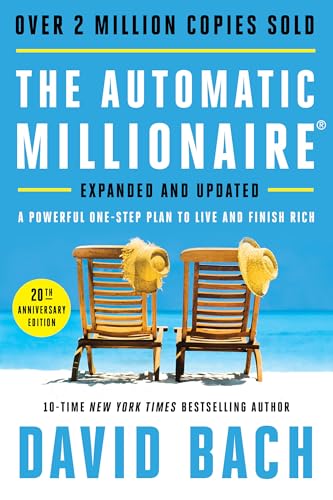
⚡️ What is The Automatic Millionaire About?
Have you ever met someone who makes a totally average salary but somehow owns two homes and has a million dollars in the bank? That’s exactly how David Bach opens this book, and I’ll be honest, it hooked me immediately. He introduces us to the McIntyres, a couple whose joint income never topped $55,000, yet they retired early with zero debt and a massive nest egg. Their secret wasn’t a lucky stock pick or a rich uncle; it was the fact that they never had to remember to save. They just made it impossible not to. You can check out more summaries by David Bach to see how he builds on these themes across his other work.
The central thesis here is that willpower is a finite resource that most of us waste. If you have to decide to save money every month, you’re eventually going to fail because life gets in the way. Bach argues that the only way to win the money game is to take the ‘you’ out of the equation entirely. It’s one of those investing book summaries that reminds us that being smart is less important than being consistent. Do you really want to spend your life worrying about a budget, or would you rather have a system that handles the heavy lifting while you sleep?
🚀 The Book in 3 Sentences
- Wealth is built by automating your savings so that ‘paying yourself first’ happens before you even see your paycheck.
- The ‘Latte Factor’ proves that small, daily expenses are the silent killers of wealth, and redirecting that cash into compound interest accounts changes everything.
- You don’t need a budget, a lot of money, or even a ton of discipline—you just need a one-time setup of an automatic financial system.
🎨 Impressions
I finished the book last week and I’ve been thinking about the ‘automation over discipline’ angle ever since. Most finance gurus try to turn you into a spreadsheet ninja, but Bach basically says, ‘Look, you’re human and you’re going to spend money if it’s in your pocket.’ I found that refreshing. It’s not about being a miser; it’s about being realistic about our own laziness. Why fight your nature when you can just outsmart it with a few clicks on a banking app?
There’s a moment early on where he breaks down the math of a daily coffee, and while ‘The Latte Factor’ has become a bit of a meme in finance circles, seeing the actual numbers still stings. It’s not just about the $5 coffee; it’s about the $2 million that $5 could have become over forty years. Honestly, I found the section on bi-weekly mortgage payments a bit repetitive, but the core message is rock solid. It’s a book for people who hate math but love the idea of being rich. Isn’t that most of us?
📖 Who Should Read The Automatic Millionaire?
If you’re in your 20s or 30s and feel like your money just disappears every month, this is your manual. It’s also perfect for people who find traditional budgeting exhausting—Bach gives you permission to stop tracking every penny as long as you automate the big stuff. However, if you’re already an advanced investor who understands tax-loss harvesting and complex derivatives, you’ll probably find this way too basic. Skip it if you’re already maxing out every possible retirement account and paying your mortgage early.
☘️ How This Book Changed My Thinking
I used to think that saving money was a test of character—if I didn’t have enough at the end of the month, I just wasn’t ‘tough’ enough. Now I realize it’s just a bad system design.
- I stopped trying to ‘budget’ my way to wealth and instead set up a 15% auto-transfer to my brokerage the day my salary hits.
- I looked at my ‘Latte Factor’ (which for me was actually unnecessary app subscriptions) and cleared out $80 a month in waste.
- I stopped viewing my home as just a place to live and started seeing the mortgage as a forced savings account that I should accelerate.
✍️ 3 Quotes That Stuck With Me
- “The fact is, you can’t trust yourself to save.” — This hits hard because it admits that our intentions are usually better than our actions.
- “You don’t need a budget, you need a system.” — This was the line I dog-eared because it removes the guilt from spending.
- “Small amounts of money can add up to huge amounts over time if you just give them a chance to grow.” — A classic reminder of the power of compound interest that we all tend to ignore.
📒 Summary + Notes
The book follows a very logical path: it starts with the realization that you’re probably richer than you think, moves into the ‘how-to’ of automation, and ends with how to protect that wealth. Bach wants you to believe that the ‘standard’ advice—work hard, save what’s left, and keep a strict budget—is actually a recipe for mediocrity. Instead, he builds a case for a hands-off lifestyle where your money works harder than you do.
By the end of the book, the author’s case is clear: the road to a million dollars is paved with small, automatic decisions, not giant leaps of faith or high-risk gambles. He walks you through everything from retirement accounts (401ks and IRAs) to emergency funds and tithing. The narrative arc is essentially moving the reader from a state of ‘financial anxiety’ to ‘financial autopilot.’ He effectively argues that by the time you finish the last page, you should have already logged into your bank account to change your settings.
1: Meeting the Automatic Millionaire
What if the secret to wealth had nothing to do with your income level? Bach introduces us to Jim and Sue McIntyre, an ordinary couple who prove that you don’t need to be a CEO to die rich. They didn’t inherit money, and they didn’t win the lottery. They simply decided to pay themselves first and let time do the heavy lifting. The most shocking part of their story isn’t their net worth, but how little they stressed about it. They owned their home outright by age 40 and retired in their early 50s.
The lesson here is that financial freedom is a choice made through systems, not a result of high earnings. Most people believe that ‘more money’ will solve their problems, but as Bach points out, usually more money just leads to more spending. Have you noticed how your expenses always seem to rise to match your raises? The McIntyres avoided this ‘lifestyle creep’ by making sure their savings were taken out before they ever had the chance to spend them.
2: The Latte Factor
Can a $5 coffee really keep you from becoming a millionaire? Bach’s most famous (and controversial) concept is the ‘Latte Factor.’ He argues that we all have small, daily expenditures that seem insignificant but actually represent massive lost opportunities for wealth. It’s not just coffee—it could be bottled water, cigarettes, magazines, or that extra streaming service you never watch. When you compound those small amounts at a 10% return over 30 or 40 years, the numbers become staggering.
- $5 a day is $150 a month.
- Over 40 years at 10%, that $150 a month turns into nearly $1 million.
- The goal isn’t to live a life of deprivation, but to be conscious of where your ‘leaks’ are.
Is your morning routine worth a million dollars? Bach isn’t saying you can’t ever have a latte; he’s saying you should decide if that latte is more important than your future freedom. He suggests tracking every cent for a week to find your own version of the Latte Factor. You’ll likely be shocked at how much you’re ‘bleeding’ without realizing it.
3: Learn to Pay Yourself First
Why do we pay the landlord, the phone company, and the grocery store before we pay ourselves? This chapter flips the traditional spending model on its head. Most people get their paycheck, pay their bills, spend some money, and then save ‘what’s left.’ The problem is, there’s never anything left. Bach insists that you must treat your future self as your most important creditor. You pay that bill first, and the rest of the world gets what remains.
He suggests starting with at least 10% of your gross income, though the truly ‘automatic’ millionaires aim for 15% or 20%. If that sounds impossible, he recommends starting with just 1% and increasing it by 1% every few months. You won’t feel the difference in your daily life, but your bank balance certainly will. How much are you currently paying everyone else while you stay broke?
4: Now Make It Automatic
This is where the ‘Automatic’ part of the title actually comes to life. Bach argues that if you have to remember to write a check or move money into a savings account, you’ve already lost. Human beings are inherently forgetful and easily tempted. The only solution is to set up a system that requires zero ongoing effort. This means setting up your 401k or IRA contributions to be deducted directly from your paycheck or bank account before you can touch it.
Bach walks through the specific accounts you should use, emphasizing tax-advantaged options. He wants you to spend one afternoon setting this up so you never have to think about it again for the next twenty years. It’s about creating a ‘virtuous cycle’ where wealth builds itself while you go about your life. If you aren’t automated, you aren’t doing it right.
5: Automate for a Rainy Day
A flat tire or a broken water heater shouldn’t derail your retirement plan. Most people live one paycheck away from disaster, which creates a constant state of low-level stress. Bach advises setting up an ‘Emergency Fund’ that is also—you guessed it—automatic. He suggests having three to six months of expenses in a high-yield savings account that is separate from your main checking account so you aren’t tempted to dip into it for ’emergencies’ like a new pair of shoes.
By automating a small transfer to this account every month, you build a ‘security blanket’ that buys you peace of mind. There is a specific psychological freedom that comes from knowing you have $10,000 in the bank for a rainy day. Have you ever felt the weight of an unexpected $500 bill? Automation eliminates that fear forever.
6: Automatic Debt-Free Homeownership
Renters stay poor, while homeowners build equity—at least according to David Bach. He is a massive proponent of owning your own home, calling it the ultimate ‘forced savings account.’ But he takes it a step further by showing you how to pay it off early without feeling the pinch. His ‘secret’ weapon is the bi-weekly payment plan. Instead of one monthly payment, you pay half every two weeks.
- Because there are 52 weeks in a year, you end up making 26 half-payments.
- This equals 13 full payments a year instead of 12.
- That one extra payment can shave 7 to 10 years off a 30-year mortgage and save you hundreds of thousands in interest.
The beauty of this plan is its simplicity. You don’t have to find thousands of extra dollars; you just have to change the frequency of your payments. Why give the bank thirty years of interest when you could be done in twenty?
7: The Automatic Debt-Free Lifestyle
Credit card debt is the ‘anti-Latte Factor’—it compounds against you instead of for you. Bach provides a clear, automatic strategy for nuking your debt. He suggests calling your credit card companies to lower your rates, then setting up automatic payments that are higher than the minimum. He also discusses the ‘Debt Sweat’—the stress that comes from carrying balances—and how it drains your energy for building wealth.
He advocates for a ‘no more credit’ policy until the balances are zero. If you can’t pay for it in cash, you can’t afford it. By automating your debt payments, you ensure that you are consistently digging yourself out of the hole rather than just treading water. Are you working for your money, or is your money working for the credit card companies?
8: The Automatic Tithe
Is it possible that giving money away actually makes you richer? Bach believes that wealth is meant to be shared and that tithing (giving 10% to charity or your church) creates a mindset of abundance rather than scarcity. He argues that you should automate your giving just like your savings. This ensures that you are contributing to the world regardless of how busy or ‘broke’ you feel in a given month.
Many of the wealthiest people in history have been massive philanthropists, and Bach suggests that there is a spiritual or psychological link between giving and receiving. Even if you don’t believe in ‘karma,’ the discipline of giving helps you realize that you have enough. If you can afford a latte, you can afford to help someone else. Who are you helping with your success?
9: The Five-Minute Automatic Millionaire Blueprint
Everything comes down to this one page. Bach provides a literal checklist of what to do right now to set your life on a new trajectory. He knows that most people read books and do nothing, so he simplifies the entire book into a five-minute action plan. It’s the ultimate ‘no-excuses’ chapter. If you can’t spend five minutes to secure your future, do you really want to be rich?
The blueprint covers signing up for the 401k, setting up the auto-transfer for the emergency fund, and arranging the bi-weekly mortgage. He ends the book with a call to action: don’t just be a reader, be an ‘Automatic Millionaire.’ The difference between where you are and where you want to be is just a few clicks away.
⚖️ A Critical Perspective
While the core advice is fantastic, Bach’s math can be a bit ‘optimistic.’ He frequently uses a 10% or even 12% annual return in his examples to show how small amounts grow into millions. In a modern 2025 economy, relying on a consistent 12% return is risky, and inflation will make ‘one million dollars’ feel a lot smaller by the time most readers retire. Additionally, his obsession with homeownership ignores the reality of many modern markets where renting and investing the difference can actually lead to higher net worth due to the high costs of property taxes, maintenance, and insurance. It’s a great ‘one-size-fits-all’ plan, but real life is often more nuanced than a coffee analogy.
🔄 How It Compares
If you compare this to Dave Ramsey’s The Total Money Makeover, the biggest difference is the tone and the role of discipline. Ramsey is like a drill sergeant who wants you to live on rice and beans and feel the ‘pain’ of your debt. Bach is more like the cool uncle who tells you to just set up an app and go back to your life. Ramsey is better for people in a total financial crisis, but Bach is much more practical for the average person who just wants a simple, hands-off wealth-building strategy.
🔑 Key Takeaways
These are the fundamental lessons that bridge the gap between being a spender and being an investor.
- Willpower is a Lie: Don’t try to be more disciplined; just make your financial decisions once and automate them forever.
- The Latte Factor is Real: It’s not about the coffee; it’s about the massive opportunity cost of mindless daily spending.
- Pay Yourself First: Move your savings to a brokerage or retirement account before you pay a single bill or buy a single grocery item.
- Own Your Dirt: Homeownership is a pillar of wealth because it acts as a forced savings plan and a hedge against inflation.
💬 Frequently Asked Questions
What is the main argument of The Automatic Millionaire?
The book argues that becoming wealthy does not require a high income, a budget, or even strong willpower. Instead, it requires a one-time setup of an automatic system that pay yourself first. By automating savings and debt payments, you remove human error and temptation from the wealth-building process.
What exactly is the ‘Latte Factor’?
The ‘Latte Factor’ is David Bach’s metaphor for the small, daily expenses we often ignore. He demonstrates that by redirecting the $5 to $10 spent daily on coffee, snacks, or subscriptions into a compound-interest-bearing account, an average earner can accumulate over a million dollars over their working career.
Is The Automatic Millionaire still relevant in 2025?
Yes, though some details have aged. While technology has made automation even easier than when Bach wrote the book, rising inflation means the ‘millionaire’ target is a lower bar than it used to be. The core principles of automation and avoiding lifestyle creep remain the most effective ways for average earners to build wealth.
Does David Bach recommend having a budget?
Bach actually discourages traditional budgeting, calling it a ‘diet’ that most people eventually fail. He believes budgets cause too much stress and friction. Instead, he advocates for automating your ‘pay yourself first’ contributions so that whatever is left in your checking account is yours to spend guilt-free.
Who should follow the advice in this book?
This book is ideal for young professionals, middle-class earners, or anyone who struggles with financial discipline. It is a ‘beginner to intermediate’ guide. If you already have a complex investment strategy or high net worth, the advice might feel too simplistic, as it focuses on foundational habits rather than advanced tactics.
Conclusion
At the end of the day, The Automatic Millionaire isn’t really a book about money; it’s a book about psychology. Bach understands that the biggest obstacle to our wealth isn’t the economy or the tax code—it’s us. We are impulsive, we are forgetful, and we are easily swayed by the latest shiny object. By building an ‘automatic’ fortress around your finances, you protect your future self from your current self’s bad decisions. It’s the ultimate ‘set it and forget it’ philosophy.
If you take away just one thing, let it be this: you don’t need to be a genius to finish rich. You just need to be someone who took twenty minutes once to set up an auto-transfer. Whether you’re a fan of the ‘Latte Factor’ or you think it’s overblown, the power of automation is undeniable. Stop trying to find the ‘perfect’ time to save and just let the machines do it for you. Your future self will thank you for being lazy enough to automate. Check out our other investing book summaries for more ways to grow your wealth.
More From David Bach →
Discover more from AI Book Summary
Subscribe to get the latest posts sent to your email.