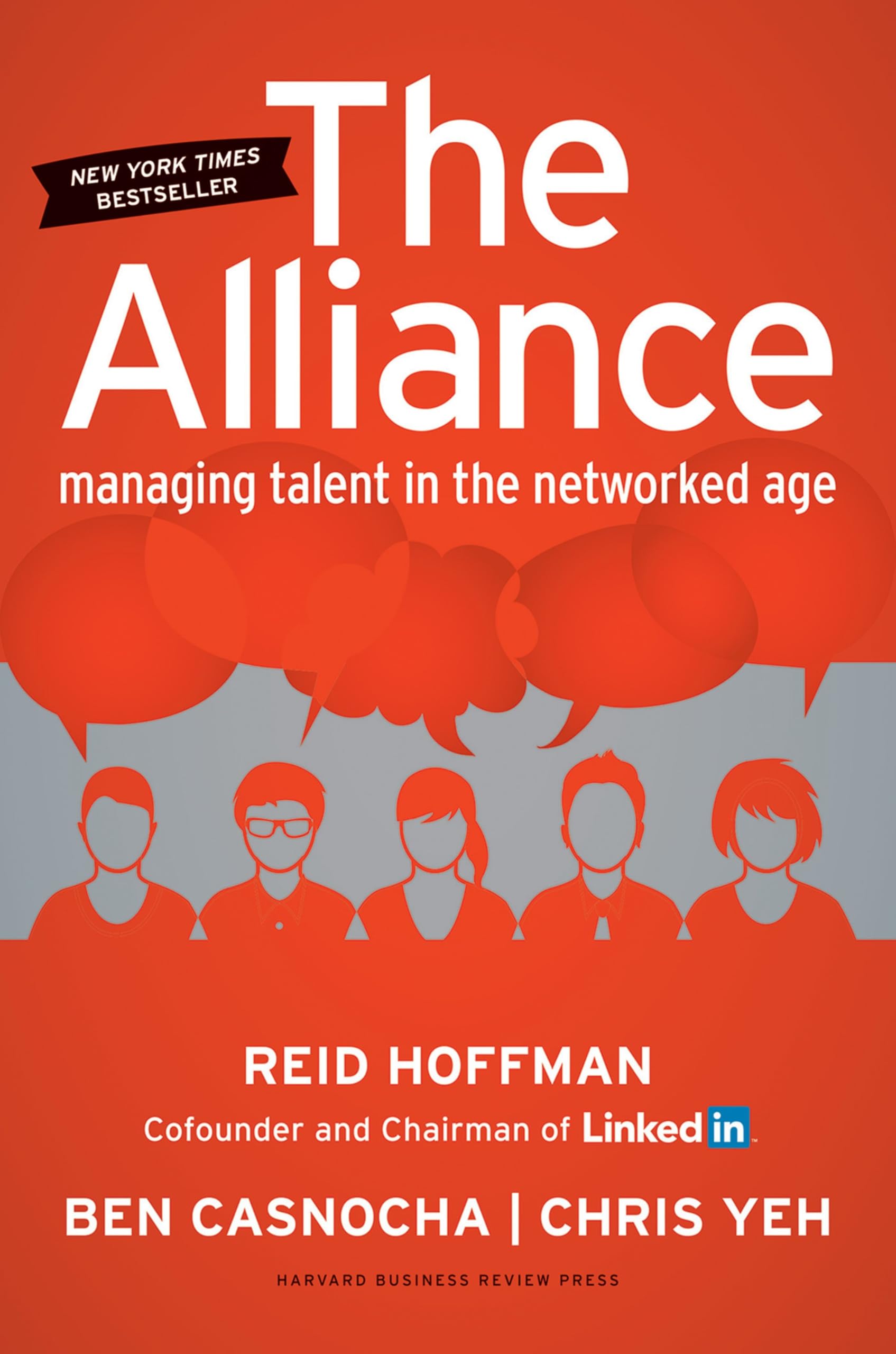
⚡️ What is The Alliance about?
The Alliance presents a revolutionary framework for managing talent in today’s networked economy. Written by LinkedIn co-founder Reid Hoffman, entrepreneur Ben Casnocha, and investor Chris Yeh, this book challenges traditional employer-employee relationships. Instead of the outdated model of lifetime employment, the authors propose a new alliance between companies and their most valuable talent – transformational employees. The book provides practical strategies for building genuine partnerships that benefit both organizations and individuals in our interconnected professional world.
🚀 The Book in 3 Sentences
- The Alliance advocates replacing the broken lifetime employment model with strategic, mutual relationships between companies and key employees.
- Companies should focus on building transformational employee partnerships that create value for both parties throughout the professional journey.
- Organizations must master The Alliance strategies to successfully navigate talent management in the modern networked economy.
🎨 Impressions
Reading The Alliance fundamentally shifted my perspective on professional relationships and talent management. The book’s core premise that traditional employment contracts are obsolete resonated deeply with my experience in today’s dynamic workforce. Hoffman, Casnocha, and Yeh present a compelling case for strategic partnerships between employers and employees, making The Alliance essential reading for anyone navigating modern career development or organizational leadership.
📖 Who Should Read The Alliance?
This book is ideal for business leaders, HR professionals, entrepreneurs, and ambitious professionals seeking to master The Alliance approach to talent management. Anyone responsible for building high-performing teams or navigating career transitions will benefit from the strategic frameworks presented. Whether you’re a startup founder scaling your team or an established executive modernizing your organization’s approach to talent, The Alliance provides actionable insights for creating mutually beneficial professional relationships.
☘️ How the Book Changed Me
How my life / behaviour / thoughts / ideas have changed as a result of reading the book.
- I now view professional relationships through The Alliance lens, focusing on mutual value creation rather than transactional employment
- My approach to team building has evolved to emphasize transformational employee development and strategic talent partnerships
- I’ve adopted The Alliance techniques for creating meaningful professional networks that extend beyond traditional organizational boundaries
✍️ My Top 3 Quotes
- “The relationship between employer and employee has been broken for decades, and The Alliance presents a bold solution: strategic alliances that create value for both parties.”
- “In the networked age, your company’s success depends not just on what happens inside your walls, but on how you leverage the external networks of your employees.”
- “The Alliance transforms the employee-employer relationship from a static contract into a dynamic partnership focused on mutual growth and transformation.”
📒 Summary + Notes
The Alliance fundamentally challenges the traditional employer-employee relationship that dominated the twentieth century. As globalization and technological advancement reshape the business landscape, Hoffman, Casnocha, and Yeh argue that companies must abandon the outdated notion of lifetime employment. Instead, successful organizations need to develop strategic partnerships with their most valuable talent through deliberate relationship management and mutual investment in professional growth.
Chapter 1: The Broken Relationship
This opening chapter establishes why traditional employer-employee relationships have become obsolete. The authors trace how the industrial age created an implicit social contract: employees provided loyalty and dedication in exchange for job security and career advancement. However, economic disruptions, technological change, and global competition have rendered this arrangement unsustainable. Companies can no longer afford to employ workers for life, while employees increasingly recognize that lifetime employment offers neither security nor optimal career development.
- The implicit lifetime employment contract between companies and employees has been fundamentally broken by modern economic realities
- Historical examples show how major corporations like IBM, General Motors, and others abandoned the traditional employment model during economic crises
- Both employers and employees waste resources maintaining an illusion of lifetime commitment when reality demands flexibility and adaptability
Chapter 2: The Alliance
The authors introduce their core concept: the strategic alliance between companies and their transformational employees. Rather than attempting to maintain the false pretense of lifetime employment, both parties should acknowledge that their relationship is temporary but valuable. This alliance requires honest communication about mutual goals, investments in professional development, and clear expectations about the duration and scope of the partnership. The alliance model recognizes that modern careers span multiple organizations while creating opportunities for meaningful contribution within each role.
- A strategic alliance requires transparent dialogue about mutual expectations, goals, and investment in each other’s success
- Transformational employees receive significant company investment in their professional development and, in return, make substantial contributions to organizational goals
- The alliance framework acknowledges that modern careers involve multiple employers while maximizing value creation in each role
Chapter 3: Becoming a Transformational Employee
This chapter focuses on the employee’s role in creating successful alliances. Transformational employees distinguish themselves by making significant impacts on their organizations’ performance and culture. They proactively seek opportunities to contribute beyond their formal job descriptions, invest in building valuable networks, and continuously develop their skills. The authors emphasize that transformational employees create portable value that benefits them throughout their careers while generating immediate returns for their current employers through innovative thinking and exceptional performance.
- Transformational employees take initiative to understand their company’s strategic objectives and find ways to contribute meaningfully beyond formal responsibilities
- Building genuine professional networks and developing rare skills create value for both current employers and future career opportunities
- The investment-return dynamic means that exceptional employees often receive accelerated career development and learning opportunities
Chapter 4: Tours of Duty
The authors introduce the concept of ‘tours of duty’ – defined periods of employment with specific missions and objectives. Each tour represents a distinct phase of professional development where employees and employers collaborate on mutually beneficial projects. These tours can range from rotational assignments that provide broad exposure to specialized missions that develop deep expertise. By structuring employment relationships around concrete missions and timeframes, both parties can maximize their investment and create clear expectations about outcomes and duration of the partnership.
- A tour of duty creates specific objectives and timelines that align employee development with organizational needs
- Routine tours provide broad exposure across different functions, while transformational tours develop deep expertise in critical areas
- Foundational tours focus on core skill development and organizational understanding that serves as the basis for future career growth
Chapter 5: Rotational Tours
Rotational tours involve moving employees through different departments or functions to provide broad organizational exposure and diverse skill development. These assignments help employees understand how various parts of the business interconnect while building versatile capabilities. For employers, rotational programs create more well-rounded talent who can contribute effectively across different organizational contexts. The chapter provides practical guidance for designing effective rotational programs that balance employee learning objectives with business needs while maintaining clear communication about expectations and career development outcomes.
- Rotational tours accelerate learning by exposing employees to different organizational functions, cultures, and operational approaches
- Examples from companies like General Electric demonstrate how systematic rotation programs develop future leaders with broad business acumen
- Successful rotations require clear communication about learning objectives, performance expectations, and how experiences connect to long-term career development
Chapter 6: Transformational Tours
Transformational tours focus on significant organizational initiatives that can fundamentally impact company performance and culture. These assignments typically involve high-stakes projects with substantial resources and visibility, allowing employees to demonstrate exceptional capabilities while making meaningful contributions to business outcomes. The authors discuss how transformational tours create opportunities for rapid career advancement and skill development while delivering measurable value to employers. These experiences often become career-defining moments that establish employees as high-potential talent within and beyond their current organizations.
- Transformational tours focus on critical business initiatives that can significantly impact organizational performance and strategic objectives
- High-profile assignments like turnaround operations or major product launches provide exceptional learning and visibility opportunities
- Employers benefit from dedicated, high-capability resources focused on mission-critical initiatives while employees gain career-accelerating experiences
Chapter 7: Foundational Tours
Foundational tours serve as the building blocks for professional development, focusing on core skill acquisition and organizational understanding. These assignments provide essential experience that enables future career advancement and specialized development. The authors emphasize that successful foundational tours establish credibility, develop fundamental competencies, and create networks that support longer-term career objectives. Both employees and employers benefit when foundational tours are structured to provide genuine learning experiences while contributing meaningfully to organizational objectives through the application of developing capabilities.
- Foundational tours establish core competencies and organizational understanding that enable future career advancement and specialization
- Effective foundational experiences focus on skill development, cultural integration, and building relationships that support long-term professional growth
- Employers benefit from developing reliable, capable talent while employees gain the experience needed for more challenging assignments
Chapter 8: Fostering an Alliance with Your Network
This chapter extends the alliance concept beyond individual employer-employee relationships to encompass broader professional networks. The authors argue that successful careers depend increasingly on leveraging external relationships and reputation to create opportunities and value. They provide practical strategies for building and maintaining meaningful professional networks that extend beyond traditional organizational boundaries. The network alliance approach recognizes that employees’ value extends beyond their current employers, and successful organizations benefit from fostering these broader professional relationships.
- Professional networks create value beyond traditional organizational boundaries through information sharing, opportunity creation, and collaborative problem-solving
- Successful networking requires authentic relationship building, value creation for others, and consistent engagement with professional communities
- Organizations benefit when they encourage employee networking as it enhances external visibility and creates opportunities for strategic partnerships
Chapter 9: Managing the Alliance
The final implementation chapter focuses on practical strategies for creating and maintaining successful alliances. The authors provide frameworks for ongoing communication, performance management, and career development discussions that acknowledge the temporary but valuable nature of modern employment relationships. They emphasize the importance of regular check-ins, transparent feedback, and mutual investment in professional growth. Effective alliance management requires both parties to approach the relationship with honesty about goals, expectations, and future plans while maximizing current contributions and learning opportunities.
- Regular, honest communication about mutual goals, performance expectations, and career development creates successful alliance relationships
- Performance management systems should align with alliance principles by focusing on value creation and professional development rather than merely fulfilling job descriptions
- Investment in employee development, clear feedback mechanisms, and mutual accountability create the foundation for productive alliance relationships
Chapter 10: Avoiding Common Pitfalls
The book concludes with practical guidance on avoiding common mistakes when implementing alliance-based relationships. The authors identify several pitfalls that can undermine alliance effectiveness, including unrealistic expectations, poor communication, and failure to align individual goals with organizational objectives. They provide specific recommendations for overcoming these challenges through clear frameworks, honest dialogue, and mutual commitment to the alliance principles. The chapter also addresses cultural and organizational barriers that may impede successful implementation of alliance-based talent management.
- Misunderstanding alliance concepts can lead to unrealistic expectations or insufficient investment in relationship development
- Poor communication about goals, expectations, and career trajectories undermines trust and reduces alliance effectiveness
- Successful implementation requires organizational commitment to alliance principles, clear frameworks, and consistent application across different levels and functions
Key Takeaways
The Alliance provides essential insights for navigating modern talent management challenges. The book’s core concepts offer practical frameworks for creating mutually beneficial relationships between organizations and their most valuable employees. These strategies enable companies to attract and retain exceptional talent while providing professionals with meaningful career development opportunities. The alliance approach recognizes both the temporary nature of modern employment and the potential for creating lasting value through strategic partnerships.
- The Alliance strategies replace outdated lifetime employment models with strategic partnerships focused on mutual value creation and professional development
- Transformational employees create portable value through skill development, network building, and exceptional performance that benefits current and future employers
- Structured The Alliance techniques like tours of duty provide clear frameworks for aligning organizational needs with employee career development objectives
- Effective alliance management requires honest communication, mutual investment, and recognition that modern careers span multiple organizations
Conclusion
The Alliance presents a compelling vision for modern talent management that addresses the fundamental disconnect between traditional employment models and contemporary business realities. Hoffman, Casnocha, and Yeh provide practical frameworks that enable organizations to build meaningful relationships with their most valuable talent while acknowledging the temporary but valuable nature of modern employment. Whether you’re leading a team, managing an organization, or navigating your own career development, the insights from The Alliance offer actionable strategies for creating mutually beneficial professional relationships. I highly recommend reading the full book to understand how these concepts can transform your approach to talent management and career development in today’s networked economy.
More From Reid Hoffman; Ben Casnocha; Chris Yeh →
Discover more from AI Book Summary
Subscribe to get the latest posts sent to your email.