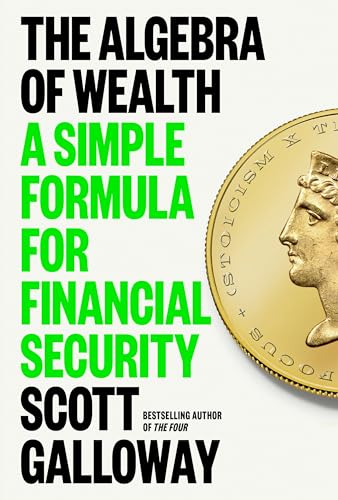
⚡️ What is The Algebra of Wealth About?
Why do we keep telling young people to follow their passion? It’s a lie that usually leads to a basement apartment and a stack of unpaid bills. In The Algebra of Wealth, Scott Galloway argues that you shouldn’t follow your passion—you should follow your talent. He suggests that being great at something and getting paid for it is what eventually creates passion, not the other way around. This book is a cold shower for anyone waiting for “the right moment” or a “lucky break.” It’s a manual for building a life that is economically secure enough to let you actually enjoy your family, your health, and your time.
Galloway, a professor at NYU Stern and a serial entrepreneur, brings his signature “Prof G” energy here: high-octane, slightly provocative, and deeply rooted in the data of modern capitalism. He isn’t interested in helping you get rich quick. He’s interested in the math of financial security. You can find more summaries by Scott Galloway on our site, but this one feels like the culmination of his advice for the next generation. If you’re looking for more Finance book summaries, this is the one that prioritizes character over charts.
🚀 The Book in 3 Sentences
- Wealth is a simple formula: Focus + (Stoicism x Time x Diversification).
- Economic security isn’t about the number in your bank account; it’s about the freedom to focus on relationships and health without financial stress.
- Success requires identifying your competitive advantage and aggressively leaning into it, even if it means sacrificing “work-life balance” in your twenties.
🎨 Impressions
I finished this book feeling like I’d just had a two-hour performance review with a boss who actually cares about me. It’s refreshing because it ignores the toxic positivity of most self-help. Galloway doesn’t pretend that the system is fair. He doesn’t pretend that everyone can be a billionaire. Instead, he treats wealth as a series of trade-offs. I dog-eared the section on “Stoicism” because it’s the most honest take on spending I’ve read in years. It’s not about skipping lattes; it’s about the internal character required to not buy a Tesla just because your neighbor did.
What frustrated me? Galloway’s insistence that you must be in a major city and must be in the office early in your career. It feels a bit pre-2020. However, I can’t deny the logic that being “in the room” builds social capital faster than a Zoom call ever will. It’s a prescriptive book, and while some of the investment advice (index funds, diversification) is basic, the psychological framework surrounding those investments is where the real value lies. It’s less of a textbook and more of a manifesto for adulting in a capitalist society.
📖 Who Should Read The Algebra of Wealth?
This is the perfect graduation gift for a 22-year-old who thinks they’re going to “manifest” a career as an influencer. It’s also for the 35-year-old who earns a great salary but feels like they’re running on a treadmill and getting nowhere. If you want a technical manual on options trading or crypto, don’t buy this. But if you want a strategy for how to behave so that you’re wealthy by 50, this is your roadmap. If you’re looking for “hacks,” skip it. If you’re willing to work, read it.
☘️ How This Book Changed My Thinking
Before reading this, I viewed wealth mostly as a function of income. If I made more, I’d be wealthier. Galloway forced me to realize that income is just the “Focus” part of the equation, and it’s often the least stable part. Now, I see my behavior (Stoicism) as a much larger multiplier of my future security.
- I stopped trying to “find my passion” in my daily tasks and started looking for where my specific skills generate the most value for others.
- I’ve reframed my savings not as “money for later,” but as “buying back my future time.”
- I’m much more aggressive about seeking out “big waves” (like AI) rather than just working hard in a stagnant industry.
✍️ 3 Quotes That Stuck With Me
- “Economic security is the time and resources to focus on relationships without economic stress.” — This redefined the “why” behind my bank account for me.
- “Follow your talent, not your passion.” — A necessary slap in the face for anyone stuck in a low-paying dream job they actually hate.
- “The most powerful force in the universe is compounding, but you have to be alive and invested to witness it.” — A grim but vital reminder that health and patience are financial tools.
📒 Summary + Notes
The Algebra of Wealth is built on the premise that wealth is a choice made over decades, not a single event. Galloway moves the reader through a four-part journey. First, you have to earn. This requires Focus—identifying which industries are growing (riding waves) and where your specific skills can make you a top 10% performer. He argues that your 20s and 30s are for “burning the midnight oil” so that your 50s can be for burning wood in a fireplace with your family. He is unapologetic about the work required.
The second half of the book deals with the internal and external forces that keep you from keeping what you earn. Stoicism is his term for the discipline to live below your means and ignore the status games of consumerism. Time and Diversification are the mechanical tools of the market. Galloway wants you to believe that if you can manage your emotions (Stoicism) and stay in the market (Time), the actual math of investing (Diversification) is relatively boring and easy. The end goal isn’t the money itself; it’s the ability to be present for the people you love.
🧠 Core Ideas Explained Simply
Galloway simplifies complex financial planning into a few psychological pillars that anyone can grasp.
The Wealth Formula
Wealth = Focus + (Stoicism x Time x Diversification). Think of it like this: Focus gets the money in the door. Stoicism decides how much of it stays. Time and Diversification turn that small pile into a mountain. If any of these numbers are zero, the whole equation collapses. You can’t save your way out of a low-income career (low Focus), but you also can’t earn your way out of a reckless spending habit (low Stoicism).
Talent Over Passion
Are you doing what you love, or what you’re good at? Galloway claims that people who “follow their passion” often end up resenting the thing they love because they can’t pay their rent. If you follow your talent, you become competent. Competence leads to mastery. Mastery leads to high pay and respect. And guess what? It’s really easy to be passionate about being a respected, highly-paid expert in your field.
Market Waves vs. Individual Grit
Would you rather be a genius in a dying industry or a mediocre worker in a booming one? Galloway argues that industry dynamics trump individual performance almost every time. He cites the tech boom and the rise of AI. If you are in a stagnant field, you are rowing against the current. If you find a “wave,” the current does half the work for you. Hard work matters, but where you work matters more.
1: Focus
How do you choose where to spend your limited energy? Galloway begins by dismantling the “follow your passion” myth. He argues that your career is a vehicle for your life, not your entire identity. The goal of your career should be to generate maximum income with the least amount of friction, which means identifying your “competitive advantage.” What do you do that feels like play to you but looks like work to others?
He identifies a few key traits of a “High-Value Focus”:
- Certification: In a world of AI, credentials and specific, proven skills are the only things that protect your wages.
- Relevance: Are you in an industry that is growing? Being the best travel agent in the world in 2025 is still a losing battle.
- The Office: Galloway is a big believer in physical presence. He argues that mentorship and “soft” opportunities happen in the hallways, not on Slack.
Why are we so obsessed with being “special”? Galloway suggests that most people would be much happier if they aimed to be incredibly useful and well-paid rather than aiming to be the next Steve Jobs. He notes that the gap between your intentions and your actions is the best indicator of your future success. If you say you want to be wealthy but you aren’t willing to move to where the capital is, your intentions don’t matter.
2: Stoicism
Wealth isn’t what you earn; it’s what you keep. This chapter maps the ancient philosophy of Stoicism to modern financial habits. For Galloway, Stoicism is the “multiplier” in his wealth formula. It’s the ability to separate your self-worth from your net worth. If you need a new luxury car to feel successful, you’ve already lost the game because your “burn rate” will always rise to meet your income.
There’s a moment early on where he talks about the “Status Trap.” We are biologically wired to show off our success to attract mates and social standing. In the 21st century, this biology is exploited by luxury brands and social media. Being stoic means recognizing these impulses and choosing a different path. He suggests a simple rule: if you can’t buy it twice in cash, you can’t afford it. Do you really need that dopamine hit from a $1,000 pair of shoes?
Stoicism also applies to how you handle market volatility. When the market dips 20%, the stoic investor doesn’t panic-sell; they see it as a sale on future wealth. Character is a financial asset. If you can control your temper and your ego, you can survive the inevitable downturns that wipe out less disciplined investors. It’s about being the person who can “keep their head when all about you are losing theirs.”
3: Time
What if I told you that the most important factor in your wealth isn’t your interest rate, but your age? Galloway highlights that compounding is back-heavy. Most of the gains happen in the final years of an investment’s life. This is why starting at 22 is infinitely better than starting at 32. He uses the analogy of a snowball: you need a long hill (time) and wet snow (capital). If the hill is short, it doesn’t matter how big the snowball is at the start.
He also ties time to physical health. This was the section I dog-eared most. Galloway argues that being unhealthy is a massive financial liability. If you die at 60, you miss the most lucrative decades of compounding. If you are chronically ill, your medical costs eat your capital. Fitness isn’t just about looking good; it’s about extending the “Time” variable in your wealth equation. Are you investing in your body as much as your 401k?
Time is also about “clock speed.” In your career, a bias for action helps you iterate faster. The person who tries ten things in a year and fails at nine is further ahead than the person who spent the whole year planning one thing. Speed of failure is a competitive advantage. How much time are you wasting on the “deliberation” phase of your life?
4: Diversification
If you think you can pick winning stocks, Galloway has a bridge to sell you. He is brutally honest about the fact that even professional fund managers fail to beat the S&P 500 over long periods. Diversification is the “only free lunch in finance.” It’s the acknowledgement that you aren’t the smartest person in the room. By owning a slice of everything, you guarantee that you’ll capture the growth of the winners without being destroyed by the losers.
He breaks down the essentials of a modern portfolio:
- Low-cost index funds (the core of everything).
- Real estate (for tax advantages and forced savings).
- Cash reserves (to avoid being a forced seller during a crash).
Diversification isn’t just about stocks; it’s about income streams. Galloway encourages the “side hustle” not as a primary career, but as a way to de-risk your life. If your main job disappears, do you have a secondary skill that can keep the lights on? Total reliance on one employer is the opposite of diversification. It’s about building a fortress where no single arrow can take you down.
⚖️ A Critical Perspective
Galloway’s advice is heavily biased toward high-achieving corporate paths in major metropolitan areas. He often ignores the systemic barriers—like student debt or rising urban housing costs—that make his “move to the city and work 80 hours” advice nearly impossible for many. Additionally, while his dismissal of “passion” is a good reality check, it risks pushing people toward soul-crushing careers where they eventually burn out before the “Time” variable can even kick in. He writes for the “alpha” personality, which might leave more collaborative or creatively-driven readers feeling like the book isn’t for them.
🔄 How It Compares
Compared to I Will Teach You to Be Rich by Ramit Sethi, Galloway is much more focused on the career side of wealth rather than just the banking side. While Sethi focuses on automating your accounts and “conscious spending,” Galloway focuses on the raw aggression needed to increase your top-line income and the philosophical character needed to withstand the pressures of capitalism.
🔑 Key Takeaways
The lessons in this book are designed to shift your focus from short-term greed to long-term security.
- Ride Big Waves: Don’t just work hard; work in an industry that is growing by 20% or more annually. Market tailwinds are more powerful than individual effort.
- The Discipline of No: Wealth is mostly the result of all the things you didn’t buy and the status games you didn’t play.
- Invest in Health: You can’t compound assets if you’re dead. Your gym membership is a financial investment with a massive ROI.
- Focus on Talent: Mastery in a boring but lucrative field beats being a mediocre performer in a “cool” field every single time.
💬 Frequently Asked Questions
What is the main argument of The Algebra of Wealth?
The book argues that wealth is the result of a predictable formula: Focus, Stoicism, Time, and Diversification. Galloway emphasizes that financial security isn’t about luck, but about choosing the right industry, living below your means, and letting compounding work over decades rather than seeking overnight success.
Why does Scott Galloway say ‘don’t follow your passion’?
Galloway believes passion is often a poor guide for career success because the most “passionate” industries are overcrowded and underpaid. Instead, he suggests following your talent to a lucrative field. Once you become an expert and achieve financial success, the passion for your work will naturally follow.
Is The Algebra of Wealth worth reading for experienced investors?
While the technical investment advice is fairly basic (focusing on low-cost index funds), the book is highly valuable for its psychological insights. Experienced investors will benefit from Galloway’s perspective on career strategy, industry waves, and the stoic mindset required to avoid emotional mistakes during market volatility.
What does stoicism have to do with getting rich?
In this context, stoicism is the ability to ignore status-driven consumption and the emotional noise of the stock market. It’s the character trait that allows you to save a high percentage of your income and stay invested when everyone else is panic-selling during a market crash.
Who is the target audience for Scott Galloway’s book?
The book is primarily targeted at young professionals and early-career adults who are looking for a realistic framework for financial success. It is also highly relevant for anyone feeling stuck in their career who needs a data-driven strategy to pivot toward more profitable and secure industries.
Conclusion
Ultimately, The Algebra of Wealth isn’t about greed; it’s about love. Galloway is very clear that the end goal of all this work and discipline is to be the person who can afford to take care of their parents when they’re old and show up for their kids’ soccer games without a phone glued to their ear. Money is just the tool that buys you the right to be present. It’s the ink in the pen, but you still have to write the story.
If you take one thing away from this, let it be that you are more in control of your financial destiny than the headlines suggest. By focusing on your talent, managing your ego, and being patient, you aren’t just building a portfolio—you’re building a fortress. This is one of those Finance book summaries that reminds us that the most important investment we ever make is in our own character and our own resilience.
More From Scott Galloway →
Discover more from AI Book Summary
Subscribe to get the latest posts sent to your email.