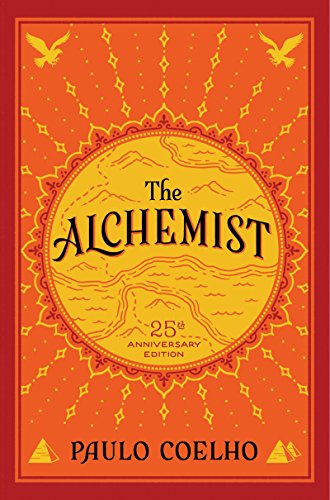
⚡️ What is The Alchemist about?
The Alchemist by Paulo Coelho is a transformative fable that follows Santiago, an Andalusian shepherd boy who dares to follow his dreams beyond the familiar pastures of Spain. At its core, this international bestseller explores the profound journey of self-discovery and destiny that occurs when we have the courage to pursue our Personal Legend—the unique purpose each person is meant to fulfill in this lifetime. The narrative begins when Santiago experiences a recurring dream about treasure buried near the Egyptian pyramids. This vision sets him on a perilous journey across the Mediterranean into North Africa, through the Sahara Desert, and ultimately to the realization that the treasure he seeks is both literal and metaphorical.
Along the way, he encounters a cast of mystical guides including Melchizedek, the King of Salem, a wise crystal merchant, and the enigmatic Alchemist himself. Through desert caravans, tribal wars, and the discovery of love at an oasis, Santiago learns that when you truly want something, the entire universe conspires to help you achieve it. The book serves as a spiritual guide disguised as an adventure story, teaching readers how to read the omens that surround them and trust the wisdom of their hearts.
🚀 The Book in 3 Sentences
- The Alchemist teaches that your Personal Legend is the divine purpose written in your heart, and fear is the only obstacle preventing you from achieving your destiny.
- Through Santiago’s journey from shepherd to seeker, Coelho reveals that the process of pursuing your dreams transforms you more than the destination itself.
- The universe communicates through omens and signs, but you must cultivate the courage to read them and act decisively to align with your true path.
🎨 Impressions
Reading The Alchemist felt like unearthing a forgotten map to my own soul. Coelho’s prose is deceptively simple yet carries the weight of ancient wisdom, creating a narrative that resonates with the raw authenticity of a bedtime story while packing the philosophical punch of a lifetime’s meditation. I found myself pausing every few pages to absorb the profound truths about fear, love, and destiny that Santiago encounters in his journey across the desert.
What struck me most deeply was Coelho’s insistence that your treasure is closer than you think, yet the journey away is necessary to appreciate its value. The book doesn’t promise an easy path—Santiago loses his money, faces death in the desert, and must choose between love and his destiny—but it assures us that every step serves the Soul of the World. The writing style is lyrical without being pretentious, spiritual without being preachy. By the final page, I felt both comforted and challenged: comforted that my dreams are valid, yet challenged to stop making excuses and start following the omens that have been appearing in my own life.
📖 Who Should Read The Alchemist?
The Alchemist is essential reading for anyone standing at the crossroads between comfort and calling. If you are currently feeling the subtle—or not so subtle—nudge that there is something greater waiting for you beyond your current circumstances, this book will serve as both permission slip and roadmap. It speaks directly to the dreamers who have buried their ambitions under practical concerns, to the creatives who fear their gifts are not enough, and to the seekers who sense there is more to life than routine.
Young adults graduating from university will find guidance in Santiago’s uncertainty, while mid-career professionals experiencing existential restlessness will recognize his longing for meaning beyond material success. Entrepreneurs will resonate with the crystal merchant’s fear of change, while spiritual seekers will devour the discussions about the Language of the World and the Master Work. Even if you consider yourself pragmatic rather than mystical, Coelho’s allegory offers practical wisdom about risk-taking, resilience, and recognizing opportunity. This is a book for anyone who has ever whispered to themselves, “There must be more than this,” and needs the courage to answer that call.
☘️ How the Book Changed Me
This narrative revolutionized my relationship with fear and uncertainty in ways I never anticipated. Before encountering Santiago’s journey, I viewed obstacles as cosmic signs to retreat, proof that I was on the wrong path; now I understand them as necessary tests of commitment to my Personal Legend. The book taught me that the fear of suffering is always worse than the suffering itself, liberating me to take calculated risks I had previously avoided due to catastrophic imagination. I stopped viewing my comfort zone as safety and began recognizing it as a comfortable cage that slowly suffocates potential.
- I began journaling my dreams and paying attention to recurring symbols, treating them as omens rather than random neural firings.
- I stopped waiting for perfect conditions and started my creative projects with the resources currently available, just as Santiago sold his sheep.
- I learned to differentiate between love that chains you to comfort and love that liberates you to pursue your destiny.
- I started speaking my desires aloud to the universe, trusting that the world conspires to help those who dare to pursue their dreams.
- I embraced the concept of the “beginner’s luck”—that the universe supports new endeavors to demonstrate what’s possible.
- I now view setbacks as part of the journey’s necessary preparation, not as evidence that I should quit.
✍️ My Top 3 Quotes
- “When you want something, all the universe conspires in helping you to achieve it.”
- “There is only one thing that makes a dream impossible to achieve: the fear of failure.”
- “The secret of life, though, is to fall seven times and to get up eight times.”
📒 Summary + Notes
The Alchemist follows a precise alchemical process of transformation, moving the protagonist—and the reader—through stages of dissolution, purification, and realization. Coelho structures the narrative as both an external adventure and an internal initiation, ensuring that every external challenge Santiago faces mirrors an internal barrier he must overcome. The book operates on multiple levels: as a straightforward adventure story, a spiritual guide to manifestation, and a philosophical treatise on the nature of happiness.
The narrative arc demonstrates that the treasure Santiago seeks is never truly in Egypt, yet he must travel there to develop the eyes capable of seeing what was always present. Each character Santiago meets—the gypsy, Melchizedek, the crystal merchant, the Englishman, Fatima, and the Alchemist—represents a different aspect of wisdom or a stage of consciousness. The desert itself becomes a character, teaching through silence and severity. As we progress through each chapter, we witness not just a journey across geography, but the alchemical transformation of leaden fear into golden courage.
Chapter 1: The Sycamore Tree and the King of Salem
Santiago’s journey begins in the rolling hills of Andalusia, where he tends his flock with contentment yet harbors a persistent restlessness. His world shifts when he dreams repeatedly of a child directing him to treasure near the Egyptian pyramids. Consultations with a gypsy woman confirm the dream’s validity, but the true catalyst arrives in the form of Melchizedek, the mysterious King of Salem. This ancient figure introduces Santiago to the concept of the Personal Legend—the destiny each person is born to fulfill.
Melchizedek gives Santiago the magical stones Urim and Thummim to help him read omens, then persuades him to sell his sheep and cross the Strait of Gibraltar into Africa. This chapter establishes the central theme: the universe conspires to help those who dare to pursue their dreams, but fear often masquerades as practicality. Santiago’s decision to leave his flock represents the terrifying leap of faith required to transform from a shepherd of sheep to a shepherd of his own destiny.
- Melchizedek explains that the world’s greatest lie is that we lose control of our own lives.
- The concept of the Personal Legend is introduced as the obligation to fulfill one’s destiny.
- Santiago receives Urim and Thummim, black and white stones representing yes and no for decision-making.
- The omens are the language of the world, communicating through signs and symbols.
Chapter 2: Tangier and the Crystal Merchant
Arriving in Tangier with his savings, Santiago experiences the harsh reality of trust when a young thief steals his entire fortune. Devastated and contemplating return, he instead chooses to view this setback as a test of his commitment. He finds employment with a crystal merchant who has grown complacent in his routine, afraid to expand his business beyond his comfort zone. Santiago’s innovative spirit—polishing glasses to attract distant customers, building an outdoor display, and offering tea in crystal—revolutionizes the shop while teaching Santiago the practical mechanics of commerce.
Over eleven months, he earns enough to buy a new flock of sheep, yet realizes that returning to Spain would mean abandoning his Personal Legend. This section illustrates that the journey toward our dreams often involves temporary defeat and that resourcefulness emerges when options seem limited. The crystal merchant represents the tragedy of unfulfilled potential—someone who dreams but never acts, preferring the safety of hope to the risk of failure.
- The crystal merchant fears change but teaches Santiago essential business skills.
- Santiago learns that every blessing ignored becomes a curse.
- The shop’s success demonstrates that taking risks creates opportunities.
- Santiago must choose between the security of new sheep and the uncertainty of the pyramids.
Chapter 3: The Caravan and the Englishman
Santiago joins a caravan crossing the Sahara, where he meets an Englishman obsessed with discovering the secrets of alchemy and the elusive Philosopher’s Stone. While the Englishman studies texts obsessively, Santiago learns to read the desert’s wordless language through observation and intuition. The Englishman reveals that the ultimate goal of alchemy is the Master Work—turning lead into gold and discovering the Elixir of Life. He also explains that these secrets are written on the Emerald Tablet, discernible only to those who understand the world through the heart.
Their contrasting approaches—intellectual versus intuitive—demonstrate different paths to wisdom. As they travel toward the Al-Fayoum oasis, Santiago learns that books can only point toward truths that must be experienced. The desert becomes a teacher of silence and patience, forcing Santiago to listen to his heart’s guidance rather than external noise. The journey emphasizes that all things are connected through the Soul of the World.
- The Englishman represents the path of knowledge through study and books.
- Santiago learns that the desert speaks through signs and omens.
- The Master Work consists of the Philosopher’s Stone and the Elixir of Life.
- The caravan must stop at the oasis due to tribal wars in the desert.
Chapter 4: The Oasis, Fatima, and the Vision
At the Al-Fayoum oasis, Santiago encounters Fatima at a well and experiences love that threatens to anchor him to comfort. Their connection is immediate and profound, yet Fatima insists that Santiago must complete his journey, refusing to be the reason he abandons his Personal Legend. Meanwhile, Santiago observes hawks in the desert and interprets an omen predicting an attack on the oasis by warring tribes. He warns the tribal chieftains, who prepare defenses that successfully repel the assault.
This act of courage and prescience draws the attention of the Alchemist, who recognizes Santiago as a receptive student. This chapter explores the tension between love and destiny, suggesting that true love never prevents one from pursuing their purpose. It also demonstrates that when you align with your Personal Legend, you gain access to the Soul of the World and can read the signs that others miss. The oasis represents a testing ground between staying safe and continuing the quest.
- True love encourages the beloved to pursue their Personal Legend.
- Santiago learns to read the Language of the World through nature’s signs.
- The vision of war demonstrates Santiago’s growing connection to the Soul of the World.
- The Alchemist appears, recognizing Santiago’s ability to read omens.
Chapter 5: The Desert Mysteries and the Wind
The Alchemist takes Santiago into the desert to complete his education, teaching him that fear of suffering is worse than suffering itself. They discuss the Language of the World—the universal tongue of creation that allows understanding between all things. When captured by warring tribesmen, the Alchemist stakes Santiago’s life on his ability to transform himself into the wind within three days. Facing death, Santiago initially panics, then enters communion with the desert elements.
He learns from the wind about the limits of power, from the sun about the transformative nature of love, and from the Hand That Wrote All about the unity of existence. Creating a massive sandstorm, Santiago disappears and reappears on the far side of the camp, convincing the tribe of his mastery. This initiation represents the ultimate dissolution of ego—Santiago becomes one with the forces of nature, realizing that all creation shares the same soul and that he can access infinite power through surrender.
- The Alchemist teaches that listening to your heart is essential to reading the world.
- Santiago must turn himself into the wind to survive the tribal challenge.
- He communicates with the wind, the sun, and ultimately the Soul of the World.
- The transformation proves that the universe responds to those who understand their connection to it.
Chapter 6: The Pyramids and the Treasure Found
Finally reaching the pyramids, Santiago begins digging where his tears fall, only to be accosted and beaten by refugees who steal his gold. When they demand what he’s seeking and laugh at his dream, one recounts his own dream of treasure buried in a Spanish church with a sycamore tree—the very church where Santiago’s journey began. Santiago laughs for the first time at the profound irony: he traveled the world to discover his treasure lay at home, exactly where he started.
Returning to the abandoned church in Andalusia, he digs beneath the sycamore and unearths a chest of Spanish gold coins and precious gems. The Alchemist’s promise proves true—the alchemy was the transformation Santiago underwent, while the physical treasure merely confirmed the journey’s validity. He plans to return to Fatima, now understanding that the treasure was never the point; the person he became capable of finding it was the real gold. The journey completed the circle, proving that sometimes you must travel far to see what was always near.
- The treasure was buried at the starting point, beneath the sycamore tree.
- The lead refugee’s dream reveals the irony of Santiago’s journey.
- The physical treasure represents the material reward of spiritual transformation.
- Santiago must return to Fatima, completing his Personal Legend.
Key Takeaways
The Alchemist distills profound spiritual wisdom into practical guidance for anyone seeking purpose. The central revelation is that your Personal Legend is not just what you want to do, but what you were created to accomplish—the universe actively conspires to help you achieve it the moment you commit. However, this journey demands that you become a different person than you were when you started. You must learn to read the omens that the universe constantly provides, treating coincidence as communication.
The book teaches that love is never an obstacle to your destiny when it is true love; rather, it empowers your journey. Most importantly, Coelho reveals that the fear of failure is always worse than failure itself, and that temporary defeat is merely part of the process of transformation. The treasure you seek may be physical, but the person you must become to obtain it is the real transformation.
- Personal Legend: Your destiny is written in your heart, and the universe conspires to help you achieve it once you commit.
- Language of the World: Learn to read omens and listen to your heart, which speaks the truth that your mind often fears.
- Fear vs. Suffering: The fear of suffering is worse than the suffering itself; every obstacle tests your commitment.
- True Love: Love never prevents you from achieving your Personal Legend; it supports and waits for your fulfillment.
- The Journey is the Treasure: What you become during the pursuit is more valuable than the destination itself.
- Beginner’s Luck: The universe gives you initial success to show you what’s possible when you dare to start.
Conclusion
Reading The Alchemist is an initiation into the art of possibility. Coelho doesn’t merely tell a story about a shepherd seeking treasure; he provides a template for anyone standing at the edge of their comfort zone, wondering if they should leap. The book reminds us that we are all alchemists capable of transforming our leaden fears into golden courage, our mundane existence into a legendary life. Santiago’s journey teaches that the signs are always there if we have the eyes to see them, and that retreating to safety often leads to the bitterness of unfulfilled dreams.
Whether you are considering a career change, a creative pursuit, or a geographical relocation, this fable assures you that the world wants you to succeed in your authentic purpose. The treasure buried beneath your own sycamore tree—whether literal or metaphorical—can only be found by those brave enough to look. I encourage you to read this book not just once, but whenever you feel your courage wavering. Keep it close as a reminder that your Personal Legend is not just possible; it is your obligation to yourself and to the world. The universe is waiting; listen for your omens.
More From Paulo Coelho →
Discover more from AI Book Summary
Subscribe to get the latest posts sent to your email.