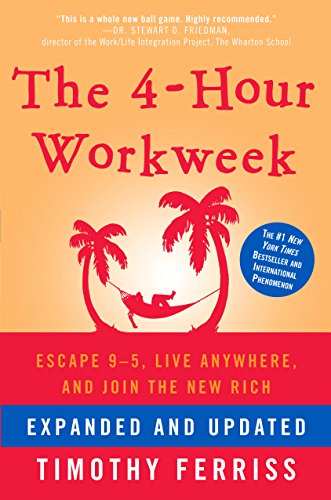
⚡️ What is The 4-Hour Workweek About?
Does the idea of working until you’re 65 just to finally “enjoy life” feel like a bad deal? I thought so too until I picked up this book. Tim Ferriss argues that the traditional deferred-life plan is a trap. Instead of trading your best years for a gold watch and a pension, he proposes a system called lifestyle design—where you maximize your “per-hour” output to fund “mini-retirements” throughout your life. It’s not about being lazy; it’s about being ruthlessly efficient so you can do what you actually want.
I first read this when I was stuck in a windowless office, and it felt like someone had handed me a hacksaw. More summaries by Tim Ferriss show his obsession with optimization, but this is the one that started the movement. He breaks down how to decouple your income from your time, using a four-step framework: Definition, Elimination, Automation, and Liberation. Whether you’re an entrepreneur or a cubicle dweller, the central thesis is simple: time and mobility are the new currency.
You can find more productivity book summaries on our site, but few will challenge your basic assumptions about work as aggressively as this one. Why are we so proud of being “busy”? Is a $100,000 salary actually worth it if you’re too exhausted to spend it? Ferriss forces you to answer these uncomfortable questions while providing a blueprint to exit the rat race.
🚀 The Book in 3 Sentences
- The New Rich focus on lifestyle design by optimizing their relative income (money per hour) rather than just their absolute annual salary.
- By applying the Pareto Principle (80/20 rule) and Parkinson’s Law, you can eliminate the majority of your work tasks and achieve the same results in a fraction of the time.
- The goal is to automate your income through a “muse” (a low-maintenance business) and liberate your location to live a world-class lifestyle anywhere on a modest budget.
🎨 Impressions
I’ll be honest: parts of this book feel like a fever dream from 2007. The advice on dropshipping DVDs or using specific fax-to-email services is hilariously outdated. But if you can look past the tech, the underlying philosophy is absolute gold. It’s the first book that made me realize that being “busy” is actually a form of laziness—lazy thinking and lazy prioritization. It’s easy to fill a day with emails; it’s hard to do the one thing that actually moves the needle.
What frustrated me was the occasional “bro-culture” vibe and the assumption that everyone wants to outsource their personal life to a virtual assistant in India. Do I really want someone else to buy my mother’s birthday flowers? Probably not. However, the chapter on “Defining Fear” is one of the most practical exercises in psychology I’ve ever encountered. It changed my relationship with risk forever. It turns out, most of the things we’re afraid of are totally reversible.
📖 Who Should Read The 4-Hour Workweek?
If you’re an entrepreneur feeling like a slave to your own business, this is your Bible. It’s also perfect for the “corporate-trapped” employee who knows they’re more efficient than their 9-5 allows. However, if you’re looking for a career in a field that requires physical presence and high-touch empathy—like surgery or social work—the automation advice won’t land well. This is for the knowledge workers and the dreamers who want to travel without waiting for retirement.
☘️ How This Book Changed My Thinking
Before reading this, I thought the only way to earn more was to work more. I was stuck in a linear mindset of hours traded for dollars. After finishing it, I started looking at every task through a lens of scalability and automation.
- I stopped checking my email first thing in the morning. I realized that my inbox is just a convenient organizing system for other people’s agendas, not mine.
- I adopted the concept of “Relative Income.” Earning $50k while working 10 hours a week is infinitely better than earning $100k while working 80 hours.
- I learned to embrace “productive ignorance.” I don’t need to know everything that’s happening in the news; if it’s important enough, someone will tell me.
✍️ 3 Quotes That Stuck With Me
- “Being busy is most often used as a guise for avoiding the few critically important but uncomfortable actions.” — This hit me like a ton of bricks because I realized I was using my to-do list as a shield.
- “Different is better when it is more effective or more fun.” — It reminded me that following the status quo is rarely the fastest path to happiness.
- “The opposite of love is indifference, and the opposite of happiness is—here’s the clincher—boredom.” — This reframed my goals from seeking “peace” to seeking excitement and engagement.
📒 Summary + Notes
The 4-Hour Workweek is structured around the acronym DEAL. The narrative moves from psychological preparation to radical efficiency, followed by business automation, and finally, geographic freedom. Ferriss isn’t just giving you a list of hacks; he’s trying to rewire your brain to value time over status symbols. He wants you to realize that you can live like a millionaire right now without having a million dollars in the bank.
The book’s arc begins by debunking the myth of retirement. Why wait until you’re too old to enjoy your health? By building a “muse” (a business that runs itself), you can fund mini-retirements throughout your life. The middle section is a masterclass in the 80/20 rule, showing you how to fire your most annoying customers and ignore the 80% of tasks that produce only 20% of your results. By the end, Ferriss provides a roadmap for working remotely, even if you have a boss who hates the idea.
🧠 Core Ideas Explained Simply
Ferriss introduces several concepts that sound radical but are actually rooted in economic and psychological principles.
Relative vs. Absolute Income
Absolute income is the total dollar amount you make per year. Relative income is how much you make per hour of effort. If a Wall Street analyst makes $200k but works 100 hours a week, they are “poorer” in time than a freelancer making $60k while working 10 hours. Ferriss argues we should always optimize for relative income to buy back our freedom.
Parkinson’s Law
Ever notice how a project takes exactly as much time as you’re given? If you have two weeks, it takes two weeks. If you have two hours, you somehow get it done. Ferriss suggests artificially shortening deadlines to force your brain to focus on the essential and discard the trivial fluff. Are you working hard, or just making the task take longer?
Fear Setting
Instead of goal setting, try fear setting. Write down the absolute worst-case scenario if you quit your job or start that business. On a scale of 1-10, how much permanent damage would it do? Usually, the answer is a 2 or 3. Then, write down the benefits of a probable success. The upside almost always dwarfs the reversible downside.
1: Cautions and Comparisons
Why do we work so hard for a future we might never reach? Ferriss opens by comparing the “Deferred Life Plan” (the 9-5 grind until 65) with the “New Rich” (NR). The NR don’t want to retire; they want to redistribute their retirement throughout their lives. He challenges the idea that being rich means having a lot of money; it actually means having the power to decide what to do, when to do it, and where to do it.
2: Rules That Change the Rules
The world is built on a set of rules that are mostly arbitrary. Ferriss suggests that “retirement is worst-case scenario insurance” and shouldn’t be the goal. He argues that interest and energy are cyclical, meaning we need periods of intense work followed by periods of intense rest. He also makes the surprising claim that less is not lazy—getting more done in fewer hours is the ultimate skill.
3: Dodging Bullets
I’ve been there—frozen by the fear of “what if I fail?” This chapter introduces the Fear Setting exercise. Ferriss details his own journey of nearly having a nervous breakdown while running his supplement company, BrainQUICKEN. By defining the worst-case scenario (living in a van), he realized his fears were manageable. He encourages us to ask: What is it costing you—financially, emotionally, and physically—to postpone action?
4: System Reset
Think of your life like a computer that needs a factory reset because the operating system is bloated with useless programs. This is where you define your “Target Monthly Income” (TMI). Most people realize they don’t need millions to live their dream life; they just need enough to cover the monthly costs of those dreams. Ferriss provides a “Dreamline” worksheet to help you calculate the exact cost of your ideal lifestyle, whether it’s owning a Ferrari or learning to fly a plane.
5: The End of Time Management
Forget everything you know about to-do lists. Ferriss argues that time management is a trap because it encourages you to do more things rather than the right things. He introduces the Pareto Principle: 80% of your results come from 20% of your activities. Do you have the courage to stop doing the other 80%? He also couples this with Parkinson’s Law, suggesting that we should limit our work time to force ourselves to be more effective.
6: The Low-Information Diet
Imagine you stopped reading the news, watching TV, and browsing social media for a week—would your life fall apart? Probably not. Ferriss advocates for a radical “low-information diet.” He argues that most information is time-consuming, negative, and irrelevant to your goals. By ignoring the noise, you regain the mental bandwidth to focus on your own projects. I tried this, and honestly, the world kept turning just fine without me knowing the latest political scandal.
7: Interrupting Interruption
How many times a day does a “quick question” from a colleague ruin your flow? Ferriss suggests that interruptions are the biggest productivity killers. He recommends “batching” tasks—checking email only twice a day, or holding all meetings on a single afternoon. The goal is to create large blocks of uninterrupted time. He even suggests using an auto-responder that tells people you only check email at 11 AM and 4 PM. Bold? Yes. Effective? Absolutely.
8: Outsourcing Life
It’s time to stop doing $10/hour tasks if you want to earn $100/hour. This is the famous chapter on Virtual Assistants (VAs). Ferriss describes how he hired VAs in India to handle everything from his email to his research. The core lesson here isn’t just about hiring help; it’s about learning to delegate and create processes. If a task can be done by someone else for less than your hourly rate, you should never do it again.
9: Income Autopilot I
You don’t want a business; you want a “muse.” A muse is an automated business that generates cash without requiring your daily presence. This chapter focuses on finding a profitable niche. Ferriss suggests looking for markets where people are already spending money and have a specific problem to solve. The key is to find a product that can be sold for $50-$200 with high margins.
10: Income Autopilot II
Building a product is like building a machine—if it needs you to turn the crank every day, it’s broken. Ferriss explains how to test your product idea before you build it using “micro-testing” with Google Ads. Spend $50 to see if people will actually click a “Buy” button for your idea. If they don’t, you’ve saved months of work. If they do, you have a validated business ready to scale.
11: Income Autopilot III
Is your business designed to grow without you? This section covers the logistics of “MBA” (Management by Absence). Ferriss describes how to set up fulfillment houses and customer service teams so that you only receive a weekly report instead of a thousand emails. The goal is to reach a state where you are the architect, not the worker, of your income stream.
12: Disappearing Act
What if you don’t want to start a business, but you want the freedom? This chapter is for the employees. Ferriss outlines a step-by-step plan to transition to remote work. He suggests becoming so indispensable that your boss can’t fire you, then slowly proving that you are more productive at home. It starts with a single remote day and builds up until you are working from a beach in Bali while your boss thinks you’re in your home office.
13: Beyond Repair
Some jobs are simply broken and can’t be fixed by remote work. If your job requires you to be in a specific place at a specific time and offers no growth or joy, Ferriss argues you should quit. He provides a framework for how to quit without burning bridges and how to handle the inevitable “what are you going to do for money?” questions from worried relatives.
14: Mini-Retirements
Why wait for a two-week vacation when you can take a six-month mini-retirement? Ferriss challenges the “binge-travel” model where you rush through ten cities in ten days. Instead, he advocates for relocating to one place for months at a time. This allows you to truly experience a culture and often costs less than living in a major US or European city. He calls this geographic arbitrage—earning in a strong currency and spending in a weak one.
15: Filling the Void
So, you’ve automated your life and have 40 extra hours a week—now what? This is the most underrated chapter in the book. Ferriss warns that total freedom often leads to an existential crisis and boredom. He suggests that the purpose of freedom is to pursue “continual learning” and “service to others.” If you don’t have a plan for your time, you’ll end up back in the rat race just to have something to do.
16: The Top 13 New Rich Mistakes
Don’t fall into the trap of becoming a “manager” of your automated systems. Ferriss lists common pitfalls, like micromanaging your VAs, checking email when you don’t need to, or trying to fix things that aren’t broken. The goal is to stay a “lifestyle designer,” not a CEO. If your 4-hour workweek turns into a 40-hour one, you’ve lost the game.
⚖️ A Critical Perspective
The 4-Hour Workweek is brilliantly provocative, but it’s far from perfect. First, much of the tactical advice on building a “muse” is dated; the e-commerce landscape is vastly more competitive and complex than it was in 2007. Second, Ferriss often ignores the social and emotional cost of his “efficiency.” His advice on avoiding all human interaction that doesn’t have an agenda can lead to a very lonely, transactional life. Finally, the book is written from a position of immense privilege—it’s much easier to take “mini-retirements” when you don’t have kids, a mortgage, or health issues that require a steady corporate plan.
🔄 How It Compares
Compared to Getting Things Done by David Allen, Ferriss is much more radical. While Allen wants to help you do more tasks efficiently, Ferriss wants you to question if the tasks should be done at all. Ferriss is focused on “effectiveness” (doing the right things) while Allen is focused on “efficiency” (doing things right). If you want a system to manage your current job, read Allen; if you want to blow up your current job and start over, read Ferriss.
🔑 Key Takeaways
These lessons are designed to move you from a worker-bee mindset to an architect mindset.
- Calculate your Target Monthly Income (TMI) to realize your dream life is cheaper than you think.
- Apply the 80/20 rule to your tasks and your customers; fire the bottom 20% who cause 80% of your headaches.
- Use Parkinson’s Law by setting impossibly short deadlines to eliminate the non-essential.
- Focus on geographic arbitrage by earning in dollars/euros and living in places with a lower cost of living.
💬 Frequently Asked Questions
Is the 4-hour workweek actually possible?
For most people, “4 hours” is a metaphor for extreme efficiency, not a literal clock-in time. While Ferriss achieved it, most readers use the principles to reduce a 40-hour week to 15-20 hours. It requires building a self-sustaining business or a highly automated remote career, which takes significant upfront work.
What is the DEAL framework?
DEAL stands for Definition (defining goals and fears), Elimination (removing the non-essential using the 80/20 rule), Automation (outsourcing and creating passive income), and Liberation (freeing yourself from a specific location). It is the step-by-step roadmap Ferriss uses to move from the deferred-life plan to the New Rich.
Is The 4-Hour Workweek still relevant in 2025?
The specific tools (like faxing) are obsolete, but the core philosophy is more relevant than ever. With the rise of remote work, AI-driven automation, and the gig economy, the barriers to entry for “lifestyle design” are actually lower now than when Ferriss first wrote the book in 2007.
What is the 80/20 rule in the context of this book?
Ferriss applies the Pareto Principle to everything. He argues that 80% of your income comes from 20% of your clients, and 80% of your stress comes from 20% of your problems. By identifying and focusing only on the productive 20%, you can slash your working hours without losing income.
Can employees use the 4-hour workweek or is it just for entrepreneurs?
The book has a dedicated section for employees. It outlines a strategy to become a remote worker by proving your value and then gradually negotiating more days away from the office. Ferriss argues that any knowledge-based job can be partially automated or outsourced to increase personal freedom.
Conclusion
At its heart, The 4-Hour Workweek isn’t about being a digital nomad or a supplement tycoon. It’s a manifesto for personal agency. It’s about refusing to accept a life that was designed by someone else—your boss, your parents, or society—and having the guts to build your own. Ferriss reminds us that the most valuable resource we have isn’t money, but time. And once that time is gone, you can’t buy it back at any price.
If you take away just one thing, let it be this: “Busy-ness” is often a form of procrastination. We fill our days with shallow work because we’re afraid of the deep, uncomfortable work that might actually change our lives. So, the next time you’re about to “delve” (sorry, couldn’t help it) into a 100-email thread, ask yourself: Is this the 20% that matters, or am I just hiding? Stop managing your time and start managing your life.
More From Tim Ferriss →
Discover more from AI Book Summary
Subscribe to get the latest posts sent to your email.