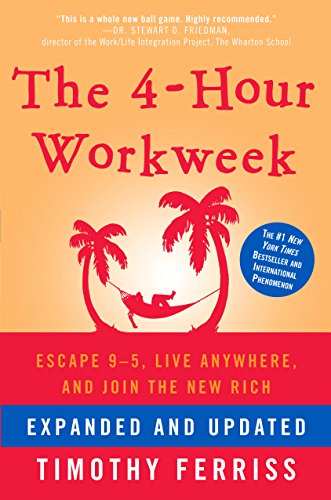
⚡️ What is The 4-Hour Workweek about?
The 4-Hour Workweek is a revolutionary guide that challenges the traditional deferred-life plan and work ethic. Tim Ferriss introduces the concept of the New Rich (NR), who prioritize time, mobility, and experiences over accumulating wealth for retirement. The book presents a practical blueprint for escaping the 9-5 grind, automating income, and living life on your own terms. Ferriss outlines his DEAL framework: Definition, Elimination, Automation, and Liberation, which provides a step-by-step approach to redesigning your lifestyle. The core premise is that geographical freedom and time freedom are more valuable than traditional measures of success, and that these can be achieved through strategic thinking and implementation of his principles.
🚀 The Book in 3 Sentences
- The 4-Hour Workweek teaches you how to escape the 9-5 grind by applying the DEAL framework: Define your ideal lifestyle, Eliminate unnecessary tasks, Automate your income, and Liberate yourself from traditional constraints.
- Ferriss demonstrates that focusing on effectiveness rather than efficiency, embracing selective ignorance, and creating automated income streams can free up your time and location.
- The book ultimately shows how joining the New Rich means measuring wealth in terms of freedom, mobility, and experiences rather than money accumulated for a distant retirement.
🎨 Impressions
The 4-Hour Workweek is an eye-opening manifesto that challenges conventional wisdom about work, retirement, and success. Ferriss combines provocative ideas with practical tactics that make the seemingly impossible goal of working just 4 hours a week feel attainable. The book’s strength lies in its actionable advice, though some suggestions may feel extreme or controversial to traditional readers. What resonates most is the emphasis on designing your ideal life rather than accepting default societal expectations.
📖 Who Should Read The 4-Hour Workweek?
The 4-Hour Workweek is essential reading for entrepreneurs, freelancers, and employees feeling trapped in the 9-5 grind who yearn for more freedom and flexibility. It’s particularly valuable for those seeking to create passive income streams, automate their business processes, or redesign their lifestyle around experiences rather than accumulating wealth. The book also appeals to digital nomads, aspiring world travelers, and anyone questioning the traditional deferred-life plan of working decades before enjoying life.
☘️ How the Book Changed Me
How my life / behaviour / thoughts / ideas have changed as a result of reading the book.
- Reading The 4-Hour Workweek completely transformed my approach to productivity, shifting my focus from being busy to being effective and questioning the necessity of every task on my to-do list.
- I began implementing the low-information diet principle, which dramatically reduced my time spent on email and news consumption, freeing up mental space for more important activities.
- The book inspired me to explore income automation and passive streams, leading to the creation of digital products that generate revenue without constant active involvement.
✍️ My Top 3 Quotes
- “The universe doesn’t conspire against you, but it doesn’t go out of its way to line up the pins either. Conditions are never perfect. ‘Someday’ is a disease that will take your dreams to the grave with you.”
- “What we fear doing most is usually what we most need to do.”
- “Being busy is a form of laziness—lazy thinking and indiscriminate action.”
📒 Summary + Notes
The 4-Hour Workweek presents a transformative approach to work and life that challenges conventional wisdom. Tim Ferriss introduces the concept of the New Rich (NR), who define wealth not by money but by freedom, mobility, and experiences. The book is structured around the DEAL framework: Definition, Elimination, Automation, and Liberation. Through this process, Ferriss guides readers from redefining their goals and fears to eliminating unnecessary work, automating income streams, and finally achieving liberation from traditional work constraints. The book is packed with practical strategies, real-world examples, and controversial advice that collectively paint a picture of a radically different way to live and work.
Chapter 1: Cautions and Comparisons
Ferriss introduces the concept of the New Rich (NR) and contrasts it with the Deferred-Life Plan (DLP). He explains that the NR prioritize experiences and freedom over accumulation of wealth for retirement. The chapter challenges readers to question their assumptions about work, retirement, and success. Ferriss argues that most people sacrifice the present for a future that may never come, and that true wealth is about having control over your time and location.
- The Relative Income concept demonstrates that earning $50,000 working 10 hours per week is wealthier than earning $200,000 working 80 hours per week.
- Ferriss introduces the DEAL framework as the blueprint for joining the NR: Definition, Elimination, Automation, and Liberation.
- The concept of mini-retirements throughout life instead of one long retirement at 65 challenges conventional retirement planning.
Chapter 2: Rules that Change the Rules
This chapter presents the foundational principles that underpin the New Rich philosophy. Ferriss outlines eight rules that challenge conventional thinking about work, money, and life. These principles include the importance of retirement as the worst-case scenario, the value of doing less meaningless work, and the power of embracing positive stress (eustress). Ferriss emphasizes that the goal isn’t idleness but rather freedom to pursue meaningful activities.
- Retirement is worst-case scenario insurance – it’s something to plan for, not the ultimate goal of life.
- The principle that interest and energy are cyclical supports the idea of alternating between periods of work and rest.
- Ferriss advocates for seeking forgiveness rather than permission when taking calculated risks that won’t cause irreversible damage.
Chapter 3: The Deal or No Deal
Ferriss introduces the DEAL framework in detail, explaining how each component contributes to the New Rich lifestyle. Definition involves determining what you want and overcoming fears. Elimination focuses on removing the non-essential. Automation covers creating systems to make income and business processes automatic. Liberation is about freeing yourself from traditional work constraints. This chapter sets up the structure for the rest of the book, providing a roadmap for readers to follow.
- The DEAL framework provides a step-by-step blueprint for transitioning from traditional work to the New Rich lifestyle.
- Ferriss emphasizes that Definition comes first because clarity of purpose drives all subsequent actions.
- The chapter highlights that liberation isn’t about escaping work but about work that aligns with your desired lifestyle.
Chapter 4: System Reset
This chapter focuses on the practical steps of defining your ideal lifestyle. Ferriss introduces exercises to help readers identify their fears, dreams, and goals. The Fear-Setting exercise is particularly powerful, guiding readers through defining their nightmares, the probability of them occurring, and how to repair the damage if they do. Ferriss also presents the Dreamline worksheet, which helps readers define their dreams in terms of having, being, and doing, with specific timelines and action steps.
- The Fear-Setting exercise helps overcome inaction by systematically analyzing worst-case scenarios and realizing they’re often not as catastrophic as imagined.
- Dreamlining involves defining 12-month goals in three categories: Having, Being, and Doing, with specific monthly costs and action steps.
- Ferriss emphasizes taking immediate action on at least one step toward your goals to build momentum.
Chapter 5: The End of Time Management
Ferriss challenges traditional time management techniques, arguing that they’re fundamentally flawed because they focus on doing things more efficiently rather than questioning whether those things should be done at all. He introduces the concept of effectiveness versus efficiency, emphasizing that effectiveness (doing the right things) is more important than efficiency (doing things right). The chapter presents Pareto’s Law (80/20 principle) and Parkinson’s Law as the foundation for a new approach to productivity.
- Pareto’s Law states that 80% of results come from 20% of efforts – identifying and focusing on this vital 20% is key to effectiveness.
- Parkinson’s Law suggests that work expands to fill available time – limiting task time increases efficiency and focus.
- Ferriss recommends applying both principles together: limit tasks to the important (Pareto) and shorten work time (Parkinson) to maximize productivity.
Chapter 6: The Low-Information Diet
This chapter addresses information overload and its impact on productivity. Ferriss advocates for a selective approach to information consumption, arguing that most news, emails, and other inputs are distractions from what truly matters. He provides practical strategies for implementing a low-information diet, including checking email only at prescribed times, practicing selective ignorance, and cultivating information fasting. The goal is to reduce mental clutter and free up time and attention for meaningful work.
- Ferriss recommends checking email twice daily at specific times to prevent constant interruption and maintain focus. li>The concept of selective ignorance involves intentionally ignoring information that isn’t actionable or relevant to your goals.
- Implementing an information fast for a day or week can reset your relationship with information and increase productivity.
Chapter 7: Interrupting Interruption and the Art of Refusal
Ferriss addresses the pervasive problem of interruptions and the importance of learning to say no. He argues that most interruptions come in the form of requests from others that don’t align with your priorities. The chapter provides strategies for managing interruptions, including batch processing, creating barriers to contact, and mastering the art of polite refusal. Ferriss emphasizes that protecting your time and attention is essential for implementing the New Rich lifestyle.
- Batch processing similar tasks together minimizes context switching and increases efficiency.
- Ferriss provides a template for politely declining requests that don’t align with your priorities without damaging relationships.
- The chapter introduces the concept of creating a moat around your focus time by establishing clear boundaries and communication protocols.
Chapter 8: Outsourcing Your Life
This chapter explores the concept of outsourcing personal and professional tasks to virtual assistants and service providers. Ferriss argues that delegating tasks that others can do more cheaply or efficiently frees up your time for high-value activities. He provides practical guidance on finding, hiring, and managing virtual assistants, along with examples of tasks that can be outsourced. The chapter challenges readers to overcome their reluctance to delegate and embrace the leverage that outsourcing provides.
- Calculate your hourly worth to identify which tasks make sense to outsource versus doing yourself.
- Ferriss recommends starting with small, time-sensitive tasks when working with a new virtual assistant to build trust and experience. li>The chapter provides specific scripts and templates for communicating effectively with virtual assistants and service providers.
Chapter 9: Income Autopilot I
Ferriss begins his exploration of creating automated income streams by explaining the concept of muses – businesses that generate income with minimal ongoing involvement. He outlines the characteristics of successful muses, including low startup costs, low maintenance, and high potential for automation. The chapter provides a framework for identifying muse opportunities based on market research, testing, and validation. Ferriss emphasizes that the goal is to create a business that supports your lifestyle rather than becoming another job.
- A successful muse should have low startup costs (under $500), no specialized expertise requirement, and minimal inventory or management needs. li>Ferriss recommends testing product ideas through micro-testing before significant investment using Google AdWords and simple landing pages.
- The chapter emphasizes targeting niche markets with passionate buyers rather than trying to compete in broad, competitive markets.
Chapter 10: Income Autopilot II
This chapter delves deeper into the practical aspects of building and launching a muse business. Ferriss provides detailed guidance on product development, manufacturing, and fulfillment. He covers topics such as finding manufacturers, creating prototypes, and establishing e-commerce systems. The chapter also addresses pricing strategies, positioning, and marketing approaches for muse businesses. Ferriss emphasizes the importance of validating demand before investing significant time or money in product development.
- Ferriss recommends using Alibaba.com for finding manufacturers and creating prototypes with minimal investment.
- The chapter outlines a reseller-to-retailer transition strategy for minimizing risk when launching a product-based business. li>Ferriss explores the concept of value-added pricing and how to position products as premium offerings rather than commodities.
Chapter 11: Income Autopilot III
The final chapter on automation focuses on scaling and systemizing muse businesses to require minimal ongoing involvement. Ferriss covers topics such as drop shipping, affiliate marketing, and licensing as alternative models for automated income. He provides strategies for reducing customer service requirements, automating fulfillment, and creating self-sustaining marketing systems. The chapter emphasizes the importance of documenting processes and gradually removing yourself from day-to-day operations.
- Ferriss recommends automating customer service through comprehensive FAQ pages and automated email sequences to minimize inquiries. li>The chapter explores affiliate marketing as a low-maintenance income model that leverages other people’s products and audiences.
- Ferriss emphasizes the importance of system documentation to make it possible for others to operate your business with minimal oversight.
Chapter 12: Disappearing Act
This chapter marks the transition to the Liberation phase of the DEAL framework. Ferriss focuses on escaping the traditional office environment and gaining location independence. For employees, he provides strategies for negotiating remote work arrangements, including demonstrating value, proposing trial periods, and setting clear expectations. For business owners, he outlines approaches to removing themselves from daily operations. The chapter emphasizes that liberation is about designing your work around your life rather than the reverse.
- Ferriss recommends proposing a remote work trial period with specific metrics to demonstrate effectiveness outside the office. li>The chapter provides strategies for increasing perceived value to employers to make remote work arrangements more likely to be approved.
- Ferriss emphasizes the importance of overdelivering during the trial period to solidify the remote work arrangement.
Chapter 13: Beyond Repair
Ferriss addresses the challenge of dealing with bosses or clients who resist remote work arrangements. He provides strategies for negotiating when traditional approaches fail, including taking stands, using ultimatums, and being willing to walk away. The chapter acknowledges that sometimes the best path forward is to find new employment or clients who align with the New Rich philosophy. Ferriss emphasizes that liberation sometimes requires difficult decisions and short-term discomfort for long-term freedom.
- Ferriss outlines a six-step process for convincing resistant employers, including demonstrating increased productivity and proposing reduced compensation for increased freedom. li>The chapter discusses the concept of quitting strategically when remote work arrangements are impossible, including building financial runway before making the move.
- Ferriss emphasizes the importance of having alternatives before initiating difficult conversations about work arrangements.
Chapter 14: Filling the Void
This chapter addresses the psychological challenge of filling the free time gained through implementing the DEAL framework. Ferriss acknowledges that many people feel lost or anxious when they suddenly have unstructured time. He provides suggestions for meaningful activities, from learning new skills to traveling to engaging in creative pursuits. The chapter emphasizes that liberation isn’t about idleness but about pursuing activities that bring fulfillment and growth beyond traditional work.
- Ferriss recommends scheduled learning and skill development to provide structure to newly freed time. li>The chapter explores the concept of mini-retirements – extended periods of travel or immersion in different cultures and activities.
- Ferriss emphasizes the importance of service and contribution as sources of fulfillment beyond traditional work.
Chapter 15: The Top 13 New Rich Mistakes
Ferriss identifies common pitfalls that people encounter when implementing the New Rich lifestyle. These mistakes include losing sight of dreams, making things more complex than necessary, not taking action despite having all the information, and mismanaging liberated time. For each mistake, Ferriss provides insights into why these errors occur and strategies for avoiding them. This chapter serves as a valuable reality check for readers embarking on their own 4-Hour Workweek journey.
- The most common mistake is losing sight of dreams and getting caught up in the details of implementation without keeping the end goal in mind. li>Ferriss warns against overcomplicating things and emphasizes the importance of simplicity in automation and liberation.
- The chapter identifies not taking action as a critical mistake that results from fear and perfectionism.
Chapter 16: The 4-Hour Workweek
In the final chapter, Ferriss brings all the concepts together and provides inspiration for readers to begin their journey toward the New Rich lifestyle. He shares his own experiences and reflections on implementing the principles outlined in the book. The chapter emphasizes that the 4-Hour Workweek isn’t about working exactly four hours but about achieving maximum freedom and fulfillment with minimal time investment. Ferriss concludes with encouragement for readers to start small, experiment, and gradually implement the DEAL framework at their own pace.
- Ferriss emphasizes that The 4-Hour Workweek is not a destination but a continuous process of refinement and optimization. li>The chapter reinforces the concept that freedom is worth more than money when truly evaluated against life goals.
- Ferriss concludes with the challenge to design your life rather than accepting the default options presented by society.
Key Takeaways
The 4-Hour Workweek offers a revolutionary approach to work and life that challenges conventional wisdom. The DEAL framework provides a practical path to freedom, starting with defining your ideal lifestyle, eliminating unnecessary tasks, automating income streams, and liberating yourself from traditional constraints. Ferriss shows that by focusing on effectiveness rather than efficiency, embracing selective ignorance, and creating automated systems, we can redesign our lives around experiences rather than accumulation.
- The New Rich measure wealth by freedom, mobility, and experiences rather than money accumulated for a distant retirement.
- Applying the 80/20 principle to identify the 20% of activities that produce 80% of results is fundamental to eliminating unnecessary work.
- Creating automated income streams through muses allows you to generate revenue with minimal ongoing involvement.
- Mini-retirements throughout life provide more fulfillment than waiting until old age to enjoy your wealth.
- The key to liberation is designing your work around your life rather than the reverse.
Conclusion
The 4-Hour Workweek is more than a productivity book—it’s a manifesto for a different way of living and working. Tim Ferriss challenges us to question the default options society presents and design our lives around what truly matters. While not all suggestions will work for everyone, the core principles of effectiveness over efficiency, automation, and liberation offer valuable insights for anyone seeking more freedom and fulfillment in their work and life. By implementing even a few of the strategies in this book, you can begin your journey toward joining the New Rich and creating a life with more time, mobility, and meaningful experiences.
More From Tim Ferriss →
Discover more from AI Book Summary
Subscribe to get the latest posts sent to your email.