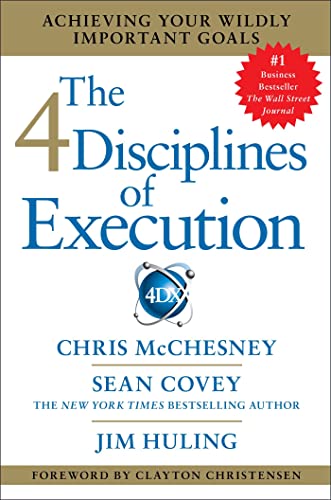
⚡️ What is The 4 Disciplines of Execution About?
Have you ever noticed how a brilliant new strategy usually dies a quiet, unnoticed death? It’s rarely because the idea was bad; it’s because the day job—what the authors call the “whirlwind”—simply ate it alive. More summaries by Chris McChesney, Sean Covey, Jim Huling explore this friction between the urgent and the truly important. The authors argue that execution isn’t a problem of intelligence, but of discipline. They offer a concrete operating system to ensure your most vital goals actually happen while you’re still answering 200 emails a day.
Chris McChesney and his team spent years studying why some organizations could move the needle while others just spun their wheels. They realized that leaders often confuse strategy with execution. Strategy is the map; execution is the actual walking. This book, a staple in management book summaries, provides four specific rules to stop the whirlwind from suffocating your progress. It’s about doing less to achieve more—a counter-intuitive move for any high-achiever.
🚀 The Book in 3 Sentences
- Execution fails because urgent daily tasks (the whirlwind) always beat out important strategic goals that don’t have an immediate deadline.
- Success requires focusing on a single “Wildly Important Goal” (WIG) and tracking lead measures—things you can influence—rather than just results.
- The secret sauce is a simple, weekly rhythm of accountability where team members commit to small, visible wins in front of their peers.
🎨 Impressions
I’ll be honest: when I first picked this up, I expected another dry corporate manual full of empty buzzwords. I was wrong. The authors aren’t just theorists; they sound like people who have been in the trenches, trying to get a distracted sales team or a messy hospital floor to change their behavior. The distinction between “lead” and “lag” measures was a lightbulb moment for me. How often have we stared at a monthly revenue report (a lag measure) and felt helpless because we can’t change the past? It’s frustrating, isn’t it?
The writing is punchy, though it does get a bit repetitive in the middle sections as they try to prove the system works across every possible industry. I found the “whirlwind” analogy incredibly validating. It finally gave a name to that feeling of being busy all day but accomplishing nothing of substance. It’s a book for anyone who feels like they’re running a marathon on a treadmill. You’re working hard, but you’re not actually going anywhere.
📖 Who Should Read This Book?
If you’re a manager who is tired of setting Q1 goals that everyone forgets by February, this is your bible. It’s also perfect for small business owners who are drowning in operations and can’t find time to actually grow the business. However, if you’re a solo creative looking for a “productivity hack,” you might find the organizational focus a bit heavy. This is a system for teams. If you don’t have a team to hold accountable (or be held accountable by), the magic of Discipline 4 is lost on you.
☘️ How This Book Changed My Thinking
Before reading this, I thought execution was about willpower and better to-do lists. I used to think that if I just worked an hour later, I’d get to the “important stuff.” Now, I realize that the important stuff will never happen unless I radically narrow my focus and build a “scoreboard” for it.
- I stopped trying to hit five big goals and started obsessing over just one “Wildly Important Goal” at a time.
- I shifted my focus from results (lag) to behaviors (lead). I don’t track “money earned” as my primary metric anymore; I track “new pitches sent.”
- I realized that “keeping score” isn’t just for sports; if there isn’t a visible chart showing whether I’m winning or losing, I’m just practicing, not playing.
✍️ 3 Quotes That Stuck With Me
- “When urgency and importance clash, urgency will win every time.” — This explains why your inbox is always full while your big dreams sit on the shelf.
- “People play differently when they are keeping score.” — It’s the difference between a casual shoot-around and the fourth quarter of a tie game.
- “If you ignore the urgent, it can kill you today… if you ignore the important, it can kill you tomorrow.” — A stark reminder that the whirlwind is necessary, but it’s not the mission.
📒 Summary + Notes
The central thesis is that there are two things a leader can influence: strategy and execution. Strategy is often seen as the “hard” part, but execution is where the real bodies are buried. Most leaders fail because they try to execute too many things at once. The authors want you to believe that the key to breakthrough results is a “less is more” philosophy combined with a rigorous, weekly rhythm of checking in. It’s not about doing more work; it’s about doing the *right* work in the middle of a chaotic environment.
The narrative arc moves from defining the problem (The Whirlwind) to introducing the four specific disciplines that counteract it. Once you understand the disciplines, the book moves into the “how-to” of installation. It’s a transition from theory to behavior change. By the end, the authors make the case that execution is a skill that can be taught, measured, and perfected, regardless of your industry or the current state of your “whirlwind.”
🧠 Core Ideas Explained Simply
The 4DX framework relies on a few concepts that might sound like standard business speak but have very specific, practical meanings.
The Whirlwind vs. Strategy
Imagine you’re trying to build a new house, but you have to spend 10 hours a day putting out small fires in your current apartment. The fires are the “whirlwind”—the urgent daily tasks required to keep the lights on. The new house is your “strategy.” The mistake most people make is trying to do both at the same time without a clear boundary. The whirlwind always wins because it’s loud and immediate.
Lead vs. Lag Measures
A lag measure tells you if you’ve achieved the goal (e.g., profit, weight loss, customer satisfaction). By the time you see it, the performance that drove it is already gone. A lead measure is predictive and influenceable (e.g., cold calls made, calories burned, response time). If you focus on the lead measure, the lag measure takes care of itself. It’s the difference between looking at the scoreboard and looking at the ball.
Discipline 1: Focus on the Wildly Important
How many priorities can a human brain actually handle before it just checks out? The authors are brutal here: if you have 2-3 goals, you’ll likely achieve them all. If you have 4-10 goals, you’ll achieve 1 or 2. If you have 11-20 goals, you’ll achieve none. The first discipline is about narrowing your focus to one (or at most two) “Wildly Important Goals” (WIGs) that cannot be achieved through the whirlwind alone.
A WIG must be expressed in a specific format: “From X to Y by When.” For example, “Increase revenue from $10M to $12M by December 31st.” This clarity is vital. Without it, the goal remains a vague aspiration. Have you ever worked on a project where nobody actually knew what “success” looked like? That’s what this discipline kills. It forces you to say “no” to a dozen good ideas so you can say “yes” to one great one.
Discipline 2: Act on the Lead Measures
Ever tried to lose weight by only stepping on the scale once a week? It’s miserable, right? You have no idea if what you did on Tuesday actually mattered. This chapter introduces the “lever” of execution. While the WIG is your lag measure, the lead measures are the high-impact actions that will move the WIG. They must be something the team can actually control every day.
Finding the right lead measure is often the hardest part of the whole process. It requires identifying the 20% of activities that generate 80% of the results. If the goal is “zero accidents,” a lead measure might be “compliance with a safety checklist.” It’s boring, but it’s predictive. The authors argue that data on lead measures is the only thing that actually changes behavior in the moment.
Discipline 3: Keep a Compelling Scoreboard
Think about a pickup basketball game. When people are just shooting around, the energy is low. But the second someone starts keeping score, the intensity spikes. The same is true for your team. Discipline 3 is about creating a visible, simple scoreboard that tells the team—not the leader—if they are winning or losing. It shouldn’t look like a complex spreadsheet. It should look like a scoreboard you’d see at a high school gym.
A key insight here is that the scoreboard must be “for the players, by the players.” If the manager is the only one who updates it, it’s just another piece of corporate overhead. When the team sees the line going up because of their specific lead measures, they start to care. Do your employees actually know if they’ve had a “winning” day by 5:00 PM? If not, you’re missing Discipline 3.
Discipline 4: Create a Cadence of Accountability
What happens when the initial excitement of a new project wears off? Usually, the whirlwind sucks everyone back in. Discipline 4 is the “rhythm” that keeps the project alive. It’s a weekly “WIG Session”—a 20-minute meeting where the team accounts for their commitments, reviews the scoreboard, and makes new commitments for the coming week. No other business is allowed. No whirlwind talk.
This isn’t a top-down reporting session. It’s a peer-to-peer commitment session. Each person asks: “What are the one or two things I can do this week, outside of the whirlwind, that will impact the lead measures?” These are small, bite-sized tasks. The magic happens because people hate letting their teammates down. It turns the strategy into a series of weekly sprints rather than a yearly marathon.
Installing 4DX: The Stages of Change
Execution isn’t a light switch; it’s a process. The authors map out the psychological journey a team takes when implementing this system. It starts with clarity, moves into “launch” (which is always messy), and eventually hits the “valley of despair” where the whirlwind tries to reclaim its territory. This is where most leaders give up. They think the system isn’t working, when in reality, they’re just in the middle of the behavior change curve.
Understanding these stages—Clarity, Launch, Adoption, Optimization, and Habits—is crucial. If you know the “valley of despair” is coming, you won’t panic when the team gets frustrated. The goal is to make these disciplines a habit. Eventually, the 4DX process becomes part of the whirlwind itself, but in a way that actually moves the organization forward rather than just keeping it afloat.
⚖️ A Critical Perspective
While the 4DX framework is incredibly robust, it feels very “command and control” at times. It assumes a traditional hierarchy where goals trickle down from the top. In today’s world of flat organizations and remote, autonomous teams, the rigid weekly meeting might feel a bit suffocating. Also, the book largely ignores the emotional or cultural side of why people don’t execute—like burnout or lack of belief in the mission. It treats execution as a mechanical problem, but sometimes it’s a heart problem. Finally, the focus on a single WIG is great for focus, but in a rapidly shifting market, it risks making an organization too slow to pivot if that one goal becomes irrelevant mid-year.
🔄 How It Compares
Compared to Jim Collins’ Good to Great, which focuses on the high-level “hedgehog concept” and leadership qualities, 4DX is much more tactical. Collins tells you *what* an elite company looks like; McChesney tells you *how* to make your frontline employees act like they’re in an elite company. It’s also a great companion to Measure What Matters by John Doerr. While Doerr’s OKRs (Objectives and Key Results) are about setting the right targets, 4DX is the specific weekly operating system to make sure those OKRs don’t just sit in a Google Doc.
🔑 Key Takeaways
If you want to turn your strategy into reality, keep these four shifts in mind:
- **Saying no is a requirement for success.** You have to reject “good” ideas to protect your “wildly important” one.
- **Stop managing by the rearview mirror.** Stop obsessing over results (lag) and start obsessing over the behaviors that drive them (lead).
- **Visuals beat spreadsheets.** If a team can’t tell if they’re winning within five seconds of looking at a chart, the chart is useless.
- **The cadence is the cure.** Consistency in small, weekly commitments is more powerful than a one-off “strategic retreat” once a year.
💬 Frequently Asked Questions
What is the main difference between the whirlwind and a WIG?
The whirlwind is the urgent daily activity required to keep the business running (emails, meetings, crises). A WIG (Wildly Important Goal) is a strategic breakthrough that requires doing something different from the status quo. The whirlwind keeps you alive today; the WIG ensures you thrive tomorrow.
What are examples of lead and lag measures?
A lag measure is a result like “total revenue” or “customer churn rate.” You can’t change these once you see them. A lead measure is an action like “number of sales demos performed” or “time taken to answer a support ticket.” Lead measures are predictive and directly influenceable by the team.
Why does execution usually fail in large organizations?
Execution fails because of the “whirlwind” effect. Urgent day-to-day tasks always take precedence over strategic goals that lack immediate deadlines. Without a specific system like 4DX to provide focus and accountability, the energy required for strategy is slowly drained by the noise of operational maintenance.
How do 4DX and OKRs differ?
OKRs (Objectives and Key Results) are a goal-setting framework focused on alignment and transparency. 4DX is an execution operating system focused on behavior change. OKRs tell you what you want to achieve; 4DX provides the specific, weekly discipline and cadence needed to actually hit those targets in a busy environment.
Is 4DX applicable to individual productivity?
While designed for teams, the principles work for individuals. You can define a personal WIG, track lead measures, and keep a scoreboard. However, the true power of 4DX lies in the social pressure and support of the “cadence of accountability,” which is harder to replicate when working alone.
Conclusion
At the end of the day, The 4 Disciplines of Execution is a challenge to our ego. It’s an admission that we aren’t as good at multitasking as we think we are, and that our big, fancy strategies are worthless if the person on the front line doesn’t know what to do on Tuesday morning. It’s a book about the humility of focus. It asks us to stop being “busy” and start being effective.
If you take away nothing else, remember this: the whirlwind isn’t going away. It’s always going to be loud, urgent, and demanding. The only way to win is to build a protected space for your WIG and a scoreboard that keeps your head in the game. That is how you stop spinning your wheels and start making real progress. It’s a journey from the chaos of the whirlwind to the clarity of the win.
More From Chris McChesney, Sean Covey, Jim Huling →
Discover more from AI Book Summary
Subscribe to get the latest posts sent to your email.