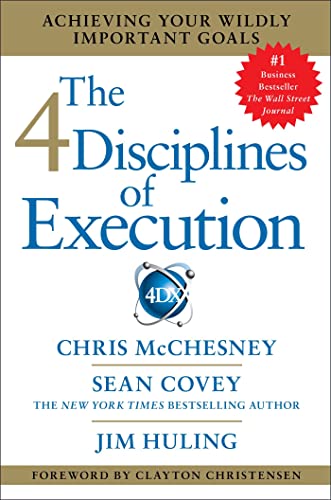
⚡️ What is The 4 Disciplines of Execution about?
The 4 Disciplines of Execution is a practical guide to achieving your most important goals in the midst of daily chaos. The authors, Chris McChesney, Sean Covey, and Jim Huling, argue that the biggest obstacle to success isn’t a lack of strategy, but the “whirlwind” of urgent day-to-day tasks that consume our time and energy. This book presents a simple, repeatable, and proven formula—The 4 Disciplines of Execution (4DX)—for executing on your most critical priorities. It’s an operating system that separates the truly important from the merely urgent, enabling teams and individuals to break through to new levels of performance. The system is designed to create focus, leverage, engagement, and accountability, turning strategic goals into a reality.
🚀 The Book in 3 Sentences
- The primary reason strategic goals fail is the daily “whirlwind” of urgent tasks that crowds out important, long-term objectives.
- The 4 Disciplines of Execution provides a systematic framework to overcome this by focusing on a Wildly Important Goal, acting on lead measures, keeping a compelling scoreboard, and creating a cadence of accountability.
- By implementing these four disciplines, teams can fundamentally change their behavior, become deeply engaged in their goals, and achieve results that were previously considered out of reach.
🎨 Impressions
My impression of The 4 Disciplines of Execution is that it’s remarkably simple yet profoundly powerful. It’s not filled with abstract theories but with a concrete, actionable system that any team can implement. I was impressed by how directly it addresses the universal struggle of balancing the urgent with the important. The concept of the “whirlwind” immediately resonated with my own experience. The book’s strength lies in its clarity and the logical flow of the four disciplines, each one building on the last. It feels less like a business book and more like a practical field guide for getting things done, making it an invaluable resource for anyone who leads a team or has ambitious goals.
📖 Who Should Read The 4 Disciplines of Execution?
\p>This book is essential reading for leaders, managers, and entrepreneurs who feel their teams are working hard but not making progress on key strategic initiatives. It’s perfect for project managers, department heads, and C-suite executives who are responsible for translating vision into results. If you’re frustrated by goals that are consistently missed or a team that is reactive rather than proactive, the strategies within The 4 Disciplines of Execution will provide a clear path forward. It’s also highly valuable for anyone in an individual contributor role who wants to improve their personal effectiveness and contribution to their team’s most important objectives.☘️ How the Book Changed Me
Reading this book fundamentally shifted my perspective on goal-setting and productivity. I moved from being overwhelmed by a long to-do list to being fiercely focused on one or two outcomes that truly matter. The most significant change was in how I measure progress; I now obsess over lead measures instead of just lag measures. This has made my efforts more predictive and effective. My approach to team meetings has been transformed, moving from status updates to dynamic WIG sessions that drive real accountability and forward momentum.
- I started identifying and ruthlessly prioritizing my own “Wildly Important Goals,” both personally and professionally.
- I began tracking lead measures weekly, which gave me a sense of control and influence over my results.
- I introduced a simple, visible scoreboard for my team’s key project, which dramatically increased engagement and ownership.
✍️ My Top 3 Quotes
- “When urgency and importance clash, urgency will win every time.”
- “People play differently when they are keeping score.”
- “If you ignore the urgent, it can kill you today…if you ignore the important, it can kill you tomorrow.”
📒 Summary + Notes
The 4 Disciplines of Execution introduces an operating system designed to help leaders and teams execute their most important strategic goals amidst the daily “whirlwind.” The authors argue that traditional management approaches fail because they don’t account for the relentless pressure of urgent, day-to-day operations. The 4DX framework is built on four simple but powerful rules that create a culture of execution. By focusing on a Wildly Important Goal (WIG), acting on lead measures, keeping a compelling scoreboard, and creating a cadence of accountability, teams can break free from the whirlwind and achieve breakthrough performance. The following chapters break down each discipline and provide a practical guide for implementation.
Section 1: The Problem
Chapter 1: The 4 Disciplines of Execution
This introductory chapter sets the stage by outlining the core problem: there is a massive gap between what companies want to achieve and their ability to execute. The authors introduce The 4 Disciplines of Execution as a proven solution to this gap. They are not presented as separate, standalone techniques but as an integrated system that must be implemented together. The four disciplines are briefly introduced: Focus on the Wildly Important Goal, Act on Lead Measures, Keep a Compelling Scoreboard, and Create a Cadence of Accountability. The chapter emphasizes that execution is the greatest challenge in business today and that 4DX is designed to create a new set of behaviors that are essential for winning.
- The primary challenge is not strategy, but executing on the strategy in the face of daily demands.
- 4DX is a complete operating system, not just a collection of good ideas.
- The disciplines are designed to work together to produce breakthrough results.
- The goal is to create lasting behavioral change within a team or organization.
- Execution fails because the “whirlwind” of urgent tasks consumes all our time and energy.
Chapter 2: The Whirlwind
This chapter dives deep into the main antagonist of execution: the whirlwind. The whirlwind is defined as the massive amount of energy required to keep your operation going on a day-to-day basis. It consists of all the urgent tasks that are necessary for survival but prevent you from moving forward on new, strategic goals. The authors make a crucial point: you cannot ignore the whirlwind, but you also cannot let it consume you. The key to execution is learning how to operate within the whirlwind while simultaneously dedicating focused time and energy to your Wildly Important Goals. This chapter effectively validates the reader’s daily struggles and frames them as the central problem that 4DX is designed to solve.
- The whirlwind is the enemy of strategic execution; it’s the day-to-day chaos that demands your attention.
- Urgency will always win over importance unless you have a system to protect the important.
- You must manage the whirlwind (the day job) while executing on new goals (the new job).
- The goal of 4DX is not to eliminate the whirlwind but to execute in spite of it.
- Trying to push too many new goals into the whirlwind will result in failure on all fronts.
Section 2: The 4 Disciplines
Chapter 3: Discipline 1 – Focus on the Wildly Important Goal
The first discipline is about narrowing your focus. You can’t do everything, so you must choose what’s most important. A Wildly Important Goal (WIG) is a goal that can make all the difference to your organization. The rule of this discipline is that no more than two WIGs should be identified for a team at any given time. The authors provide a clear formula for defining a WIG: “from X to Y by when.” This ensures the goal is specific, measurable, and time-bound. The chapter emphasizes the importance of translating broad organizational strategy into clear, compelling WIGs for every level of the team. This focus is what allows a team to break through the noise of the whirlwind and achieve something truly significant.
- A WIG is a goal so critical that failing to achieve it makes other achievements inconsequential.
- The rule is to focus on no more than 1-2 WIGs per team at a time to ensure maximum impact.
- Every WIG must be expressed in the format: “from X to Y by when” to ensure clarity.
- Senior leaders should set the overall WIG, but allow teams to create their own supporting WIGs.
- The first discipline requires making tough choices and consciously saying “no” to good ideas.
Chapter 4: Discipline 2 – Act on Lead Measures
This chapter introduces the most strategic and often most challenging discipline. It distinguishes between lag measures and lead measures. Lag measures track the results you’re trying to improve (e.g., revenue, weight loss), but you can’t directly influence them. Lead measures are the high-impact actions that predict future success on the lag measures and are directly within your team’s control. The authors state that a good lead measure must be both predictive (it influences the lag measure) and influenceable (the team can impact it). This discipline forces teams to stop focusing on past results and start focusing on the activities that will drive future success. Finding the right lead measures is the key to unlocking breakthrough performance.
- Lag measures are the results (e.g., sales revenue); lead measures are the actions that drive those results (e.g., sales calls).
- Lead measures are the two levers you can pull to move the lag measure: predictive and influenceable.
- This discipline shifts the team’s focus from outcomes they can’t control to behaviors they can.
- Identifying true lead measures requires deep thinking and a clear understanding of what drives success.
- Acting on lead measures gives the team a sense of agency and control over achieving the WIG.
Chapter 5: Discipline 3 – Keep a Compelling Scoreboard
Discipline 3 is about engagement. The authors argue that people play differently when they are keeping score. A compelling scoreboard is designed for the players, not the coaches. It must be simple, visible to everyone, and show at a glance whether the team is winning or losing. The chapter outlines the five criteria for a great scoreboard: it’s simple, it shows the lead and lag measures, it’s visible to everyone, it’s updated quickly, and it creates a clear line between performance and the goal. The purpose of the scoreboard is to motivate the team by making the game real. When team members can see the impact of their actions on the score in real-time, their level of engagement and accountability skyrockets.
- A great scoreboard is designed for the players, providing instant feedback on whether they are winning or losing.
- It must be simple enough to be understood in five seconds.
- The scoreboard should display both the lead measures (the game) and the lag measure (the score).
- Visibility is key; it must be in a place where the team can see it all the time.
- A compelling scoreboard creates a sense of urgency, competition, and camaraderie within the team.
Chapter 6: Discipline 4 – Create a Cadence of Accountability
The final discipline is what makes the system work over time. It’s about creating a rhythm of regular and frequent team meetings focused on the WIG. These are not typical staff meetings; they are WIG sessions. The authors recommend a weekly meeting of no more than 20-30 minutes. The agenda is simple: review the scoreboard, account for past commitments on lead measures, and create new commitments for the upcoming week. This cadence of accountability ensures that the WIG remains top-of-m amidst the whirlwind. It creates a powerful cycle where the team is constantly learning, adapting, and holding each other accountable for the most important work.
- The WIG session is a short, weekly meeting focused exclusively on the Wildly Important Goal.
- The agenda is fixed: review the scoreboard, account for past commitments, and plan for the next week.
- This discipline creates a powerful rhythm of peer-to-peer accountability.
- It’s the driver of execution, ensuring that the team consistently acts on the lead measures.
- The WIG session is where the team learns what works and what doesn’t, allowing for rapid course correction.
Section 3: Installing 4DX in Your Organization
Chapter 7: The Five Stages of Change
This chapter explores the behavioral journey teams go through when implementing 4DX. The authors outline five predictable stages: Getting Clear, Launch, Adoption, Optimization, and Habits. In the “Getting Clear” stage, the leader must achieve clarity on the WIG, lead measures, and scoreboard. “Launch” is the initial kickoff meeting. “Adoption” is where the team starts to use the system, often clumsily at first. “Optimization” is when the team begins to refine their lead measures and processes. Finally, “Habits” is when 4DX becomes part of the team’s DNA. Understanding these stages helps leaders anticipate challenges and manage their team’s expectations, providing the right support at each phase of the implementation journey.
- Stage 1: Getting Clear – The leader must have absolute clarity on the WIG and lead measures before launching.
- Stage 2: Launch – A high-energy kickoff meeting to introduce the 4DX system to the team.
- Stage 3: Adoption – The team begins to use the system; this is often the messiest stage.
- Stage 4: Optimization – The team refines its approach, improving lead measures and strategies based on data.
- Stage 5: Habits – The 4 disciplines become a natural and integrated part of the team’s operating rhythm.
Chapter 8: The 4DX Meeting
This chapter provides a detailed playbook for running the weekly WIG session, the engine of Discipline 4. The authors stress that this meeting must be protected from the whirlwind and never be canceled or postponed. They provide a precise, 20-30 minute agenda: a quick review of the scoreboard (5 minutes), a review of the past week’s commitments (5-10 minutes), and the creation of new commitments for the coming week (10-15 minutes). The focus is entirely on the lead measures. The chapter emphasizes that the leader acts as a facilitator, not a boss, in this meeting. The goal is to create an environment of open, honest accountability where team members hold each other responsible for their commitments.
- The 4DX meeting has a strict, non-negotiable agenda that must be followed every week.
- The meeting is fast-paced and focuses entirely on the team’s commitments to the lead measures.
- It is not a status report meeting for the leader; it’s a planning and accountability meeting for the team.
- The leader’s role is to coach and facilitate, not to solve problems or assign tasks.
- This weekly cadence is the most critical element for sustaining execution over the long term.
Chapter 9: The 4DX System at the Team Level
Here, the focus shifts to practical implementation for a single team. The authors provide a step-by-step guide for a leader to install the four disciplines with their direct reports. This includes how to identify the team’s WIG, brainstorm and select the best lead measures, design a compelling scoreboard, and launch the first WIG session. The chapter is filled with real-world examples and tips for overcoming common resistance. The key message is that 4DX is not a top-down mandate but a collaborative process. The leader’s job is to guide the team through the process so they feel ownership of the goal and the plan to achieve it. This is where the abstract system becomes a concrete reality.
- Installation starts with the leader clearly defining the team’s WIG in the “from X to Y by when” format.
- The team should be involved in brainstorming and selecting the lead measures to build buy-in.
- The scoreboard should be co-created with the team to ensure it is simple and compelling to them.
- The first WIG session is critical for setting the tone and establishing the rhythm of accountability.
- The leader must model the behaviors of 4DX and be the chief champion for the process.
Chapter 10: The 4DX System at the Organizational Level
Scaling 4DX from a single team to an entire organization presents unique challenges. This chapter addresses how to roll out 4DX across multiple levels and departments. The authors argue that it must start at the top, with the senior leadership team fully committed and operating under the same four disciplines. They outline a six-step process for organizational rollout, which includes creating a central 4DX team, aligning all departmental WIGs to the overall company WIG, and providing consistent training and support. The chapter also discusses how to measure the overall impact of 4DX on the organization’s performance. This is about creating a culture of execution that permeates every level of the company.
- Successful organizational rollout requires 100% commitment from the senior leadership team.
- All departmental WIGs must be aligned with and support the overall organizational WIG.
- A central 4DX implementation team is often needed to guide and support the rollout.
- Consistent communication and training are essential to ensure everyone understands the system.
- The goal is to create a “new normal” where executing on Wildly Important Goals becomes part of the company’s DNA.
Chapter 11: Committing to 4DX
The final chapter is a call to action. The authors argue that implementing The 4 Disciplines of Execution is not a one-time initiative but a long-term commitment to a new way of operating. They address common fears and excuses, such as a lack of time or resources, and reiterate that the cost of inaction—of remaining stuck in the whirlwind—is far greater. The chapter reinforces that the principles of 4DX are simple, but their application requires discipline and persistence. It ends with an inspiring message about the transformative power of execution and the incredible results that teams can achieve when they commit to focusing on what truly matters and holding themselves accountable to it.
- 4DX is not a quick fix; it’s a fundamental change in how you operate.
- The biggest barrier is not the complexity of the system, but the discipline to stick with it.
- The authors challenge leaders to make a choice: continue to be a victim of the whirlwind or commit to execution.
- The payoff for committing to 4DX is not just better results, but a more engaged and fulfilled team.
- The ultimate goal is to build an organizational culture where exceptional execution is the norm.
Key Takeaways
The core message of this book is that execution can be systemized. The 4 Disciplines of Execution provides a clear roadmap for overcoming the daily whirlwind and achieving your most important goals. The biggest takeaway is the power of extreme focus—choosing one or two Wildly Important Goals and dedicating your best energy to them. Another critical lesson is the distinction between lead and lag measures; focusing on predictive actions you can control is the key to influencing results. Furthermore, the book taught me that engagement comes from making the game visible with a simple scoreboard and that accountability is not an event but a rhythmic process.
- You must narrow your focus to no more than 1-2 Wildly Important Goals to achieve breakthrough results.
- Identify and act on lead measures—the predictive actions that drive your results—instead of just tracking lag measures.
- Create a player-focused scoreboard that is simple, visible, and instantly shows whether you are winning.
- Establish a weekly WIG session to create a powerful cadence of peer-to-peer accountability.
- The four disciplines work together as a complete system; you cannot pick and choose and expect the same results.
Conclusion
The 4 Disciplines of Execution is more than just a book; it’s a field guide for winning. It provides a timeless, repeatable, and practical framework for turning strategy into reality, even in the midst of overwhelming daily demands. By focusing on a Wildly Important Goal, acting on lead measures, keeping a compelling scoreboard, and creating a cadence of accountability, any team can break free from the whirlwind and achieve extraordinary results. This book has fundamentally changed how I approach goals and lead my team. If you’re looking to close the gap between your goals and your actual results, I highly recommend you read this book and commit to applying its powerful principles. It will equip you with the strategies and techniques you need to execute on what matters most.
More From Chris McChesney, Sean Covey, Jim Huling →
Discover more from AI Book Summary
Subscribe to get the latest posts sent to your email.