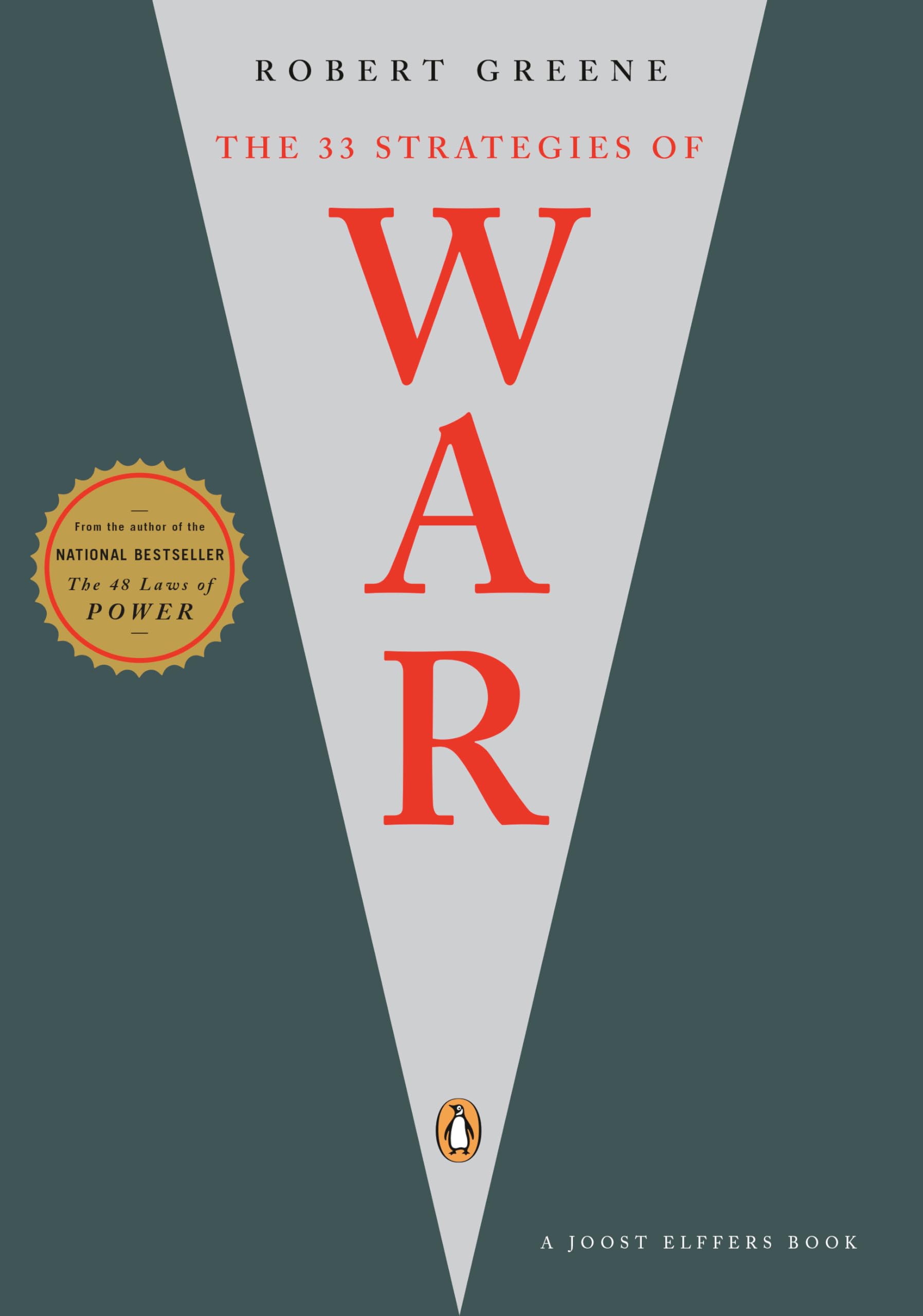
⚡️ What is The 33 Strategies of War About?
Most people think war is something that happens on a distant border or a map in a situation room. It’s not. According to More summaries by Robert Greene, war is the fundamental reality of human interaction. Whether it’s a passive-aggressive colleague, a competitive marketplace, or your own internal self-sabotage, you’re constantly in a state of conflict. The problem? Most of us are trained to be nice, to avoid friction, and to hope for the best. Greene argues that this “peace-at-all-costs” mindset is exactly what makes us victims.
The book is a brutal, clinical dissection of how power actually works when the gloves come off. It synthesizes thousands of years of military history—from Napoleon and Sun Tzu to Zulu warriors and modern political campaigns—to show that the same principles of deception, speed, and psychology apply to your board meeting or your family feud. If you’ve ever enjoyed psychology book summaries that look at the darker side of human nature, this is the masterclass. It isn’t just about winning; it’s about not being destroyed by those who play the game better than you do.
🚀 The Book in 3 Sentences
- Life is a state of perpetual conflict, and pretending otherwise only leaves you vulnerable to those who are strategically minded.
- The greatest battlefield is your own mind, where you must declare war on your own cowardice, rigid habits, and emotional reactivity.
- By mastering the 33 strategies—ranging from defensive maneuvers to unconventional “dirty” warfare—you gain the ability to navigate any social or professional hierarchy with detachment and precision.
🎨 Impressions
Reading this book feels like having a late-night drink with a very cynical, very brilliant retired general. It’s dense, it’s dark, and it doesn’t care about your feelings. I’ve read a lot of self-help that tells you to “manifest” success, but Greene tells you to prepare for a siege. There’s something deeply refreshing about his lack of sentimentality. He doesn’t tell you how the world should work; he shows you how it does work when people are fighting for resources, status, or survival.
I’ll admit, some chapters made me squirm. The section on “Unconventional Warfare” feels borderline sociopathic if you read it as a guide for your personal life. But that’s the point. Even if you don’t want to use these tactics, you’re almost certainly having them used on you. The moment I finished the chapter on “The Strategy of the Void,” I realized I’d been letting a specific person bait me into emotional reactions for months. I wasn’t being “authentic”; I was being outmaneuvered. Why did I wait so long to stop playing their game? This book provides the armor you didn’t know you were missing.
📖 Who Should Read The 33 Strategies of War?
If you’re in a high-stakes corporate environment, navigating a toxic social circle, or trying to scale a business in a cutthroat market, this is your Bible. It’s for the person who feels like they’re doing everything “right” but still losing to people who are more aggressive or manipulative. However, if you’re looking for a book on how to build healthy, vulnerable relationships or team-building through empathy, you should put this down immediately. This is a book for the arena, not the living room.
☘️ How This Book Changed My Thinking
Before reading this, I viewed conflict as a failure of communication. Now, I view it as a natural state of tension that requires a calculated response rather than an emotional one.
- I stopped trying to “win” every argument and started using the Counter-Attack Strategy—letting the other person vent and reveal their position first.
- I became much more protective of my time by applying the Perfect Economy Strategy, realizing that not every slight deserves a response.
- I’ve started creating my own “Death Ground” by setting deadlines that leave me no choice but to succeed or face real consequences.
✍️ 3 Quotes That Stuck With Me
- “Your days are numbered. Will you pass them half awake and halfhearted or will you live with a sense of urgency?” — This turns strategy from a business tool into a visceral philosophy of living.
- “Events in life mean nothing if you do not reflect on them in a deep way.” — A reminder that experience is just noise without the signal of analysis.
- “The best form of aggression is one hidden behind a loving exterior.” — This is chilling because it’s the strategy we see most often in polite society.
📒 Summary + Notes
Greene’s central thesis is that strategy is a mental discipline. It’s the ability to keep your head while everyone else is losing theirs. The book is structured to move from the internal to the external. First, you must fix your own mind (Part 1), then you must learn to lead a team (Part 2), and finally, you learn the mechanics of defense, offense, and psychological sabotage. The narrative arc suggests that all failure is ultimately a strategic failure—specifically, a failure of the mind to adapt to the present reality.
He wants you to believe that there is no such thing as a “fair fight.” The world is filled with people who will use your kindness against you. By the end of the book, the goal is to transform you from a reactive “emotional” soldier into a proactive “strategic” general. He strips away the myth of the genius leader and replaces it with the reality of the prepared analyst who uses speed, deception, and timing to win before the battle even starts.
🧠 Core Ideas Explained Simply
Some of Greene’s concepts are dense with historical references, but the core mechanics are actually quite intuitive once you strip away the muskets and horses.
1. The Polarity Strategy
Are you trying to be friends with everyone? Greene says that’s a recipe for weakness. This strategy is about defining yourself by what you are against. By identifying an enemy—even a metaphorical one—you gain a sense of purpose and a clear line of fire. It creates an internal “us vs. them” that focuses your energy and prevents you from drifting into apathy.
2. The Death Ground Strategy
Why do you procrastinate? It’s usually because you have a safety net. This strategy involves burning your bridges so that you have no choice but to fight for your life. When you put yourself in a situation where the only way out is through, your brain unlocks a level of focus and creativity that is impossible to reach when you’re comfortable.
3. The Strategy of the Void
How do you fight someone who isn’t there? This is about non-engagement. When an opponent tries to bait you into a fight, you give them nothing—no reaction, no anger, no presence. They end up swinging at air, exhausting themselves while you remain perfectly composed. It’s the ultimate power move in an era where everyone is desperate for your attention.
01: Declare War on Your Enemies (The Polarity Strategy)
Who are you actually fighting? Greene opens by suggesting that clarity comes from conflict. Most of us try to hide our antagonisms, but that just makes us fuzzy and directionless. You need an enemy. This doesn’t mean you need a physical villain; it means you need a clear sense of what you oppose. When you declare war on a specific injustice, a competitor, or even a bad habit, you stop diffusing your energy. You become a focused beam instead of a dim light bulb.
02: Do Not Fight the Last War (Guerrilla War of the Mind)
The biggest threat to your success is your own past experience. It sounds counterintuitive, doesn’t it? We’re told that experience is our greatest asset. But Greene argues that what worked for you yesterday is exactly what will sink you today. Why? Because the world has moved on, and you haven’t. You’re trying to apply old solutions to new problems. To survive, you have to be ruthlessly present. You have to be willing to kill your own favorite ideas the moment they stop serving you. Flexibility is the only true security.
03: Amidst the Turmoil of Events, Do Not Lose Your Presence of Mind (The Counterbalance Strategy)
Imagine you’re in a meeting and everything is going sideways. Someone attacks your integrity, the data is wrong, and your boss is looking at you for an answer. Most people panic or get defensive. Greene calls this losing your “presence of mind.” This chapter is about the internal discipline of staying calm when the building is on fire. It’s about detaching yourself from the immediate emotion so you can see the board clearly. If you can’t control your own nerves, you can’t control the outcome.
04: Create a Sense of Urgency and Desperation (The Death Ground Strategy)
There’s a famous story of a general who landed his troops on a hostile shore and immediately burned his own ships. His message was simple: win or die. That’s the “Death Ground.” We are at our best when our backs are against the wall. If you want to achieve something great, you have to stop giving yourself an out. Cut off the retreat. Make the consequences of failure so high that your survival instinct takes over and does the work for you.
05: Avoid the Snares of Groupthink (The Command-and-Control Strategy)
Why do committees always produce such mediocre results? Because everyone is trying to please everyone else. Greene warns against the modern obsession with horizontal leadership. He argues that while you want your team to feel involved, the actual command must be unified. If the lines of communication are blurred, your strategy will be diluted. You need a clear chain of command where the vision is protected from being “compromised” into oblivion by the group.
06: Segment Your Forces (The Controlled Chaos Strategy)
Napoleon’s secret wasn’t that he was smarter than everyone else; it was that his army was more modular. Most armies moved as one giant, slow block. Napoleon broke his into smaller groups that could move independently. In business, this means avoiding a massive, bloated hierarchy. If you can break your project into small, autonomous units that can react quickly to changes, you will run circles around a larger, more traditional competitor. Speed is a byproduct of structure.
07: Transform Your War into a Crusade (The Morale Strategy)
Logic doesn’t make people fight; meaning does. If you want a team that will work through the night and sacrifice for the cause, you can’t just give them a paycheck. You have to give them a crusade. You need to frame your goal in a way that makes it about more than money—it has to be about justice, or changing the world, or defeating a common enemy. People will do for a “cause” what they would never do for a “company.”
08: Pick Your Battles Carefully (The Perfect Economy Strategy)
We only have a finite amount of time and energy. Why are you wasting yours on petty arguments on Twitter or fighting for 2% more of a market that is dying anyway? This strategy is about the “economy” of war. It’s better to lose a small skirmish if it saves your energy for the big battle. Know your limits. Sometimes the best way to win is to simply walk away and let your opponent waste their energy fighting shadows.
09: Turn the Tables (The Counterattack Strategy)
Mid-thought: what if being the aggressor is actually a position of weakness? When you attack, you reveal your position and your strength. Greene suggests that often, the smartest move is to let the other person attack first. You bait them into making a move, watch how they deploy their resources, and then hit them exactly where they’ve left themselves exposed. It’s the strategy of the martial artist—using the opponent’s own momentum to throw them.
10: Create a Threatening Presence (Deterrence Strategies)
The best way to win a fight is to make sure it never happens. This is the art of deterrence. You need to cultivate a reputation for being a bit unpredictable, or even slightly irrational, when crossed. If people think the cost of attacking you is higher than the potential gain, they’ll leave you alone. It’s not about being a bully; it’s about making sure your borders are clearly marked and well-defended by your reputation.
11: Trade Space for Time (The Non-Intercourse Strategy)
When you’re facing a superior force, don’t stand and fight. Retreat. In the military, this is called trading space for time. In life, it might mean quitting a job that is destroying you or pulling back from a toxic friendship. By retreating, you buy yourself the time to regroup, gather resources, and wait for the enemy to get overconfident. Retreat is not defeat; it’s a strategic maneuver to ensure future victory.
12: Lose the Battles but Win the War (Grand Strategy)
Most people are obsessed with the “now.” They want the win today, the dopamine hit this afternoon. Grand Strategy is the ability to look 10 years down the line and sacrifice your short-term ego for a long-term goal. It means being willing to look like a loser today so that you can be the undisputed champion a decade from now. It’s the hallmark of every great leader in history: they had a map, not just a plan.
13: Know Your Enemy (The Intelligence Strategy)
How much do you actually know about the people you’re competing with? Not their LinkedIn bio—their fears, their insecurities, their childhood wounds. This chapter is about deep intelligence. You shouldn’t just guess what someone will do; you should know their character so well that their actions become predictable. Information is the ultimate leverage. If you know what drives a person, you can lead them exactly where you want them to go.
14: Overwhelm Resistance with Speed and Suddenness (The Blitzkrieg Strategy)
Speed kills. If you move fast enough, you don’t even need to be the strongest; you just need to be the most surprising. The Blitzkrieg strategy is about striking before the opponent has even finished their first cup of coffee. By the time they realize they’re in a fight, you’ve already taken the high ground. In a world of slow bureaucracies, the person who can decide and act in 24 hours what others do in a month will always win.
15: Control the Dynamic (Forcing Strategies)
Don’t react to others; make them react to you. This is the essence of “forcing.” You set the tempo of the interaction. You define the terms of the debate. If you let someone else set the agenda, you’ve already lost. Even if you’re the one being interviewed or the one in the junior position, you can control the dynamic by the questions you ask and the subtle cues you give. He who controls the frame controls the outcome.
16: Hit Them Where It Hurts (The Center-of-Gravity Strategy)
Every organization and every person has a single point of vulnerability—a center of gravity. If you hit ten different spots, you waste energy. If you hit that one spot, the whole structure collapses. This might be a specific person’s ego, a company’s cash flow, or a political candidate’s one dark secret. Don’t spray and pray. Analyze the situation until you find the pillar that holds everything up, then put all your force into knocking it down.
17: Divide and Conquer (The Strategy of the Part)
A unified enemy is a dangerous enemy. But no group is truly unified. There are always cracks, jealousies, and hidden agendas. Your job is to find those cracks and wedge them open. Sow distrust. Make the lieutenants question the captain. If you can break a large problem into smaller pieces, or a large team into bickering factions, you can defeat them one by one without ever having to face the full force of the group.
18: Expose and Attack Your Opponent’s Soft Flank (The Turning Strategy)
Why would you attack a front door when the back window is open? Direct confrontation is expensive and risky. The Turning Strategy is about flanking. Instead of arguing with someone’s main point, you attack their underlying assumptions. Instead of competing with a product on price, you compete on a feature they haven’t even thought about. Go where they aren’t looking. The most effective way to win is to make their strength irrelevant.
19: Envelop the Enemy (The Annihilation Strategy)
Sometimes, a partial victory is worse than no victory because the enemy lives to fight another day. This is the “Annihilation” strategy. It sounds harsh, but in business, it means creating a product so dominant that the competition simply vanishes. You don’t just want to be better; you want to surround the market so completely that there is no room for anyone else. Create a total environment that makes your presence inevitable and their presence impossible.
20: Maneuver Them into Weakness (The Ripening-for-the-Sickle Strategy)
Wait. Patience is a weapon. Sometimes you don’t need to do anything at all; you just need to wait for your opponent to exhaust themselves. You maneuver them into a position where they have to work harder and harder for smaller and smaller gains. You wait for the moment when they are tired, frustrated, and overextended. That’s when they are “ripe.” Only then do you move in for the kill. The best fruit is the one that falls into your hand.
21: Negotiate While Advancing (The Diplomatic-War Strategy)
Never stop fighting just because you’re talking. Most people think negotiation is a pause in the conflict. Greene says it’s just conflict by other means. You should keep applying pressure even while you’re at the table. If you stop your advance, you lose your leverage. The best deals are made when the other person realizes that every minute they don’t sign, their position gets worse. Negotiation is a tool of war, not a substitute for it.
22: Know How to End It (The Exit Strategy)
How you leave a situation determines your reputation for the next ten years. Messy breakups, bitter resignations, and lawsuits are all signs of poor strategic thinking. You should know your exit point before you ever enter. If you’ve won, don’t get greedy—take your winnings and go. If you’re losing, know when to cut your losses so you can fight again elsewhere. A clean ending is the ultimate mark of a pro.
23: Weave a Seamless Blend of Fact and Fiction (Misperception Strategies)
An analogy: if you want to catch a fish, you don’t just jump in the water; you use a lure. This chapter is about the art of deception. It’s about controlling what people see so they come to the wrong conclusions. If you’re weak, appear strong. If you’re about to attack from the left, make a lot of noise on the right. In the information age, reality is often less important than the perception of reality. He who controls the narrative controls the world.
24: Take the Line of Least Expectation (The Ordinary-Extraordinary Strategy)
Have you ever noticed how the most effective people are often the most boring-looking? They use the “ordinary” as a camouflage. They behave exactly as you expect them to—until the moment they don’t. By lulling people into a sense of predictability, you make your “extraordinary” move ten times more effective because they never saw it coming. Be a sheep in the streets, but a wolf in the sheets of your strategy.
25: Occupy the Moral High Ground (The Righteous Strategy)
Guilt is a powerful motivator. If you can frame your cause as the “moral” one, you gain an incredible advantage. You’re no longer fighting for profit; you’re fighting for “the people” or “the truth.” This makes your opponents look like villains, which dries up their support and boosts your own morale. It’s a cynical strategy, but look at any political campaign or corporate PR disaster—it’s the one that works every single time.
26: Deny Them Targets (The Strategy of the Void)
What happens when you punch a pillow? Nothing. You just get tired. This is the strategy of non-resistance. When someone attacks you, give them nothing to hit. Don’t defend yourself, don’t argue back, don’t even acknowledge the attack. By creating a “void,” you force the aggressor to waste their energy and reveal their intentions. Silence is often the most aggressive move you can make because it drives people insane with uncertainty.
27: Seem to Work for the Interests of Others While Furthering Your Own (The Alliance Strategy)
The best way to get what you want is to make other people think they’re getting what they want. This is the art of the alliance. You find people whose goals temporarily overlap with yours and you use their resources to move your agenda forward. You don’t need to own everything; you just need to be the one holding the leash of the alliances. Just remember: alliances are temporary. When the goals stop overlapping, you must be ready to walk.
28: Give Your Rivals Enough Rope to Hang Themselves (The One-Upmanship Strategy)
Sometimes the best thing you can do for an enemy is to encourage their worst instincts. If they’re arrogant, flatter them until they do something stupid. If they’re impulsive, bait them into an overreaction. You don’t need to defeat them; you just need to clear the way so they can defeat themselves. It’s a passive form of warfare that leaves your hands clean while your opponent destroys their own reputation.
29: Take Small Bites (The Fait Accompli Strategy)
If you try to take over the whole building at once, people will stop you. But if you just take one room? People might grumble, but they probably won’t fight. Then next week, you take another room. This is the “Fait Accompli.” You do things in such small increments that by the time people realize what’s happening, it’s already done. It’s too late to stop you, and the cost of reversing your progress is too high. Victory by a thousand tiny cuts.
30: Penetrate Their Minds (Communication Strategies)
Mid-thought: communication is just a more subtle form of war. You aren’t just “sharing information”; you’re trying to occupy the other person’s brain. You want your ideas to become their ideas. This chapter is about how to frame your messages so they bypass people’s natural defenses. Use stories, use metaphors, use their own language. If you can get someone to believe your idea was actually their idea, you have achieved the ultimate strategic conquest.
31: Destroy from Within (The Inner-Front Strategy)
The most dangerous enemy is the one already inside the walls. This is the strategy of infiltration. Instead of fighting an organization, you join it. You become indispensable. You learn its secrets. And then, when the time is right, you take control or dismantle it from the inside. It’s slower than an external attack, but it’s nearly impossible to defend against. If you want to change a system, you often have to become the system first.
32: Dominate While Seeming to Submit (The Passive-Aggression Strategy)
We’ve all dealt with this, but Greene frames it as a high-level siege tactic. Passive aggression is the weapon of the seemingly powerless. By being “difficult,” by “forgetting” things, by being subtly unhelpful, you can stall a superior force indefinitely. You never give them a reason to fire you or attack you, but you make their life so miserable that they eventually give in to your demands. It’s the strategy of the slow-down.
33: Sow Uncertainty and Panic Through Acts of Terror (The Chain-Reaction Strategy)
Greene closes with the most controversial strategy: the use of fear to cause a total breakdown. This isn’t about physical violence; it’s about psychological terror. It’s about doing something so unexpected and so bold that it causes your opponents to lose their grip on reality. They panic. They overreact. They make huge mistakes. In the chaos that follows, a single disciplined mind can take control of everything. It’s the ultimate dark art of strategy.
⚖️ A Critical Perspective
While the historical depth is staggering, there’s a massive blind spot here: the power of radical cooperation. In the 2025 landscape of open-source projects and transparent startups, Greene’s “dirty” tactics can often backfire. If you’re caught using the “Righteous Strategy” or “Infiltration” in a world of high-speed information, your reputation can be nuked in an afternoon. Greene assumes everyone is a secret enemy, which is a great way to stay safe but a terrible way to build something truly innovative. Sometimes, the best strategy is actually to be a decent human being—something this book treats as a quaint tactical error.
🔄 How It Compares
Compare this to The 48 Laws of Power and you’ll find it’s much more practical for day-to-day friction. While 48 Laws is about gaining status, 33 Strategies is about resolving (or winning) active conflict. It’s a much more “active” book. Where 48 Laws tells you to be a statue of power, 33 Strategies tells you how to move, strike, and defend in the middle of a chaotic battle.
🔑 Key Takeaways
These are the fundamental shifts you need to make to stop being a target and start being a strategist.
- Detachment is Power: Your emotions are the enemy’s best friend. If you can’t stay calm, you can’t win.
- Deception is Essential: Everyone is hiding something; you must learn to read the reality beneath the surface.
- Urgency is the Only Catalyst: You will only reach your full potential when failure is not an option.
- Reputation is a Weapon: It is better to be feared and respected than to be “nice” and ignored.
💬 Frequently Asked Questions
Is The 33 Strategies of War a sequel to The 48 Laws of Power?
Think of it as a companion rather than a sequel. While 48 Laws focuses on the social cues of status and dominance, this book is specifically about conflict and navigation of high-stress competitive environments. It is more focused on the psychology of action and response during active power struggles.
Are the strategies in this book actually moral or ethical?
Robert Greene writes from an amoral perspective. He argues that strategy itself is a tool, much like a hammer. Whether it is used to build or destroy depends on the person wielding it. He believes understanding these “dirty” tactics is essential for self-defense, even if you never use them.
Who is the target audience for Robert Greene’s books?
Anyone operating in high-stakes environments—business leaders, politicians, and creatives—will find value here. However, it’s also widely read by people who feel they have been consistently taken advantage of by others. It provides a toolkit for those who need to sharpen their social awareness and self-protection.
What is the most famous strategy in the book?
The “Death Ground” strategy is arguably the most cited. It refers to the psychological state where you have no choice but to succeed or face ruin. Modern entrepreneurs often use this concept when they quit their jobs to focus entirely on a startup, leaving themselves no safety net.
Why does the author use so much military history?
Greene uses military history because the stakes of war—life and death—reveal human psychology in its purest, most desperate form. He argues that the strategies used by generals like Napoleon or Sun Tzu are timeless because human nature has not changed, only the tools we use have.
Conclusion
The 33 Strategies of War is not a comfort read. It’s a cold shower for the soul. It forces you to look at your life and admit where you’re being lazy, where you’re being naive, and where you’re letting others dictate the terms of your existence. It’s a dense, challenging manual that demands you stop hoping for things to get better and start making them better through the application of will and intelligence.
If you take only one thing away from this book, let it be this: you are responsible for the outcome of your conflicts. You can’t blame an “unfair” opponent for your own lack of strategy. Whether you want to lead an army or just navigate your office politics without losing your mind, the principles of presence, speed, and detachment will serve you. This is the ultimate guide to psychology book summaries that matter in the real world. Now, go burn your ships.
More From Robert Greene →
Discover more from AI Book Summary
Subscribe to get the latest posts sent to your email.