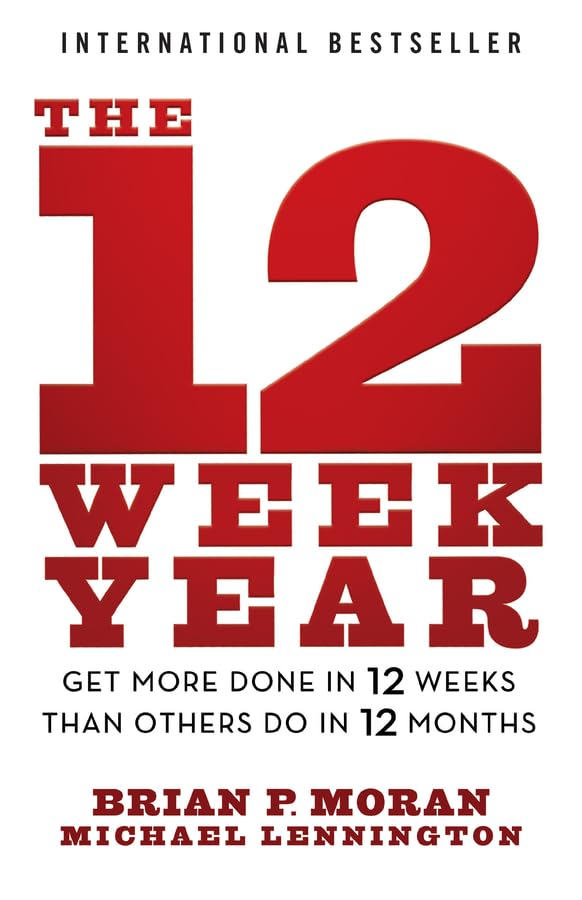
⚡️ What is The 12 Week Year About?
Have you ever noticed how everyone in the office suddenly becomes a high-performer in November and December? It’s that year-end panic. We realize we’ve spent nine months coasting and only have weeks left to hit our numbers. In More summaries by Brian P. Moran, the author argues that this “annualized thinking” is actually a trap. It gives us the illusion that we have plenty of time, which is just another way of saying we have plenty of time to procrastinate.
The central thesis of this framework is simple but aggressive: replace your 12-month calendar with a 12-week cycle. By redefining a “year” as just 12 weeks, you create a permanent sense of urgency. There is no “mid-year slump” because there is no mid-year. Every week counts as a month; every day counts as a week. This isn’t just about working harder; it’s about narrowing your focus to the few activities that actually move the needle. If you’re tired of setting New Year’s resolutions that die by February, Productivity book summaries like this one offer the tactical manual you’ve been looking for.
🚀 The Book in 3 Sentences
- Annual planning creates a false sense of security that leads to procrastination; 12-week cycles force immediate action by making the deadline visible at all times.
- Success isn’t about knowing what to do, but about closing the “execution gap” through rigorous weekly scoring and lead-indicator tracking.
- By using intentional time blocking and a compelling personal vision, you can produce more in three months than most people manage in an entire year.
🎨 Impressions
I’ll be honest: when I first picked this up, I thought it was going to be another “hustle harder” manifesto. I expected to find advice on drinking more coffee and sleeping less. Instead, I found a deeply logical system for managing focus. It’s actually a bit dry in parts—it reads more like a corporate operations manual than a self-help book—but that’s secretly its greatest strength. It doesn’t want to inspire you; it wants to give you a dashboard.
The part that really stuck with me was the emphasis on scoring. I’ve always been good at making to-do lists, but I’ve been terrible at holding myself accountable when I don’t finish them. Moran’s system of “Weekly Execution Scores” turned my productivity into a game. It’s uncomfortable to see a 45% score on your Friday review, but it’s the exact slap in the face I needed to stop lying to myself about how busy I was versus how productive I was actually being.
📖 Who Should Read The 12 Week Year?
This is a must-read for entrepreneurs and freelancers who struggle with the lack of structure in their days. If you’re someone who feels like you’re constantly “busy” but your bank account or project list isn’t moving, this will fix your alignment. However, if you’re looking for a book on how to find your passion or “dream big” without the math, you’ll probably hate this. It’s for the person who already knows what they want but can’t seem to get their hands to do the work.
☘️ How This Book Changed My Thinking
Before reading this, I viewed my year as a marathon where I could afford a few slow miles in the beginning. Now, I view my time as a series of 100-meter sprints.
- I stopped tracking “Results” (money made, pounds lost) as my primary metric and started tracking “Execution” (did I do the workout, did I make the calls).
- I killed my 12-month goal list. It’s too long and too vague. I now only care about what happens between now and the next 84 days.
- I realized that “work-life balance” is a myth; instead, I use Moran’s idea of “intentional imbalance” to go all-in on specific goals for short bursts.
✍️ 3 Quotes That Stuck With Me
- “When you’re committed to something, you accept no excuses, only results.” — This reminds me that most of my ‘reasons’ for missing a task are just sophisticated lies.
- “Measurement drives the execution process. It is your touchstone with reality.” — Without numbers, we are all just optimists guessing at our progress.
- “Accountability is first a mind-set, then an action.” — It’s about taking ownership before the result happens, not just apologizing afterward.
📒 Summary + Notes
The core of the book is about bridging the gap between what we know and what we actually do. Most of us don’t have a knowledge problem; we have an execution problem. Moran explains that annual goals are actually detrimental to high performance because the deadline is too far away to influence today’s behavior. By the time we feel the pressure of a December deadline, it’s often too late to change the outcome.
To fix this, the system uses a 12-week cycle followed by a 13th week for reflection and celebration. This rhythm mimics the “end-of-year” push four times a year instead of once. The book provides a rigid structure consisting of a compelling vision, a 12-week plan with specific tactics, and a weekly scorecard that measures how many of your planned tactics you actually completed. By the end of the book, Moran wants you to believe that your results are a direct byproduct of your weekly execution score, and if you fix the score, the results take care of themselves.
01: The Challenge
Why does productivity usually spike at the end of the year? Moran starts by pointing out the absurdity of the “annualized thinking” that most companies and individuals use. We treat January like it doesn’t matter because we have eleven more months to catch up. This creates a cycle of complacency followed by a frantic, stressful finish. The challenge isn’t that we aren’t capable; it’s that our timeframe is working against our psychology.
02: Redefining the Year
What if December 31st happened every twelve weeks? This chapter introduces the core concept: 12 weeks equals one year. In this new reality, there is no “next month.” A week is now the equivalent of a month, and a day is the equivalent of a week. This shift in perspective eliminates the “I’ll start next Monday” syndrome because the end of the year is always just around the corner. It forces you to be much more selective about which goals you pursue, as you simply don’t have time for fluff.
03: The Emotional Cycle of Change
There’s a moment about three weeks into any new plan where the excitement wears off and the hard work sets in. Moran maps out the emotional journey of change: Uniformed Optimism, Informed Pessimism, the Valley of Despair, Informed Optimism, and finally, Success. Most people quit in the “Valley of Despair.” The 12-week structure is designed to help you navigate this valley by giving you a short enough horizon that the “light at the end of the tunnel” stays visible even when things get tough.
04: The 12 Week Year
So, how does this actually look in practice? This chapter provides the high-level framework of the system. It’s built on three core principles—Accountability, Commitment, and Greatness in the Moment—and five disciplines: Vision, Planning, Process Control, Measurement, and Time Use. It’s a holistic system. If you try to do the planning without the measurement, you’ll fail. If you do the measurement without the vision, you’ll burn out. You need the whole engine to move the car.
05: Establish Your Connection to the Future
Why would you bother doing all this hard work if you don’t have a reason? Moran argues that execution starts with a compelling vision. Not a “corporate mission statement” type of vision, but a personal, emotional one. You need a 10-year vision that feeds into a 3-year vision, which eventually dictates your current 12-week goals. Without this link, the daily tactics feel like a chore rather than a choice. I found this section surprisingly deep; it’s the “fuel” for the rest of the mechanical system.
06: Build a 12 Week Plan
Imagine trying to build a house without a blueprint. Most people’s “plans” are actually just lists of desires. This chapter teaches you how to write a real plan.
- Select no more than 1–3 goals for the 12 weeks.
- Break each goal down into the specific, daily tactics required to achieve it.
- Each tactic must start with a verb and be measurable.
The goal is to make the plan so clear that you don’t have to think about *what* to do when you sit down at your desk; you just have to do it.
07: Install Process Control
Willpower is a finite resource, so why do we rely on it so much? Process control is about building structures that keep you on track when your motivation fails. The most important tool here is the “Weekly Plan.” This is a subset of your 12-week plan that lists only the tactics due *this week*. Moran also suggests a “Weekly Accountability Meeting” (WAM) where you review your progress with a peer or a group. It’s much harder to slack off when you have to report your failures to someone else every Monday morning.
08: Keep Score
How do you know if you’re actually winning? Most people look at “lag indicators”—the money in the bank or the weight on the scale. But you can’t control lag indicators; you can only control “lead indicators” (the actions). Moran insists on a weekly execution score: the percentage of tactics from your weekly plan that you actually completed. The magic number is 85%. If you hit 85% of your tactics, you will almost certainly reach your goals. It shifts the focus from “Did I get the result?” to “Did I do the work?”
09: Take Back Your Time
If you don’t control your time, your time will control you. This was the chapter I dog-eared most. Moran introduces a performance-based schedule using three types of time blocks:
- Strategic Blocks: 3 hours of uninterrupted time for deep work on your 12-week tactics.
- Buffer Blocks: 30–60 minutes for the low-value reactive stuff like email and phone calls.
- Breakout Blocks: 3 hours of “unplugged” time to recharge and prevent burnout.
Honestly, the idea of a Breakout Block during a work day felt like heresy at first, but it’s what keeps the high-intensity sprint sustainable.
10: Accountability as Ownership
Is accountability a burden or a gift? Most people see it as something that happens when things go wrong—a blame game. Moran flips this on its head. Accountability is a character trait where you take full ownership of your results, regardless of the circumstances. It’s the realization that you are the primary cause of your success or failure. This mindset shift is what separates high performers from people who constantly have a list of reasons why “it didn’t work out this time.”
11: Commitment
What does it actually mean to keep a promise to yourself? This chapter dives into the mechanics of commitment. Moran argues that a commitment isn’t a feeling; it’s an action you take when you don’t feel like it. He outlines four keys to successful commitment: strong desire, identification of the required actions, awareness of the costs, and acting on the commitment even when your emotions are telling you to quit. It’s a sobering look at why most of our resolutions fail.
12: Greatness in the Moment
Success isn’t a destination; it’s a series of small, mundane decisions made correctly. This chapter argues that “greatness” happens when you choose to do the difficult tactic on your list instead of checking social media. It happens in the moment of choice. You don’t become a success when you reach the goal; you become a success the moment you decide to follow your plan when it would be easier to coast. This was a powerful reminder that the “big win” is just a collection of tiny, disciplined moments.
13: Intentional Imbalance
Should we really be aiming for a “balanced life”? Moran says no. True high performance requires intentional imbalance. During your 12 weeks, you might focus heavily on your business while merely maintaining your health, or vice-versa. The key is that it’s *intentional*. You aren’t neglecting areas of your life by accident; you are choosing to prioritize one area for a limited window of time. This takes the guilt out of the process and allows for much deeper progress.
14: Implementation: Week 1
How do you start without stumbling? The first week is all about setup. You have your vision, your goals, and your first weekly plan. Moran emphasizes that your only job in Week 1 is to get a score. Don’t worry if it’s not perfect. Just start tracking. The goal is to build the habit of the system itself. If you can get through Week 1 with a decent score, you’ve already beaten 90% of the people who just “try” to be more productive.
15: Execution: Weeks 2–11
What happens when the novelty wears off? This section covers the “grind” phase. This is where your WAMs (Weekly Accountability Meetings) and your scoring become vital. Moran provides tips for dealing with distractions and how to adjust your tactics mid-way if they aren’t producing the results you expected. The focus stays relentlessly on the weekly score. As long as the score stays high, you stay on the path.
16: The 13th Week
Why do we need a break? The 13th week is for celebration and review. It acts as the “New Year’s Eve” of the system. You assess what worked, what didn’t, and you take time to rest before the next 12-week cycle begins. This is crucial for preventing burnout. It gives you a chance to breathe and ensures that the system feels like a series of manageable sprints rather than one never-ending slog.
17: Implementation in a Team Setting
Can you apply this to a group without them hating you? This chapter focuses on leadership. It explains how to align a team’s 12-week plans with the company’s overall vision and how to run effective WAMs for groups. The key is to create a culture of high performance where the “score” is a tool for empowerment, not a weapon for punishment. It’s about collective accountability.
18: Common Pitfalls
Where do most people mess up? Moran lists the usual suspects: having too many goals, failing to score your week, not using your strategic blocks, and losing connection with your vision. He also warns against “annualizing” the 12-week year—basically, treating the 12th week like there’s still plenty of time. It’s a useful reality check for anyone who has started the system and felt it beginning to slide.
19: Final Thoughts
The book ends with a call to action. Knowing about the 12 Week Year does nothing for you; executing it does everything. Moran reiterates that the system is simple, but simple isn’t the same as easy. It requires courage to look at your weekly score and admit when you’ve failed. But on the other side of that honesty is a level of productivity and freedom that most people will never experience. It’s a final push to get out of your head and into your calendar.
⚖️ A Critical Perspective
While the system is undeniably effective for project-based work, it can feel a bit “one-size-fits-all.” Moran oversimplifies the creative process, assuming that all valuable work can be broken down into neat, predictable weekly tactics. If you’re in a role that requires deep, unplanned incubation or reactive problem-solving, the scoring system can become more of a source of anxiety than a tool for growth. Additionally, the book’s tone is very corporate; it ignores the reality of neurodivergence or personal life crises that don’t fit into a 12-week sprint. It’s a high-performance machine, but machines don’t always handle the messiness of human life well.
🔄 How It Compares
Compared to Getting Things Done (GTD) by David Allen, which is about managing the infinite flow of inputs, The 12 Week Year is about managing the finite focus of output. While GTD helps you organize your life, Moran’s framework helps you accelerate a specific goal. If GTD is the filing cabinet, The 12 Week Year is the engine.
🔑 Key Takeaways
If you want to master your execution, these are the fundamental shifts you need to make:
- Kill the 12-month calendar; it is the enemy of urgency and the friend of procrastination.
- Focus on your Execution Score (lead indicators), not just your results (lag indicators), to stay in control of your progress.
- Use Strategic Blocks to protect your deep work from the “whirlwind” of daily emails and minor tasks.
- Commitment is an act of the will, not a state of the emotions; do the work because you planned it, not because you feel like it.
💬 Frequently Asked Questions
What is the main concept of The 12 Week Year?
The main concept is to compress your planning and execution cycles from 12 months into 12 weeks. This creates a heightened sense of urgency and focus, preventing the typical “mid-year slump” and forcing you to prioritize the few actions that truly drive results.
How do you calculate a weekly execution score?
You list the specific tactics you planned to do for the week and track how many you actually completed. If you had 10 tasks and did 8, your score is 80%. The book suggests that hitting 85% consistently is the threshold for achieving your goals.
What are Strategic, Buffer, and Breakout blocks?
These are time-blocking techniques: Strategic Blocks are 3-hour chunks for deep work on goals; Buffer Blocks are for reactive tasks like emails; and Breakout Blocks are 3-hour periods away from work to refresh your mind and prevent burnout.
Why is the 13th week important?
The 13th week acts as a buffer between years. It is used to review the previous 12-week performance, celebrate wins, and plan for the next cycle. It prevents the feeling of an endless grind and allows for a fresh start.
Can I use this for personal goals like weight loss?
Absolutely. The system works for any area where there is an “execution gap.” You simply define the vision (health), set a 12-week goal (lose 10 lbs), and list the weekly tactics (workout 5x, track calories daily) and score yourself.
Conclusion
At its heart, The 12 Week Year is a confrontation. It confronts the lie that we have “plenty of time” to do great things. By shrinking the year, Brian P. Moran forces us to realize that today is the only time we actually have. It’s a rigorous, sometimes uncomfortable system that swaps the fuzzy comfort of long-term dreaming for the cold, hard clarity of weekly scoring.
If you take away nothing else, remember this: your results aren’t a reflection of your potential; they are a reflection of your execution. You don’t need a more detailed 12-month plan; you need a more disciplined 12-week cycle. Whether you’re trying to scale a business or just get your personal life in order, this framework provides the blueprint to stop coasting and start sprinting. Now, go look at your calendar—your first week starts now.
More From Brian P. Moran →
Discover more from AI Book Summary
Subscribe to get the latest posts sent to your email.