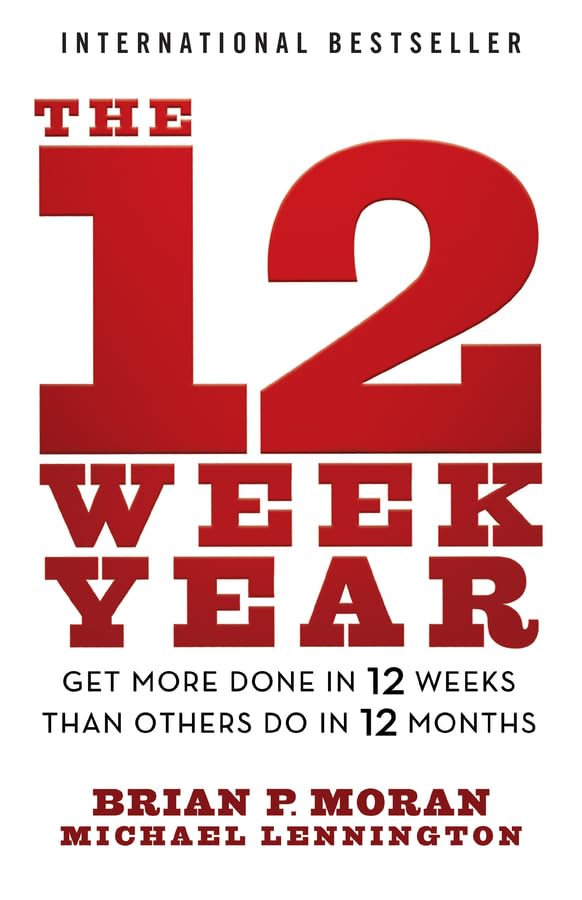
⚡️ What is The 12 Week Year about?
The 12 Week Year by Brian P. Moran is a revolutionary execution framework designed to obliterate procrastination and skyrocket productivity. The core premise is simple yet profound: ditch the traditional 12-month annual plan and compress your goals into a 12-week timeframe. This shift creates a powerful sense of urgency and focus that is often absent in long-term planning. Moran argues that most people waste the first two quarters of the year, believing they have plenty of time, only to scramble in the final quarter. By treating every 12 weeks as a full year, you eliminate this complacency. The book provides a complete system, blending mindset principles with tactical disciplines, to help you achieve in 12 weeks what most people take a year to do. It’s not about working harder, but about working smarter and with greater intentionality on what truly matters.
🚀 The Book in 3 Sentences
- The 12 Week Year redefines your annual timeline, creating intense focus and urgency that drives massive execution and results.
- The system is built on three core principles—accountability, commitment, and greatness in the moment—and five disciplines including vision, planning, and measurement.
- By implementing these strategies, you can fundamentally change how you think about time and action, achieving more in 12 weeks than you previously did in 12 months.
🎨 Impressions
Reading The 12 Week Year was a genuine paradigm shift for me. What struck me most was how the book validates the feeling I often had at the end of a year: “Where did the time go?” Moran’s framework directly addresses this by making every day count. I appreciated that it wasn’t just a motivational speech; it’s a practical, step-by-step operating system. The blend of mindset work (like taking radical accountability) and tangible tools (like the weekly scorecard) makes it incredibly robust. It feels less like a time management trick and more like a complete life-execution model. The book is direct, no-fluff, and laser-focused on one thing: results.
📖 Who Should Read The 12 Week Year?
This book is essential for anyone who feels stuck, overwhelmed, or consistently falls short of their annual goals. Entrepreneurs and business leaders will find its focus on execution invaluable for driving team performance. Professionals aiming for a promotion or trying to manage complex projects will gain a powerful framework for staying on track. Even students and individuals with personal goals—like writing a book or getting fit—will benefit from the The 12 Week Year strategies. If you’re tired of the “I’ll start Monday” cycle, this book is your antidote.
☘️ How the Book Changed Me
\p>Implementing The 12 Week Year fundamentally altered my relationship with planning and execution. My life used to be a series of sprints followed by long periods of inactivity, driven by arbitrary annual deadlines. Now, my approach is one of consistent, focused intensity. I no longer see a year as 12 months; I see it as four distinct opportunities to achieve something significant.- I shifted from making vague New Year’s resolutions to setting concrete, measurable 12-week goals that I review weekly.
- I became fiercely protective of my time, implementing strategic blocks to ensure I work on my highest-impact activities daily.
- I learned to embrace the scorecard, which provides honest, unemotional feedback on my efforts, forcing me to confront when I’m not doing what’s necessary.
- I stopped blaming a lack of time and started taking full ownership for how I use the 168 hours I get each week.
✍️ My Top 3 Quotes
- “If you are not in control of your time, then you are not in control of your results.”
- “When you’re committed to something, you accept no excuses, only results.”
- “Vision is the starting point of all high performance. You create things twice; first mentally, then physically.”
📒 Summary + Notes
The 12 Week Year is built upon a foundation of eight core elements: three principles and five disciplines. These are not just ideas; they are the non-negotiable components for success with this system. The principles—Accountability, Commitment, and Greatness in the Moment—form the internal mindset required to win. The disciplines—Vision, Planning, Process Control, Measurement, and Time Use—are the external actions that bring your goals to life. Together, they create a holistic operating system that changes how you think and act on a daily basis. The following chapter notes break down each of these critical components.
Chapter 1: The New Year
This chapter sets the stage by highlighting the common pitfalls of traditional annual planning. Moran explains how the 12-month model encourages procrastination, mediocrity, and a false sense of security. People believe they have plenty of time, leading to a lack of focused action. The first quarter is often spent “ramping up,” the second and third are for “business as usual,” and the fourth is a frantic, last-ditch effort. This cycle consistently under-delivers on potential. The chapter introduces the core idea of redefining a year to be just 12 weeks, creating a new paradigm that fosters urgency and execution from day one.
- The annual plan creates an illusion that there is plenty of time, which kills urgency.
- Most results in a traditional year are achieved in the final quarter due to pressure and deadlines.
- Redefining a year as 12 weeks forces you to be more intentional and strategic with your time.
- The goal is not just to be busy, but to be busy with the right things that drive your goals forward.
- This new definition of a year is the foundational mindset shift required for the entire system.
Chapter 2: Rethinking the Year
Here, Moran dives deeper into the “why” behind the 12-week cycle. He explains that a 12-week period is the perfect balance between being long enough to accomplish meaningful goals and short enough to maintain focus and urgency. Unlike a 12-month plan, which is derailed by countless unforeseen variables, a 12-week plan is more predictable and manageable. This chapter also debunks the myth that this system is about working 80-hour weeks. It’s about working smarter, eliminating low-value activities, and focusing your energy on the critical few tasks that will move the needle. The concept of intentional imbalance is introduced, where you consciously focus intensely on one or two areas for a short period.
- A 12-week timeframe is optimal for maintaining high levels of focus and motivation.
- Compressing your goals forces you to identify what is truly important and discard the rest.
- The system promotes “intentional imbalance”—focusing heavily on key priorities for a defined period.
- Success in a 12 Week Year comes from strategic execution, not just working harder.
- This approach makes your actions more predictive and your results more reliable.
Chapter 3: The 12 Week Year System
This chapter provides a high-level overview of the entire system, introducing the three core principles and five disciplines that form its foundation. The principles (Accountability, Commitment, Greatness in the Moment) are the internal game—the mindset you must cultivate. The disciplines (Vision, Planning, Process Control, Measurement, Time Use) are the external game—the actions you must take. Moran emphasizes that all eight elements are crucial; neglecting any one of them will compromise your results. This chapter serves as a roadmap for the rest of the book, promising a detailed exploration of each component. It frames the The 12 Week Year not as a time management trick, but as a complete life and business operating system.
- The system is built on 3 principles that govern your mindset and 5 disciplines that govern your actions.
- Accountability is about owning your outcomes, regardless of the circumstances.
- Commitment is the promise to do what it takes to achieve your goals, without excuses.
- Greatness in the Moment is about making the right choices, especially when it’s difficult.
- The disciplines are the practical tools that translate your vision into reality.
Chapter 4: Principle 1: Accountability
Moran defines accountability not as blame, but as ownership. It’s the recognition that you are the ultimate cause of your results. This principle is about shifting from a victim mindset (“The market was bad,” “I didn’t have enough time”) to a creator mindset (“What could I have done differently?”). True accountability means you own your mistakes, learn from them, and adjust your strategy. It’s a proactive stance that empowers you to change your future. This chapter argues that without personal accountability, none of the other disciplines will work, because you’ll always have an excuse for not following through. It is the first and most critical step toward gaining control of your results.
- Accountability is a mindset first, and an action second. It’s about owning your reality.
- When you are accountable, you stop making excuses and start finding solutions.
- This principle requires you to confront the truth about your performance and choices.
- Accountability is not about blaming yourself; it’s about empowering yourself to change.
- You must hold yourself accountable to your commitments even when no one is watching.
Chapter 5: Principle 2: Commitment
This chapter distinguishes between interest and commitment. When you’re interested, you do things only when it’s convenient. When you’re committed, you accept no excuses, only results. Commitment in the context of The 12 Week Year is about making a promise to yourself and doing whatever it takes to keep it. It’s the inner drive that pushes you to execute your plan on days when you lack motivation. Moran explains that true commitment is tested when faced with adversity. It’s about staying the course even when the path gets difficult. This principle ensures that your goals aren’t just wishes, but non-negotiable targets you are determined to hit.
- Commitment is doing what you said you would do, long after the mood you said it in has left you.
- It’s about making your goals a “must” instead of a “should.”
- True commitment is revealed in the face of challenges and temptations to quit.
- You must be willing to make sacrifices and operate outside your comfort zone to honor your commitments.
- Commitment provides the resilience needed to execute your plan consistently for 12 weeks.
Chapter 6: Principle 3: Greatness in the Moment
\p>Greatness isn’t a single, heroic act; it’s the sum of all the small, seemingly insignificant decisions you make moment by moment. This principle is about being fully present and making the right choice in the “now.” Will you hit the snooze button or get up to work on your goal? Will you watch another episode or make your sales calls? Greatness in the Moment is about mastering these daily choices. Moran argues that your long-term success is a direct result of the quality of your daily actions. This discipline bridges the gap between your intentions and your reality, ensuring that you are consistently taking the actions that align with your 12-week goals.- Success is built on the foundation of daily, disciplined actions.
- Each decision is an opportunity to either move closer to or further from your goal.
- This principle requires you to be conscious and intentional rather than acting on autopilot.
- It’s about valuing your long-term vision over your short-term comfort or desires.
- Mastering the moment is the key to building momentum and achieving extraordinary results.
Chapter 7: Discipline 1: Vision
Your actions will never exceed the limits of your vision. A compelling vision is the starting point of all high performance. This chapter explains that your vision acts as a filter for decision-making and a source of motivation when things get tough. A great vision is not just a list of goals; it’s a vivid, emotional picture of what you want to create in your life and work. Moran provides guidance on how to craft a vision that is so inspiring it pulls you forward. You must create it twice: first mentally in your vision, and then physically through your actions. Without a clear and compelling vision, your The 12 Week Year goals will lack meaning and power.
- A clear vision provides the “why” behind your daily actions and weekly goals.
- Your vision should be inspiring enough to push you through challenges and setbacks.
- You create things twice: first in your mind (vision), then in reality (action).
- A weak vision leads to weak commitment and mediocre results.
- Spend time defining what you truly want in all areas of your life to build a holistic vision.
Chapter 8: Discipline 2: Planning
A vision without a plan is just a dream. This chapter details the critical process of planning, which translates your broad vision into a concrete 12-week plan. Moran breaks down the planning process into three parts: a 12-week goal, weekly tactics, and a weekly plan. Your 12-week goal should be specific, measurable, and compelling. The weekly tactics are the specific actions you must take each week to achieve that goal. The weekly plan is where you schedule those tactics into your calendar. This structured approach ensures that you are always proactive, working on what matters most, rather than being reactive to whatever comes up. Planning is the bridge that connects your vision to your daily execution.
- Effective planning turns your vision into an actionable roadmap.
- Your 12-week goal should be a stretch but still believable.
- Break your 12-week goal down into the critical few activities (tactics) that will drive the result.
- A weekly plan is a non-negotiable schedule of when you will execute your tactics.
- The plan is not set in stone; it should be reviewed and adjusted based on your performance.
Chapter 9: Discipline 3: Process Control
You cannot rely on willpower alone for success. This chapter is about installing systems and processes that make execution automatic. Process control involves creating structures that support your goals, such as a weekly routine, checklists, or standard operating procedures. Moran introduces the concept of the “Weekly Accounting,” a meeting with yourself to review performance, analyze data, and plan the upcoming week. This routine is a critical process control that ensures you stay on track. By building these systems, you remove the need for constant motivation and decision-making, making it easier to stay consistent. Process Control is about designing an environment where success is the default outcome.
- Willpower is a finite resource; systems and processes are more reliable for ensuring consistency.
- The Weekly Accounting is a powerful meeting to review your scorecard, learn from the past week, and plan the next.
- Identify the critical processes in your business or life and document them to ensure quality and consistency.
- Process control frees up your mental energy to focus on strategic thinking rather than remembering what to do.
- Build routines that support your goals, such as a morning ritual or an end-of-day shutdown process.
Chapter 10: Discipline 4: Measurement
What gets measured gets managed. This chapter emphasizes the vital role of measurement in the execution process. Moran explains the difference between lag and lead measures. Lag measures (e.g., revenue) track the outcome, while lead measures (e.g., sales calls) track the high-impact activities that drive the outcome. In The 12 Week Year, you must identify and track your lead measures weekly on a scorecard. The scorecard provides objective, unemotional feedback on your performance. It tells you if you are doing the necessary work to achieve your goal. This data allows you to make informed decisions and adjustments, rather than guessing what’s working.
- Measurement is your touchstone with reality; it tells you the truth about your performance.
- Focus on tracking lead measures—the predictive actions that influence your lag measures.
- A weekly scorecard is a simple tool to track your performance on your critical lead measures.
- The data from your scorecard should drive your decisions and adjustments for the following week.
- Measurement drives the execution process by creating awareness and accountability.
Chapter 11: Discipline 5: Time Use
You will never have enough time to do everything, so you must be intentional about how you use it. This chapter is about reclaiming control of your calendar. Moran introduces the concept of “strategic blocks”—uninterrupted blocks of time dedicated to your most important, high-value activities. He also discusses “buffer blocks” for handling the unexpected and “breakout blocks” for planning and strategic thinking. The key is to schedule your priorities first, rather than fitting them in around the urgencies of the day. If you are not in control of your time, you are not in control of your results. This discipline ensures that your time is spent on activities that align with your The 12 Week Year plan.
- Safeguard your time by scheduling strategic blocks for your most important work.
- Protect your strategic blocks from all distractions, including email and meetings.
- Use buffer blocks to deal with the inevitable interruptions and lower-priority tasks.
- Plan your week on paper before it begins, assigning your tactics to specific days and times.
- Greatness is achieved in the strategic blocks; everything else is just support.
Chapter 12: Putting It All Together: Your First 12 Weeks
This chapter serves as a practical guide for launching your first 12-week cycle. Moran walks you through the process step-by-step, from crafting your vision and setting your 12-week goal to building your weekly plan and scorecard. He emphasizes the importance of the first week in setting the tone for the entire 12 weeks. The chapter also addresses common challenges and how to overcome them, such as dealing with a week where you fall short on your scorecard. The key message is to just get started and learn as you go. Your first The 12 Week Year will be a learning experience, and the goal is to build the habit of execution and weekly review.
- Your first 12 weeks is about building the muscle of planning and execution.
- Don’t aim for perfection; aim for consistency and learning from your mistakes.
- The first week is critical for establishing momentum and your new routine.
- If you have a bad week, own it, learn from it, and recommit for the next week.
- Focus on building the habit of the Weekly Accounting above all else.
Chapter 13: The 13th Week
The 13th Week is the week between your 12-week cycles. It’s not for starting new goals but for rest, reflection, and renewal. This chapter outlines a process for using this week effectively. You should celebrate your wins, conduct a thorough review of the past 12 weeks (what worked, what didn’t), and plan your next 12-week cycle. This period is crucial for preventing burnout and ensuring continuous improvement. It allows you to step back, gain perspective, and recharge before diving into the next intense period of execution. The 13th Week is what makes the The 12 Week Year a sustainable, long-term system rather than a short, exhausting sprint.
- The 13th Week is a built-in period for recovery, reflection, and strategic planning.
- Celebrate your achievements to acknowledge your hard work and build motivation.
- Conduct a post-mortem to analyze your performance and identify lessons learned.
- Use this time to plan your next 12-week goals and tactics with the benefit of fresh insight.
- This week is non-negotiable; it is essential for long-term sustainability and growth.
Key Takeaways
The essence of The 12 Week Year is that execution is the key to results, and this system is built to drive execution. The most profound lesson is redefining a year, which fundamentally alters your perception of time and urgency. Secondly, success is a product of both mindset (the principles) and action (the disciplines); you cannot have one without the other. Thirdly, measurement is non-negotiable. Tracking your lead measures on a weekly scorecard provides the reality check needed to stay on course. Finally, the system is designed for sustainability. The 13th Week ensures you can operate at a high level indefinitely without burning out.
- The 12 Week Year is a complete system for execution, not just a goal-setting technique.
- Compressing your timeline creates the urgency and focus needed for breakthrough performance.
- Radical accountability and unwavering commitment are the foundational mindsets for success.
- You must be intentional with your time, using strategic blocks to protect your highest-value work.
- Consistent measurement and weekly review are the feedback loops that drive improvement and ensure you hit your goals.
Conclusion
The 12 Week Year is more than a book; it’s a high-performance operating system for life and business. It challenges you to stop settling for mediocrity and to start living with intention, focus, and urgency. By adopting its principles and disciplines, you can break free from the cycle of procrastination and finally achieve the results you’re capable of. While the system is simple, it’s not easy; it demands discipline and a commitment to personal growth. If you’re ready to take control of your time and your results, I highly recommend you read this book and begin your first 12-week journey. It has the power to transform your productivity and, ultimately, your life.
More From Brian P. Moran →
Discover more from AI Book Summary
Subscribe to get the latest posts sent to your email.