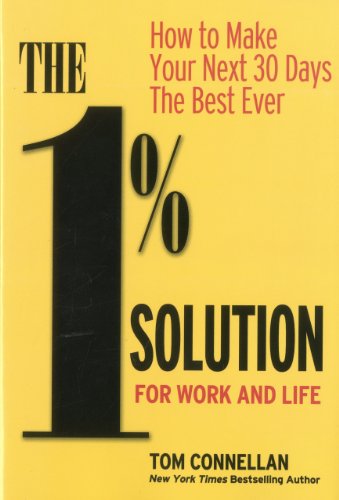
⚡️ What is The 1% Solution About?
I used to think that if I wanted to double my income or get in the best shape of my life, I needed a massive, soul-crushing life overhaul. Tom Connellan argues that we’ve got it all wrong. In The 1% Solution, he suggests that trying to change everything at once is a recipe for failure. Instead, the book introduces us to the concept of ‘marginal gains’—the idea that a tiny, almost imperceptible 1% improvement in several different areas compounds into a massive competitive advantage over time. It’s the ultimate guide for anyone tired of the ‘go big or go home’ mentality that usually just leads to ‘going home’ and quitting.
The author spent years studying peak performance in athletes and CEOs, and he found a recurring theme: the winners aren’t 100% better than the losers. They are just 1% better in a hundred different places. This book is a practical manual on how to apply that logic to your next 30 days. It fits perfectly into our productivity book summaries section because it focuses on sustainable output rather than temporary bursts of energy. Connellan’s central case is that consistency beats intensity every single time. Why burn out in a week when you can evolve over a month?
🚀 The Book in 3 Sentences
- Major success is rarely the result of one giant move, but rather the cumulative effect of tiny, 1% improvements across your habits, work, and health.
- By breaking down huge objectives into manageable ‘micro-wins,’ you bypass the brain’s natural resistance to change and build unstoppable momentum.
- The true ‘solution’ lies in identifying small adjustments—like one extra phone call or ten minutes of planning—and repeating them until they become your new baseline.
🎨 Impressions
I’ll be honest: when I first picked this up, I thought it was going to be another generic self-help book filled with ‘rah-rah’ motivation. I was wrong. It’s actually quite grounded. Connellan writes with the voice of a coach who’s seen it all and knows that most people quit because they set the bar too high, too fast. I found myself dog-earing the pages where he talks about British Cycling because that specific example of ‘marginal gains’ is just so damn logical. It made me realise how much energy I’ve wasted trying to find the ‘one big thing’ that would change my life, instead of just fixing the small leaks in my daily routine.
The book’s structure is a bit like a workbook, which I usually find annoying, but here it actually works. It doesn’t just tell you to ‘be better’; it asks you to look at your last 24 hours and find where that 1% shift can happen. It’s a fast read, but don’t let that fool you into thinking it’s shallow. The psychological shift from ‘I need to lose 20 pounds’ to ‘I need to be 1% better at my meal choices today’ is massive. It removes the guilt and replaces it with a sense of control that I’ve found missing in a lot of other productivity frameworks.
📖 Who Should Read The 1% Solution?
If you’re a high-achiever who’s currently hitting a plateau, this is your wake-up call. It’s also perfect for the chronic procrastinator who gets overwhelmed by the scale of their goals. However, if you’ve already read James Clear’s Atomic Habits and you’re looking for something radically different in terms of ‘habit science,’ you might find this a bit repetitive. But for anyone who prefers a business-centric, coaching-style approach to personal growth, this is a must-read. If you’re looking for deep neurological research, skip it—this is about implementation, not theory.
☘️ How This Book Changed My Thinking
Before reading this, I viewed my goals as a mountain I had to climb in one go. Now, I see them as a series of 1% adjustments to my trajectory. It’s much less stressful.
- I stopped trying to ‘fix’ my entire workday and started focusing on making my first 30 minutes 1% more intentional.
- I realised that being 1% better than the competition doesn’t mean working 1% harder; it often means being 1% more focused on the right tasks.
- I’ve adopted the ‘marginal gains’ mindset for my health—I don’t need a 2-hour workout; I just need to move 1% more than I did yesterday.
✍️ 3 Quotes That Stuck With Me
- “Small, daily improvements are the key to achieving sustained success.” — This serves as a constant reminder that the ‘grind’ is actually just a series of tiny wins.
- “Change doesn’t have to be monumental; it just has to be consistent.” — I loved this because it lowers the barrier to entry for starting anything new.
- “Focus on getting one percent better each day; compounds over time create remarkable results.” — It’s the mathematical proof that patience pays off.
📒 Summary + Notes
The 1% Solution is built on the premise that our brains are hardwired to resist big changes because they feel like threats. When we try to ‘revolutionise’ our lives overnight, our internal alarm system goes off, leading to procrastination and self-sabotage. Connellan argues that we can ‘sneak’ past this mental guardian by making changes so small that the brain doesn’t even notice them. It’s like turning up the heat on a stove by one degree every ten minutes; the frog doesn’t jump out because the change is incremental.
The book moves through personal development, work performance, and relationships, showing that the 1% rule is universal. In the workplace, it’s about ‘Kaizen’—continuous improvement. In relationships, it’s about the ‘micro-moments’ of connection. By the end of the book, the author wants you to believe that you are already capable of greatness; you just need to stop tripping over your own feet by trying to run before you can walk. The narrative arc moves from understanding the math of compounding to the psychology of staying the course when the 1% gains feel invisible.
1: Understanding the Power of Small Changes
Have you ever wondered why a world-class sprinter wins by a fraction of a second, yet earns ten times more in endorsements than the person in second place? The difference in performance is usually around 1%, but the difference in rewards is exponential. This is the heart of the 1% Solution. Connellan tells the famous story of the British Cycling team, which went from being a laughingstock to winning multiple Olympic golds by improving ‘everything’—from the aerodynamics of the bikes to the type of pillow the athletes slept on—by just 1%.
The beauty of this approach is that it’s accessible. You don’t need a PhD or a million-dollar budget to be 1% better today than you were yesterday. You just need a target. The math of compounding is staggering: if you improve by 1% every day for a year, you’ll be 37 times better by the end of it. Why don’t more people do this? Because in the short term, 1% feels like nothing. It’s the ‘invisible progress’ phase where most people quit.
2: Applying the 1% Solution to Personal Development
Is your life audit telling you that you’re stuck in a rut? Connellan suggests that personal growth fails because we treat it like a project with an end date rather than a lifestyle shift. To apply the 1% rule here, you have to start by identifying your ‘keystone’ areas—health, mindset, or learning. Instead of vowing to read 50 books a year, can you read just one page tonight? Instead of a marathon, can you walk for five minutes?
- Audit your current habits without judgement.
- Identify one area where a 1% shift is ‘too small to fail.’
- Track these micro-wins to build a visual chain of success.
3: Enhancing Work Performance Through Incremental Improvements
What would happen if you were just 1% more efficient with your time every day? In a professional setting, this doesn’t mean working more hours; it means refining the hours you’ve already got. Connellan points to Toyota’s ‘Kaizen’ philosophy as the gold standard. In the office, this might look like clearing your inbox 1% faster, or making one extra sales call before you head home. Over a month, that one extra call per day adds up to 20+ more opportunities.
I dog-eared the section on ‘workflow optimization.’ The author suggests that most of our workday is eaten up by ‘frictions’—tiny annoyances that we just accept. If you can remove a 1% friction in your filing system or your communication style, you free up massive amounts of mental energy for higher-level work. It’s about being a ‘professional student’ of your own job.
4: Building Better Relationships One Step at a Time
Can you really ‘fix’ a marriage or a team dynamic by 1%? Absolutely. Relationships are built on thousands of tiny interactions, and most of them are neutral or negative by default because we’re tired or distracted. The 1% Solution for relationships is about ‘intentional micro-moments.’ This could be as simple as a 30-second genuine compliment or actually putting your phone down when someone enters the room. These small acts build ‘relational capital’ that you can draw on when times get tough.
5: Overcoming Obstacles and Staying Committed to the 1% Solution
What do you do when the 1% gains feel like they aren’t working? This is the ‘Plateau of Latent Potential.’ Connellan is very honest here: there will be days when you feel like you’re doing the work but seeing zero results. He suggests using ‘accountability loops’—friends or trackers that keep you honest. The biggest obstacle isn’t failure; it’s boredom. We get bored with the 1% changes and want to go back to searching for a ‘magic bullet.’ Resistance is a sign that you’re close to a breakthrough, not a sign to quit.
6: Integrating the 1% Solution Into Daily Life
How do you make this permanent? Connellan introduces the idea of habit stacking—connecting your 1% shift to something you already do. If you want to improve your posture, do it every time you walk through a doorway. If you want to practice gratitude, do it while your coffee is brewing. By anchoring the 1% change to an existing anchor, you bypass the need for ‘willpower.’ He also emphasizes the environment: if you make the 1% better choice the easiest choice, you’ve already won.
7: The 1% Solution For Work And Life Review
What is the ultimate takeaway from the last 30 days? Connellan wraps up by reminding us that the 1% Solution isn’t a 30-day challenge; it’s a lifelong operating system. The book ends with a call to action: don’t go back to your old ways. If you’ve managed to be 1% better for 30 days, you’ve already proven you can change. The goal now is to maintain the trajectory. Are you willing to be slightly better than yesterday, every single day, for the rest of your life?
⚖️ A Critical Perspective
While the ‘marginal gains’ logic is rock solid, the book occasionally oversimplifies complex systemic issues. For example, it suggests that 1% improvements can fix almost any professional slump, but it doesn’t account for toxic work environments or structural economic barriers where ‘working 1% smarter’ isn’t the real bottleneck. Additionally, the 1% figure is more of a metaphor than a literal mathematical requirement; in some cases, you might need a 20% jump to see any traction at all. It’s a great ‘mindset’ book, but it shouldn’t be your only tool for navigating deep career crises.
🔄 How It Compares
Compared to James Clear’s Atomic Habits, which is the gold standard for habit formation, The 1% Solution is more focused on the ‘performance’ aspect of growth. While Clear focuses on the ‘how’ of building a habit, Connellan focuses on the ‘competitive edge’ you get from compounding. It’s slightly more corporate and leadership-oriented, making it a better fit for managers and executives than Clear’s more general-audience approach.
🔑 Key Takeaways
Here is what you should start doing the moment you finish this summary:
- Stop aiming for the moon; aim for a 1% better launchpad today.
- Identify your ‘frictions’—the tiny things that drain your energy—and fix one per week.
- Use habit stacking to anchor your 1% wins to your existing morning or evening routines.
- Measure the input (your 1% effort) rather than the output (the final goal) to stay motivated during plateaus.
💬 Frequently Asked Questions
What is the main argument of The 1% Solution?
The book argues that extraordinary success is the result of small, 1% improvements across many different areas rather than one single ‘big break.’ By focusing on marginal gains, you bypass the brain’s resistance to change and allow the power of compounding to create massive, long-term results in your work and life.
How did British Cycling use the 1% rule?
Coach Dave Brailsford broke down everything about cycling—from tires and seats to the pillows the riders used—and improved each by 1%. This cumulative approach turned a mediocre team into a dominant force, winning countless Olympic gold medals. It proved that optimizing ‘everything’ slightly is more effective than optimizing ‘one thing’ massively.
Is The 1% Solution worth reading if I’ve read Atomic Habits?
Yes, but with caveats. While the core philosophy of small gains is similar, Connellan’s book is more focused on performance and competitive advantage in a professional context. It provides a slightly different ‘coaching’ lens and real-world business examples that can help you apply the ‘habit’ logic to your career and leadership style.
How do I apply the 1% rule to my work?
Start by identifying one tiny task you can do 1% better tomorrow. This could be preparing for a meeting five minutes earlier, making one extra client call, or refining your email response time. The key is to keep the change so small that it’s impossible to skip, then repeat it until it’s your baseline.
What is the ’30 Days’ part of the subtitle about?
Connellan provides a framework for testing the 1% rule over a 30-day period. It’s designed to show you that a month of consistent, tiny improvements can yield more results than a year of inconsistent ‘big’ attempts. It’s a practical trial period to prove to yourself that the 1% math actually works.
Conclusion
Ultimately, The 1% Solution is a permission slip to stop beating yourself up for not being a superhero. It tells us that we don’t need a total transformation to be successful; we just need to be slightly more intentional than we were yesterday. The magic isn’t in the 1% itself, but in the fact that it’s a goal you can actually hit. When you hit a goal, you feel good. When you feel good, you do it again. That loop is how champions are made.
If you take away just one thing from this book, let it be this: the ‘perfect’ plan you never start is worthless, but the ‘1% better’ plan you actually do today is priceless. Whether you’re trying to lead a team, save a marriage, or just get through your inbox, remember the ‘marginal gains’ philosophy. It might not feel like much on Tuesday, but by this time next year, you won’t even recognise your old self. It truly is the ultimate framework for sustainable growth in our productivity book summaries library.
More From Tom Connellan →
Discover more from AI Book Summary
Subscribe to get the latest posts sent to your email.